Archive for June, 2015

Deadliest Watch

Posted in American TV Shows, Behind-The-Scenes, Reality TV, TV Acting, TV channels, TV History with tags , , , , on June 26, 2015 by Tom Steward

Next time you’re wondering why broadcast television still matters, consider A Deadly Adoption. This perfectly pitched pastiche of Lifetime original movies would entertain if accessed from any platform, but aired on Lifetime during the Saturday evening timeslot reserved for premieres of genuine original movies it pushes the limits of hoax or even cultural terrorism. As a Brit with an interest in the history of television, A Deadly Adoption reminded me of Ghostwatch, a pre-recorded BBC TV horror drama from the early 90s styled as a live factual special of the kind that were popular on the BBC around those years.

Nothing funny about this.

Nothing funny about this.

Ghostwatch and A Deadly Adoption exploited their network and timeslot to convince audiences of their veracity, the former as a piece of primetime public service television and the latter as a legitimate original movie ‘inspired by a true story’. Both programmes used, at cross-purposes, a mixture of familiar faces from the genre they were approximating and those that you wouldn’t expect to see. In both cases, the anomalies were supposed to tip off the audience as to the subterfuge. But while widely-known comic actors Will Ferrell and Kristen Wiig nudge the viewers in the direction of parody, the same couldn’t be said for the jobbing BBC character actors that Ghostwatch’s producers naively assumed would lead a Saturday evening audience to conclude it was a drama. Ghostwatch recruited actual BBC presenters of the moment to play themselves while A Deadly Adoption called upon veterans of the casts of Lifetime movies. Again, this had mixed results. The agency of presenters affiliated with a broadcaster reputable for its trustworthiness contributed to viewers becoming disturbed, confused and angry while watching. Having Erik Palladino play the cop he always plays asking the questions he always asks increased the plausibility but was also a satirical detail.

Perhaps the most striking similarity between the two programmes lies in the execution of the deception. Neither seems to let the mask drop, and yet they seem to be pointing you to the inauthenticity all the time. Crucially there is no over-acting, at least none outside the conventions of infotainment or TV movies. In Ghostwatch, direct address to the camera is a two-way street. It’s part of the fraud and also tells viewers to their faces that what they’re doing is tantamount to a hoax. It even has the audacity (and foresight) to pre-emptively chide parents for letting their children stay up to watch. Like any skilled comic actor (I’m put in mind of Jerry Lewis in The King of Comedy here too), Wiig and Ferrell’s faces can simultaneously pay lip service to the earnest drama around them while sporting an inner smirk that lets the audience know they’re in on the joke. While they (wonderfully) break character in the final scene, the leads in A Deadly Adoption are generally content to merely stand near the entrenched clichés and overwrought conventions of the Lifetime movie canon and gesture to them discreetly. The comic agenda, like Ghostwatch’s dramatic one, is effaced.

Another lesson that A Deadly Adoption learnt from Ghostwatch is that the most effective spoof is the one that runs like the real thing. Ghostwatch should have been by rights shot on film but the choice was to make it as if it were at every stage a piece of factual television broadcast live from a studio. That meant both the audience and the ‘actors’ were reacting as they would to the very thing it was not. I think this is also why Police Squad! is such an exquisite send-up of Dragnet, largely because it wasn’t much different in production values. Apparently, some BBC executives didn’t get what the Ghostwatch directors were trying to do and rejected some of the shots as cheap and amateur. A Deadly Adoption is going for the clunky symbolism and magazine-plate portraiture of the Lifetime in-house style, not trying to improve on it. To expect A Deadly Adoption to live up to the cinematic comedy of Ferrell, Wiig and director Adam McKay’s previous work is to miss the point. It’s a clever move, and one that demonstrates confidence in the art, that the movie was poised to allow audiences to occasionally forget it was parody.

He ain't 'fraid of no disgruntled viewers.

He ain’t ‘fraid of no disgruntled viewers.

Ferrell and Wiig’s IFC mock-miniseries The Spoils of Babylon played a similar game, invoking a phony industry backstory through trailers and faking-of documentaries, and playing on a network that revives obscure cult media. However, I stick with my Ghostwatch comparison. The aim is never truer when you become your target.

Controvers-TV

Posted in American TV (General), American TV Shows, Reviews, TV History with tags , , , , on June 19, 2015 by Tom Steward

One of the historic functions of American sitcoms has been to deal with taboo issues in the society of the time. This purpose has been all but forgotten as network television becomes increasingly more conservative, both on the production and audience side. Although, it’s not as if cable TV is stepping into the breach. Cable channels tend to use their license to push boundaries on representation for infantile laughs rather than a progressive cause. I suspect that increased conglomerate ownership of TV stations has something to do with this too. If you’re appealing to the same judges, you’re bound to get the same verdict. I bring this up because I just happened to come across episodes of two 1980s sitcoms based around controversial topics on TV recently, although the rate of re-run on some channels does rather push the odds in favour of that happening. I was first struck by how committed each sitcom was to serious treatment of the issue in question, as opposed to today when it would need to be discussed by proxy. Then what stayed with me was the contrast between the ways the sitcoms handled delicate subjects, though neither seemed to proceed with much delicacy.

Yes, this really happened...

Yes, this really happened…

The first was a two-part episode of Different Strokes called ‘The Bicycle Man’. It’s a notorious episode of an already pretty notorious sitcom. You may think there’s nothing creepier than a grown man with an ageing disorder being made to play a child but there is, and it’s a grown man with an ageing disorder being made to play a child being pursued by a paedophile. It’s a classic case of wanting to have your cake and eat it, appropriately enough as that’s what the child molester uses to try and get into Arnold’s pants. The sitcom is earnest about educating the audience (especially children) on the dangers of paedophilia, and the final scene, which seems to go on forever, is basically a PSA. But the producers are also clearly reluctant to disturb the conventions of the studio sitcom, and so we still have a laughter track and one-liners about paedophilia. Some of this works in regards to the molester himself, who uses comedy to cosy up to children, but most of the time it feels like the episode is pulling in different directions. That said, the pathological profiling of the paedophile is the most sophisticated I’ve seen in television.

The second was an episode of The Golden Girls called ’72 Hours’ in which Rose is informed she may have contracted HIV from a blood transfusion and has a three-day wait to find out. Unlike Different Strokes which doubled its length and set aside screen time to outline the issue, Rose’s predicament is a subplot of a normal episode rather than an issue-based special. This underlines the fact that the sitcom dealt with taboo topics like racism, sexism and homophobia all the time but was also indicative of how the writers wanted the audience to calm down about HIV rather than obsessing over it. This was 1990, so it’s not exactly typical at this point to portray HIV as an everyday part of contemporary society that affects straight as well as gay people, yet that’s exactly the jumping-off point of this episode. Not that the writers are in any way idealistic about how people of an older generation respond to the threat of HIV. Rose is understandably scared and turns to scapegoating promiscuous gay men while Sophia starts labelling her cups and using different bathrooms. No-one is condemned for acting irrationally here but no-one is let off the hook either.

HIV and The Golden Girls

HIV and The Golden Girls

It’s a shame these episodes stand out in today’s TV. Look at Modern Family. We have a gay couple at the heart of the show yet the Christian ownership of ABC by Disney means that we’ve never had a storyline which draws attention to their struggles in society. We only got a kiss between them after gay marriage became culturally acceptable, five seasons in. You might argue that the permanent presence of previously marginalised characters in a sitcom is a bigger step forward than a devoted storyline to issues in their community, but, again, take Modern Family. Have any of the clichés or misconceptions about gay men disappeared by having Mitch and Cam as protagonists? When it comes to taboo issues in sitcoms, I think concept and execution are polarising. Many sitcoms like The Middle address agonising social problems because of what they are and not what they talk about.

Info a Treat

Posted in American TV (General), American TV Shows, TV channels, TV Criticism, Watching TV with tags , , , , on June 17, 2015 by Tom Steward

TBS’ late-night talk show Conan features a segment called ‘What am I Watching?’ in which titular host O’Brien flips through the cable channels with the aid of the info button on his remote. Pressing the button reveals skewed descriptions of each show encountered, such as ‘Entertainment Tonight: Two lifelike cyborgs are programmed to think everything Hollywood does is fantastic’ and ‘Diners, Drive-ins and Dives: Guy Fieri plays an out-of-work party clown who is addicted to lard’. There are two diametrically opposed laughs here. One is the absurd – yet entirely truthful – inversions of the straight-faced synopses that info buttons on cable remotes give us about TV shows. The other (which sadly nowadays may be as socio-economically discriminatory as those jokes in The Sopranos about Kierkegaard) is about people who have cable recognizing how close these summaries come to the real thing.

All you need to know...

All you need to know…

The descriptions contained on info buttons are not as openly critical as the fake ones on Conan but they do often make you wonder who the authors are and what their criteria is. Whatever possessed the person that wrote the digital synopsis for Jaws: The Revenge to question the scientific plausibility of the storyline when they wrote ‘Disregarding the behaviour typically exhibited by the rest of its species, a revenge-minded shark follows a woman from New England to the Bahamas’? What is to be gained from listing the events that take place in the 1920s surrealist avant-garde short Un Chien Andalou – including a woman’s eye being cut and ants spilling from a wound in someone’s hand – as if it were an episode of Columbo? And these are the ones that actually get the descriptions right.

The buttons struggle noticeably with anything resembling emotional complexity. They can’t seem to get around the fact that Jackie Peyton from Nurse Jackie isn’t a good person and doesn’t find redemption each week. TCM’s button writer needs an education in film noir – one incidentally that the network will provide in association with Ball University – if it thinks that anyone in The Glass Key is in any way moral or decent. As misleading as they can be, info buttons are impossible to do without. With shows on cable now mired in the mud of endless re-runs and encores (which are re-runs that run on from the first run, like a bad sequel), it’s essential to have something to distinguish individual episodes, and sometimes the description on the info button is the only way to be sure.

This new technology has created a completely different experience of watching television, one that we’re perhaps less willing to recognize because it doesn’t involve a computer screen. It’s just on our TV rather than our phones and devices but that in itself is significant. We have much less need for TV listings or paper guides, which means that journalistic commentaries on TV shows has been supplanted by anonymous synopses. While before, viewers would read a critics’ review to get a sense of whether they wanted to watch a programme or not, now they have to go off the plot, and be less informed about the success of the project than its aims. Maybe it’s clearer now why the description of Jaws: The Revenge was so unfavourable. Button writers don’t rate TV, but nor should they have blood on their hands.

Info buttons only skim the surface of how cable remotes alter our perception of television. Every time I try to erase an episode of Conan, the remote asks me ‘Are you sure you want to erase Conan?’ as if the host himself will be vanquished from history once I press ‘Ok’. Whenever I do, I genuinely believe that Conan O’Brien has disappeared into the ether. All right, that’s not true. But making me think twice about whether I want to keep a show or not has made me re-evaluate what in TV is worthy of a second or third viewing.

I’ve made lots of assumptions here about the people who write the descriptions on info buttons – as well as assuming that this is a dedicated profession and not an intern’s copy-and-paste job – so anyone who knows anything about how these show summaries get written, please get in touch with me and I’ll write another post about it, with whatever level of anonymity you wish. Poverty and convenience may one day render cable obsolete, so I want to learn what I can about this phase of TV history while I can. I also want to know who wrote that Jaws blurb!

Remote Viewing

Posted in American TV (General), American TV Shows, TV Dreams with tags , , , , on June 12, 2015 by Tom Steward

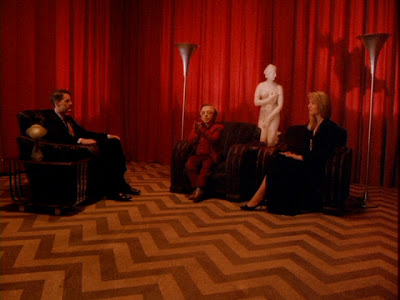
Quite often, my dreams take the form of anticipating event television. If the finale of Mad Men had played out according to my subconscious, the series would have ended with an elderly Don Draper boarding a Concorde in a Madison Avenue version of the last scene from Kubrick’s 2001: A Space Odyssey. I had a vision of the new season of Twin Peaks picking up from the season two cliffhanger, with Agent Dale Cooper suddenly exorcising Bob and then explaining to Sheriff Harry Truman how he deliberately trapped the serial killing spirit inside him to draw him out into the open and destroy him forever. If Showtime were hesitant about giving David Lynch a generous budget for making the season, I doubt they’d be willing to fork out for circa-1991 digital avatars of Kyle MacLachlan and Michael Ontkean. This is where dreams become necessary. Sometimes they’re simply an improvement on what we eventually got in reality. My dream projection of the Season 8 premiere of Doctor Who was something akin to Peter Greenaway’s film of The Tempest, with Peter Capaldi Toyah Wilcoxing it in full new romantic regalia. At least it was portentousness done well and not by Steven Moffat.

Have you ever had a dream with a midget?

Have you ever had a dream with a midget?

Stranger still is when dreams you have had appear on television. Louie recently aired an episode in which the comedian is pursued in his dreams by a naked man with invisible eyes who charges at him from the darkness. I’m sure everyone will recognise the dream-like pacing and movement that Louis C.K. managed to cultivate in these sequences, and it’s about the best simulation of a dream state I’ve seen since Jonathan Miller’s Whistle and I’ll Come to You. But Louie and I have the same Freddy Krueger as I’m frequently stalked by the same figure in exactly the same way night after night. It once became so vivid that I started screaming uncontrollably in bed. But the experience of seeing the inner-workings of my subconscious laid out onscreen was actually rather therapeutic. I laughed the laugh of recognition that usually accompanies my viewing of Louie but with greater hysteria and mania, as if repelling a demon. Louis C.K. and I are so evenly matched in looks, outlook and social reaction that I shouldn’t really be surprised that we dream the same dreams. We want the same thing…lots of bad food to eat quickly! It’s better than a support group.

Sometimes I think there is method to my madness. My dreams honed in on the one aspect of Twin Peaks that could not be done in a revival 25 years later, while acknowledging that whatever I dreamt was almost certain to be less weird than what will air in 2016. The finale of Justified consumed my thoughts perhaps more than any other show has or will, and yet it never intruded into my dreams. Perhaps it’s because there was no anxiety or insecurity about how fulfilling it was going to be, whereas I couldn’t say the same for Mad Men and Doctor Who. I don’t want you to think that there’s a TV set in my head (but wouldn’t that be lovely?) and that my dreams are broken down into life and TV shows. Often the two merge. The other night I was in a car with Manny from Modern Family at the wheel, trying to stop an irresponsible relative (no-one specific) from letting him drive us to our death. Now a lot of the kids on my street look exactly like Manny so I don’t know which part of my memory my subconscious was laundering at that particular moment.

There's a horse loose aboot this hoose!

There’s a horse loose aboot this hoose!

I’m aware of the futility and irony of dreaming about shows that are already dreamy or fantastic. Neither Twin Peaks nor Doctor Who adhere to any real-world logic (though the latter is supposed to nod to it from time to time) and Mad Men was always going to end on a note of ambiguity rather than come to any definite conclusion. I’ve yet to see that endless passive flow of dreaming captured in a TV show, which is odd since endless passive flow is exactly what TV is. Even Louie’s dream is a temporary psychological condition caused by guilt at abandoning a divorcee in need, rather than an ongoing haunting. The Sopranos came close with an episode-length dream sequence which drifted in and out of real-life and popular fiction, but the pat Freudianness of everything we saw made it somehow unappealing to watch. It’s as easy as going to sleep.