Archive for the American TV (General) Category

Opening the Box

Posted in American TV (General), American TV Shows, Reviews, TV advertising, TV channels, Watching TV with tags , , , , , , , , , on January 15, 2014 by Tom Steward

In the last few weeks I’ve watched more game shows than at any time in my life. Some of this is pure accident. I’ve been going to the gym at 9 the morning just as the mounted screens capture the moment that network TV is taken over by previously respected comedians taunting hysterical kleptomaniacs dressed as food. Now that I’m working out regularly I can sit through The Biggest Loser without feeling I should be doing so from inside an exercise wheel. It’s also partly about the age of television that we live in. The contestification of reality TV means that if you want to watch a cooking programme you have to endure some laborious competition while foraging for crumbs of culinary information under the table. Plus The Bachelor is back, which is the slowest game of Guess Who? ever played. Here’s some of the winners, losers and returning contestants:


Let’s Make a Deal/The Price is Right (CBS, mornings)
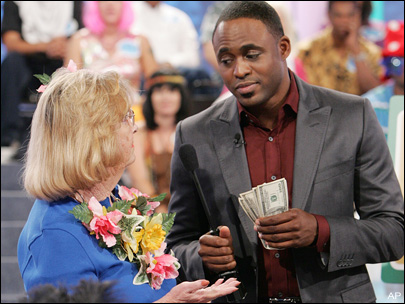
Wayne Brady withholds money from old white lady-you make up the caption!

Essentially the same programme from two parallel dimensions where the only difference is who people liked more on Whose Line is it Anyway?, these two shows feature audiences whose enthusiasm wouldn’t look out of place at the Nuremberg rally attempting to turn their capitalist pre-conditioning into prizes. In the former, incest love-child of Uncle Ben and Aunt Jemima Wayne Brady sells the public toxic assets while looking offscreen for his credibility. The latter has the master of weight-to-spectacle ratio Drew Carey rewarding conspicuous consumption. Brady’s fancily dressed studio audience appear to have been plucked from a Twilight Zone episode where it’s Halloween every day and Carey’s contestants are so elated by being selected you’d think the alternative was The Running Man.

The Winner is: Free enterprise.

The Loser is: Market regulation.

Returning Contestant?: Until the gym shows something other than Bones.


The Taste (ABC, Thursdays)

‘Ok is it an animal that flies or grazes?’

It’s quicker to replace the word ‘voice’ with ‘taste’ and apply everything you know about NBC’s The Voice than to describe this primetime cooking competition. Plagiarism aside, The Taste is closer to the spirit of the blind judging concept than its sensually conjoined twin, which has ironically produced more conventional-looking winners than the image-obsessed American Idol. The judges continue to taste blind even after selecting their teams, which often results in publicly humiliating their protégés. It also reveals the astoundingly poor palettes of those in the food industry, as they bemoan the lack of protein in desserts and consistently lose at ‘guess the animal’. The lack of prejudice in the selection process is offset by the judges’ freely expressing their sexism and dietary bigotry.

The Winner is: Whoever gets the leftovers.

The Loser is: Any vegetarian.

Returning Contestant?: For as long as Anthony Bourdain is there.


The Biggest Loser (NBC, Tuesdays)

‘Why do I have to have my shirt off again?’

One mustn’t scoff at an American game show where the prize is better health instead of more stuff. But don’t be naïve enough to think this is public service television. Underneath the noble purpose is a ‘watch fatty jiggle’ voyeurism which forces contestants to turn their bodies into freakshow curiosities before losing weight. The show is padded with needless challenges and needlessly complicated rules tenuously linked to some sort of obesity fable that only makes weight loss harder and more arbitrary. And if the thing you need to lose weight isn’t made by a sponsor, forget it. The ongoing weight loss is undoubtedly a serial hook here, and the perverse satisfaction of seeing a body waste away is what keeps you coming back.

The Winner is: Subway.

The Loser is: Whoever Subway’s competitors are.

Returning Contestant?: Either that or my TV’s screen ratio keeps changing.


The Bachelor (ABC, Mondays)

‘I need that in the form of a question’

If the holiday you won on a game show turned out to be to a leper colony or the games room you risked everything for was just Ker-Plunk in a box, you probably wouldn’t go back as a contestant. However, despite former ‘winners’ chalking up an abysmal tally of estrangements, broken engagements and divorces, people keep wanting to be and wanting to be on The Bachelor(ette). Even having been a contestant seems to be life-threatening these days. Unlike other game shows, The Bachelor(ette) likes to invite its losing contestants back to occupy more senior roles in the programme, like Juan Pablo who was sent home in a previous season and is now the bachelor. It’s like losing Final Jeopardy and then next day replacing Alex Trebek.

The Winner is: Rose-growers.

The Loser is: Divorce statistics.

Returning Contestant?: I’ve watched so much I’ll be the next bachelor.

Orange is the New Flashback

Posted in American TV (General), American TV Shows, Internet TV, Reviews, TV channels, Watching TV with tags , , , , , , , on January 7, 2014 by Tom Steward

In retrospect Lost ruined American television storytelling. Despite the unbeatable meat locker premise of plane crash survivors trapped on a desert island, the series was an exercise in turning story back to front. Each episode was padded with extensive flashbacks detailing the lives and backgrounds of each character which would routinely distract the series from its primary location and central conceit. In periodic flashback, the writers had discovered a structural ploy that could get them out of having to do character development and exposition in the screenplay. US TV writers have been using these throwbacks ever since the success and acclaim of Lost made it acceptable to do so and they are now synonymous with quality. Today you’d be hard pushed to find an American TV drama (and non-studio comedy, for that matter) that doesn’t have flashback hard-wired into its format. Lurching into the past occurs so regularly in the course of coveted TV series such as Breaking Bad and The Walking Dead that it begins to look like a sophisticated way to tell stories.

Lost in the past?

Flashback-in-the-pan storytelling has reached new extremes in the Netflix original series Orange is the New Black. Like Lost, the series has a genre setting-the prison-which can create a self-enclosed world for the drama to play out in. And Jenji Kohan’s series seems equally determined to throw away this potential with lengthy origin stories for each prisoner propping up the episodes. But Orange is the New Black puts the cart before the horse like never before. We’re barely allowed to glimpse inside the walls of the prison before we’re in the televisual time tunnel witnessing protagonist Piper’s road to incarceration. To add insult to injury the life events we’re seeing are not so idiosyncratic as to be completely unimaginable by the (presumably free-thinking) audience. I can figure out in my head what Piper coming on to the idea to make and sell artisanal bath products with her sister looks and sounds like as a dramatic scene. All I need is the knowledge of it. Most subsequent episodes begin with prisoner origin stories instead of the prison.

You’ll see more of the prison here than in the pilot!

This is undoubtedly the culmination of nearly a decade of bumping backstory upfront but it’s also a by-product of Netflix viewing practices. With Netflix series, all of a season’s episodes are released to subscribers at once. Producers and writers have to assume that there are significant numbers of viewers who will consume the episodes in one go. With this in mind, it might be deemed more important to give the audience something to go on to rather than something to go on. With a week (or more) separating each episode of a network-aired series, single instalments must deliver a gain or development of substance to keep viewers going in the meantime. Not so much for Netflix which puts no delays in front of ongoing viewing and hence never has to get anywhere by the ends of episodes. Orange is the New Black can then afford to indulge in flashback as the prison story may be told piecemeal without incurring the same frustration it would in a series where viewers have to wait for new episodes.

Cards on the table. I’m prejudiced against TV using flashbacks to tell stories. It’s so normalised in American TV now that most viewers probably don’t notice, or don’t find it that disagreeable. But I don’t like it because I think it’s a cheat. To put something back in that’s been forgotten about or not properly realised at a later date is fine, as long as it’s a heartfelt apology. To do it with the pretence of complex storytelling, as if it is somehow a better alternative to writing a screenplay properly in the first place, is just dishonest. Used sparingly and as a last resort for conveying information, I think flashback can be massively effective. The governor of all prison dramas Oz had flashbacks to the crimes of all the inmates as they were introduced, but in uninterruptive 10-second blips with startling power and minimum story drag. The Sopranos saved flashbacks for life events that had just been recovered in memory or for moments too painful for characters (or viewers) to endure at the time.

Oz: a prison drama…in prison.

Now that flashbacks are inextricably bound up in what we think of as good television and are favoured in the ascendant Netflix model of TV viewing, American television storytelling is only going to get worse. My only hope is the linear becomes fashionable again when TV flashbacks finally become passé.

Zappy Holidays

Posted in American TV (General), American TV Shows, Internet TV, Reviews, TV Culture, TV Dreams, TV History, Watching TV with tags , , , , , , , , on December 4, 2013 by Tom Steward

Like the most innocuous word in the English language, the phrase ‘holiday TV special’ means something very different in Britain and America. Christmas specials on UK television are typically bloated extrapolations or unwanted revivals of popular programmes while in the US they tend to be family-friendly entertainment specially made for the occasion. In Britain, the runs of TV series are normally over by Christmas meaning that each show is unnaturally forced back into the schedules. However, in the US Christmas falls slap-bang in the middle of the network season, allowing for a festively-themed episode preceding the mid-season break that incorporates the holiday rather than the other way round. American holiday specials tend to go straight for spectacle and showmanship, something we’ve tried unsuccessfully to imitate with musical versions of our soap operas and star performances where you text the Bee Gees for no apparent reason. I’m sure we Brits used to do this better in the days when vaudeville ruled our airwaves but US TV remains far less hesitant and bashful about pure, uncomplicated show. With the help of my wife G, who has been willingly indoctrinated by American holiday TV fare since childhood, I’ve been watching some classic specials.


Rudolph the Red-Nosed Reindeer (1964)


The oppressed in 1960s American society.


What begins as a music video for the beloved Christmas song soon transforms into a scathing indictment of racism, homophobia and sexism. Appropriately for a TV movie made in the year the Civil Rights Bill was signed, Rudolph’s ostracision is an issue of skin colour. There’s also Hermey, a gay elf (acknowledged by seldom-used codeword ‘Dentist’) whose good hair, handsome looks and ambitions for a white-collar career make him a social misfit in the North Pole. It’s one of the few occasions in mainstream entertainment you’ll see a gay man as our closest link to normality. Such prejudices are shown to be a symptom of the stagriarchal society in which women are kept out of decision-making processes. The bare bones of the song are fleshed out with references to every children’s story and American myth you can think of: The Abominable Snowman, The Gold Rush, Narnia. There’s also a scene with disabled toys that could keep Pixar in court with the Rankin-Bass estate for the rest of existence. Add in transcendent stop-motion animation and wonderfully offbeat characters (like the prospector looking for silver and gold in the North Pole) and you have a deserved classic.


A Charlie Brown Thanksgiving (1973)


Stomach pump, please.


Having some of the best jazz piano riffs ever, ever, ever (courtesy of the Vince Guaraldi Trio) would be enough to destine this cartoon for greatness. But it’s so much more. A Thanksgiving variation on Charles M. Schultz’s Peanuts comic strip, the special has that perfect blend of wit and slapstick that distinguishes the very best cartoons. The combination of intelligent adult humour and childish situations sets an enduring template for some of the finest animation of the last thirty years: The Simpsons, Rugrats, King of the Hill. Schultz’s genius premise of a child with the malaise of a middle-aged man and friends who act like dinner party guests in a Woody Allen movie has one of its most memorable outings here, as Charlie tries to avoid social awkwardness by hosting an en-masse Thanksgiving dinner. Helped immeasurably by the wistful score, there’s a deep-seated melancholy here, which gives the special an unusually dark adult tone for family entertainment, making it the heir of troubling holiday movies like It’s a Wonderful Life and appropriate for Conan O’Brien’s deleted suicide scene parody. The painful deadpan on Charlie’s face was my own expression after a Thanksgiving buffet dinner.


The Star Wars Holiday Special (1978)


A long time ago in a galaxy far far gone…


A classic of you’ll-think-you-dreamt-it television, this Thanksgiving spectacular featuring characters and actors from the original Star Wars movie was never re-broadcast and recordings were suppressed for decades by creator George Lucas in his ongoing quest to change history. Thanks to fans’ recordings of the original broadcast that can now be shared via the internet, we’re able to see the special in all its eminently bizarre glory. It’s the only time you’ll ever see an elderly wookie orgasming watching a helmet porno of Diahann Carroll, Golden Girl Bea Arthur tossing drunks out of the cantina, and a space drag queen TV chef cooking bantha meat while spinning her bosom. There’s a nice idea in here somewhere about using TV to bring the domestic verisimilitude of everyday life to the Star Wars universe but it gets drowned out by the tonal confusion and unintentional avant-garde of the execution. It also features some of the oddest dramatic choices in the history of TV (probably culture) such as dialogue-free, grunt-based scenes of Chewbacca’s family at home. At least we now have an idea of what Return of the Jedi would have been like had David Lynch directed it.

Watching TV with Americans will return in January…Merry Christmas and a Happy New Year to all!

Telly-picking

Posted in American TV (General), American TV Shows, Reviews, TV Acting, TV channels, TV in a Word, Watching TV with tags , , , , , , , , , , , , , on November 12, 2013 by Tom Steward

As someone who has spent the best part of their life enthusing, studying and writing about television, I often get asked what’s best to watch, as if I have access to a secret channel that only the TV wing of Mensa are eligible to subscribe for. I’m always hesitant to answer. As a self-confessed TV snob, I know that whoever’s asking will have dipped their toes into far more shows than I ever have and experimented with titles I would have simply dismissed. When you teach the tube (if you’re doing it properly) you learn to embrace more of the spectrum of what we might call television. So I’m worried I would answer with something insane like CBS’ coverage of the NFL or a public access schools programme about surrealism. It’s also because there’s now so much choice in television that it’s possible (at least as a middle-class white man) to find a show that caters exclusively to you. I genuinely couldn’t say whether or not Boardwalk Empire is great TV since it features just about everything I love in this world (gangsters, American history, HBO, Steve Buscemi), achieving distinction in my eyes just by being made in my lifetime.

Boardwalk Empire: If you don’t like it, you’re not me.

When people ask I’m pretty sure they want a good drama to sink their teeth into and aren’t asking for advice on what rolling news service they should tune to. Givens that, (pun not typo) my go-to is always Justified which I can universally recommend with more, ahem, justification than my TV make-your-own pizza Boardwalk Empire. It’s a show that’s off a lot of people’s radar, or at the bottom of their list, so I feel I might actually be telling them something they don’t know rather than sounding like I’m reading from a list of trending tags. There’s plenty for me to get excited about as an Elmore Leonard aficionado and lover of TV westerns and cop shows but there’s something for everyone here. Every character from walk-on to lead is immaculately written and acted (even Bubba from Forest Gump) and there are beautiful men and women to gaze at, whether you like rough or smooth, or both. If you like your CSIs and your SVUs there’s a whole, complete and expertly crafted story each week. If you’re more of a long game person, behold the four seasons of onion-peel plot development and character works-in-progress like the ever-elusive Boyd Crowder (Walton Goggins). Without sounding like all the good things are in the past-to paraphrase Stevie Wonder-Justified represents a kind of television there’s a severe shortage of today. A medley of action, story, humour and character that’s entirely entertaining and yet never lacking in quality and complexity, not seen fully since The Rockford Files. With kicking dialogue and music to boot, you can’t go wrong. And you’ll be in love with from the first scene.

A Justified choice!

I often feel guilty about recommending shows that don’t warm up until a few seasons in. In essence you’re asking someone to commit all their free time to something that won’t pay off for months. It’s like getting someone to invest their life-savings in a niche restaurant that you know won’t make any money for the first few years. How can I tell someone to start watching Breaking Bad in full knowledge that nothing compelling will happen until the third season? Sons of Anarchy doesn’t even come together until the fifth season! That’s roughly fifty hours of television to tunnel through before seeing any kind of daylight. In all but the rarest cases, we’re talking about shows that you can’t tell someone to jump into already knee-deep in story so you’re really signing them up for work as much as enriching their lives. You see people that you’ve recommended slow-burning TV series to and you can see they’re worn down and trying to think of something nice to say in order to match your enthusiasm but sweating pure ambivalence. If I think someone has the strength of character to endure the grind, I may nod them in the direction of The Walking Dead purely because it’s only a mini-series worth of mediocrity before it all starts to fall in place, a comparative blink of the eye. Fancy a bet on a rank outsider? Try Portlandia. Ostensibly a location-specific sketch show, it’s actually more freely artistic and socially incisive than most TV comedy or drama. You can keep asking me what’s good but most of the time either you know or you don’t want to know.

No Sets Please, We’re British

Posted in American TV (General), American TV Shows, Behind-The-Scenes, British Shows on American TV, TV Acting, TV advertising with tags , , , , , , , , , , , , , , , , , on November 5, 2013 by Tom Steward

There are endless reasons why I’m happy to be with G but I’ve always been especially grateful that she’s not an Anglophile or fangirl of British pop culture. I find G’s nonplussed reaction to most things British, including accents and the sights of London, oddly comforting.  I suppose it’s just reassuring to know that it’s me she interested in not my country of origin. I say this because you Americans are obsessed with us Brits. Actually, it’s truer to say you’re obsessed with what you think we are. American television is fanning the fires of this fascination like a Pudding Lane bake-off…and you can’t get more British than that!

There’s not a show I’ve seen on American TV that doesn’t either have in it a British performer or someone pretending to be British, often both given the lax standards of background research for writing British characters. It doesn’t even have to be a show. Various American companies have British spokespeople and mascots in their TV advertising. Why am I not flattered? Because the fascination somehow never extends to actually finding out what the diverse and varied life and culture of Britain is like. Instead it’s an incredibly narrow, dated and ignorant version of our national culture (royalty, the swinging sixties, Victorian cockneys) that is continually reproduced across American television.

A Cockney lizard is the Geico mascot…for some season!

I’m sure all non-Americans (even ethnic-Americans) and American minorities have much the same beef and I’m not saying the British have any special claim to reductive racial stereotyping on TV. It’s the inverse relationship between the interest taken and the research done that makes American TV’s obsession with the British so bemusing to me. Why go to the trouble of inorganically adding a British person to the cast of an American-set show or concept and then not do the requisite due diligence to give them a chance of convincing at what they’re supposed to be?

A cynical answer would be that Americans know so little about Britain that TV viewers wouldn’t know the difference. But why then are Brits so prominently placed in American television as leads or major supporting characters, presenters and stars, and commercial representatives? Why are we not marginalised like so many other nationalities that American TV knows next to nothing about?

‘You make one more crack about pocket-rocket and I’ll paddle you!’

There are doubtless innumerable political and historical reasons for this (the need to keep us arcane and aristocratic seems pretty closely related to an age-old American view of the British as colonisers from the old world) but in the superficial now I think it has a lot to do with Britain being a major producer and exporter of TV to an extent not seen before. The US, traditionally a powerhouse of global TV distribution, has to find methods of coping with this new threat and slotting British actors and characters into TV shows (often for no good story reason) seems as good a way of joining the competition as any.

There’s also something about always having to laugh at or undermine British people appearing on TV that means however high up in the pecking order they are, their one-dimensionality will always be more important than their function. Think about how many American shows sacrifice character development for a couple of cheap shots at cross-cultural misidentification or excuses for vicarious swearing (the British obscenity ‘wanker’ frequently passes Broadcasting Standards unnoticed). On Dancing with the Stars, Len Goodman has been hired to impart his technical opinion on dancing, drum up the crowd and occasionally play the pantomime villain. Increasingly, however, he’s been there to provide British slang for the other presenters to mock.

The British wing of the CIA.

There’s a quieter British invasion going on (we don’t like to make a fuss) in TV casting. Most of your favourite American TV shows will boast British cast members, many or all passing as natives. I’ve never quite got over Mancunian Egg from This Life as an Atlantan sheriff’s deputy in The Walking Dead or Homeland’s marine double-agent Brody being as British as the head of the CIA. Often producers are calling on past prejudices about British actors to inject a note of taste but it’s also about an Anglicisation of the American acting workforce taking root over recent years.

All the way from Ian Fleming to yours truly, Brits have recognised that keeping your accent quiet is how to be taken seriously in America. British actors playing Americans may have blended in to TV without a trace but those who chose to wear Britishness on their sleeves will remain the rodeo clowns of television.