Archive for the American TV (General) Category

Nineties Degree

Posted in American TV (General), American TV Shows, Internet TV, TV channels, TV History with tags , , , , , , , on June 12, 2017 by Tom Steward

Nineties 1

This isn’t the first post I’ve written about nineties nostalgia in television but at the time of writing I had no idea how contagious it would be. Consider the evidence. The most innovative program on TV remains Twin Peaks (I’ll hold off on saying the best until it’s over). There is a television revival of Fargo which not only seems determined to re-capture every iconic moment from the golden decade of The Coen Brothers, but also currently stars Trainspotting’s Ewan McGregor (incidentally, this is too much for someone who once owned VHS of both movies with the other film’s trailer before them). Louis C.K’s experiments with television comedy, both on and off the air, channel nineties indie cinema auteurs like Jim Jarmusch, and what is Horace & Pete but a serialised soundstage version of star Steve Buscemi’s Trees Lounge? Factor in a Friends revival and you couldn’t be more nineties.

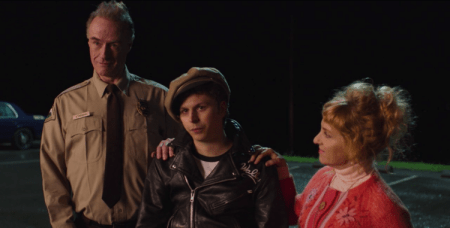
The best of nineties nostalgia TV is also a cultural commentary on it. Netflix’s transcendent sitcom The Unbreakable Kimmy Schmidt uses the device of a woman kidnapped and secluded for fifteen years in a bunker to retrofit the majority of the program’s points of reference to nineties pop culture. There are so many I’ve lost track but imagine an alternate universe where the apotheosis of pop culture remains Kelsey Grammer. It’s a satire of our arrested development that also manages to capture the (albeit anachronistic) zeitgeist, as any successful sitcom must. Though not specifically aimed at the early nineties, Twin Peaks processes its nostalgic appeal in fittingly gothic ways. In the reboot, the Sherriff’s Department receptionist Lucy has a debilitating phobia of cell phone use, which she regards as some kind of witchcraft, while her son Wally Brando (an unusually well-used Michael Cera) delivers an eerie ventriloquism of namesake Marlon.
Nineties 2

In some sense, it was only a matter of time. We’re about as far now from the nineties as we were from the fifties when movies and TV shows romanticising the decade like American Graffiti and Happy Days started to dominate pop culture. We may be waiting a while for the nineties-set equivalent of the explicit love letter to the fifties that is Back in the Future, which is to say this phase probably hasn’t peaked yet, but it can’t be far from saturation point. Enough time has passed that any piece of media dealing with the nineties can now legitimately be seen as a work of history. Indeed, this very Summer CNN premieres the graduation of its decade-based documentary series The Nineties, the trailer for which positions the CD player as the relic of a bygone era and The Backstreet Boys as detached from the present as The Beatles.

Nineties nostalgia is also a by-product of a TV ecology where the past is always present. Though claiming to revolutionize the reception of television, Video-On-Demand platforms like Netflix and Hulu have done more to take TV content back in time than any oldies station ever did. Entire canons of popular (and not so) TV shows from the 1950s onwards are now instantly accessible to a vast viewership, and without the bitter pill of catheter commercials to swallow. The appeal of such platforms is as much being able to binge on Cheers as House of Cards. If lifespan permits, such extensive replay creates a natural demand for revival, which the VOD platform’s business models are always more-than-happy to accommodate, with a slew of fannish resurrections. Done so routinely online, the on-air networks are now spicing their season line-ups with revivals of nineties properties, as shown by the upcoming return of Roseanne.
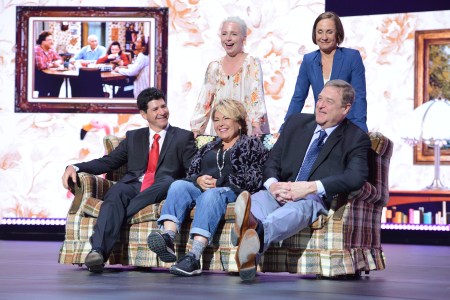
The 2017-2018 ABC Television Upfront Presentation

I was a teenager in the nineties and those were my formative cultural years. At the time, I thought the best of film, TV and music had been and gone, though it turns out that’s a very nineties way of looking at things. Now I fetishistically relish what came out of that decade, and regard it as a far more sophisticated era in mainstream media arts than we are currently experiencing. I think I’m pretty typical of my generation, if we can be uniformly tantalised by the prospect of a Minnesota-based police procedural coming to primetime or react excitedly when one of the most belaboured sitcoms of all time returns to network TV. There’s no doubt we’re the demographic that television executives are targeting with their retroactive approach to commissioning, and that producers find common ground with their fragmented audience based on a shared love of the decade’s cultural output.

 

Stage Set

Posted in American TV (General), American TV Shows, Behind-The-Scenes, Internet TV, TV Acting, TV Culture, TV History on March 29, 2017 by Tom Steward

Stage 1

I’ve spent a lot of time away from this blog because I’m building a career in theatre. However, I’m finding that the playwrights I come across when I’m reading plays or looking for audition monologues are many of the same names I’m seeing in the writing credits of the TV shows I watch. In a previous career as a TV historian, I observed many instances of theatre artists crossing over into American TV – or vice versa – and each time emigres were brought in to help shape or re-define the medium, carrying with them the necessary cultural cache to do it.

And here they are doing it again. Louis C.K’s web experiment Horace and Pete used the internet to deliver a fusion of TV and theatre which was hitherto unseen in the US, and he enlisted the help of Pulitzer Prize-winning playwright Annie Baker in the process. While Baker declined the offer to be a staff writer on the project, the author of The Flick and The Aliens was instrumental in bringing her trademark edge of masochistic naturalism to the third episode of the mini-series (which begins with a 12-minute monologue by Laurie Metcalf), where she is loosely credited as consultant.

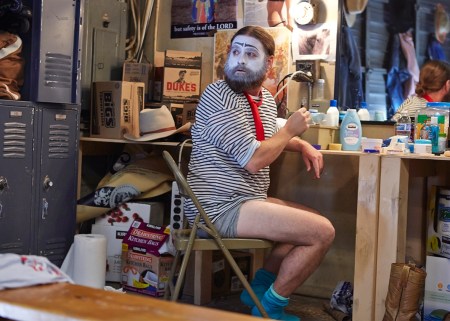
Louis C.K. eventually succeeded in getting an award-winning playwright to join his writing staff when he hired author of The Whale and A Bright New Boise Samuel D. Hunter to pen episodes of Baskets, a dramedy starring Zach Galafianakis that he produces for FX. Though far more conventional than Horace and Pete in form, Baskets nonetheless confounds expectations of tone for a series which led strongly with broad physical comedy before existentially breaking down each of the absurd characters. Hunter’s episodes go a long way towards this analytical deepening of the (sometimes literally) massive stereotypes established in the opening episodes.

Stage 2

Orange is the New Black writer Jordan Harrison is also a renowned playwright, with Pulitzer Prize finalist Marjorie Prime under his belt. It’s interesting that a playwright concerned with digital technologies which change human-machine relations should be involved with a series that’s at the cutting edge of the electronic televisual experience. Having seen the play along with his Amazons and their Men, I can see how (for better or worse) the clipped art of TV writing has affected his theatre pieces, with both feeling like they cut away from a scene too early or, more importantly, that they need follow-ups.

Gina Gionfriddo is the playwright of Becky Shaw and Rapture, Blister, Burn. She also wrote for Law & Order and Cold Case. Given the obscenity and offensiveness of her plays, it’s a safe bet she had to self-censor when it comes to satisfying the still-draconian standards of network television, at least where words were concerned. However, if you follow John Mulaney’s thinking (and who wouldn’t?), the two procedurals with their graphic depictions and explications of heinous crimes would be the perfect dwelling place for a writer concerned with the underside of human behaviour. But these are by no means pioneers.

The play format of early American television resulted in the employment of writers who both came from and subsequently went to the theatre, including Horton Foote, Tad Mosel, Paddy Chayefsky and Reginald Rose. Much of the immediacy we still associate with television came from it being written as a live, continuous experience by theatre-savvy artists in those years. Even when TV eschewed theatrical trappings, playwrights continued to enter the medium, such as Neil Simon, who worked on comedy vehicles for Phil Silvers and Sid Caesar in the late 1950s. Simon would later theatricalize this for Laughter on the 23rd Floor.

Stage 3

While we’re used to talking about writers from the movies coming to TV, we’ve traditionally overlooked stage playwrights who moonlight in the medium. In the 1980s, another Pulitzer Prize-winner David Mamet, author of American Buffalo and Glengarry Glen Ross, was ahead of the game when he penned an episode of the transformative cop show Hill Street Blues, before following this up decades later with military drama The Unit, which he co-created with Shawn Ryan of The Shield. The Hill Street Blues episode was before Mamet made the jump to cinema and well before great writers flocked to US quality TV. It’s easy to see playwrights who come to TV as Greek Gods who deign to push us mere mortals in the right direction, but the truth is much messier and speaks to exchanges of ideas between the two art forms which have always been around and are still in development.


Trump TV

Posted in American TV (General), American TV Shows, Reality TV, TV History, TV News on January 20, 2017 by Tom Steward

trump-2

Following Barack Obama’s consecutive election triumphs, cultural commentators lined up to congratulate American TV for paving the way towards national acceptance of an African-American President. Among those frequently cited were 24’s David Palmer (played by Dennis Haysbert), TV’s first African-American President outside of a comedy skit or cartoon. Though Hispanic, The West Wing’s Matt Santos (played by Jimmy Smits) represented a minority rising to the Presidency with producers claiming (retrospectively) the character was based on Obama. As Donald Trump takes office, which TV portrayals will be deemed responsible for his ascension to power? Here are some of my personal predictions.

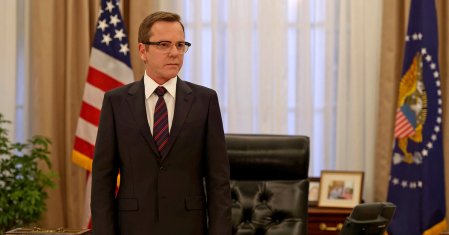
Though only a few weeks into its pilot season, ABC’s Designated Survivor projected that someone who was drastically under-qualified for the Presidency coming from outside the Washington establishment could successfully take office. Given that the 2016 election went right down to the wire and polls were offset in the final couple of weeks before voting, it’s not unthinkable that this fish-out-of-water political drama normalized the idea of a Trump presidency for some swing voters. Although since Tom Kirkman’s lack of fit with the job derives from his liberal bent and academic background, this is where any resemblance to Trump ends.

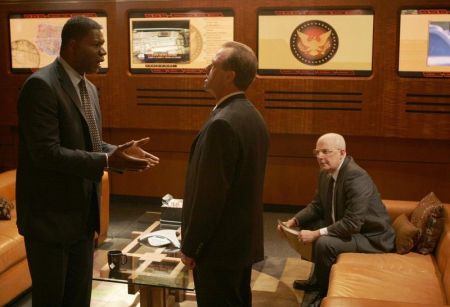
24 should not be let off the hook either. Palmer had become President by the show’s second year, yet subsequent seasons undercut the legitimacy of his administration, much as Republicans and their affiliated media outlets would eventually do to Obama. Dead-in-the-water after one term, Palmer’s administration is mired in scandal while the Democrat is deemed incapable of handling rising national security threats, and capitulates to an ignominious, seemingly inevitable assassination. As many have viewed 24’s later seasons as a (more) fictional extension of Fox News, the synonymy of their respective rhetoric for debunking an African-American Commander-in-Chief cannot be a coincidence.

trump-1

24 may have overreached in its predictions of Palmer being succeeded by Romney-clone John Keeler (whose fate, thanks to uneven storytelling, we remain unsure of) and later the first female President, Alison Taylor. Although, to be fair, Romney was a close call and Hillary Clinton was twice a foregone conclusion for the office. But the series was right on the money when it prophesized that the US Presidency would fall into the hands of a treasonous, spineless egomaniac engaged in a criminal conspiracy with Russia who demonstrated a reckless regard for weapons of mass destruction. Charles Logan was a trailblazer.

Indeed it’s hard to believe that 24 didn’t have a psychic consultant on staff when it aired scenes of a newly sworn-in Logan rushing former President Palmer into his office to advise the new Commander-in-Chief how to do the job in spite of utter incompetence and inconsistency, before shunning his predecessor and claiming all the credit for their successes.  While many looked back to Nixon (especially considering actor Gregory Itzin’s astounding physical resemblance to the man himself), Logan looked into a Trump crystal ball, which is not only a metaphor but an actual domestic good produced by the Trump brand.

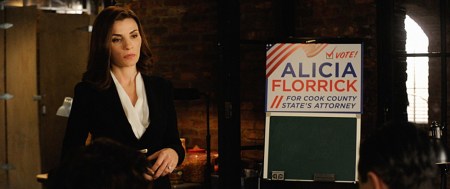
With his rank outsider status, any consideration of what brought Trump into office must also consider what kept Hillary Clinton out of it. CBS’s The Good Wife had a lot to say about that. In the latter seasons of the hit legal drama, Alicia Florrick runs for the political office of Illinois State’s Attorney, having witnessed her husband Peter’s consecutive electoral victories which propelled him to Governor. Despite winning outright, Alicia is forced to resign her office after an election fraught with allegations of vote tampering and concerns about the integrity of the Democratic Party image. Starting to sound familiar?

trump-3

What The Good Wife saw, that most in politics would not, was the inevitability of a woman failing to succeed to the offices that their male peers had risen to against worst odds. Peter is an adulterous ex-con with a reputation as one of Illinois’s most corrupt politicians, yet he glides effortlessly from State’s Attorney to Governor, and even runs for President. Alicia is an outstanding lawyer with no stain on her character, and yet is forced to be the fall guy for a party at war with itself, despite her achievement. Similarly, Hillary Clinton shoulders two unsuccessful bids for the Presidency in the shadow of her philandering, ethically dubious two-term President husband while the marital indiscretions of former Congressman Anthony Weiner provided the impetus for the FBI to besmirch her name just prior to election day. She lost to an inexperienced African-American male and won to an internet troll.


Garry Under Wood

Posted in American TV (General), American TV Shows, Americans watching British TV, Reality TV, TV Acting, TV advertising, TV History, Uncategorized, Watching TV with tags , , , , , , , on April 22, 2016 by Tom Steward

2016 has been the Year of Death…or so clickbaiters will have you believe. I’m sure at any given moment there is a steady stream of celebrities dying but what’s so remarkable about the glut of passings we’ve witnessed since the beginning of this year is that it’s concentrated around the great innovators of pop culture. Comedy and music have been hit the hardest and key artists have been dying with such frequency that two of the most significant names in television comedy on either side of the Atlantic, namely Garry Shandling and Victoria Wood, died within weeks of each other.

It occurred to me while taking in that Garry Shandling and Victoria Wood are both gone from the world that the pair were almost counterparts in their understanding and reinvention of television in America and Britain. Though both took fairly traditional career routes into the TV of their native lands – with Shandling a sitcom writer and Wood a variety star – they mastered the medium by keenly observing its conventions and then satirically reproducing them. The self-reflexive sitcom It’s Garry Shandling’s Show and talk-show set The Larry Sanders Show both featured note-perfect facsimiles of longstanding TV formats with a knowing (distinctively buck-toothed) smile at their absurdities. Wood’s As Seen on TV featured a myriad of TV flow pastiches including commercials and soap operas, the latter of which was Acorn Antiques, a devastating summation of the budget-constrained, storm-in-a-teacup melodrama that had been commonplace in regional daytime dramas in Britain since the seventies.

Wood and Shandling were also too overflowing with brilliance and creativity to accept their place in the TV hierarchy. Wood began her TV career as winner of the talent show New Faces performing her own comic songs on the piano, earning her a place as a novelty act on the consumer affairs and erotically shaped vegetable discussion programme That’s Life. Rather than continue to plug the remaining – and increasingly unlikely – spaces for traditional vaudeville performance in a changing TV ecology, she diversified into playwriting, sketch comedy, character stand-up and pop culture parody. Her focus on the latter meant that Wood was ahead of a curve of self-referential television comedy that is typically seen as coming into existence when it became male. As Seen on TV first aired in 1985 which significantly pre-dates the supposed watershed moment of televisual self-awareness with Armando Iannucci and Chris Morris’s The Day Today in 1994.

Shandling’s career could have gone two ways. Instead it went a third that was almost the same as the first two. After writing for sitcoms such as Sanford & Son as well as a successful stint guest-hosting for Johnny Carson’s Tonight Show, Shandling seem destined to graduate either to an eponymous sitcom or late-night talk vehicle. He did both and neither. Shandling sold It’s Garry Shandling’s Show to cable station Showtime after networks balked at the idea of a show that actively drew attention to the mechanics and artifice of the studio audience sitcom. It was a revolution in TV form. As Shandling once explained to Ricky Gervais: ‘Either I did a talk show or a sitcom about a talk show.’ Of course he did the latter. The result was The Larry Sanders Show, set behind the scenes of a continually fledging late-night talk show, while commenting wittily upon it.

Their commitment to raising the bar of television comedy was so wide-ranging that neither stopped at satire. Both Shandling and Wood embraced comedy that was as real as it could be, and that eschewed the synthetic qualities of much comic material on TV. In Shandling’s The Larry Sanders Show, the naturalism of both visual style and performance was staggering and well beyond what audiences were used to seeing. Needless to say, The Office and its mock-doc ilk would never have existed without this breakthrough. Wood’s comic characters were drawn with such observational realism their dialogue could have been telegraphed from an encounter on public transport and she frequently emulated the fly-on-the-wall documentary but as a route to pathos rather than irony or sneer, something Shandling also achieved with The Larry Sanders Show. In particular, the ‘Swim the Channel’ segment of an As Seen on TV episode has rarely been bettered.

Of course, there are massive differences. Wood is far less cruel to and awkward with her characters, and Shandling much more provocative in his humour. But it’s hard to imagine we’d be watching half (and that’s being generous) of the comedies we currently do without either of these two colossuses.

The Cast Members

Posted in American TV (General), American TV Shows, Behind-The-Scenes, Local TV, TV Acting, Unsung Heroes with tags , , , , , , , on April 7, 2016 by Tom Steward

It’s not often I ask you to do something – except look up words (or so G tells me). But at the end of this post, I’m going to ask you for money. It’s not going to me (not for a long time anyway) instead to a group of talented and ambitious individuals who want to shape the future of television sitcoms. But they need your help to do it!

The true test of a great sitcom idea is this. If you hear it and your first thought is ‘why haven’t they done that before?’, it’s a winner. If you ask that question and get the reply ‘it has’ it’s a loser. Aaron Roberts, Executive Producer of The Cast Members, needn’t worry because his sitcom about a rag tag group of movie theater employees is one of the most original yet obvious (in a good way) premises we’ve had in television comedy for years. In fact, Aaron is hoping to breathe fresh air into the comedy world:

‘Television is at its golden age with dramas, most people believe it is consistently better than the films that flood the box office week after week. But, television sitcoms? The last great ones to go off the air left what was NBC’s comedy block in shambles a few years ago. The bad outweigh good and most networks continue to rehash old premises with new faces or even worse – straight rebooting old IP’

The Cast Members is a grassroots project from independent production company Blue Vision Entertainment, who have already scripted 6 episodes and are ready to shoot an initial season with an insanely talented ensemble cast already assembled (ensembled?!) and an award-winning crew behind-the-scenes. The Cast Members is on Indiegogo to raise funds for a pilot from the 1600+ strong audience they’ve found on social media and actors and crew even got together to shoot some promo videos introducing the ensemble cast in separate scenes to really showcase all the talent attached to the project and obtain a picture of what audiences would expect to find in full length episodes.

What Aaron is doing is highly ambitious, but not unprecedented in television comedy:

‘This is the beginning of another Always Sunny or Broad City type of story; the small production that started on the web that will mark the precipice of some great comedy careers’

Nor is this a flash-in-the-pan. It’s a show that has been evolving in independent development for over 2 years and that – Aaron guarantees – will eventually air somewhere. As for content, Aaron is confident of the sitcom’s broad appeal:

‘With performers from all ethnicities and walks of life…the story has heart and speaks to anyone who has ever held a minimum wage, first employment that they sort of ‘had’ to work’

Aaron is, however, under no delusions as to what the main selling point of the sitcom is; the cast members…appropriately enough:

‘The best possible cast of the rise acting talent possible from California was assembled. Multiple NYT award nominees and recipients. Actors with credits list such as The Daily Show, Modern Family, Faking It, Tangerine and more are finally ready to break out from bit roles and showcase their true comedic chops. Two actors are currently starring in theater productions in New York and San Diego that are receiving rave reviews. Not to mention the couple working stand-up comedians portraying different characters on the show’

I’m glad Aaron said all that, so I didn’t have to. You see, I’m in the cast of this show, playing (movie) theater (concessions) veteran Peter Peterman, who thanks to Aaron’s keen sense of comedic resource exploitation developed an English accent and gained a wife between drafts. I’m even in one of the crowdfunding videos, which you can watch below. See if you can spot me. I do rather blend in:

So take a chance on this production. It’s got an interesting story to tell and 20 absolutely talented actors to do it. If you need more proof for your purchase, you can watch all ten superbly written and performed crowdfunding videos for free via the show’s Facebook page or on Indiegogo, where you can also send your donation. The amount doesn’t matter (but don’t hold back if you don’t have to!) just be sure to help us out and you can say you were a part of sitcom history before anyone else. And – if you need a closer – just remember how critical I’ve been of TV on this blog then re-read this post!