Archive for the American TV Shows Category

Beard To Death

Posted in American TV (General), American TV Shows, TV Acting, TV in a Word with tags , , , , , , , , , on April 1, 2015 by Tom Steward

It’s been a season of hashtag-friendly character deaths on The Walking Dead; #Bobecue, #BethDeath, #TyreecesPieces and #NoahFuture. But no loss is more tragic than #RickShave. Rick Grimes’ beard is one of the longest-surviving characters on the show and – even more than Karl who went through puberty – we have watched him grow on TV. He was the only character keeping Rick sane. After losing his beard, Rick seems incapable of ending a sentence without threatening someone’s life. So in lieu of a blog about the season finale, which for an episode set in one street with no major character deaths can be summed up by Nelson Muntz’s review of Naked Lunch (‘I can think of at least two things wrong with that title’), here’s a rundown of the best bearded moments in TV, starting with Rick:

Rick shaves his beard – The Walking Dead – Season 5

As a bearded man myself, I know well the eerie feeling of shaving and not recognizing the man underneath. Here The Walking Dead takes this to proportions of body horror. Afforded the luxuries of running water and private bathrooms, Rick can now part with the beard that has faithfully accompanied him through the zombie apocalypse. Unfortunately, he’s been hiding his moral decay behind that cake-catcher and is no longer the same person beneath. Rather than removing a mask, he’s revealing one. Without looking like Charles Manson, Rick starts to get really insecure about expressing his murderous insanity and massively overcompensates with blood-soaked demonstrations in public and recreating scenes from Romeo & Juliet with passing zombies.

Jack is back with a beard – 24 – Seasons 2 and 6
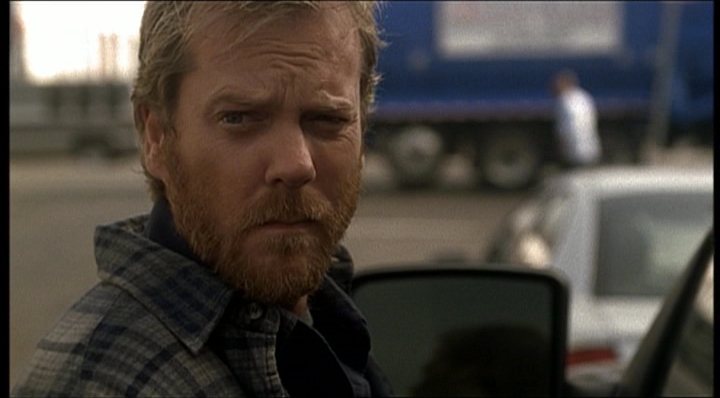
Where's the shaving balm?!

Where’s the balm?!

When Jack cracks, he grows a beard. It’s our only visual clue that a man who tortures and fakes his death for a living has finally gone off the deep end. But it also acts as a protective seal – grouting if you will – for Jack’s madness. After Jack shaved his widow-grief beard at the beginning of Season 2, he immediately went about severing a paedophile’s head with a hacksaw. An hour after removing his Chinese-torture beard in Season 6, a nuclear bomb went off. Jack remaining clean-shaven after he faked his death was how we knew he wasn’t really serious about giving up work. Well, that and going into hiding mere miles from L.A.

It’s Harrison Ford in there – The Fugitive – Movie

Ok, it’s a movie but it’s based on a TV series but that should be justification enough for what remains one of the most incredible uses of facial hair in screen history. For a third of the movie, Harrison Ford and the star promise of action therein have been hiding behind what looks like mouldy Weetabix on the actor’s face. As convicted murderer Dr. Richard Kimble goes on the run, he stops off at a hospital to engage in a morning routine beloved of all medical practitioners; stealing water and breakfast from a dying old man. He adds milk to his Weetabix and it quickly dissolves, leaving Ford free to jump off viaducts and fight disabled people.

Strike beards – Late Show with David Letterman, Late Night with Conan O’Brien – 2007/8

Before...and way before!

Before…and way before!

During the writers’ strike of 2007-8, late-night chat show hosts David Letterman and Conan O’Brien came out in sympathy with their colleagues by growing ‘strike beards’ throughout the picket. Of course, this assumes that being on strike makes any difference to writers’ shaving routines, which is nonsense, and the sizeable increase in meta-comedy was already enough to demonstrate to viewers that there was a writers’ strike going on. While Conan mutated into a Seinfeld-era Bryan Cranston, Letterman slipped back through time posing first as a Civil War general and then Piltdown man along the way. Otherwise, it gave us a rare glimpse into what late-night television would look like following the apocalypse.

Hiatus beards – Everyone on a show where they have to be clean-shaven – Off-season
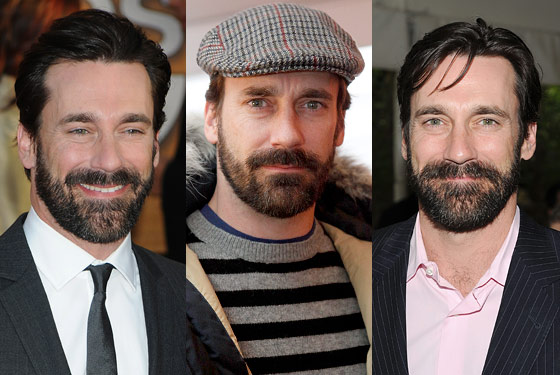
Bearded Hamm!

Bearded Hamm!

When you can’t scratch, that’s when you want to scratch. Well, apparently, if you’re an actor on a seasonal TV show, when your face is scratch-free all you’re thinking about is having something scratchy on your face. In those few months between filming seasons, TV actors choose to celebrate their temporary freedom from the yoke of shooting schedules by doing fuck-all with their faces. But it doesn’t make as much sense as it first seems. I’m sure the actors still go out during the day even though they’re not shooting, and wear clothes even though they don’t have to be in costume.

Justified And Ancient

Posted in American TV (General), American TV Shows, Reviews, TV Acting, TV History, Unsung Heroes with tags , , , , , , , , , on March 27, 2015 by Tom Steward

Currently my two favourite shows are both revivals of iconic literary characters and new twists on old TV genres. Justified features Deputy U.S. Marshal Raylan Givens from the Elmore Leonard novels Pronto and Riding the Rap as well as the short story ‘Fire in the Hole’ from which the FX series sprung. As Justified aired, Leonard wrote his final novel Raylan about the character. Elementary is based around scatological-saying sleuth Sherlock Holmes from Arthur Conan Doyle’s short stories and novellas, re-located and updated to present-day New York. Both are ostensibly police procedurals, a genre spanning the history of television, but they also resurrect some more archaic formats, such as the western and the mystery drama. These are shows that can appease snobs and slobs. Elementary goes under the radar while Justified will soon fall in the woods without sound. So why don’t people like them as much as I do?

I love those old black-and-white westerns!

I love those old black-and-white westerns!

I’m not saying that Justified and Elementary are in any way reviled, but neither are they exalted like the offerings of AMC, HBO and Showtime. Despite being on a network with a stellar reputation for original drama, Justified is continually overshadowed by series like Fargo and The Americans, both of which are unlikely to have existed without Justified blazing the trail. Elementary has the disadvantage of being on CBS rather than cable, but it is still far from being considered a giant of well-made, middle-of-the-road entertainment like The Good Wife. This is what they get for doing everything a complex, mature character-driven drama would without disturbing what makes good television. Surely that is more remarkable than trying to produce something worthy without regard to what works on TV (American Crime, I’m looking in your direction!) or even accomplishing great art on networks that are purpose-built to challenge mainstream television conventions.

Maybe they’re a victim of the times. Elementary comes in the wake of the BBC’s Sherlock, a contentless self-hyping publicity machine that has established itself as the worthier successor to the Sherlock Holmes name without any claims between opening and closing credits to that title. Justified began as an episodic procedural and grew into long-form storytelling, and may have looked to those who think good TV comes in serial boxes as unfashionable. Maybe they care too much about history. Justified is pulp fiction comedy in the noble tradition of The Rockford Files and Magnum P.I. and homage to the TV westerns (and disguised police westerns thereof) of the 1960s and 1970s, underlined by Timothy Olyphant borrowing Clint Eastwood’s legs for the project. Elementary doesn’t contemporize like Sherlock, or at least it doesn’t fetishize new technologies as a substitute for coherent storytelling, and at its best it’s Columbo in a brownstone.

I suppose what’s layers to some people is packaging to others. But what would it take to understand how holistic a television experience it is to watch Justified and Elementary? I’m watching TV now and in the past, a pleasurable formula alongside a gruelling psycho-drama, good television and the cherry-pickings of popular culture. I look to other TV shows that currently fascinate people like Scandal and Empire and the common denominators are melodrama and outrageous behaviour. Perhaps Justified and Elementary are too straight-faced and plausibly written to stand out in primetime. Maybe the success of Breaking Bad and Better Call Saul is not so much in the transformative character arcs (which both my faves provide in equal measure) but the Dickensian coincidences and lunacy of the protagonists. It’s a fine line between ambiguity and characters doing stupid things to create drama. Characters in these two shows are drawn not sketched.

'Look Holmes, the table mat that the script for Sherlock is written on!'

‘Look Holmes, the table mat that the script for Sherlock is written on!’

Because Justified and Elementary derive from a body of work outside of themselves, perhaps audiences assume they need prior knowledge of the characters and authors’ previous works in order to enjoy these series. Nothing could be further from the truth. Elementary eschews the fan-fiction qualities of Sherlock in favour of original content utilising the character dynamics of the literary cycle. You do not feel like you have to be a devoted reader of Conan Doyle nor worship the cult of Sherlock Holmes to appreciate Elementary. Yet it is an authentic introduction to the Holmes stories in a way that Sherlock refuses to be. Elmore Leonard is simply a point of departure for Justified and his characters and storylines have been reinterpreted, interwoven and extrapolated to the point where they are born anew (for copyright reasons just as much as artistic ones). Leonard is the midwife here not the overprotective mother.

Equal Opportunity Knocks

Posted in American TV (General), American TV Shows, Behind-The-Scenes, British Shows on American TV, Reality TV, TV advertising with tags , , , , , , , , , on March 25, 2015 by Tom Steward

If there’s one thing Dancing with the Stars is in dire need of – apart from a decent house band, a competent co-host and, y’know, stars – it’s an equal opportunities seminar. I don’t know how many sensitivity courses you’ve been on, but they’ll all tell you (and if they don’t you should) that equality isn’t about treating everyone the same. One of the best teachers I ever had, the film writer and sociologist Richard Dyer, once explained equality to me using male and female public toilets. Men rush in and out, while women take longer. So while giving men and women a bathroom each with the same number of facilities might superficially seem to be giving them identical resources, the sexes are not being treated equally.

I'll give it 5.

I’ll give it 5.

This struck me two seasons ago when Judge Len Goodman told contestant Amy Purdy, who has prosthetic limbs below both knees, that he was going to score her like everyone else in the competition, and that she’d prefer it that way. For the entire competition, Purdy was judged against able-bodied dancers (and Billy Dee Williams) rather than on a scale of achievement that befitted her unique body type. It wouldn’t have been easy for the judges, especially as Purdy herself kept changing the rules of what was possible with her body week by week, but they never had any intention of taking her different abilities into account. To not even attempt this, and to assume Purdy wanted this kind of judging, is to ignore equality.

The Judges have continued to score disabled contestants in this fashion, even when they are physically prevented from competing at the same level as the other dancers. This season features Noah Galloway, who has both his left leg and arm missing. While the Judges are happy to gush and cry for the cameras over Galloway’s overcoming of the odds (and he’s a veteran too, so nothing but conspicuous sentimentality will do), they give him decidedly average scores, reminding us that that they are painting two more limbs on his body in their minds. The Judges’ rhetoric seems to have some idea of how equality works. Carrie Ann Inaba talked of how Galloway ‘challenged’ her judging. But there’s no evidence of this in the competition itself.

But Dancing with the Stars is already a show that seems designed to give Shami Chakrabarti nightmares. It asks people of different ages, genders, bodies and professional dance experience to compete against each other, with no consideration given to how there should be different judging criteria for each group. Doubtless there is some ideological undercurrent of the cream rising to the top regardless of adversity here and whoever said entertainment was a level playing field? However, if the show wishes to bask in the glory of giving a national TV platform to minorities and a diverse range of people (as it has referred to itself doing on several occasions) it cannot simply work around the fact that democracy is just as much about positive discrimination.

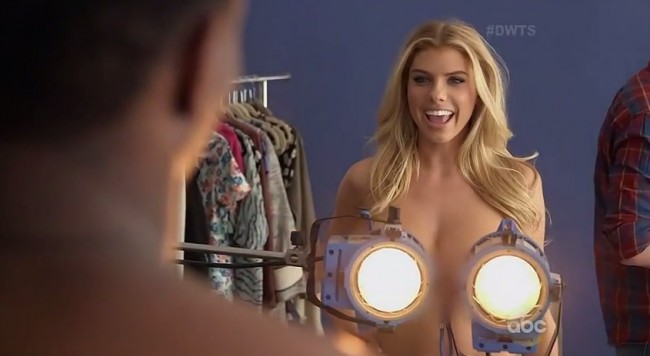
I’ve talked about the show’s objectification of female bodies before – and it’s getting no better – but in recent weeks we’ve actually seen feminist perspectives on Dancing with the Stars being written off live on air as ‘cyber-bullying’. Contestant Charlotte McKinney received harsh criticism and, let’s face it, personal abuse from social media after the star of sexist Carl’s Jr. commercials appeared in the season premiere. Her experience was the basis of the pre-dance ‘package’ (although why we have to all use the industry term here, I don’t know) in Week 2 and following her dance, the negative Twitter comments read-out on air were all dismissed as body jealousy by the judges Julianna Hough and Bruno Tonioli and then as body fascism by co-host Erin Andrews.

Benny Hill guest-judges on DWTS!

Benny Hill guest-judges on DWTS!

Now, I’m not saying that the sinister forces of the internet comments feed weren’t at work here and I don’t approve of targeting someone who is as much a victim of the sexist culture as the women it leaves out (as opposed to, say, the people who sit down and write the Carl’s Jr ads). That said, it’s clear to me that many of those comments, however personally directed they were, were aimed at McKinney’s participation in advertising that demeans and degrades women, and to disregard all the criticism directed at her as troll-grudge is to silence a protest against television’s ongoing celebration of women as sexual objects. Dancing with the Stars cannot continue to swim in these choppy waters without changing its body politics.

The Apprentice’s Apprentice

Posted in American TV (General), American TV Shows, British Shows on American TV, Reality TV, TV channels, Watching TV with tags , , , , , , , , , on March 11, 2015 by Tom Steward

‘Don’t it always seem to go, that you don’t know what you’ve got ‘til it’s gone…’

I’m quoting Joni Mitchell not (only) because I’m reading Morrissey’s autobiography and have the urge to paste song lyrics into prose when I’ve run out of things to say but rather as a description of the way I feel about The Apprentice. It’s rare in our culture to prefer the re-make over the original but even rarer that we admit to preferring another country’s version of an idea to ours, regardless of which came first. It’s this paradoxical thinking that draws me to the BBC adaptation of The Apprentice and makes me resent the NBC original. Now that I live in America, the latter is my bread-and-butter and the former feels too distant from my daily existence to be relevant viewing anymore. As I sit writing this on a winter’s day with the sun beating my back, I don’t ask for sympathy. But I do rather feel like the person who bought the last painting before they discovered perspective.

From the arse's mouth!

From the arse’s mouth!

Like most shows sold overseas, the format remains largely unchanged. But there’s something about the translation of American corporate-speak and aspirational diatribe into the laughably misjudged self-esteem of Britain’s business classes that gives The Apprentice on the BBC an ironic quality which bends a celebration of capitalism into a critique of the ideology. Goebbels once said that no-one could watch an Eisenstein film without becoming a communist. Well, I severely doubt anyone could sit through an episode of UK version of The Apprentice and still think capitalism is going to last. It’s not hard to believe we have economies based on nothing because The Apprentice UK tells us the people who front it are never less than vacuous. While the American original has the product placement and commercial saturation of a major US network in its arsenal, the BBC version is broadcast on a British public service station which prohibits advertising. The former is mired in a web of cross-marketing, while the latter seems inhospitable to the idea of a TV programme as a commodity.

Go waste the President's time instead...

Go waste the President’s time instead…

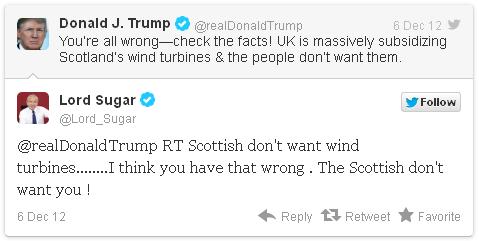
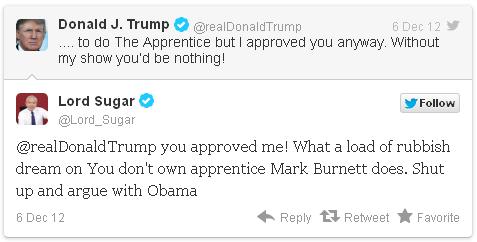
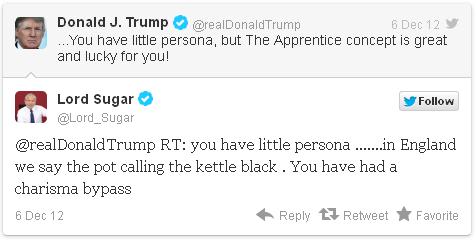
This is not to say that The Apprentice UK is some sort of subversive attempt by the imagined leftist conspiracy at the BBC to undermine British entrepreneurship. It’s more accurate to call it ‘private service television’, a mode of broadcasting addressed to a society dominated by privatised industry and designed to make the best of it (even that is being a touch generous!). But neither does it use its airtime to consolidate a corporate empire through media exposure, like its forbearer. The Donald Trump Apprentice never misses a chance to tell you how powerful and glorious the various business enterprises of the Trump family are, whereas the Alan Sugar counterpart (which sounds like the greatest 80s garage band that never was!) makes his company look like a loosely connected network of 1940s-style spivs and barrow-boys. The tasks assigned by Trump are publicity-centric busywork (especially in the current Celebrity variant) but Sugar’s are about the hard graft of street selling and face-to-faces with customers. You’re the apprentice of a swindler learning how to avoid being swindled.

Sugar doing my job for me!

Sugar doing my job for me!

Perhaps this is because ivory-towerism doesn’t sit so well with the British public, while it taps into the ultimate aspirations of many Americans. The British version is certainly not intended as satire (though the directors do like to puncture with visual gags anyone who takes self-assessment as business elites too literally) but it is playing to a crowd who like sarcasm, wit and darkly awkward comedy. Sugar and his associates are fans of linguistically inventive cruelty, the directors eek every ounce of uncomfortable voyeurism out of the documentary filming (in a style borrowed from pioneering UK sitcom The Office), and the show itself is framed as a sadistic prank played on those who applied to appear. It’s marginally better now the prize is a sizeable investment in a business venture a la Dragon’s Den/Shark Tank (delete monster and monster holding cell as appropriate) but I remember when winners were rewarded by an internship at a digital signage company amid the electro-magnetic subjugation of Tottenham Court Road. Somnambulist losers of Touch the Truck have it better. No-one expects Donald Trump to say anything intelligent, funny or creative (even his racist metaphors lack flair) and the verbal garbage emerging from the Ridley Scott-alien mouths of his children is a generation stupider. Mavericks are praised not parodied and the mere act of aspiring is deemed worth the risk.

Man and Nimoy

Posted in American TV (General), American TV Shows, TV History, Unsung Heroes with tags , , , , , , , , , on March 4, 2015 by Tom Steward

The tragedy of the TV actor is that they are haunted by one character for their entire life. For Leonard Nimoy, who died of end-stage chronic obstructive pulmonary disease last Friday at 83, the character of Mr. Spock overshadowed fine performances in many of the defining TV series of the 1960s and 1970s. But popular culture would never allow his empirically-minded alien starship science officer from Gene Roddenberry’s Star Trek to die, and if the onscreen death of the character and demise of the movie franchise didn’t finish him off, then it’s unlikely that Nimoy’s passing will do it either.

Finding Nimoy.

Finding Nimoy.

Spock will continue as a character in J.J. Abrams’ rebooted Star Trek movies and will continue to be played by Leonard Nimoy, albeit as an impersonation by Zachary Quinto. TV characters are so much their actors that for a replacement to offer an original interpretation would be as detrimental as casting them in the wrong age or gender. Rather than passing the gauntlet, the movie prequel to the original Star Trek series (and I suppose sequel to Enterprise if you put it that way) concocted a scenario in which Quinto’s Spock was a younger version of the character as played by Nimoy – who also appeared in the movie because time travel heals all continuity wounds – and thus had to customise his mannerisms and delivery according to his predecessor. This freely admitted in plot terms that no-one but Nimoy could play Spock. Technically, re-setting the clock allowed Quinto to go his own way with the character but if anything his performance became more like Nimoy’s in the sequel Star Trek into Darkness, attested to by another appearance by Nimoy as Spock’s future self. Without Nimoy to play off in future films, I fully expect Quinto to compensate further with thorough mimicry.

Looking back from the Spock-themed obituaries, it’s hard to imagine that there was a time when Nimoy would have played Spock for only three years. Of course, three years is another ten in re-runs, and the re-circulation of Star Trek (as much in off-air audio recordings shared between fans as repeats) is what brought Nimoy back to play Spock, first in the astonishingly comparable animated series spin-off that ran in the mid-70s and then in a series of continuation movies that ran from 1979 to 1991, or between Shatner’s third and seventh girdle, whichever way you care to think about it. After that, Spock made his way back onto TV featuring in two episodes of Star Trek: The Next Generation, before he became the missing link between Gene Roddenberry and J.J. Abrams. Spock was the Jack Bauer of his day, unkillable by man or logic. Neither death, nor time, not even the series not being about him anymore, would stop him appearing in it. And this doesn’t even begin to include the times Nimoy performed Spock outside of Star Trek, perhaps most poignantly as a disembodied head reviving the Vulcan for the entertainment of an omniscient teenage alien in Futurama.

Nimoy was already a face in American television by the time he took the role of Spock, and good television at that. He already had a Twilight Zone and an Outer Limits under his belt, which gave the actor anthology pedigree to add to his generic bow of westerns and detective shows. Nimoy had a knack for finding his way into the most accomplished shows of the 1960s, including The Man from UNCLE (which has no reboot forthcoming, regardless of what ANYONE says) and Mission: Impossible, his first TV role after Star Trek was cancelled. Even into the 70s, he was on Rod Serling’s horrific(ally underrated) Night Gallery and Columbo, because no American actor is allowed in SAG without it. His was a face for television, betraying nothing and letting whatever fine piece of screenwriting he was bestowed do the work. It was a time on American TV when emotions were optional, but class was not. Sci-fi TV is his, and it owes him a living. He returned to The Outer Limits when it re-appeared in the 90s, in a re-make of the same episode he had starred in during the 60s. A role was waiting for him on Fringe.

Nimoy also did pro-bono legal work for robots

Nimoy also did pro-bono legal work for robots

There’s more to Leonard Nimoy than Spock (and there’s at least two of his careers I haven’t mentioned) but the character presented him with limitless possibilities for remaining in the zeitgeist long after he ceased playing him on TV. He lived longer and more prosperously than even Spock could predict.