Archive for the Behind-The-Scenes Category

Acts of Television

Posted in American TV (General), American TV Shows, Behind-The-Scenes, TV channels, TV News with tags , , , , , , , , on November 24, 2015 by Tom Steward

In the week following terrorist attacks on Paris, Beirut and Lebanon, the response of American television to these events is of little importance. But this is a blog about American television and so that’s what I’m going to talk about. To make this blog about the attacks – as if that had been its dormant purpose all along – would do a severe injustice to what is a complex geo-political situation. Sometimes I wish American television knew its limitations as well as I do. News and current affairs programs obviously must deal with what has happened – unfortunately for those of us who don’t think that refugees are responsible for the crimes of their persecutors – but TV entertainment doesn’t necessarily have to engage unless the latter’s remit crosses over into the former’s. Nonetheless, all entertainment programming, at least that which has been made since the attacks, seems to have an unwritten obligation to comment on the human tragedy. This sounds like an altogether good thing, suggesting that the genre isn’t as trivial as we suspected, but what it actually discovers is that entertainment formats are simply not equipped to handle this level of political discourse. Many of the results have been frankly insulting.

paris

Jean Oliver!

Take, for instance, Chris Hardwick’s gabbled epilogue of pseudo-Churchillian platitudes no doubt compiled from a graphic novel about Dunkirk in the closing moments of AMC’s Talking Dead, a post-show discussion of The Walking Dead. This resembled one of those rushed disclaimers at the end of pharmaceutical commercials. For events of this magnitude, you either have time to talk about them or you don’t. I’m all in favour – as my younger self would not have been – of cancelling scheduled shows in favour of extended news coverage, though this is one of the few times that a 24-hour news cycle is justified in my view. TNT made the decision to postpone the broadcast of an episode of Sean Bean vehicle Legends set in Paris, which though it may appear overly-sensitive also takes into account the fact that a terrorist act is represented. CBS’ Supergirl and NCIS: Los Angeles also shelved episodes that involved bombings and terrorists. Networks tend to err on the side of caution in these instances, reducing TV to a set of trending keywords and then disseminating entire programs that use them incidentally. It’s one of the few occasions that networks admit outright that their programming is not socially responsible.

Some responses were more judicious. As you might expect from our ironic culture of news, parodies of broadcast journalism did far better than the real thing in their treatment of the attacks. Last Week Tonight with John Oliver kept the talk of war cultural, badgering ISIS into taking on the global leaders of art, food and music with their apocalyptic asceticism. While this is one of the few shows on TV that had the time and scope to offer a full account of the attacks and their significance, the suddenness of the events and their proximity to airtime meant that the program was safer – and more effective – to be as schoolboy as possible in its response, exploiting the other boutique quality of HBO: Obscenity. While broader as befits its appeal, The Late Show with Stephen Colbert adopted a similar tact, leaving it to New Orleans-based house jazz band Jean Baptiste and Stay Human to pay tribute to the French origins of their musical culture. Colbert has always played both sides of the American political sphere and, whether scheduled or not, the pairing of Bill Maher and Medal of Honor recipient Flobert Groberg kept the extremists on both sides at bay.
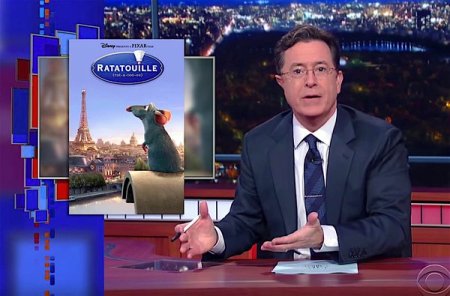
Vive la Rat!

Vive la Rat!

But what made Colbert’s response particularly powerful was its self-reflexive commentary on how to respond to events such as these. There was an affectionate poke at the tweeters who had the combination of compassion and ignorance that makes watching Ratatouille an act of solidarity with the French and a behind-the-scenes glimpse at the dilemma over whether to keep the booking of feline circus act The Acro-Cats on the first show since the attacks. Since taking over from Letterman at CBS, Colbert has made himself a defender of both American high culture and light entertainment, and so the ISIS attacks were a real (surely unwanted) test of his mettle in his dual function as cultural commentator and ringmaster, which he passed with high-flying colours. Colbert is unusually thoughtful for a talk show host, Oliver a journalistic powerhouse. It’s the ones who think they’re being thoughtful through acknowledgment that are the problem.

Network Failure

Posted in American TV (General), American TV Shows, Behind-The-Scenes, Reviews, TV Acting, TV channels with tags , , , , , on November 9, 2015 by Tom Steward

If there’s one problem that ABC have – apart from being a Big Three network in an era of digital multiplatforming – it’s authenticity. For two years in a row, debuting primetime offerings from the network have been pulled up for artificially rendering their source material. The complaints are as much from authors as critics. Second-generation Chinese-American restauranteur, writer and cultural activist Eddie Huang laid in to the ABC sitcom Fresh off the Boat based on his memoir of the same name for reverting to ethnic and racial stereotype in its depiction of a Chinese immigrant family settling in 1990s Orlando. Though credited as a producer and a narrator for the pilot season, Eddie has continually spoken against the homogenising and caricaturing of his life and people by the show’s writers and producers, as well as the network itself. Having read his memoir, it’s certainly no exaggeration that the events of Eddie’s life have been sanitised, his political views marginalized, and his experience of growing up in America made secondary to the demands of a family sitcom.

Eddie Huang, then and never!

Eddie Huang, then and never!

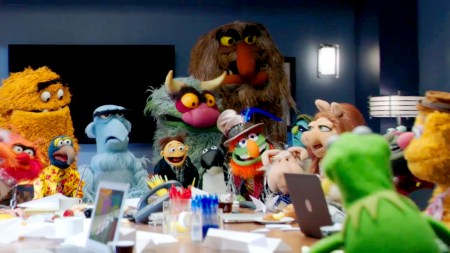
Flash-forward one year and critics are saying the same about The Muppets, ABC’s TV revival of the vaudevillian puppet characters owned by parent company Disney. While the two Disney movies that rebooted the Muppet franchise were highly regarded returns to the original talent show premise, the sitcom that followed revisited the characters in a behind-the-scenes mockumentary format replete with self-consciously adult humour. It’s no Meet the Feebles but nor it is the family-oriented and friendly fare we’re used to. Retrofitting Muppets like Miss Piggy, Kermit, Gonzo and Fozzy Bear into a Larry Sanders-style sitcom has meant the libidinal and laconic sides of these characters – which were traditionally alluded-to, offscreen things – have come to the fore, and long-time Muppet aficionados have questioned the connection between the current and original incarnations. Again, it’s hard to disagree. The Muppets were always meant to appeal to adults, but not solely, and usually as a by-product of their pan-familial ambitions. The idea that Jim Henson’s ensemble are able to compliment twisted modern comedy is cross-breeding even he would balk it.

Inauthentic? Yes. But worthless? Absolutely not. The sitcom variation on Fresh off the Boat may be far too cosy to do justice to the raw and acerbic memoir it was inspired by, but it is has never shied from addressing questions of race and assimilation. Last week’s episode filtered its discussion of Chinese media self-representation through the ghost of Long Duk Dong from Sixteen Candles, seen here as the gold standard of racist Asian stereotype in American popular culture. Occasionally, too, a fiercer take on caucasian culture and community reminiscent of Eddie’s own bleeds through, as when Grandma Huang casually remarks on the subject of family relations, that white people ‘are the cruellest race’. Though the format is familiar, the content is often challenging and we don’t forget about the problem of difference. There’s universality to the representation of the latter-day immigrant experience that even G, a Mexican-American, recognizes. To his credit, Eddie is gracious enough to admit that this universality is not altogether a bad thing, just that it lacks the reality he knows.

Though some of ABC’s The Muppets is like watching your parents make out (or worse!), I’ve enjoyed a lot of the writing that uncovers the parts of Muppet culture that previously remained – mostly for reasons of censorship – latent. Whether it’s the band’s unspoken pot habit finally exhaling it’s now-legal name or the romantic truth behind the sado-masochistic relationship between Beaker and Dr. Bunsen Burner, you might also say that in more progressive, accepting times, it’s the obvious way for the characters to go. Speaking of diversity, it’s been a pleasure to see Pepe the Prawn, a Latin Muppet, get some much-deserved screen time, including some of the show’s best dialogue. Having had an episode order trimmed severely and their showrunner leave after a single season, it seems as though the network is not happy, or at least buckling under the heavy criticism, much of it from parents and conservatives concerned about the sitcom contaminating the moral fibre of the Muppet brand. I’d disagree with them anyway, but objectively the transgressive stuff is still done tastefully.

The Writer's Room!

The Writer’s Room!

I’m not completely sold on either of these shows. Fresh off the Boat made father Louis Huang a virtual replica of Phil Dunphy instead of a progressively contradictory character while The Muppets has some of the worst qualities of the navel-gazing industry mockumentary tradition. But they make their own reality.

The Balking Dead

Posted in American TV (General), American TV Shows, Behind-The-Scenes, TV advertising, TV channels, TV Sports with tags , , , , , on October 26, 2015 by Tom Steward

I didn’t blog yesterday as usual because I was at my first (American) football (not soccer/football) game, which coincidentally took up the whole day due to stoppages for television. I’m glad though because now I get to talk about something that happened on TV last night. WARNING: DO NOT READ THIS BLOG POST IF YOU ARE NOT UP TO DATE WITH THE WALKING DEAD OR ARE PLANNING ON BINGEING THE SERIES IN THE FUTURE (UNLESS YOU TEND TO FORGET TV DRAMA CHARACTERS AS IF THEY WERE CONTESTANTS ON THE BACHELOR).

As spoiler-free a picture as I could find...

As spoiler-free a picture as I could find…

On Sunday’s The Walking Dead, everyone’s favorite post-apocalyptic pizza delivery boy – with the possible exception of Fry from Futurama – Glen Rhee apparently died. I say ‘apparently’ because while visually we seem to have seen his demise (and intestines), the storytelling, which continues intertextually in post-show discussion program Talking Dead, left Glen’s fate ambiguous, despite the unlikelihood of his escape from a throng of hungry, handsy walkers. In a series where every character is already to some degree dead, the writers and directors are obliged to be specific about what character is in which state of death. Moreover, the emotion surrounding certain leading characters, including Glen who has been there from the start, means there is an unwritten rule that they be killed visibly and memorably, so as to not play with or minimise those feelings.

Last night, when it came to ‘killing’ Glen, The Walking Dead did neither. Add this to the absence of the character death rituals on Talking Dead of having the actor appear as a guest and a slow-motion replay of their death on the mock-mournful ‘In Memoriam’ section of the show, and it appears that either the producers are playing a dangerous game with Walking Dead fans or floating the possibility that we didn’t see what we think we did. A note read out on Talking Dead by producer Scott M. Gimple hedged their bets even further, saying that ‘a version…or part’ of Glen would return to ‘complete the story’. Lost creator Damon Lindelof was a guest on the show – which is perhaps another clue that in a show where everyone is already dead anything is possible (OH YEAH DON’T READ THIS IF YOU HAVEN’T SEEN LOST) – and found it hard to believe that The Walking Dead would pull a Dallas and have Glen return from the dead against all conceivable odds.

Not that it will surprise anyone who suffered through all six seasons of Lost but Lindelof may be overstating the case here. The Walking Dead is rather fond of melodramatic cliffhangers, as the final ‘how do we get out of this’ moment of Season Four nicely illustrates. The show is not above waiting off on spoiling the death of a character if it helps heighten the drama. In Season Five, we didn’t know Bob had been bitten for nearly a whole episode until he finally revealed it to the cannibals who had just eaten his leg for dinner. The quality seal of the Mad Men network (which is also a guarantee of having to watch crappy action and horror movies back-to-back) sometimes makes us forget that what we’re watching here is popular genre television – quite literally a televised comic strip – in which such matinee-style twists and turns are not only possible, but rather their stock-in-trade.

Don't take it out on me, it's this guy's fault!

Don’t take it out on me, it’s this guy’s fault!

No-one doubts the class of Arthur Conan Doyle’s Sherlock Holmes stories yet the author had the Great Detective return from the dead in implausible circumstances. More to the point, I can see about three or four different ways Glen could have escaped from the pile of walkers he was crowd-surfing on. A couple of those have already been tried and tested in the series, so while the Talking Dead panel saw the callbacks to Glen’s earlier episodes as signs of his impending death, they may also spell the solution to his survival. All of this rhetoric might be my way of deflecting deep-seated sadness about seeing Glen depart The Walking Dead, and of course I’d rather all this conspiracy theorising be true rather than false (as anyone who purports a conspiracy theory does). But don’t underestimate the extra-textual games that TV producers in the digital age are willing to play to maintain interest in their program. One day we might be talking about the ‘Glen hoax’ in the same way we talk about affinity-based publicity stunts like ‘new Coke’. On a story level, if Glen does survive the unsurvivable, it’s a sure sign he’ll be the last man walking.

Tarantino on TV II

Posted in American TV (General), American TV Shows, Behind-The-Scenes, TV Acting, TV channels, TV Culture, TV News with tags , , , , , on October 18, 2015 by Tom Steward

Once again – and just as unintentionally – Quentin Tarantino has re-opened the debate about TV and film. Speaking on the release of The Hateful Eight in dual versions, one complimenting a 70mm Panavision format, the other more conducive to multiplexes and subsequent TV airings, the director observed:

‘The 70 is the 70. You’ve paid the money. You’ve bought your ticket. So you’re there. I’ve got you. But I actually changed the cutting slightly for a couple of the multiplex scenes because it’s not that. Now it’s on Showtime Extreme. You’re watching it on TV and you just kind of want to watch a movie on your couch. Or you’re at Hot Dog on a Stick and you just want to catch a movie.’

A 70mm shotgun!

A 70mm shotgun!

Tarantino has always been a lone voice in the debate, distinguished by an unerring respect for television as an artistic medium and his belief that there is still a tangible distinction between TV and cinema. There are few commentators on either side that can keep hold of both these ideas. Some of Tarantino’s finest work as a director was in television – in ER and CSI, no less – and it’s clear from his movies that TV falls under his muse. But he’s a filmdamentalist and his staunch refusal to acquiesce to the digital industry standard is also an outright denial that TV and cinema have conflated. Tarantino’s vivid descriptions of two experientially different media are more compelling than most critics’ vague sense that TV is becoming more like cinema.

The auteur reserves his derision for the cultural no man’s land of mall-adjunct multiplexes where, as Jackie Brown’s Max Cherry once observed, you see ‘something that starts soon and looks good’. It’s here that film is simply an afterthought of conspicuous consumption, not a thing of grand beauty and spectacle or part of a boutique outlet delivering sophisticated cable programming. There’s an all-or-nothing-at-all fatalism about Tarantino’s views on cinema, a regression to the mid-century belief in a divergence between TV and movies based solely on the size of the screen. It’s a welcome counterpoint to the ubiquity of convergence rhetoric, but perhaps in the end just as misguided and myth-driven as its opposing view.

Another coincidence is that Tarantino’s remarks were reported in the same week that FX began airing the new season of Fargo, a series that asks questions about the relationship between TV and cinema. The series is a spin-off from the 1996 movie directed by Tarantino’s indie contemporaries The Coen Brothers, but once again this season is elusive about its status in regards to the cinematic source material. Actors in the series are frequently costumed and posed to look like characters from the movie, even though they’re playing completely new roles. This season is set during the Carter administration and has the crumpled golden look of late seventies movies, yet the split screen techniques speak more to TV title sequences of the era, not to mention a much more recent breakthrough in televisual narration, Fox’s own 24.

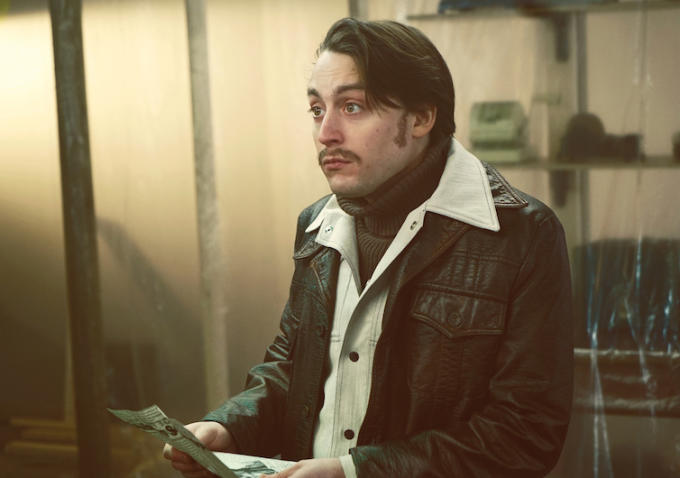
The previous season of Fargo – an anthology of season-long stories, which doesn’t make eliciting its cinematic and televisual qualities any easier – seemed at first a remake of the movie’s storyline with similarly Manichean characters and labyrinthine plotting yet by its end, it felt more like a sequel, having been found in and extrapolated from the timeline of the original. With Kieran Culkin’s uncanny resemblance to a young Steve Buscemi and in the very first episode a visual homage to the late Harve Presnell, whose implacable moustache loomed large over the movie, I suspect we might have just as ambiguous a play with the cinematic mythology this time around. The stars don’t help. Ted Danson has long been identified with television. Meanwhile there’s a Culkin in the cast and plenty of actors who are split exactly evenly across the two media. It’s almost as if Fargo wants to create a new hybrid creature that is neither and both.

Another funny-looking guy.

Another funny-looking guy.

Fargo’s messy intertwining of TV and film consciousnesses works at cross-purposes to what Quentin Tarantino is saying about the continued separation of the two. When we watch Fargo, we’re unsure about how much of what we’re watching belongs to which media. As Tarantino suggests, seeing a movie at a multiplex as a food court folly could lead to the same confusion, while watching it projected wide on film stock would absolutely not. The couch brings together movies and TV, often in the same flowing package, but does it always clarify which is which?

The Pig Country

Posted in American TV (General), American TV Shows, Behind-The-Scenes, TV Culture, TV History, TV News with tags , , , , on October 4, 2015 by Tom Steward

British and American TV are so rarely united, making it doubly surprising that there have been two stories in as many weeks relating to genitalia in the television cultures of both countries. Honestly, pigs might fly and the Old West will rise again before we see another coincidence like this.

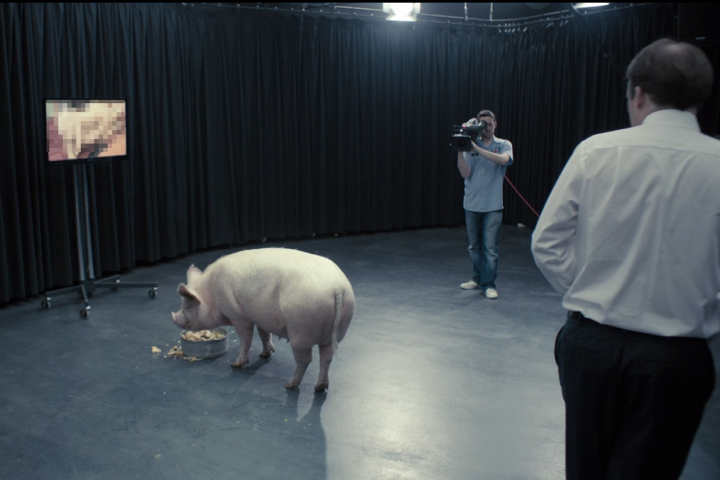
Footage from The Conservative Party Conference

Footage from The Conservative Party Conference

On September 20th 20(and)15, British national newspaper The Daily Mail published extracts from an unauthorised biography of current Prime Minister David Cameron co-authored by passed-over former Deputy Conservative Party Chairman Michael Ashcroft. In them contained a story that as a student at Oxford University, Cameron had put ‘a private part of his anatomy’ into a dead pig’s mouth as part of an initiation ceremony for The Piers Gaveston Society (some paraphrasing of Groucho Marx’s famous ‘club’ quote is surely necessary here!). Remarkable as this allegation was for a sitting head-of-state – outside of Italy – it was not the first time such an idea had been nationally circulated. In 2011, British TV Renaissance man Charlie Brooker launched his modern-day answer to The Twilight Zone, a technology-fearing anthology made of speculative fiction called Black Mirror, the first instalment of which concerned a modern-day British Prime Minister blackmailed into having sex with a pig live on television to meet the ransom demands of a royal kidnapper. Like David Bowie after liquid water was discovered on Mars, Brooker was hounded by the press and social media following this story, asking him whether his television play was inspired by real rumours of which he had foreknowledge.

Brooker says he didn’t, which I for one believe wholeheartedly, namely because you don’t have to know the actual circumstances of such an act to imagine that it would be exactly the kind of thing a person of that background would do. I’m not convinced that the story – hashtagged ‘Piggate’ thus throwing agricultural livestock message boards into a state of disarray – is anything more than a revenge blow from an embittered ex-colleague but we know what absurd extremes the hazing rituals of fratboys at elite universities – on both sides of the Atlantic – can go to, and Cameron’s posh pillaging of the social contract as a university student has been well-documented. Even the most rudimentary scandalmonger could put a scenario like that together from Cameron’s backstory. Brooker, too, was trading off the fact that we as a nation could easily believe our Prime Minister was and has been capable of such things. My mentor in all things televisual Helen Wheatley observed that the morning after the Black Mirror episode ‘The National Anthem’ was first broadcast, it genuinely felt as if Cameron had fucked a pig the day before. It’s that vague aura of authenticity that both Brooker and Lord Ashcroft mined.

In the last couple of days, it has been reported that extras on the set of HBO’s reboot of the 1970s cult sci-fi western Westworld have been compelled to sign a consent form specifying numerous and elaborate acts of sexual contact and nudity, including the touching of each other’s genitals. Some extras apparently complained to their union SAG-AFTRA, who are currently investigating the matter. Those who know HBO (in the Biblical as well as the binge sense) won’t be surprised that one of its shows should contain such graphic content, but the concerned parties have different views about how bound (this is not a metaphor) supporting artists are to such demands contractually. I as a TV blogger (and potential future SAG-AFTRA member) am obviously fascinated by this story, but a lot of viewers I’m sure simply don’t want to know how the organic sausage is made. Great art and human exploitation have always gone hand-in-hand, and, to many, I’m sure this revelation makes Westworld seem like a far more interesting prospect than previously. Also, this seems the thin end of the wedge, providing everyone knows their rights and has the ability to pull out of the project at willy. Penis.

'While you're down there...'

‘While you’re down there…’

If there’s a theme here, it’s indecent exposure. Private parts have been unlawfully displayed in public. Whether it’s bestiality libel or union disputes, these kinds of stories are not for public consumption unless in fictional form. HBO needs to push boundaries on sexual representation to be challenging, while the inhuman behaviour of the Cameron-led Conservative government needs to be challenged for what it is, not what it represents satirically in some bizarre Animal Farm-like parallel reality. Piggate didn’t lend any credence to Black Mirror, rather the reverse. And sex acts and nudity on HBO is simply not a news item!