Archive for the Behind-The-Scenes Category

The Tommys 2015

Posted in American TV (General), American TV Shows, Behind-The-Scenes, British Shows on American TV, Reality TV, Reviews, TV Acting, TV Criticism, TV Culture with tags , , , , on September 27, 2015 by Tom Steward

It’s that time of year again when those we trust with the responsibility of deciding what makes good television publicly demonstrate they have no idea what makes good television. Yes, The Emmys. As with every year, the Academy of Television Arts and Sciences make two glaring errors. Firstly, they overlook the best TV of our time in favour of academy pets like Modern Family (Just a side note: Unlike most television critics, I rather like Modern Family. I just don’t happen to think it’s the only sitcom of the last six years worthy of celebration). Secondly, they create convoluted, counter-intuitive categories of awards that prevent the finest shows from being recognised because they don’t tick a bunch of weirdly shaped boxes. To rectify this, I’m starting my own annual television awards ceremony (yes, it’s going to be one of those articles!) called The Tommys with the sole purpose of demonstrating that you can still recognise the best TV around even when you have bullshit categories.

Best Shaving of Iconic Facial Hair in an FX Series, Zombie-Based Comic Book Adaptation, or Timely Political Commentary

Winner: Sam Elliott for Justified

tommys

Nominated: W. Earl Brown for American Crime/Andrew Lincoln for The Walking Dead/Kathy Bates for American Horror Story: Freakshow (disqualified for chin curtain)

Least Mentally Prepared Husband in a Housewives Franchise, Vanity Project or Marriage Experiment

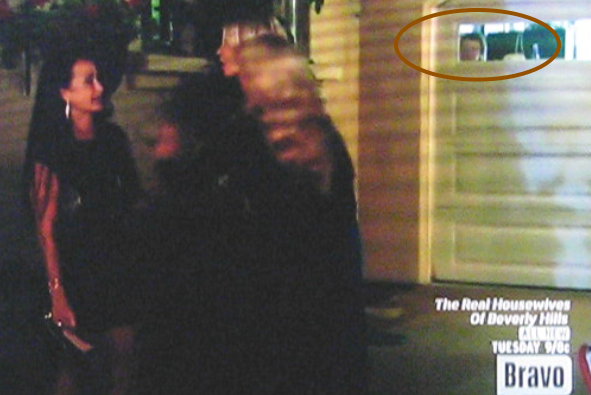
Winner: Vincent ‘Garage Face’ Van Patten for The Real Housewives of Beverly Hills
tommys 2

Nominated: Hank ‘The tranny’s hand walked into my penis’ Baskett for Kendra on Top/David ‘Golem’ Beador for The Real Housewives of Orange County/Mohammed ‘It’s against my religion to express genuine affection for my wife’ Jbali for 90-Day Fiance

Most Impatient Response to a Format Change in an Anthology Series, Prequel Spin-Off, or Homeland

Winner: True Detective (aka Noir is Supposed to be Urban, Idiots!)

Nominated: Fear The Walking Dead (aka Before They Were Zombies)/Homeland (aka Awayplace)/Better Call Saul (aka How The Lawyer got his Spotty Morality)

Most Overrated Drama, Sitcom or Tonally Confused Variation upon The Two Previous Sub-Categories featuring Martin Freeman, Kevin Spacey or Andy Samberg

Note: In this category, the award will be collected by an actor better at playing the role than the actor who actually did*

*Even if Kevin Spacey is in the audience doing his ‘I’m the first ever person to talk to a camera in a TV show’ schtick

Winner: Sherlock (award collected by Lucy Liu)

Nominated: House of Cards (award to be collected by the ghost of Ian Richardson)/Fargo (award to be collected by William H. Macy)/Brooklyn Nine Nine (award to be collected by whoever is near)

Biggest Load of Horseshit Onscreen Explanation of Something That is Clearly an Offscreen Issue in a Trumped-Up Soap Opera, Underrated Popular Literature Adaptation or Reality Show on a Bottom-Feeding Network

Winner: Scandal for the end-of-season held-at-gunpoint cliffhanger and season premiere cold open funeral of Harrison Wright during the domestic abuse court case of Columbus Short.

Nominated: Elementary for the complete absence of LGBT housekeeper Ms. Hudson in the third season while actress Candis Cayne became a visible activist for transgender rights/Marriage Boot Camp: Reality Stars for Hank Baskett’s ‘magic penis’ theory of how he could be caught red-handed in a transsexual three-way and yet not have participated

Worse Kept Secret in a Deathcount-Oriented Drama, Television Awards Show or Publicity-Loving Satire of Advertising

Winner: The Tommys 2015 for revealing multiple spoilers in TV shows not yet caught up on by most viewers by simply listing the nominees

Nominated: The Walking Dead for posting news of Beth’s death on social media the day that the episode aired/The Emmys 2015 for spoiling the series finale deaths of Nucky Thompson in Boardwalk Empire, Zeek Braverman in Parenthood, Jax Teller in Sons of Anarchy, Bill Compton in True Blood and Raylan Givens’ hat in Justified/Mad Men for having a series ending that was tiresomely ambiguous

Most Unconvincing Justification of a Blatant Freakshow in a Bafflingly Popular Horror Anthology Series, Footage-Shy Reality Show or Modern-Day Version of Public Hanging Entertainment

Winner: Botched for claiming to be a fly-on-the-wall documentary about plastic surgeons

Nominated: American Horror Story: Freakshow because if it’s about an actual freakshow, we can’t get upset at the title/America’s Got Talent for exploiting the lack of a substantive mental health care system in the US

Reality Contestant who Looks Most Like a Popeye Character

Winner: Josh Altman (Wimpy) for Million Dollar Listing: Los Angeles

tommys 3

Nominated: The Situation (Popeye) for Marriage Boot Camp: Reality Stars/Josh Altman (Alice The Goon) for Million Dollar Listing: Los Angeles

Deadliest Watch

Posted in American TV Shows, Behind-The-Scenes, Reality TV, TV Acting, TV channels, TV History with tags , , , , on June 26, 2015 by Tom Steward

Next time you’re wondering why broadcast television still matters, consider A Deadly Adoption. This perfectly pitched pastiche of Lifetime original movies would entertain if accessed from any platform, but aired on Lifetime during the Saturday evening timeslot reserved for premieres of genuine original movies it pushes the limits of hoax or even cultural terrorism. As a Brit with an interest in the history of television, A Deadly Adoption reminded me of Ghostwatch, a pre-recorded BBC TV horror drama from the early 90s styled as a live factual special of the kind that were popular on the BBC around those years.

Nothing funny about this.

Nothing funny about this.

Ghostwatch and A Deadly Adoption exploited their network and timeslot to convince audiences of their veracity, the former as a piece of primetime public service television and the latter as a legitimate original movie ‘inspired by a true story’. Both programmes used, at cross-purposes, a mixture of familiar faces from the genre they were approximating and those that you wouldn’t expect to see. In both cases, the anomalies were supposed to tip off the audience as to the subterfuge. But while widely-known comic actors Will Ferrell and Kristen Wiig nudge the viewers in the direction of parody, the same couldn’t be said for the jobbing BBC character actors that Ghostwatch’s producers naively assumed would lead a Saturday evening audience to conclude it was a drama. Ghostwatch recruited actual BBC presenters of the moment to play themselves while A Deadly Adoption called upon veterans of the casts of Lifetime movies. Again, this had mixed results. The agency of presenters affiliated with a broadcaster reputable for its trustworthiness contributed to viewers becoming disturbed, confused and angry while watching. Having Erik Palladino play the cop he always plays asking the questions he always asks increased the plausibility but was also a satirical detail.

Perhaps the most striking similarity between the two programmes lies in the execution of the deception. Neither seems to let the mask drop, and yet they seem to be pointing you to the inauthenticity all the time. Crucially there is no over-acting, at least none outside the conventions of infotainment or TV movies. In Ghostwatch, direct address to the camera is a two-way street. It’s part of the fraud and also tells viewers to their faces that what they’re doing is tantamount to a hoax. It even has the audacity (and foresight) to pre-emptively chide parents for letting their children stay up to watch. Like any skilled comic actor (I’m put in mind of Jerry Lewis in The King of Comedy here too), Wiig and Ferrell’s faces can simultaneously pay lip service to the earnest drama around them while sporting an inner smirk that lets the audience know they’re in on the joke. While they (wonderfully) break character in the final scene, the leads in A Deadly Adoption are generally content to merely stand near the entrenched clichés and overwrought conventions of the Lifetime movie canon and gesture to them discreetly. The comic agenda, like Ghostwatch’s dramatic one, is effaced.

Another lesson that A Deadly Adoption learnt from Ghostwatch is that the most effective spoof is the one that runs like the real thing. Ghostwatch should have been by rights shot on film but the choice was to make it as if it were at every stage a piece of factual television broadcast live from a studio. That meant both the audience and the ‘actors’ were reacting as they would to the very thing it was not. I think this is also why Police Squad! is such an exquisite send-up of Dragnet, largely because it wasn’t much different in production values. Apparently, some BBC executives didn’t get what the Ghostwatch directors were trying to do and rejected some of the shots as cheap and amateur. A Deadly Adoption is going for the clunky symbolism and magazine-plate portraiture of the Lifetime in-house style, not trying to improve on it. To expect A Deadly Adoption to live up to the cinematic comedy of Ferrell, Wiig and director Adam McKay’s previous work is to miss the point. It’s a clever move, and one that demonstrates confidence in the art, that the movie was poised to allow audiences to occasionally forget it was parody.

He ain't 'fraid of no disgruntled viewers.

He ain’t ‘fraid of no disgruntled viewers.

Ferrell and Wiig’s IFC mock-miniseries The Spoils of Babylon played a similar game, invoking a phony industry backstory through trailers and faking-of documentaries, and playing on a network that revives obscure cult media. However, I stick with my Ghostwatch comparison. The aim is never truer when you become your target.

Party Like It’s 1990 Time

Posted in American TV (General), American TV Shows, Behind-The-Scenes, Reviews, TV channels, TV History, TV News with tags , , , , , , , , , on April 22, 2015 by Tom Steward

90s TV is back in vogue, appropriately enough. Twin Peaks is soon to be revived in such exacting detail that Showtime even sought to bring back David Lynch’s fights with the network. Cali has been fornicated enough by David Duchovny – and his series Californication has been cancelled – while Gillian Anderson appeared to be getting her life together but is going back to her abusive ex; thus The X-Files is returning to Fox, it now seems as a replacement for the network’s all-too-rare new-thing-that-people-like Empire. Even The CW’s version of The Flash recently featured Mark Hamill reprising his role as The Trickster from the original early 90s live-action TV adaptation, now father to the heir to his title, allowing the Star Wars actor to cathartically wail the words that every kid in a Darth Vader mask has been saying to him since 1980.

That the decade that time did not give us time to forget is coming back to TV doesn’t come as much of a surprise. The 90s was when the cup of quality American television first runneth over, never to be empty again. Contemporary Hollywood is increasingly dependent on rebooting classic pop iconography. In fact, Hamill was filming his scenes as The Trickster at virtually the same time he was reviving Luke Skywalker for Star Wars: The Force Awakens. But the choice of series has so far been disappointing. The 25-year gap in Twin Peaks was always part of the story, but in truth much of the second final season was completely unwatchable, with the Lynch-helmed finale the only saving grace (and he may not even be directing this time round). If the cast continue to protest Lynch’s absence, we may be looking at a spin-off about The Log Lady’s Log.

Everyone has signed back on for The X-Files but the series was to TV sci-fi what Judd Apatow is to movie comedy. The original series was a good few years too long, and that’s even before Billy Connolly came into the picture! Yes, TV needs more X-Files about as much as literature needs more books about killing heads of state written by Bill O’Reilly. Maybe it’s my comic apathy or that The CW’s demographic version of the flashing lifeclock from Logan’s Run has already gone off in the palm of my hand, but I found nothing to enjoy in The Flash to enjoy apart from Hamill’s scenery-chewing performance (forever to be known as ‘Hamillery’). So if there are any TV executives out there reading (either this blog or just in general) here are some 90s TV shows that are far more worthy candidates for revival:

Murder Three

'My blinds...LaPaglia!'

‘My blinds…LaPaglia!’

The first season of Steven Bochco’s Murder One was a compelling, narratively experimental, impeccably cast piece of TV drama. The second, which I will call Murder Two – not because the crimes prosecuted were lesser but because the quality was – proved altogether more formulaic, B-casted and conventional. Murder Three could right these wrongs. I foresee a pre-credits teaser in which respective season one and two leads Daniel Benzali and Anthony LaPaglia fight Sunshine Boys-like over the configuration of the furniture in the firm’s office, culminating in Benzali’s Teddy Hoffman throwing LaPaglia’s not-Teddy Hoffman out of the window, before lowering the blinds…and then peering through them ominously. We would revive the first season’s 23-episode serial arc, with a case that begins as Murder Three…and ends up as Murder One!

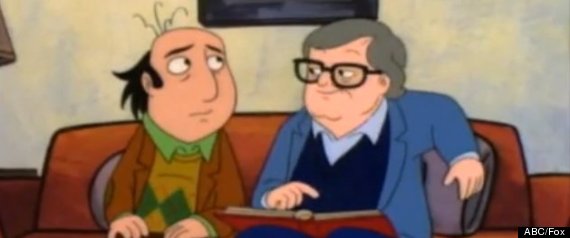
The Critic (Or It’s Not That Tough Being a Film Cricket)

Together at last!

Together at last!

At the time we might have thought that the 90s were the summit of all that was ridiculous about Hollywood movies. But given how extra inflated and predictable blockbusters have become since, surely Al Jean and Mike Reiss’ animated comedy about a TV film critic would now have plenty of kindling for the movie parody fire. Cancelled after one season, there’s still plenty to do with the format and reviving the character of the Ebert-like Jay Sherman would be a greater tribute to the late film critic than any statue.

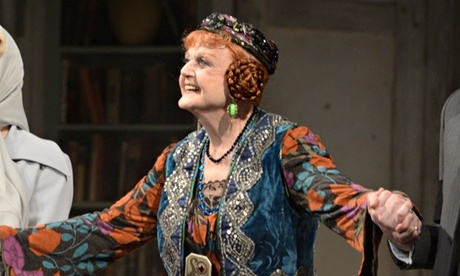
Murder She Wrote

History's greatest serial killer!

History’s greatest serial killer!

Still alive and acting…all I’m saying.

Cop Rock: Laboured Musical Premise Unit

A spin-off of the quickly-cancelled musical police drama about a special team of cops who investigate off-colour musical episodes in other TV series.

Paulie Loves Pussy

A buddy comedy featuring Paulie Walnuts and Pussy Bonpensero from The Sopranos based on this HBO commercial:

We’d figure out the timeline stuff later!

The Cosby Show

I drank from the wrong glass...

I drank from the wrong glass…

Worth pitching just to see the look on the executives’ faces. ‘Drink this, Mr. Greenblatt’.

Equal Opportunity Knocks

Posted in American TV (General), American TV Shows, Behind-The-Scenes, British Shows on American TV, Reality TV, TV advertising with tags , , , , , , , , , on March 25, 2015 by Tom Steward

If there’s one thing Dancing with the Stars is in dire need of – apart from a decent house band, a competent co-host and, y’know, stars – it’s an equal opportunities seminar. I don’t know how many sensitivity courses you’ve been on, but they’ll all tell you (and if they don’t you should) that equality isn’t about treating everyone the same. One of the best teachers I ever had, the film writer and sociologist Richard Dyer, once explained equality to me using male and female public toilets. Men rush in and out, while women take longer. So while giving men and women a bathroom each with the same number of facilities might superficially seem to be giving them identical resources, the sexes are not being treated equally.

I'll give it 5.

I’ll give it 5.

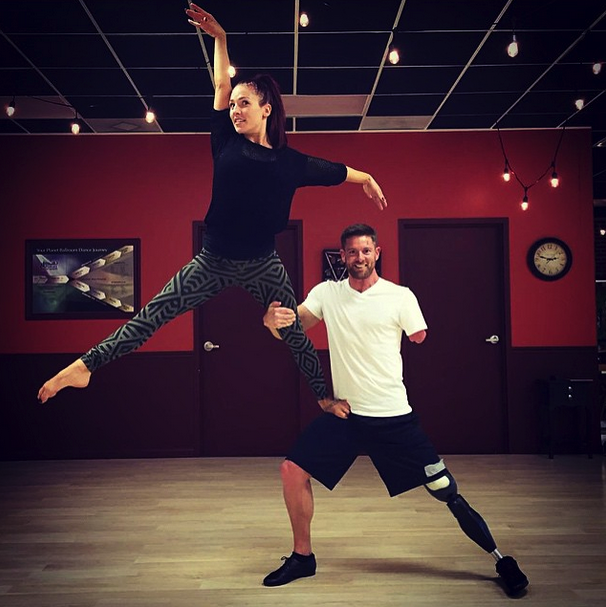
This struck me two seasons ago when Judge Len Goodman told contestant Amy Purdy, who has prosthetic limbs below both knees, that he was going to score her like everyone else in the competition, and that she’d prefer it that way. For the entire competition, Purdy was judged against able-bodied dancers (and Billy Dee Williams) rather than on a scale of achievement that befitted her unique body type. It wouldn’t have been easy for the judges, especially as Purdy herself kept changing the rules of what was possible with her body week by week, but they never had any intention of taking her different abilities into account. To not even attempt this, and to assume Purdy wanted this kind of judging, is to ignore equality.

The Judges have continued to score disabled contestants in this fashion, even when they are physically prevented from competing at the same level as the other dancers. This season features Noah Galloway, who has both his left leg and arm missing. While the Judges are happy to gush and cry for the cameras over Galloway’s overcoming of the odds (and he’s a veteran too, so nothing but conspicuous sentimentality will do), they give him decidedly average scores, reminding us that that they are painting two more limbs on his body in their minds. The Judges’ rhetoric seems to have some idea of how equality works. Carrie Ann Inaba talked of how Galloway ‘challenged’ her judging. But there’s no evidence of this in the competition itself.

But Dancing with the Stars is already a show that seems designed to give Shami Chakrabarti nightmares. It asks people of different ages, genders, bodies and professional dance experience to compete against each other, with no consideration given to how there should be different judging criteria for each group. Doubtless there is some ideological undercurrent of the cream rising to the top regardless of adversity here and whoever said entertainment was a level playing field? However, if the show wishes to bask in the glory of giving a national TV platform to minorities and a diverse range of people (as it has referred to itself doing on several occasions) it cannot simply work around the fact that democracy is just as much about positive discrimination.

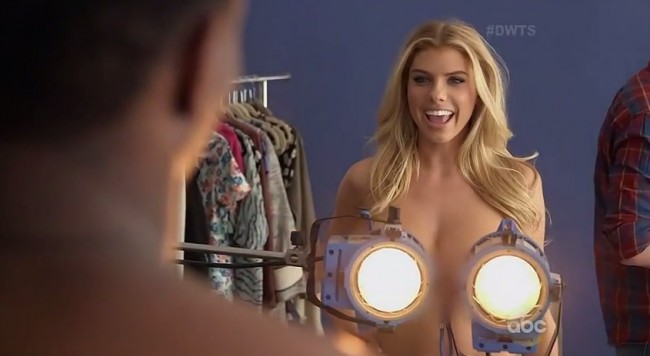
I’ve talked about the show’s objectification of female bodies before – and it’s getting no better – but in recent weeks we’ve actually seen feminist perspectives on Dancing with the Stars being written off live on air as ‘cyber-bullying’. Contestant Charlotte McKinney received harsh criticism and, let’s face it, personal abuse from social media after the star of sexist Carl’s Jr. commercials appeared in the season premiere. Her experience was the basis of the pre-dance ‘package’ (although why we have to all use the industry term here, I don’t know) in Week 2 and following her dance, the negative Twitter comments read-out on air were all dismissed as body jealousy by the judges Julianna Hough and Bruno Tonioli and then as body fascism by co-host Erin Andrews.

Benny Hill guest-judges on DWTS!

Benny Hill guest-judges on DWTS!

Now, I’m not saying that the sinister forces of the internet comments feed weren’t at work here and I don’t approve of targeting someone who is as much a victim of the sexist culture as the women it leaves out (as opposed to, say, the people who sit down and write the Carl’s Jr ads). That said, it’s clear to me that many of those comments, however personally directed they were, were aimed at McKinney’s participation in advertising that demeans and degrades women, and to disregard all the criticism directed at her as troll-grudge is to silence a protest against television’s ongoing celebration of women as sexual objects. Dancing with the Stars cannot continue to swim in these choppy waters without changing its body politics.

Sunday Day Recorded

Posted in American TV (General), American TV Shows, Behind-The-Scenes, Reviews, TV channels, TV History, Unsung Heroes, Watching TV with tags , , , , , , , , , on February 25, 2015 by Tom Steward

‘For a lot of people, their favourite part of the show is the short films, which makes you wonder why don’t they just do the whole show that way. They’ve been doing the show wrong for 40 years. The sketches, they’re nice but they’re long.’

Louis C.K. has made a career out of hitting the nail on the head – and inducing involuntary laughter from the brain – but in as many words as there’s been years of Saturday Night Live, the comedian summed up the fatal (surely tragic by now) flaw of NBC’s late-night sketch show, which celebrated 4 decades on the air this month. C.K. was introducing a compilation of shorts on the SNL anniversary special, scheduled on a Sunday and in primetime (who says American don’t get irony?) and may well have been feeding in to the inverted back-slapping that was pungent throughout the evening. But as soon as the clips rolled, and names like Jim Jarmusch, Mike Judge, Albert Brooks and Paul Thomas Anderson filled the screen, C.K.’s roast zinger becomes an unarguable truism. I myself once had a similar thought before when watching the late-90s British daily sketch programme The 11 O’Clock Show which was written on the day of broadcast and wondering why they didn’t just spend more time on the jokes and make them funny.

Crapping on SNL!

Crapping on SNL!

The more you think about it, the more damning C.K.’s accusations become. Who honestly prefers to watch an SNL sketch featuring The Blues Brothers instead of just watching The Blues Brothers? Where’s the pervert that would endure SNL’s fake public access show ‘Wayne’s World’ as anything other than the intro to Wayne’s World (or Wayne’s World 2)? SNL cast members try to make out that movies based on their sketches are duds (presumably for fear someone might decide to cut out the middleman) but its filmed elements are the only great comic art the show has ever contributed the world. And a sketch worth of Coneheads feels like an hour-and-a-half movie anyway, so you might as well watch the feature spin-off. C.K. might be biased since his sitcom has the finesse of art cinema, but we’re not talking about a group of comedy Oliviers with rave live notices that seem hopeless on film. Every SNL legend has proven themselves masters of screen comedy and the mythical thrill of live TV shouldn’t distract us from that.

Unless I’m severely underestimating Lorne Michaels’ command of irony, I don’t think the inflated length of the anniversary special – coming in at four-and-a-half hours – was meant as a poke at SNL’s reputation for overlong sketches. Again, C.K. was on point (why don’t I just marry him?) and the underwhelming reaction he received was not simply audience fatigue, but a nervous titter of cold, hard realization. The amount of sketches (if you can call them that) and appearances on the night looks impressive on paper, and yet SNL has that amazing ability to appear stretched even when pushed for time. It doesn’t help that so many of the most famous sketches which were revived for the afternoon/evening are based on repetition; Celebrity Jeopardy, The Californians, Weekend Update, The Bass-O-Matic Infomercial. What start out as parodies of overly-formatted TV programming end up using that format as padding. It’s a mistake for SNL to assume that everyone finds their overlength endearing. Like their very own Drunk Uncle, the nostalgic surface hides a multitude of outmoded beliefs and behaviours.

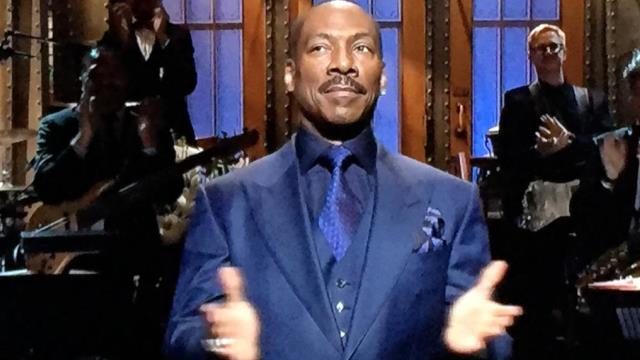
Eddie Murphy doing for real what he does in his mind.

Eddie Murphy doing for real what he does in his mind.

For a sketch show that invests such capital in the idea of shedding its history as soon as it qualifies, the current SNL cast were rather conspicuous by their absence on the anniversary special. Perhaps it’s not so much about them as the greatest generation that fought for their freedom to pretend to be Justin Bieber, but what this sketch comedy version of Apocalypse Now (minus Brando mumbling about snails – that was cut so Eddie Murphy could applaud himself) somehow failed to acknowledge was continuity. It’s a slap in the face that a cast who may be in the process of getting SNL’s shit together for the first time in quite a while should be passed over in a four-hour show and made to look like the weakest links in the chain. Given that Eddie Murphy has only just forgiven SNL after former cast member David Spade ridiculed his career on-air, despite Murphy single-handedly keeping the show on the air (like 1986 World Cup Maradona), they’re clearly not the ones who should have been asked to clean boots that night/day.