Archive for the Behind-The-Scenes Category

One Pundred Hosts (Without Typos Or Cheap Puns)!!!!

Posted in American TV (General), American TV Shows, Americans watching British TV, Behind-The-Scenes, BiogTV, British Shows on American TV, Reality TV, Reviews, TV Acting, TV advertising, TV channels, TV Culture, TV History, TV Sports, Watching TV with tags , , , , , , , , , on September 3, 2014 by Tom Steward

We’re into syndication! With 100 blogs under my belt, I can now sell the rights to the A.V. Club who will publish the same three posts over and over again – with every third sentence removed – for the next twenty years. In the true spirit of American TV, I’ve decided against celebrating this milestone with a piece of considered, original writing (why break with tradition now?) and instead hastily assembled and artlessly compiled a list of extracts representing the best (or at least most comprehensible out-of-context) of the blog…and split it into two parts. Thanks for watching and enjoy!

A specially-created TV series just for this milestone!

A specially-created TV series just for this milestone!

‘Years previously I used to run on the spot along to chase sequences in cartoons like a dwarf soothsayer doing a dance prophesising the age of TV interactivity’

‘My friend openly admitted to finding the slapdick (my term) comedy of the three hosts hilarious, commenting that “we don’t have people like Clarkson on American TV”. “Fox News” I thought, but didn’t say’

‘So shifting viewing an hour or two to make way for a pizza is not exactly the end of television’

‘Yes, Chantix is apparently not just a wonder-drug but a porthole into an alternative universe of Marxist dialectic or, if that’s too posh a reference for you, the Bizarro World’

‘All my morning shows on the day of the Royal Wedding were attended or discussed by the hosts with a bizarre royalty-envy that ill fits a country founded on telling the King of England to fuck off’

‘After weeks of sounding like a malfunctioning motivational speaker robot, Celebrity Apprentice contestant and consecutive mental-of-the-week Gary Busey was appointed project manager on a task’

‘For G, it was as if Britons had collectively decided to substitute a working TV set in the corner of the room for a 19th Century ventriloquist dummy with its mouth sprung to repeatedly gawp the word “Mummy”’

‘When war “came to Downton Abbey” it went by so fast that it seemed to have actually been fought in the grounds of the building, like a game of Risk gone awry’

‘Now I’m starting to think that I was in some sort of hallucinogenic fever state the night before because I could’ve sworn I saw Hollywood actor-director Clint Eastwood hold a conversation with a chair while an audience of magenta elephants cheered him on’

‘TV Land is where sitcoms and their stars go to die’

'Memba them?

‘Memba them?

‘After prolonged exposure to American TV news, however, I now long for a token alternative viewpoint and the masquerade of even-handed commentary’

‘Watching a Halloween-themed sitcom episode used to be like watching film footage of Hitler’s speeches; unimpressive and kind of shambolic and yet those in the crowd seem to be going wild for it’

‘Like anything in life which I have no direct experience of, I looked to American TV for advice on how best to handle the situation’

‘All I found on The Travel Channel were programmes about the excessive intake of high-calorie foods which make Americans less able to move. When I turned over to The Learning Channel I saw wall-to-wall programming about people without formal educations’

‘I’m sure Harry Enfield will be relieved to know that after decades of writing and performing some of the best character comedy and social satire in Britain he is finally known in America…as a talking gnome with goggles’

‘But a 3 hour serialised pilot? It’s like the feeling you get ordering a starter of garlic bread with tomato and cheese in a pizza restaurant. It’s enjoyable and you wanted a starter but it’s also what you’re getting for the main course’

‘I mean, what exactly is gained showing Goodfellas at 2 in the afternoon?’

‘It seems that if reality TV was more like reality, with all its loose ends and uneven surfaces, fans of the genre wouldn’t necessarily want to watch it’

‘Early in his career, artist Roy Lichtenstein produced a series of paintings based on advertisements. In one of the great cultural ironies of our times, advertising started appropriating Lichtenstein’s paintings. Something similar is going on with Mad Men

‘To those who know football from the European or Latin American leagues, watching a US soccer team play feels like the moment in Futurama where Fry finds that in the 30th Century baseball has become ‘Blernsball’, a barely recognisable Twilight Zone twist on the sport where spectators try to catch players instead of balls and giant spiders roam free through the diamond’

‘It’s a perfectly normal road to marriage…if you’re James Bond’
 

Box Jumps

Posted in American TV (General), American TV Shows, Behind-The-Scenes, TV channels, TV History with tags , , , , , , , , , on June 24, 2014 by Tom Steward

With the possible exception of serial killing, the part of our culture most likely to produce copycats is television. Each idea that has any kind of success with or impact on viewers will be re-circulated more or less unmodified until the imitation has paled to the point it recalls the scene in Moulin Rouge where Nicole Kidman pretends to be Madonna pretending to be Marilyn Monroe. This is why there are currently five series airing on US television (that I can name!) about software developers and why so many recent TV dramas use flashback, even though it runs counter to the logic of television’s simultaneous time. A particularly alarming television trend doing the rounds at the moment is arbitrary jumps in time that leave huge gaps in series timelines. Rather than heralding a new style of TV storytelling, these flashforwards seem more like afterthoughts designed to resolve awkward continuity problems.

Fargo the year!

Fargo the year!

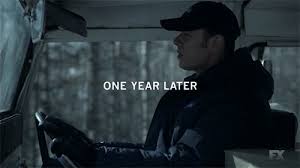
It was recently announced that the final season of HBO’s prohibition-era gangster drama Boardwalk Empire would take place in 1931, seven years after the end of the previous season, which had covered the late teens and early twenties in its first four seasons. The final few minutes of the latest season of docu-sitcom Parks and Recreation jumped three years ahead, omitting Leslie Knope’s pregnancy, the birth of her triplets, and the first years of her new job. FX’s thriller mini-series Fargo skipped a year in its last few episodes, this time allowing police Deputy Molly to get pregnant and criminal conspirators Lester and Lorne to start new lives. After nine episodes out of twelve, we’re still waiting for the belated revival of 24, Live Another Day, to jump a few hours to get us to the end of the day before the season ends, as promised by the show’s producers.

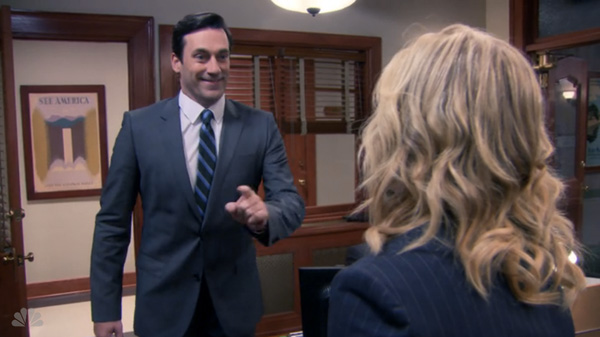
When TV shows did this in the past, it always smacked of desperation. It was no coincidence that Desperate Housewives jumped five years in its fifth season the same time as viewers were leaving the show in droves. Nor was a secret that One Tree Hill’s skip ahead four years halfway through its run was a thinly veiled attempt to bring characters’ ages into touch with the actors playing them. The time jump might be being deployed in a slightly smarter way these days, with Parks and Recreation’s implication that the nation has missed out on a three-year recurring guest role from Mad Men’s Jon Hamm, who is fired from Leslie’s office seconds after the ellipsis. But if you look at where the jumps are situated in the runs of these series, and think about why they should happen at that exact point, you’ll see they are no less crude.

As with flashbacks, part of the problem is that time jumps upset the way time works in television. It’s conventional that TV time runs concurrently with the time in which we live out our lives, and pleasurably so since much of the joy of watching TV is the way it syncs with what we’re doing. Time jumps invariably put a show ahead of the time of viewing, which makes it a kind of science-fiction, and would be fine if that’s what the programme-makers were going for. Aside from problems of realism and plausibility caused by the time jump, it also puts viewers at odds with programmes rather than it seguing with their daily and weekly lives. It’s also more of a placebo for story problems than a panacea. Things take time to work themselves out in television, and television should remain a record of that not a remedy for it.

Look what we missed!

Look what we missed!

A time jump might have relieved Parks and Recreation viewers of another pregnancy storyline but it also cheated them of character development. It’s very much a self-written corner since no-one asked the writers to put two pregnancies back-to-back. The loss of a full year in Fargo deprived the series of the suspenseful and tightly-knit storytelling that held the show together, resulting in a deeply unsatisfying denouement. We’ve yet to see how 24 will skip ahead to later hours of the day, but it’s bound to disrupt the real-time orthodoxy of the premise. The producers of Boardwalk Empire may feel they have more justification to move forward in time since it is a historical piece. My initial thoughts are that the 1930s is a very different animal historically, and that Boardwalk Empire can’t help but become a different programme. Can we jump forward to a time when TV doesn’t time jump?


Live Another UK

Posted in American TV (General), American TV Shows, Behind-The-Scenes, Reality TV, Reviews, Touring TV, TV channels, TV Criticism, TV History, TV News with tags , , , , , , , , , on May 15, 2014 by Tom Steward

Perennial bad penny of television 24 returned to our screens last week, four years after the show’s cancellation, which everyone – other than flagging network Fox it seems – felt was already long overdue. Along with being cut in half (12 must not be a sellable number these days), one of the more remarkable changes to the series, sub-titled Live Another Day, is its re-location to London. In the later years of the series proper, 24 left America’s centre of terrorist activity L.A. to tour the East Coast with seasons seven and eight set in Washington and New York respectively. The show only ever ventured from U.S. shores when its many presidents would harangue middle-eastern statesmen by phone to reveal their country’s official secrets in order to avert a nuclear attack they know nothing about. African-set spin-off TV movie 24: Redemption is the exception here, but everyone concerned would I’m sure like to write that abomination out of the show’s history along with ER’s excursion into the dark continent of television. Besides, 24 was always characterised more by rampant xenophobia than cosmopolitanism. So why on earth would the producers of 24 want to re-launch the series in The Big Smoke?

24 solves mystery of London's traffic problem.

24 solves mystery of London’s traffic problem.

Well, the official explanation is that setting Live Another Day in London pays tribute to the UK TV audiences and critics who championed 24 in its early years when the US was still ambivalent. The first and second seasons of 24 were essential cult viewing when they aired on the free-to-air channel BBC Two in the early 2000s, gaining a large and devoted viewership, incessant national media attention and even a digital BBC sister show in a mould recently revived by AMC’s Talking Dead. The Guardian’s TV critic Charlie Brooker even had to be asked by his editors to stop writing about the show in his weekly column. 24 was lost to the nation as a watercooler show once premium satellite channel Sky One bought the exclusive rights to air the series from season three onwards, but Britain doubtless helped to ensure renewal in the years before the show was a signature Fox mainstay, and became too big to cancel. If this is the case, then speaking for the entirety of the UK – which as an ex-pat I do daily – we’re flattered. But will Britain end up resenting 24 in a manner previously reserved for Dick Van Dyke?

Three episodes in, it’s too early to tell but the signs are encouraging. Live Another Day has so far conspicuously avoided the axis of bobbies, minis and red phone-boxes that still dominates the representation of Britain in American popular culture. Sometimes, it even looks like it was conceived by someone who knows London, or has at least obsessively Google-street-viewed it. The season premiere opened with an East-London street market scene that authentically captured the area’s large Asian population, a fact of our diversity that Americans often miss. Whether or not the Prime Minister would have been a caricature of the privileged classes anyway I’m not sure, but that’s what we currently have, and Stephen Fry’s neckless bumbler is a suitably Cameronesque figure. Apart from some tourist traps like assuming that someone could pursue a Tube train through Central London by driving, the show is pretty faithful to the city’s geography and infrastructure and, at the time of writing, we’ve seen way more of London’s liminal council estates and industrial wastelands than its tourist hardware. We don’t see natives often, but when we do they have the sarcasm and cynicism towards America’s intelligence melodrama that I expect from my fellow Britons.

Jack's in a pickle again!

Jack’s in a pickle again!

Sadly, the cinematographers have CSI’d the show’s colour palette, making London more grey than it actually is, which I didn’t think possible. As revelations about the origin of the attacks unfold, I’m beginning to worry that we’re about to be portrayed as a country that harbours and sympathises with middle-eastern terrorism, rather than one that benignly questions the motives of US foreign wars from time-to-time. Given 24’s scapegoating of anyone East of Alaska, I’m not sure those Asian and Eastern-European Londoners are going to stay innocent bystanders for long. Of course, this London layover is symptomatic of a broader reverse-colonization of American television by UK popular culture, with a quota of British acting in every new show. It comes at a time when Bravo is launching the reality show Ladies of London looking at the city’s transatlantic socialites. As self-appointed visual archive of the rich and famous, Bravo is hardly likely to offer us a London in accordance with social realities. Preview material of a barrow boy speaking entirely in cockney rhyming-slang more or less confirms this. So at a time when American TV is obsessing over Britain without ever attempting to understand it, should we be grateful for Jack?

TV in Short

Posted in American TV (General), American TV Shows, Behind-The-Scenes, British Shows on American TV, Reviews, TV channels, TV Criticism, TV Culture, TV History, Watching TV with tags , , , , , , , , , on January 29, 2014 by Tom Steward

The significance and impact of American TV shows are usually measured by longevity since it takes an inordinate amount of public will, critical favour and cultural reputation to dodge cancellation year after year. But every so often a programme with a relatively short life on the air ends up being hugely influential in TV, art and culture. Premature cancellation often becomes part of the show’s cult – see Josh Whedon’s Firefly – or masks a rapid decline in quality that makes another season seem deeply undesirable. Either way, these programmes tend not to be cancelled before their time but are just way ahead of their time. It’s hard to see how many of these shows could go on but harder to imagine what future denizens of popular culture would have done without them as inspiration. Here are some TV shows with small runs that ended up being a big deal:

Freaks and Geeks (NBC, 1999-2000)

The future of American popular culture

A Wonder Years for the remaining 99.99999% of the American population that didn’t draw a life lesson from every single incident of their education, this stripped-back yet heart-warming look at high school from the perspectives of its most marginalised students lasted only one season on the air. But the show has sent ripples through American popular culture ever since. Producer Judd Apatow and stars Seth Rogen, James (Di optional) Franco and Jason Segal have completely sewn up US movie and TV comedy in the 15 years since the show aired and they now rank as some of the biggest names in Hollywood. Moreover, Freaks and Geeks incorporation of the socially outcast and physically different into mainstream teen television made a cultural phenomenon like Glee possible and the show’s unglamorous depiction of young Americans is the essence of Apatow and Lena Dunham’s hit HBO series Girls.

Twin Peaks (ABC, 1990-1991)

Like Laura Palmer Twin Peaks dies young.

Widely credited as the show that brought American TV into touch with fine art, David Lynch and Mark Frost’s sci-fi procedural super-soap also heralded a revolution in television storytelling. Melodramas such as Dallas and Dynasty had already shown that ongoing stories and cliffhanger endings weren’t an anathema to primetime popularity but Twin Peaks demonstrated that a single storyline could captivate audiences over a year of television. The question of ‘Who killed Laura Palmer?’ would have normally been answered in as little as 60 minutes of television but took over a year and half to be settled. Now detective programs all over the world from Denmark’s Forbrydelsen to Britain’s Broadchurch wear the season-long mystery as a badge of quality. In fact, it was only when Twin Peaks tied up the Laura Palmer case and pursued half-baked replacement storylines that the program was cancelled following its second season.

Cop Rock (ABC, 1990)

Cops Rock!

By 1990, producer Steven Bochco was already established as someone who mixed television genres but this medley of musical and police procedural was a step too far for most people when it aired. How times have changed. One of the biggest TV hits of recent years has been Glee, a high school dramedy liberally peppered with musical numbers and – as witnessed by Buffy the Vampire Slayer and How I Met Your Mother – it’s long been considered de rigueur for TV shows to have a musical episode. Of course, it’s one thing to have a show whose premise falls naturally into song and another to try to crowbar music into a decidedly spoken-word genre. It’s also worth remembering that what viewers enjoy about one-off musical episodes is their novelty and Cop Rock was relentlessly musical. It’s maybe why the show never lasted beyond 11 episodes.

Doctor Who: The Movie (Fox, 1996)

Before Dr. Phil there was…

The long-running cult UK science-fiction series had been off the air for 7 years when Fox decided to revive it as a show that could live in America and alongside stylish adult science-fiction like The X-Files. The feature-length pilot tried to keep one foot in both camps, playing as a continuation of the series rather than an American re-make while changing some of the key aspects of the programme’s mythology. Consequently, the revival alienated both the fan base and new audiences and the pilot was never picked up. The people behind the re-launched UK version of the program were obviously not as turned off as viewers at the time. New Doctor Who has taken on many of the US re-vamps, including its romantic predilections, focus on special effects and elaborate set design, and these have helped make it the international hit it is today.


No Sets Please, We’re British

Posted in American TV (General), American TV Shows, Behind-The-Scenes, British Shows on American TV, TV Acting, TV advertising with tags , , , , , , , , , , , , , , , , , on November 5, 2013 by Tom Steward

There are endless reasons why I’m happy to be with G but I’ve always been especially grateful that she’s not an Anglophile or fangirl of British pop culture. I find G’s nonplussed reaction to most things British, including accents and the sights of London, oddly comforting.  I suppose it’s just reassuring to know that it’s me she interested in not my country of origin. I say this because you Americans are obsessed with us Brits. Actually, it’s truer to say you’re obsessed with what you think we are. American television is fanning the fires of this fascination like a Pudding Lane bake-off…and you can’t get more British than that!

There’s not a show I’ve seen on American TV that doesn’t either have in it a British performer or someone pretending to be British, often both given the lax standards of background research for writing British characters. It doesn’t even have to be a show. Various American companies have British spokespeople and mascots in their TV advertising. Why am I not flattered? Because the fascination somehow never extends to actually finding out what the diverse and varied life and culture of Britain is like. Instead it’s an incredibly narrow, dated and ignorant version of our national culture (royalty, the swinging sixties, Victorian cockneys) that is continually reproduced across American television.

A Cockney lizard is the Geico mascot…for some season!

I’m sure all non-Americans (even ethnic-Americans) and American minorities have much the same beef and I’m not saying the British have any special claim to reductive racial stereotyping on TV. It’s the inverse relationship between the interest taken and the research done that makes American TV’s obsession with the British so bemusing to me. Why go to the trouble of inorganically adding a British person to the cast of an American-set show or concept and then not do the requisite due diligence to give them a chance of convincing at what they’re supposed to be?

A cynical answer would be that Americans know so little about Britain that TV viewers wouldn’t know the difference. But why then are Brits so prominently placed in American television as leads or major supporting characters, presenters and stars, and commercial representatives? Why are we not marginalised like so many other nationalities that American TV knows next to nothing about?

‘You make one more crack about pocket-rocket and I’ll paddle you!’

There are doubtless innumerable political and historical reasons for this (the need to keep us arcane and aristocratic seems pretty closely related to an age-old American view of the British as colonisers from the old world) but in the superficial now I think it has a lot to do with Britain being a major producer and exporter of TV to an extent not seen before. The US, traditionally a powerhouse of global TV distribution, has to find methods of coping with this new threat and slotting British actors and characters into TV shows (often for no good story reason) seems as good a way of joining the competition as any.

There’s also something about always having to laugh at or undermine British people appearing on TV that means however high up in the pecking order they are, their one-dimensionality will always be more important than their function. Think about how many American shows sacrifice character development for a couple of cheap shots at cross-cultural misidentification or excuses for vicarious swearing (the British obscenity ‘wanker’ frequently passes Broadcasting Standards unnoticed). On Dancing with the Stars, Len Goodman has been hired to impart his technical opinion on dancing, drum up the crowd and occasionally play the pantomime villain. Increasingly, however, he’s been there to provide British slang for the other presenters to mock.

The British wing of the CIA.

There’s a quieter British invasion going on (we don’t like to make a fuss) in TV casting. Most of your favourite American TV shows will boast British cast members, many or all passing as natives. I’ve never quite got over Mancunian Egg from This Life as an Atlantan sheriff’s deputy in The Walking Dead or Homeland’s marine double-agent Brody being as British as the head of the CIA. Often producers are calling on past prejudices about British actors to inject a note of taste but it’s also about an Anglicisation of the American acting workforce taking root over recent years.

All the way from Ian Fleming to yours truly, Brits have recognised that keeping your accent quiet is how to be taken seriously in America. British actors playing Americans may have blended in to TV without a trace but those who chose to wear Britishness on their sleeves will remain the rodeo clowns of television.