Archive for the Internet TV Category

Stage Set

Posted in American TV (General), American TV Shows, Behind-The-Scenes, Internet TV, TV Acting, TV Culture, TV History on March 29, 2017 by Tom Steward

Stage 1

I’ve spent a lot of time away from this blog because I’m building a career in theatre. However, I’m finding that the playwrights I come across when I’m reading plays or looking for audition monologues are many of the same names I’m seeing in the writing credits of the TV shows I watch. In a previous career as a TV historian, I observed many instances of theatre artists crossing over into American TV – or vice versa – and each time emigres were brought in to help shape or re-define the medium, carrying with them the necessary cultural cache to do it.

And here they are doing it again. Louis C.K’s web experiment Horace and Pete used the internet to deliver a fusion of TV and theatre which was hitherto unseen in the US, and he enlisted the help of Pulitzer Prize-winning playwright Annie Baker in the process. While Baker declined the offer to be a staff writer on the project, the author of The Flick and The Aliens was instrumental in bringing her trademark edge of masochistic naturalism to the third episode of the mini-series (which begins with a 12-minute monologue by Laurie Metcalf), where she is loosely credited as consultant.

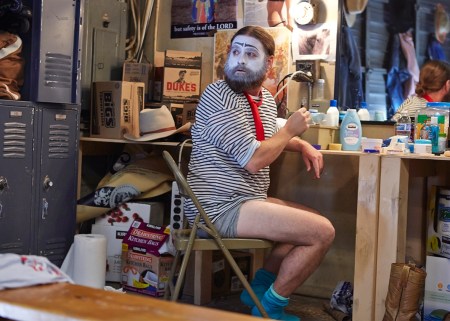
Louis C.K. eventually succeeded in getting an award-winning playwright to join his writing staff when he hired author of The Whale and A Bright New Boise Samuel D. Hunter to pen episodes of Baskets, a dramedy starring Zach Galafianakis that he produces for FX. Though far more conventional than Horace and Pete in form, Baskets nonetheless confounds expectations of tone for a series which led strongly with broad physical comedy before existentially breaking down each of the absurd characters. Hunter’s episodes go a long way towards this analytical deepening of the (sometimes literally) massive stereotypes established in the opening episodes.
Stage 2

Orange is the New Black writer Jordan Harrison is also a renowned playwright, with Pulitzer Prize finalist Marjorie Prime under his belt. It’s interesting that a playwright concerned with digital technologies which change human-machine relations should be involved with a series that’s at the cutting edge of the electronic televisual experience. Having seen the play along with his Amazons and their Men, I can see how (for better or worse) the clipped art of TV writing has affected his theatre pieces, with both feeling like they cut away from a scene too early or, more importantly, that they need follow-ups.

Gina Gionfriddo is the playwright of Becky Shaw and Rapture, Blister, Burn. She also wrote for Law & Order and Cold Case. Given the obscenity and offensiveness of her plays, it’s a safe bet she had to self-censor when it comes to satisfying the still-draconian standards of network television, at least where words were concerned. However, if you follow John Mulaney’s thinking (and who wouldn’t?), the two procedurals with their graphic depictions and explications of heinous crimes would be the perfect dwelling place for a writer concerned with the underside of human behaviour. But these are by no means pioneers.

The play format of early American television resulted in the employment of writers who both came from and subsequently went to the theatre, including Horton Foote, Tad Mosel, Paddy Chayefsky and Reginald Rose. Much of the immediacy we still associate with television came from it being written as a live, continuous experience by theatre-savvy artists in those years. Even when TV eschewed theatrical trappings, playwrights continued to enter the medium, such as Neil Simon, who worked on comedy vehicles for Phil Silvers and Sid Caesar in the late 1950s. Simon would later theatricalize this for Laughter on the 23rd Floor.

Stage 3

While we’re used to talking about writers from the movies coming to TV, we’ve traditionally overlooked stage playwrights who moonlight in the medium. In the 1980s, another Pulitzer Prize-winner David Mamet, author of American Buffalo and Glengarry Glen Ross, was ahead of the game when he penned an episode of the transformative cop show Hill Street Blues, before following this up decades later with military drama The Unit, which he co-created with Shawn Ryan of The Shield. The Hill Street Blues episode was before Mamet made the jump to cinema and well before great writers flocked to US quality TV. It’s easy to see playwrights who come to TV as Greek Gods who deign to push us mere mortals in the right direction, but the truth is much messier and speaks to exchanges of ideas between the two art forms which have always been around and are still in development.



The Schmidt Girl

Posted in American TV Shows, Behind-The-Scenes, Internet TV, Reviews, Uncategorized with tags , , , , , , , , , on May 10, 2016 by Tom Steward

Netflix is a revolution in television delivery, but the same can’t be said for content. Until very recently, that is. The ability to watch an entire season of a program as soon it was released made dramas like Orange is the New Black and House of Cards seem tremendously interesting and complex. But if the same derivative, underwritten and overacted series were offered as weekly recurring fare, they would simply never invite comparison to the original dramatic achievements of HBO, FX and AMC (ranked in order and not accidentally, by the way) or even video-on-demand rivals (and successors) Amazon Prime and Hulu. But now Netflix has something that can genuinely rival the very best of television. It’s not a drama nor did it begin life on the web. In fact, it’s a series that remains indebted to its pre-history as a major network show and its esteemed lineage in television.

unbreakable

Mr. and Mrs. Robot

Unbreakable Kimmy Schmidt is a sitcom originally developed by NBC that was eventually sold to Netflix following concerns about the network’s intentions for and confidence in the project. Created by 30 Rock alumni Tina Fey and Robert Carlock, it also features many of the cast from the endlessly brilliant sitcom that savaged the world of network television. Part of the success of Unbreakable Kimmy Schmidt is its elevation to star billing of actors who were bit players in NBC’s now sadly-burst bubble of sitcom genius in the noughties and its strategic placing of the legends of that era on a dream subs bench of scene-stealers. Ellie Kemper, who played the naïve receptionist Erin in The Office, is the titular character here, and Titus Burgess, seen as PA D’Fwan in the weak Bravo parody episodes of 30 Rock, looms large as roommate Titus (Andromedon) with Tina Fey and Jane Krakowski foils.

Whoever at NBC made Tina Fey look elsewhere for a home deserves a sitcom to be written about them but since Unbreakable Kimmy Schmidt was conceived within network censorship standards, it streamed on Netflix with little of the obscenity you might expect from a service that competes with unregulated cable and VOD. Again, this quirk is crucial to the appeal of the series. It developed a family audience because of its (surface) suitability to all viewers which only served to reinforce an already-existing sweet, sentimental streak that is much rarer in the adult sitcom domain than in network primetime. The calibre and reputation of antecedent 30 Rock precedes Unbreakable Kimmy Schmidt, but doesn’t eclipse it. As innovative and creative as it was, 30 Rock was looking back to something that had been lost, whether in TV or the culture, while its successor seems rooted in the problems of our times.

But Unbreakable Kimmy Schmidt builds on what 30 Rock did to make live-action sitcom a limitless art form, something that previously had only been achieved and been possible in animated comedy. Nothing is too far, near, high or low for Unbreakable Kimmy Schmidt. Cartoons, meta-musicals and puppets are not out of place here. Lowest-common-denominator gags and obscure, elitist sniggers sit side-by-side in a harmony that never looks imbalanced. There are a whole bunch of sub-worlds which permeate whole episodes and seasons, from a counter-factual Great American Songbook to realities intruding on other TV universes. Find me another sitcom that could make Mad Men’s Don Draper and The Reverend Wayne Gary Wayne the same person. And that’s before taking into account what the show has to say about the world we live in, be it auto-tuned viral videos of human atrocity or the ubiquity of Robert Durst as an urban pedestrian.

unbreakable 2

Mama Dolmio

So why do I think of Unbreakable Kimmy Schmidt as the bedfellow of series like The Sopranos, Deadwood or Breaking Bad? Sure, they all have sitcom-like elements but that’s not the reason. It’s because these shows are the only points of comparison for the kind of in-depth archetype-deconstruction, devastating cultural commentary, and sublime stylistic reinvention that Unbreakable Kimmy Schmidt achieves in the sitcom genre. The only antipathy the show has engendered has come with its sophisticated signification of social caricatures – mainly racial and ethnic – which, even though any shortcomings are quickly asked-and-answered, seem to convey actual racism to some viewers. Whereas typically such problems are a result of the laziness of the writing, in this instance it is a testament to how complex and multi-faceted the show’s representations of stereotype and cultural attitudes are. This is not sitcom doing good badly; it’s a sitcom raising the bar on what’s good.

On Your Marks…Set…HBO!

Posted in American TV (General), Behind-The-Scenes, Internet TV, TV channels, TV Culture, TV History with tags , , , , , on February 22, 2016 by Tom Steward

I hate to use the word adulting – primarily because it’s not a word – but it now seems that every major TV network in America has at least one program that is mature and sophisticated in content, execution or both (except NBC, who are labouring under the delusion that a Ryan Seacrest police procedural is somehow acceptable). It may be true that the best (non-pornographic) adult programming these days comes from basic cable networks like FX (Fargo, The Americans) and AMC (Better Call Saul, The Walking Dead) but that doesn’t mean they got there first. Subscription network – and Adam Sandler movie buyer – HBO has been adulting since the late nineties, when arty prison drama Oz and revolutionary crime drama The Sopranos heralded a wave of complex, experimental and provocative television that has yet to subside. This was politically and artistically reinforced by Six Feet Under and The Wire in the naughties, but overall the network that is an alternative to itself has re-defined just about every genre of TV you can think of, from post-feminist rom-com to news satire. But is it possible that HBO is finally entering a period of arrested development, and might that actually be a good thing?

hbo.png

Well, people would have liked it a lot more!

HBO now looks to re-define quality television for children, mostly by making parents pay – or wait – for it. Last year the network struck a deal with PBS to co-produce the  iconic educational television show Sesame Street so that the show would air first on the subscription-based provider and then on free-to-air TV months later. It’s perhaps the only time I can think of (maybe you can do better) that HBO has exploited an established commodity rather than making an improved version of it and it’s one of the few signature series the network has that doesn’t rely on obscenity to make audiences spend to see it. HBO has now added the football-themed Dwayne ‘The Rock’ Johnson vehicle Ballers to its roster of original series, which seems to be playing to the Fast and Furious-watching, sports-loving element of its demographic. Even a critic’s darling like Game of Thrones which is certainly distinguished by heavy and explicit levels of sex, violence and offensive language resembles the kind of mediaevalesque fantasy stories beloved by the nerdy young and is perhaps the first time that a HBO series with a continuous narrative arc has seemed more like a children’s matinee serial than a novel.

It’s rare that a HBO series goes over its audience’s head – though we all remember the debacle of John from Cincinnati – but last year the high-profile misfire of True Detective Season Two suggested that viewers weren’t always going to lap up the most extreme, idiosyncratic television that the network could produce. Vinyl is just beginning but it’s hard to see where this Scorsese creation detailing the record industry of the seventies will go in exploring the organized criminal elements of historical American leisure that Boardwalk Empire didn’t. The network has cancelled Looking and put a time limit on Girls, which will curb its claim to have the most socially incisive, funniest and best-written comedy-dramas on TV. If it is to continue its unwritten policy of having a maximum of six seasons of every show, then we know that Game of Thrones can’t last much longer, though the saga’s literary predecessor suggests otherwise. So what is the future of HBO? Will the network start to polarise its appeal by producing television that is either infantile or avant-garde, with nothing inbetween? Perhaps the open access of HBO GO and HBO NOW is doing something irrevocable to the adult remit of the network.

hbo 2

‘Finish the series, George, I have indie movies to make!’

I’m sure many have written these ‘death of HBO’ articles before, and I’m sure they were as premature then as this is now. But I’m worried about the point of HBO changing, not the quality. Game of Thrones is wonderfully compelling and I admired True Detective a great deal, but at its best HBO always gave us innovative, game-changing television that never seemed too slight or too weighty. That balance may be in jeopardy as HBO diversifies into a Netflix-style online video service, or perhaps FX and AMC have found the mean when it comes to quality television, without needing to resort to pornographic shock tactics or take too much cash out of viewers’ pockets. Last Week Tonight and Silicon Valley suggest that a change in direction is not necessarily a bad thing, and that HBO is still finding the best people and concepts in television. But for how long?

I Capture The Castle

Posted in American TV (General), American TV Shows, Internet TV, Reviews, TV Acting, TV History, Watching TV with tags , , , , , , , , , on December 7, 2015 by Tom Steward

Delivering seasons of TV programs through internet streaming has made writing a conventional review an even more fruitless enterprise than it already was. It’s impossible to determine – or even average – where those watching a season currently are in the run of episodes and it’s possible that they’re already done with it. A review makes no sense in either context. For want of a better solution to the futility of internet TV journalism, I’ve decided to formulate my response to Amazon Prime’s original series The Man in the High Castle as a list of what I’ve learned from the first season:


Who do you think you are kidding Mr. Churchill?

Who do you think you are kidding Mr. Churchill?


  1. The program doubles as an instructional video showing employers how to treat Amazon workers.


  1. There is no ‘Reich’ pun beyond the writers.


  1. I learnt what happened in the post-war world by the show telling me what didn’t happen in the post-war world.


  1. You will say the words: ‘I want Hitler to come back’.


  1. In a parallel universe where Philip K. Dick didn’t exist, people would have a lot less respect for Ridley Scott.


  1. I am still not convinced that the Trade Minister isn’t Hiro.


  1. South America is now a haven from Nazis.


  1. There is a moment where you will believe that Hitler’s apocryphal ‘one ball’ will become a plot point.


  1. The opening sequence is like Dad’s Army on rewind.


  1. There are British spies in The American Reich.


  1. All it took to teach Rufus Sewell restraint was playing a Nazi.


  1. It contains the best scene of an African-American man teaching a dwarf to fish outside of an epilogue of Walker, Texas Ranger.


  1. Berlin is still cool.


  1. We’d have had colour TV a lot sooner if the Nazis had won.


  1. Hitler must have been really affected by post-war European art cinema since he now prefers avant-garde documentaries to American B-movies.


  1. In Japan, morality is measured in spectacle rims.


  1. The Man in the High Castle is not Julian Fellowes, though they share a lot of the same political views.


  1. Hitler is way ahead of home theaters.


  1. The Smith & Jones sketch outlining the five Nazi General archetypes is still the standard for all screen portrayals.
  1. It’s basically Sliders.


Bad Morning Television

Posted in American TV (General), American TV Shows, Behind-The-Scenes, BiogTV, Internet TV, Reviews, TV advertising, TV channels, TV History, Watching TV with tags , , , , , , , , , on February 18, 2015 by Tom Steward

It was upon returning to my hotel room at 5 in the morning after seeing some of the best and oldest bluesmen in Chicago and celebrating the existence of an L-train with a trip to a 7-11 to get some cheese-filled-bread (or bread-filled-cheese) with a side dish of whatever was left on the room service tray a few doors down and being confronted with the blurry, blobby outline of Tony Danza that I came to a grave realisation. In the land of 24-hour business, late licensing, and all-night dining, there’s nothing on TV in the middle of the night. So why have two major TV events recently debuted in the early hours of the morning?

Last November the comedy short Too Many Cooks aired around 4am during the infomercial block on Adult Swim, the late night version of Cartoon Network. A parody of both the opening credits of 1980s sitcoms and the insanely dark and genre-bending possibilities of TV comedy in that decade (and before you dismiss it as exaggerated, remember that ALF was dissected by the government in the finale), Too Many Cooks became a viral video smash and was repeated each day at midnight for the next week. The perverse choice of a graveyard slot more or less guaranteed the short’s success, not only because re-run and internet re-circulation was necessary, but also because there was no competition.

Adult Swim seemed to cotton on to the fact that there’s an undiscovered country of television between the hours of 1 and 6 in the morning. I understand why they’d want to be the pioneers, but I don’t understand why there’s not a frontier-style rush to claim territory from every other producer in TV. If the entertainment market is so damn saturated, why not get a head-start by putting out your show in the vast wasteland of unused hours in the TV day? For once, having a variety of media platforms to re-play TV on is a blessing, since audiences will need and want to see your show again once they hear they’ve missed out.

It’s surprising that the networks haven’t come to these conclusions already, since they’ve had such great success by pushing their best programming later and later in the evening. The 11 o’clock talk show is an institution that has spread to virtually every channel in the schedule and their midnight sister programmes aren’t far behind. This weekend NBC celebrated 40 years of Saturday Night Live (ironically on Sunday and in primetime), a show which begins at 11.30pm and runs to 1.30 in the morning. This isn’t, as I once thought, because Americans stay out or go to bed later, but because it’s untapped resources. In Britain at this hour, they start playing movies starring Eric Roberts.

And what if you actually need to bury a show? There was surprise in early February when FXX aired a pilot for a series based on the popular Wheel of Time fantasy novels by Robert Jordan at 1.30am. Not only do the books have a huge fan-base, but with Game of Thrones still going strong, there’s a deep well of fantasy (probably with a goblin in it) that everyone in TV can draw water from. It soon became clear, however, that the air time wasn’t a stunt to get the show ahead of the competition but to keep it firmly under the radar, being the best all-round solution to legal issues facing such a project.

The television rights to the books were to revert to a new owner on February 11 (two days after airing) and so the previous owners were probably trying to get something based on the books out on TV before that happened. Author Jordan’s widow has contested the claims of the producers to the rights and they are threatening legal action. Interestingly, FXX were able to offload responsibility by treating the pilot as ‘client-supplied programming’ i.e. an infomercial. If you’ve got a show mired in legal trouble, 1.30 in the morning is clearly the place for it. The Wheel of Time pilot used the early-morning hours as a dumping ground for toxic material but it still shares similarities with Too Many Cooks’ deployment of late TV.

Both programmes traded on the idea that anyone watching at that hour can’t be sure of what they’ve seen; one for comic effect, the other for legal protection. With each one, being mistaken for a promo or infomercial actually helped. It makes financial and creative sense. Why still the hesitation?