Archive for the Reality TV Category

Equal Opportunity Knocks

Posted in American TV (General), American TV Shows, Behind-The-Scenes, British Shows on American TV, Reality TV, TV advertising with tags , , , , , , , , , on March 25, 2015 by Tom Steward

If there’s one thing Dancing with the Stars is in dire need of – apart from a decent house band, a competent co-host and, y’know, stars – it’s an equal opportunities seminar. I don’t know how many sensitivity courses you’ve been on, but they’ll all tell you (and if they don’t you should) that equality isn’t about treating everyone the same. One of the best teachers I ever had, the film writer and sociologist Richard Dyer, once explained equality to me using male and female public toilets. Men rush in and out, while women take longer. So while giving men and women a bathroom each with the same number of facilities might superficially seem to be giving them identical resources, the sexes are not being treated equally.

I'll give it 5.

I’ll give it 5.

This struck me two seasons ago when Judge Len Goodman told contestant Amy Purdy, who has prosthetic limbs below both knees, that he was going to score her like everyone else in the competition, and that she’d prefer it that way. For the entire competition, Purdy was judged against able-bodied dancers (and Billy Dee Williams) rather than on a scale of achievement that befitted her unique body type. It wouldn’t have been easy for the judges, especially as Purdy herself kept changing the rules of what was possible with her body week by week, but they never had any intention of taking her different abilities into account. To not even attempt this, and to assume Purdy wanted this kind of judging, is to ignore equality.

The Judges have continued to score disabled contestants in this fashion, even when they are physically prevented from competing at the same level as the other dancers. This season features Noah Galloway, who has both his left leg and arm missing. While the Judges are happy to gush and cry for the cameras over Galloway’s overcoming of the odds (and he’s a veteran too, so nothing but conspicuous sentimentality will do), they give him decidedly average scores, reminding us that that they are painting two more limbs on his body in their minds. The Judges’ rhetoric seems to have some idea of how equality works. Carrie Ann Inaba talked of how Galloway ‘challenged’ her judging. But there’s no evidence of this in the competition itself.

But Dancing with the Stars is already a show that seems designed to give Shami Chakrabarti nightmares. It asks people of different ages, genders, bodies and professional dance experience to compete against each other, with no consideration given to how there should be different judging criteria for each group. Doubtless there is some ideological undercurrent of the cream rising to the top regardless of adversity here and whoever said entertainment was a level playing field? However, if the show wishes to bask in the glory of giving a national TV platform to minorities and a diverse range of people (as it has referred to itself doing on several occasions) it cannot simply work around the fact that democracy is just as much about positive discrimination.

I’ve talked about the show’s objectification of female bodies before – and it’s getting no better – but in recent weeks we’ve actually seen feminist perspectives on Dancing with the Stars being written off live on air as ‘cyber-bullying’. Contestant Charlotte McKinney received harsh criticism and, let’s face it, personal abuse from social media after the star of sexist Carl’s Jr. commercials appeared in the season premiere. Her experience was the basis of the pre-dance ‘package’ (although why we have to all use the industry term here, I don’t know) in Week 2 and following her dance, the negative Twitter comments read-out on air were all dismissed as body jealousy by the judges Julianna Hough and Bruno Tonioli and then as body fascism by co-host Erin Andrews.
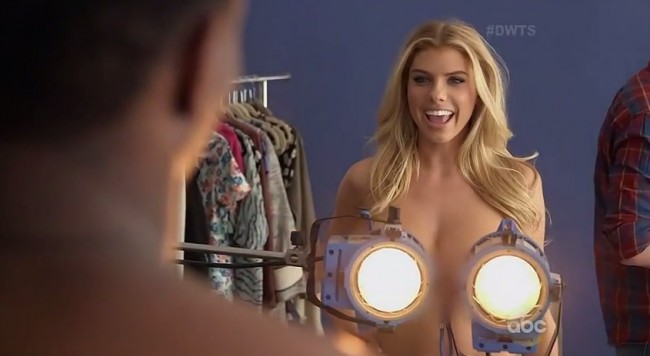
Benny Hill guest-judges on DWTS!

Benny Hill guest-judges on DWTS!

Now, I’m not saying that the sinister forces of the internet comments feed weren’t at work here and I don’t approve of targeting someone who is as much a victim of the sexist culture as the women it leaves out (as opposed to, say, the people who sit down and write the Carl’s Jr ads). That said, it’s clear to me that many of those comments, however personally directed they were, were aimed at McKinney’s participation in advertising that demeans and degrades women, and to disregard all the criticism directed at her as troll-grudge is to silence a protest against television’s ongoing celebration of women as sexual objects. Dancing with the Stars cannot continue to swim in these choppy waters without changing its body politics.

The Apprentice’s Apprentice

Posted in American TV (General), American TV Shows, British Shows on American TV, Reality TV, TV channels, Watching TV with tags , , , , , , , , , on March 11, 2015 by Tom Steward

‘Don’t it always seem to go, that you don’t know what you’ve got ‘til it’s gone…’

I’m quoting Joni Mitchell not (only) because I’m reading Morrissey’s autobiography and have the urge to paste song lyrics into prose when I’ve run out of things to say but rather as a description of the way I feel about The Apprentice. It’s rare in our culture to prefer the re-make over the original but even rarer that we admit to preferring another country’s version of an idea to ours, regardless of which came first. It’s this paradoxical thinking that draws me to the BBC adaptation of The Apprentice and makes me resent the NBC original. Now that I live in America, the latter is my bread-and-butter and the former feels too distant from my daily existence to be relevant viewing anymore. As I sit writing this on a winter’s day with the sun beating my back, I don’t ask for sympathy. But I do rather feel like the person who bought the last painting before they discovered perspective.

From the arse's mouth!

From the arse’s mouth!

Like most shows sold overseas, the format remains largely unchanged. But there’s something about the translation of American corporate-speak and aspirational diatribe into the laughably misjudged self-esteem of Britain’s business classes that gives The Apprentice on the BBC an ironic quality which bends a celebration of capitalism into a critique of the ideology. Goebbels once said that no-one could watch an Eisenstein film without becoming a communist. Well, I severely doubt anyone could sit through an episode of UK version of The Apprentice and still think capitalism is going to last. It’s not hard to believe we have economies based on nothing because The Apprentice UK tells us the people who front it are never less than vacuous. While the American original has the product placement and commercial saturation of a major US network in its arsenal, the BBC version is broadcast on a British public service station which prohibits advertising. The former is mired in a web of cross-marketing, while the latter seems inhospitable to the idea of a TV programme as a commodity.

Go waste the President's time instead...

Go waste the President’s time instead…

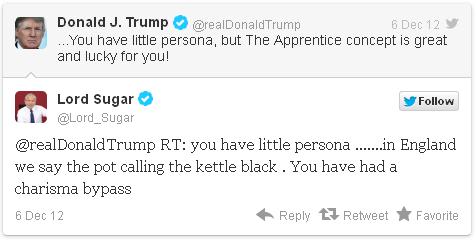
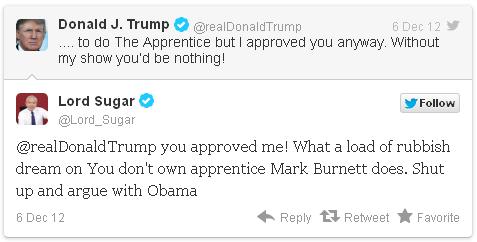
This is not to say that The Apprentice UK is some sort of subversive attempt by the imagined leftist conspiracy at the BBC to undermine British entrepreneurship. It’s more accurate to call it ‘private service television’, a mode of broadcasting addressed to a society dominated by privatised industry and designed to make the best of it (even that is being a touch generous!). But neither does it use its airtime to consolidate a corporate empire through media exposure, like its forbearer. The Donald Trump Apprentice never misses a chance to tell you how powerful and glorious the various business enterprises of the Trump family are, whereas the Alan Sugar counterpart (which sounds like the greatest 80s garage band that never was!) makes his company look like a loosely connected network of 1940s-style spivs and barrow-boys. The tasks assigned by Trump are publicity-centric busywork (especially in the current Celebrity variant) but Sugar’s are about the hard graft of street selling and face-to-faces with customers. You’re the apprentice of a swindler learning how to avoid being swindled.

Sugar doing my job for me!

Sugar doing my job for me!

Perhaps this is because ivory-towerism doesn’t sit so well with the British public, while it taps into the ultimate aspirations of many Americans. The British version is certainly not intended as satire (though the directors do like to puncture with visual gags anyone who takes self-assessment as business elites too literally) but it is playing to a crowd who like sarcasm, wit and darkly awkward comedy. Sugar and his associates are fans of linguistically inventive cruelty, the directors eek every ounce of uncomfortable voyeurism out of the documentary filming (in a style borrowed from pioneering UK sitcom The Office), and the show itself is framed as a sadistic prank played on those who applied to appear. It’s marginally better now the prize is a sizeable investment in a business venture a la Dragon’s Den/Shark Tank (delete monster and monster holding cell as appropriate) but I remember when winners were rewarded by an internship at a digital signage company amid the electro-magnetic subjugation of Tottenham Court Road. Somnambulist losers of Touch the Truck have it better. No-one expects Donald Trump to say anything intelligent, funny or creative (even his racist metaphors lack flair) and the verbal garbage emerging from the Ridley Scott-alien mouths of his children is a generation stupider. Mavericks are praised not parodied and the mere act of aspiring is deemed worth the risk.

Thai TV

Posted in BiogTV, Internet TV, Local TV, Reality TV, Touring TV, TV channels, TV Culture, Watching TV with tags , , , , , , , , , on February 4, 2015 by Tom Steward

I’m sure Thai people are as baffled that we spend our evenings watching millionaires shoot ducks (I’m talking about both Duck Dynasty and Downton Abbey here) as I was with some of the curious and absurd programmes I saw in the country while I was visiting last month, so please take what follows with a pinch of cultural relativism. As I’m pig-ignorant about much of Thai culture, I’m going to stick with what I know and talk about Thai TV’s engagement with English language and culture.

Ridiculing Southeast Asian television is a rite of passage for popular TV critics. In my childhood, there were at least two (probably more) shows like Clive James on Television and Tarrant on TV where westerners who should know better giggled and guffawed at clips of Japanese game shows (now British TV from that era is our source of the very same mockery). I’m not much interested in this glasshouse criticism – though it’s hard to let go of the Thai TV show where they did nothing but pick up pens for half-an-hour – but I still have that same voyeuristic fascination as those orientalist broadcasters did when I was watching Thai television on my recent trip to the country. Bizarrely (though maybe not to Edward Said), it’s those moments of overlap with the English language and culture that are the strangest.

A case in point is English Delivery, a primetime educational programme using the comic talents and general enthusiasm of its hosts to teach English to viewers, and teach it well. It not so much about learning English words (and my limited experience of Thai people suggests they already know a lot) but getting the drop on misunderstandings resulting from translating Thai into English. To wit, the hilarious consequences that might ensue from confusing ‘pig’s balls’ with ‘pork balls’. As you can see from the examples they use, it’s more about conveying aspects of Thai culture to English speakers so they can understand it than learning about the culture or customs of English-speaking nations. That’s more than likely because so much of the Thai economy depend on tourists who speak English, or those that speak it so they may be understood by Thais.

I’m not saying that Anglo-American culture (well English culture, well English sport, well English football, well Manchester United) isn’t a big deal in some parts of Thailand, like Bangkok where we visited, but more often it feels like a policy of ‘do what you want…but give it an English name’. I was alerted to Don’t Lose the Money because I could read the title (and even when I know the Thai word it often isn’t recognizable in writing) but the show itself was simply a succession of contestants running back and forth between piles of money and empty boxes trying to carry one to the other with the use of head magnets. Increasingly we have game shows like this but we ruin their uncomplicated fun with ironic snark or over-complicated rules, or Richard Hammond.

I wasn’t surprised that when we got to the touristy island of Ko Samui there was so much European and American TV in our hotel satellite services. What did take me by surprise was the exchange of movie channels like HBO and Cinemax for a feed of someone’s laptop playing jittery, low quality streams of recent American blockbusters simply called ‘Island’. This became increasingly evident when we would return to our room to find a Windows shutdown message on the screen, and we knew exactly how long each movie had run for because whichever tech-savvy teenager was running it left the arrow and all the player information on the screen. With the trade in pirate DVDS they do in Thailand, it makes business sense.

HBO Thailand!

HBO Thailand!

Not all my jarring experiences of watching Thai TV were in English. At certain, seemingly random, points of the day, whatever was on TV was suddenly interrupted by choirs of fidgety schoolchildren singing in tribute to ‘The National Council of Peace and Order’, which is the name by which the military junta that has run Thailand since mid-2014 goes. It’s a startling reminder that you’re in a country under military rule, something G and I didn’t get a sense of as tourists – until we went to places where military officers were being served and the waitresses reacted like they were all Justin Bieber – and that TV is still (overtly) a propaganda medium in many countries. Come to think of it, the titles were in English.

Home Movies

Posted in American TV (General), Reality TV, TV channels, TV Culture, TV History, TV News with tags , , , , , , , , , on January 7, 2015 by Tom Steward

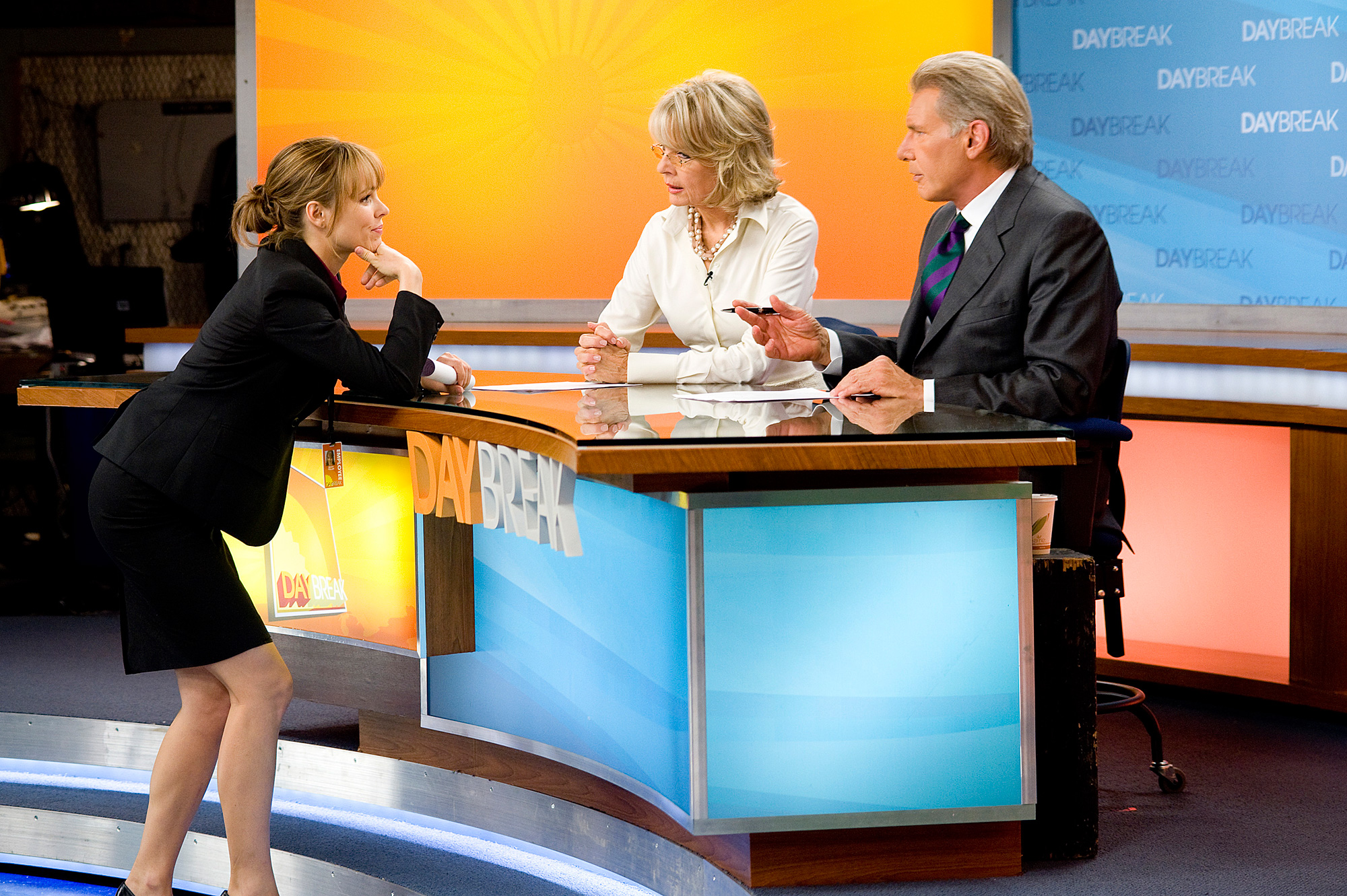
Though I’ve devoted the last decade of my life to television (in both work and play!), movies were my first love and they’re still at the heart of what I write and do. Consequently, I’m often asked what the best movies about television are. I’m always unsure what I’m supposed to evaluate; the quality of the movie or how well it deals with TV. The two very rarely go together. For instance, my first instinct is to say Morning Glory, a mature TV news satire that neither skirts around the rampant commercialism of American television nor uses it as a brush to tar the medium with. But the acting is regularly terrible, the (non-TV related) storyline lousy, and the ham-fisted direction really kills the comedy. But as a movie about television, I infinitely prefer it to the pious nostalgia of Good Night and Good Luck and TV writer Paddy Chayefsky’s glorified revenge pic Network, as superiorly artful as those two films are. So I was conflicted in my feelings about the TV news thriller Nightcrawler.

...not to be confused with the porn parody of the same name!

…not to be confused with the porn parody of the same name!

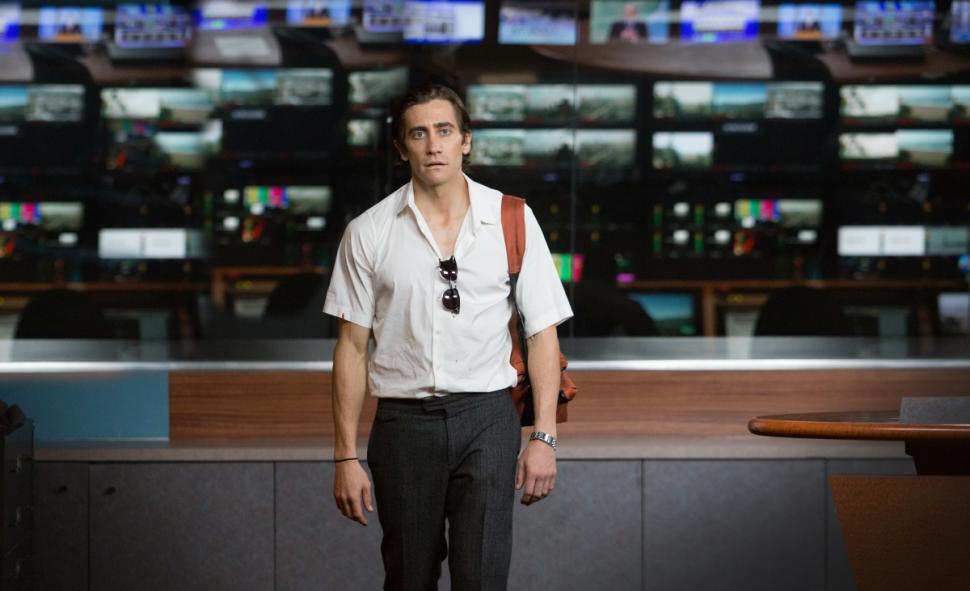
Both Jake Gyllenhaal and Rene Russo give remarkable (and remarkably unusual) performances. The script is utterly solid, something which cannot be underestimated in contemporary American cinema. The suspense elements are well-handled, and the photography mixes the best of cinematic vistas with the seedy beauty of urban photojournalism. I thoroughly enjoyed it, which is a rare experience for me in the cinema (seeing a new movie). I have no issue with the portrayal of American TV news, as it clearly is as base, gruesome and sociopathic as the movie suggests, and just as culturally defunct and laughably moribund. But it’s a narrow view of television that is loath to admit the frequency with which contemporary TV beats out cinema for complex drama and art and unfairly highlights its tabloid extremes. It also suggests that the capacity for TV to be live (not that it really ever is anymore!) is a crutch to its expression that makes TV necessarily artless and sensationalist. But as far as movies about TV go, these kinds of representations are old news.

Movies about TV almost always focus on the production of non-fiction (typically news), stress the live aspects of television broadcasting (regardless of how live TV is at any given historical moment), and never fails to mention any quality of the medium that might situate it as inferior to cinema, like its commercial interruptions or diminished screen size and image quality. Comment me if I’m wrong, but all movies about TV have at least ONE of these three typicalities. What’s also significant is how ahistorical this cinematic portrayal of TV is. You could understand it when TV was the new kid on the block and the film industry wanted to play up the disparity between fulfilment and experience in consumption of the two moving image media (although historians question whether we can ever see the two so separately). But it doesn’t really make sense when you consider that film and TV industries have for large swathes of their history been interrelated economically under dual or conglomerate ownership. What is the advantage of saying TV sucks then?

It’s not a riddle I’ve particularly solved, except that the mythmaking of movies depends so heavily on the distinction of the cinematic experience that it behoves the industry to promote the fairytale of exceptionalism in the face of overwhelming economic, technological and cultural evidence to the contrary. I’m pretty sure that hijacking the feeling of live TV in these movies derives from a kind of jealousy about the immediacy and presence that the medium can cultivate, as in Tootsie which go to extreme expository lengths to make a broadcast of the intra-diegetic soap opera live. With bigger, clearer home sets and smaller, digital ‘studio’ theatre screens as well as a parity of commercial content and product placement in both new movies and TV transmissions, cinema hasn’t a leg to stand on. It is, however, a strategy that boutique television networks also use to distinguish themselves from everyday TV flow, judging by the number of tiny, flickering sets we see on HBO and AMC shows in the service of dispensing an endless barrage of homogeneous crap.

Fishing for a story!

Fishing for a story!

It may be time for the movies to start acknowledging some of the realities of contemporary television. It wouldn’t be hard – just ask the many actors who now regularly moonlight between the two! TV is better than its news output and infinitely more interesting than its increasingly rare live transmissions.

The Rest Of The Year’s TV

Posted in American TV (General), American TV Shows, British Shows on American TV, Reality TV, Reviews, TV advertising, TV channels, TV Criticism, TV History, Unsung Heroes, Watching TV with tags , , , , , , , , , on December 31, 2014 by Tom Steward

There’s a formula for writing annual ‘Best Of’ TV lists. First it’s compulsory to observe how pointless a task it is making such a list for a vast and varied medium like television, then talk about how your criteria will be completely different, before naming the SAME EXACT shows as every other critic. Well, I don’t think it’s pointless, at least no more futile than doing it for books or films (where critics don’t seem to have the same anxieties about habitually omitting factual and lifestyle titles). I have no wish to create an opaque ratings system that will lead me back to shows which come pre-ordained as the best of TV. But I do want to ensure that the titles I choose won’t appear on anyone else’s list, something which gets harder and harder as critics begin to fawn over the nichest possible television. So don’t consider this the year’s best TV (see I’m doing it in spite of myself!) but rather good TV that has been overlooked simply because it doesn’t get listed.

Botched (E!)

...what if he dies first?

…what if he dies first?

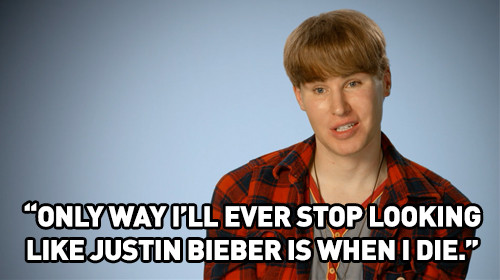
Real Husbands Dr. Paul Nassif (disguised as Moe Syslak from The Simpsons for ease of viewer identification) and Dr. Terry Dubrow (other two-quarters of Heather Dubrow, who must always be named twice) are L.A. plastic surgeons who specialize in fixing botched jobs. There’s some emotional hard luck stories but basically it’s the best excuse ever for social voyeurism and with patients like a Human Ken Doll and a 33-year old man with the face of an early-teen Justin Bieber it’s about as visually mesmerizing as reality TV gets. The show is also indispensable body horror, with its drop-in circus of malfunctioning and distorted anatomy. Even E’s glossification can’t mask the raw psychological distress.

90-Day Fiancé (TLC)

A show close to mine and G’s hearts, since I arrived in the US on a marriage visa. This observational documentary follows six couples during the 90-day window for visitors to the US to marry on the K-1 visa. It’s as compelling for its cartoon parodies of loving marriage as it is for reaffirming the borderless beauty of the institution. So extraordinary and bizarre is the experience for these culture-clash couples that the network barely needs to meddle in the melodrama, as it does for its other reality shows, giving it a more natural (if no less extreme) flow of real events than heavily devised TLC docu-soaps like Here Comes Honey Boo-Boo.

Muppets Most Wanted (Disney)

Variety at heart!

Variety at heart!

Probably more likely to be dismissed on grounds of not being a TV show, this was nonetheless the movie that in 2014 most thoroughly blurred distinctions between film and television. The Muppets are a creation of television, stars Ricky Gervais, Ty Burrell and Tina Fey are all television personalities, and the legacy of The Muppet Show is privileged at the expense of the movie franchise (the latter self-consciously in comic acknowledgements of the diegetic amnesia around popular movie characters and sequels). The movie is a joyous celebration of the achievements and talents of television past and present, reminding us of how far the medium has come. And it’s full of commercials!

LIVE With Kelly And Michael! (ABC)

A show that will doubtless elude recognition for its monotony and ubiquity, but this doesn’t change the fact that host Kelly Ripa is by several miles of open country the funniest, smartest, wittiest and most multi-dimensional presenter in daytime. Her work in morning television is more akin to what Conan, Colbert and Craig Ferguson have done with the late-night form than the platitudinous moron-making of virtually everybody else on TV at that time, and until about 11 in the evening. This is an everyday occurrence, which makes it all the more startling, but her essential impersonation of Laura Linney in the Halloween parody of PBS Masterpiece Theater speaks volumes.

The Late Late Show With Craig Ferguson (CBS)

Not like any other late night show!

Not like any other late night show!

Dare I say that Craig Ferguson’s departure from late-night talk shows will leave an even bigger hole than David Letterman? While Letterman innovated within the format, Ferguson created a new late-night form that was genuinely subversive, avant-garde and experimental, importing a brand of British vaudeville surrealism reminiscent of Reeves & Mortimer and The Mighty Boosh. Like those acts, Ferguson meshed light entertainment with serious art, carved out an absurd fantasy using television grammar, and delivered alternative culture disguised as broad comedy. It was a rejection of all that was bland and formulaic about one of American TV’s most intransigent genres, and a complete reinvention of its possibilities.