Archive for the Reviews Category

Madvertising

Posted in American TV (General), American TV Shows, Reviews, TV Culture on May 28, 2013 by Tom Steward

Early in his career, artist Roy Lichtenstein produced a series of paintings based on advertisements. In one of the great cultural ironies of our times, advertising started appropriating Lichtenstein’s paintings. Something similar is going on with Mad Men. Actors best known for appearing in a programme about an advertising agency have now become the commercial spokespeople for major companies. Lichtenstein’s work was ambivalent about advertising, or at least not wholly critical of it, and Matthew Weiner’s Mad Men is equally equivocal. Yet advertising which trades off them makes it seem as if the artists were wholeheartedly in favour of it.
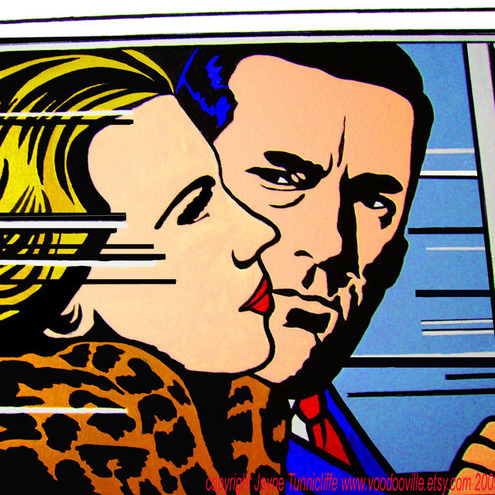
Why, Don, darling! This commercial of yours is a masterpiece. Soon you’ll have all of New York clamoring for Heinz beans!

The way Mad Men sits in relation to the commercials fronted by its actors varies. Christina Hendricks’s ad for Johnnie Walker Red Label recalls the hard liquor consumed by the executives (and 1960s Americans) in the programme, hoping consumers will ignore the repercussions of excessive alcohol consumption shown by the series and only remember how delicious the drinks look poured over ice. It tries to capitalise on Mad Men’s re-invention of classic American styles and fashions to give Johnnie Walker’s outdated brand a retro spin. Hendricks is key here, having customised a classic sex symbol body image towards contemporary desires.

Jon Hamm’s American Airlines commercials have a more complicated relationship with Mad Men. Not only was the airline one of the fictional agency’s clients in the series (the irony of advertising companies by having them as clients within the show hasn’t escaped me) but the voiceover seems to have been modelled on one of Don Draper’s presentations. Hamm’s Sartre-with-abs voice is a big part of why a description of air travel ends up sounding like a metaphysical treatise on the American condition. But Draper’s pretentiously existential monologues about beans and hubcaps are clearly the inspiration behind what Hamm is saying.

As with virtually everything in Mad Men, including mind-altering drugs, John Slattery aka Roger Sterling aka the reason for sticking through shit Mad Men episodes is the trailblazer. Slattery’s deadpan punchline-intoned delivery and Ted Danson-without-horse-parent looks graced Lincoln commercials in 2010. Although Hamm beat Slattery to the luxury car gig with his Mercedes-Benz voiceovers (reminiscent of the pissing contest between Roger and Don in the series) Slattery was the first to extend his Mad Men persona into advertising, and make it acceptable. This was a smoother transition for the actor playing Sterling, who viewers already love as a shameless sell-out.

There is another campaign going on here. These commercials work incredibly hard to repress Mad Men’s misgivings about advertising. There’s no doubt that Mad Men treats advertising as art, or certainly as creative, innovative and disciplined as any other medium of expression, but it always confronts the unscrupulous, amoral and inhumane behaviour of advertising executives and clients. Advertisers generally use TV personalities who symbolise a feeling or an idea that they want their product to capture. What Roger, Don and Joan represent are people betrayed, victimised and held hostage by lives of advertising. It’s almost as if the commercials are aimed at the people who watch Mad Men for the curtains and have extrapolated from this that it was a good time to be alive.
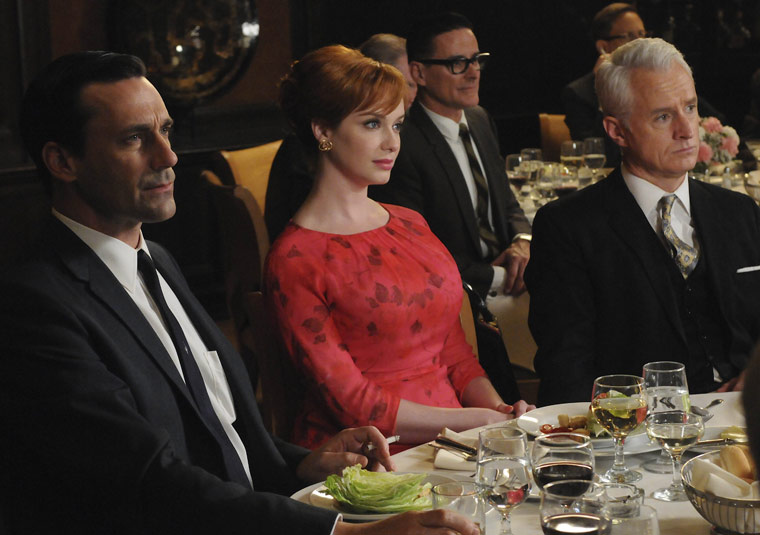
Not exactly an advertisement for a life in advertising.

This probably explains why the most overtly sexy and glamorous actors (and characters) in Mad Men are the same cast members who now feature in commercials. I’m including Peggy here, as Elizabeth Moss did commercials for drug Excedrin, even though the character is rarely sexualised or regarded solely for her beauty, as the ads dreamily play up her cute girlish qualities and gorgeous natural skin tone. You’re unlikely to see Harry Crane hocking Dolce & Gabbana frames or Pete Campbell becoming the spokesman for Regaine (any brands I’ve mentioned should feel free to send me complimentary gifts, but especially the last two!). It’s much harder to re-brand avowedly mediocre characters whose onscreen personas make them the opposite of sex appeal as icons of stylish goods.

American TV is unthinkable without sponsorship and Mad Men’s network AMC is not even one of those boutique cable channels-like HBO and Showtime-that can claim independence from advertisers. So really it’s perfectly normal for the commercial airtime of Mad Men to be filled with ads featuring cast members and for the programme to be sponsored by many of the companies that the executives in the show deal with on a weekly basis. But it’s also undeniably jarring to see an industry and a culture dealt with so ambiguously suddenly depicted in an unreservedly optimistic light by the very same faces.

Going out with a Clanger

Posted in American TV (General), American TV Shows, BiogTV, Reviews, TV channels, TV Culture, TV History with tags , , , , , , , , , , , , , , , , , , , on May 3, 2013 by Tom Steward

It’s official! The Office is now unwatchable. But since you can have this opinion any way you want on the internet-like eggs in a diner-I’ve decided against blogging about this (for the record, I blame hiring Catherine Tate, firing Mindy Kaling and too much Jenna Fischer) so instead here’s a rundown of some other US TV shows that tanked in their final season:

Catherine Tate giving an offhand lecture on how to ruin TV shows!

Northern Exposure-Season 6

A series about a New York doctor forced to take up residency in an Alaskan small-town should have conceivably ended when said doctor returned to New York. But when actor Rob Morrow, playing Dr. Joel Fleischman, wanted to leave the show, the producers decided it wasn’t the character, the performance or his rapport with the rest of the cast (including the driving-force storyline of Fleischman’s on-again-off-again romance with Maggie O’Connell) that was essential but the idea of a fish-out-of-water New York doctor in Alaska. It didn’t help that to ease Morrow out of the show the writers did a 360 on Fleischman’s character transforming him from a neurotic urbanite into a Zen wild man of the woods and that Maggie was soon randomly paired up with another of the show’s leading men.

Rob Morrow celebrates being allowed to wear a tie again

Seinfeld-Season 9

Don’t get me wrong I’ll happy sit through any episode of this final season of the groundbreaking sitcom and it’s not short of classic moments (‘Serenity Now!’, Festivus etc.). But two years after the departure of creator Larry David, much of Season 9 feels like a cartoon parody of Seinfeld, continuing to hit all the misanthropic notes that its creators insisted the show couldn’t do without (if not more) but without the easy-going naturalism of previous seasons. The storytelling relies far too much on fantasy rather than contrived coincidences, diluting the carefully crafted multi-stranded writing with lazy shortcuts. Though I’m not as down on the finale as some, the decision to make its second half a thinly disguised clip show following an hour-long tribute the previous week was deeply ill-advised.

Oh come on guys, it wasn’t that bad!

 Roseanne-Season 9

There isn’t space here to list all the mistakes family sitcom Roseanne made in its final season but here are some of the major gaffes. There’s no John Goodman. Imagine Lucy without Desi or Samantha without Darrin (the first one at least!). What’s more, Dan is written out of the show by Roseanne leaving him, which completely goes against the unshakeable strength of their marriage established in the previous 8 seasons. It makes what went before seem like a dream. And while we’re on the topic of dreams, there’s way too many of them here. Every other episode is an extended dream sequence, something we would previously get only once or twice a season. The storyline of the season is that Roseanne wins the lottery which hits the jackpot of bad sitcom ideas, the episodes are basically strung-together celebrity cameos, and the finale rivals Lost in the incomprehensible endings stakes.

I wish it had been a dream…rather than making the rest seem like it was!

ER-Season 15

Legend has it that the long-running hospital drama managed to maintain its quality of cast and writing right through to the end but those who actually watched those final few seasons-as opposed to rounding up from the first 12 years-have a very different story to tell. ER always prided itself on effectively replacing beloved cast members time and again. After all, this was the series that survived the loss of George Clooney. But by Season 15, there are no more heroes, admirable adults or esteemed actors left in the show but just a thin residue of the leftover comic sidekicks and kids, running around quipping and accidentally killing people like Bugsy Malone in a hospital. And when a series is relying on a revolving door of guest stars to fill the lead roles, it’s time to pull the plug.

‘Where did all the good characters go?’ 

Murder One-Season Two

Steven Bochco’s TV series are usually synonymous with longevity and the first season of this innovative courtroom drama which covered a single trial over 23 episodes set in motion a formula that seemed destined for ongoing success. And it probably would have achieved it had it not been for the series producers changing everything that made it great. Star and heart of the show Daniel Benzali was axed and replaced by Anthony LaPaglia, an actor with far less gravitas playing a character without the compelling presence of Benzali’s Teddy Hoffman. The season was no longer one trial but three, thus the unique selling point of the series was gone, and so was a reason for the audience to care.

We’re back…minus everyone you like!

America is Not Ready for Love

Posted in American TV (General), American TV Shows, Reviews, TV channels, TV Culture with tags , , , , , , , , , , , , , , , , , , , on May 1, 2013 by Tom Steward

G and I have the TV on while we’re working in the living room. Don’t worry, it’s not like we’re doing anything important like finding someone the perfect home or determining the future of local government. I look up thinking I must have been writing the last sentence for hours as the programme has changed. I put my head down again and before I know it we’ve moved on to something else. I ask G if she went through with the surgery to get the remote chip installed in her brain. It’s not scheduled until next Thursday. So what’s happening?

There should have been a question mark where Eva Longoria was.

We’re watching Ready for Love, NBC’s new dating show. Or rather we’re watching Blind Date and Take Me Out closely followed by The Bachelor and Millionaire Matchmaker. It’s shopping mall television; all your favourite programmes under one roof. Unfortunately, the storeroom’s empty and the stock’s limited to what you see in the window. Each sequence is edited briskly in order to cram in all the various formats and create the illusion of pace in a 2-hour show. So what the viewer actually gets is a severely truncated cut-down of a pre-existing format that’s barely recognisable and lacks the original’s appeal.

Name the dating show…all of them!

In scenes eerily reminiscent of Invasion of the Body Snatchers women are delivered by pods into a studio. A man is then introduced via a video segment done in the style of a Just-for-Men commercial. The man is brought into the studio but cannot see the women and has to judge compatibility from their words, though superficiality has already been applied at the screening stage so no body-type surprises here. The podspawn that are not eliminated (apparently by incineration in the basement) are then imprisoned in a house together awaiting date-release and then the one with a personality goes home.

The women of the pod!

Periodically, the contestants are mentored by a panel of matchmakers, one of whom is played by a graduate Harry Potter interning at a stockbroker firm. Their advice is uniformly terrible, steering the women away from genuine self-expression and the men from picking a partner with a modicum of self-respect. At least the matchmakers on other dating programmes pay lip service to the contestants not picking women based entirely shallowly but here individuality is ruthlessly pruned like a weed.

What Harry did next…

NBC has already announced that it will cancel Ready for Love after only 3 airings. I’m no fan of snap cancellations nor the increasingly chop-happy actions of the networks but when a programme is so shamelessly derivative and cynically leeches off the success of other formats without putting anything new on the table, it is richly deserved. There is also something deeply offensive about continuing to promote the harem approach to dating. While the dating show is no stranger to giving a man his choice of women with no recourse in the other direction, Ready for Love does this unthinkingly.

‘Have the women incinerated’

I’m fully aware Ready for Love didn’t start the balls rolling on the sister-wife format. Though The Bachelor, from which this tradition sprung, had the good grace to turn the tables with The Bachelorette where men get the cattle market treatment. I know mutual exploitation isn’t exactly progressive gender politics but it’s better than dick all. Millionaire Matchmaker in which women are routinely subjected to the kind of bodily scrutiny one would typically see at a slave auction is still a reporting of what happens within an industry where women are demeaned, even if the producers don’t comment on the abnormality.

The Bachelorette: both genders exploited!

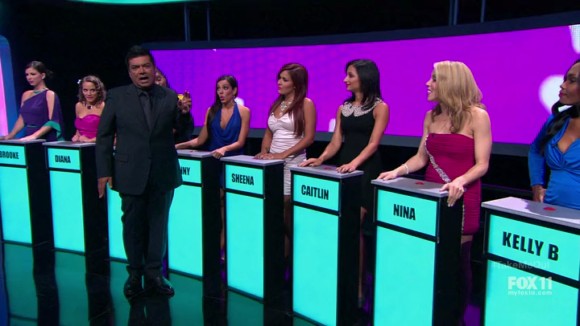
Take Me Out is another dating show where women outnumber men but for much of the process women have the upper hand even if the power of selection ultimately reverts to the man. Ready for Love seems to have no such compunctions and seems to want to add to the surplus of single, unfulfilled women left by dating shows as they whizz through the contestants with ruthless efficiency. It’s just as unforgiving for women who express qualms about how appropriate the format is for forging a healthy relationship. If you’re not willing to pander to male ego, please step aside.

Take Me Out: where women are in control…most of the time.

Though TV may seem like a sausage machine of recycled formats at times, the truth is that programmes which simply imitate other shows without useful variation will always fail miserably. Ready for Love didn’t make an argument for why it should be watched instead of its forbearers, except convenience and bulk buying, which given that the viewer doesn’t have to travel more than a few channels, isn’t really a selling point.

That Was The Week That Was Ass

Posted in American TV (General), American TV Shows, Reviews, TV channels, TV Culture, TV News with tags , , , , , , , , , , , , , , , , , , , , on April 22, 2013 by Tom Steward

Apologies for the extended break from posting and thanks for continuing to read the site in my absence. I took the last couple of weeks off while G and I got married. However, there’s been no shortage of stories about TV in America since we went away so don’t expect a quiet first day of term. We resume with a post on the TV coverage of the maelstrom of tragic events that devastated the USA over the past seven days:

It’s been a shitty week in America. Last Monday bombs went off at the Boston marathon killing 3 people and injuring over 150 more. On Wednesday, the first round of gun control reform legislation tanked in the Senate. On Wednesday night, an explosion at a fertiliser plant in Texas killed 14, injured around 200 and destroyed 50 homes. By Friday, Boston was in a state of lockdown as armoured tank police vehicles searched the city streets for the outstanding bomber, Dzokhar Tsarnev, who had escaped custody following a battle the previous night with police that killed brother and collaborator Tamerlan.

Three dead as bombs explode at the Boston marathon last Monday.

How did TV cover the seven-day shitstorm? Well, while a number of entertainment shows such as Live with Kelly and Michael and Conan expressed compunctions about peddling amusement in the wake of the Boston bombings, news programmes seemed to have no obvious qualms about this. News reporters constantly reminded viewers how exciting the events unfolding in Boston were, as if the city had been collectively entered in a catch-the-terrorist role play game. ABC news anchor Diane Sawyer at one point thanked a reporter for her ‘thrilling’ coverage of the aftermath like she was Ben Affleck at an Argo press conference.

ABC World News: ‘Entertainment with a Hint of Fact’

On Tuesday, CNN pulled a CNN and falsely reported that an arrest had been made in connection with the bombings despite official denials. The cable news network had been under fire in recent weeks for its misreporting of the Steubenville rape case and now seems to have moved on from doubting moral and legal verdicts to blindly ignoring empirical fact. Later in the week, while covering the hunt for Dzokhar Tsarnev, CNN reporters seemed to suggest that the lockdown was voluntary, ignoring the tanks patrolling Boston neighbourhoods which gently hinted to residents that it was probably wasn’t a park day.

CNN pull a CNN!

To give them their due, CNN were once again the lone voice of reason when it came to the reporting of gun control following Wednesday’s senate debacle. I’m talking of course about Piers Morgan, who has repeatedly slammed President Obama’s inability to mobilise the gun control lobby and exposed the NRA’s hold over senate voting, and was entirely vindicated this week. To offer some cultural perspective, Piers Morgan is known in Britain for being a dick. Yet in the bizarro world of American TV news, his smug, unremitting self-righteousness somehow twists its way into being the perfect conduit of outrage.

Piers Morgan: smug, self-righteous and…right in this case.

Just when it seemed as if it could get no worse for the USA, it did, and the TV coverage followed the downhill gradient. After the Texas fertiliser plant exploded, news channels once again oohed and aahed over the spectacle and somehow managed to disproportionally report an already heinous disaster as an apocalyptic catastrophe. Fox’s ‘Breaking News’ coverage sat back and admired the epic visuals of nuclear mushroom cloud-like smoke and giant soaring fireballs in viewers’ photos and videos, offering aesthetic judgement and firework-display awe rather than the information necessary to understand the localised explosion that these images related to.

But nothing could take screen time away from Boston last week. On Thursday, the networks’ morning line-up was pulled for coverage of a memorial ceremony for the victims of the marathon bombings in which Obama gave a eulogy. It was the kind of heartrending, preacher-style oratory that made the president look powerful again instead of the lame duck frontman (think Bez with missile privileges) this week’s vote confirmed he was. I’m sure Obama’s speechwriters were grateful events took place in such a culturally and historically prominent city and not some backwater small-town where the annual highlight is a vegetable festival.

TV newspeople set up camp on the streets of Boston and no straight-to-air programme could go without some sort of mention of Monday’s bombings. Given that the bombings were more exceptional and containable and less devastating in terms of lives and infrastructure destroyed than the explosion in Texas, why did it get so much more air time? Well, American TV is a largely local animal and the marathon was attended by runners from all over America, making it relevant to a larger number of regional news programmes. Plus, more people on TV seem to come from Boston than West, Texas.

Explosion at Texas fertiliser plant last Wednesday.

But the main difference is in the news story that results. Texas was an instantaneous disaster that left nothing for follow-up coverage. It exposed systematic failures at a federal and local level. Boston was the explosion that kept on exploding, first the hunt for the bombers, then the capture, then the escape, then the re-capture. And law-and-order eventually triumphed. It couldn’t have played better if it were an episode of Dragnet and intrigue was maintained across the week like a soap opera. Interest in West, Texas dwindled faster than in Smash weand ended up looking like a programme cancelled mid-season.


You Don’t Have To Be Mad Men To Work Here

Posted in American TV (General), American TV Shows, Reviews, TV Dreams with tags , , , , , , , , , on April 8, 2013 by Tom Steward

I’m sure the last thing you all want to read is another blog post on the Mad Men Season 6 premiere and there are lots of people who read this blog who won’t want to know what happens in the episode. So instead of a review with spoilers, I’ve compiled a list of unconnected observations about the feature-length opener:


Giving nothing away as usual!


1. Despite being a pointedly metaphysical episode, the mystical flow associated with the series is absent and it feels quite choppy, almost like an extended ‘Previously On’ re-cap.


2. There are so many non-sequiturs and sections focusing on a single character that you keep expecting it to be revealed that we are watching a montage of everyone’s dreams.


3. We get a glimpse of what catching up with TV was like in the days before DVR.


4. Unsurprisingly Roger has the best scene, another one in which he is comedian and straight man simultaneously. And we learn that his knowledge of Pacific Island culture comes straight out of From Here to Eternity.


5. Harry walking up stairs in a huff is hilarious.


6. The opening twenty minutes is like the film spin-off of a sitcom.


Mad Men on tour


7. Burt is better with buildings than people.


8. Don falls back into old habits…and it’s not (just) what you think.


9. Peggy ruins New Year for Freddy Crane.


10. Nothing is more tense than not knowing how Don will react to a situation outside his comfort zone.


11. In male grooming style in late 60s America, you were either a Morrison or a Zappa.


12. Sterling-Cooper-Draper-Pryce storyboard the titles for The Fall and Rise of Reginald Perrin.


13. Joan gets more screen time in her Johnnie Walker commercials than in the episode.


14. Don enters the cast of Scooby-Doo.


15. Megan is forced to take work as a maid but turns to violence against her employer after her hours increase substantially.


16. Betty stars in her own version of Trading Places but it isn’t her face she’s blacking.


17. A shine box makes a better heirloom than a ring.


18. Ken’s conversation at funerals is on message.


19. Don nearly finds out what it’s like to die.


20. Who the hell knows what is going to happen next, if anything?