Archive for the Reviews Category

Flipping Channels

Posted in American TV (General), American TV Shows, Reviews, TV channels, TV Culture with tags , , , , , , , , , , , , , , , , , , , on March 28, 2013 by Tom Steward

When adjusting to TV in another country foreign viewers need all the help they can get. Even something as basic as the name of the channel can provide indispensable clues to the kind of programmes likely to appear. Unfortunately after flipping through the channels on American TV I’m none the wiser. The naming of networks here seems to be ironic. All I found on The Travel Channel were programmes about the excessive intake of high-calorie foods which make Americans less able to move. When I turned over to The Learning Channel I saw wall-to-wall programming about people without formal educations. By the time I got to The History Channel I wasn’t at all surprised to find a show about the latest cars on the market. Given that the networks score hit-after-hit by commissioning against type, I’ve come up with a list of channels that might benefit from a bizarro re-brand:


Current Network Name: HBO (Home Box Office)

‘It’s still TV’

New Network Name: OGSD (Outdoor Gas Station DVD)


New Slogan: ‘It’s still TV’


Changes to Network: The channel ident will have to be changed. Instead of celestial white letters burning transcendently out of the white noise of a TV screen against the sound of a heavenly choir, there will be a pixelating logo of a limp hot dog on a pirated DVD menu (with only a ‘Play Movie’ option) for a 90s thriller starring Ice Cube and the sound of a trucker dumping audible in the background.


Marketing Strategy: Subscription free with any Slurpie.


Current Network Name: USA

‘Characters arrested on sight’

New Network Name: The Islamic Republic of Iran


New Slogan: ‘Characters Arrested on Sight’


Changes to Network: The network will commission a new Law & Order spin-off called ‘State Torture Victims Unit’. They will also develop a home-cooking themed reality show called ‘Guess Who’s Coming to Ahmaddinejad?’ in which the Iranian President drops by to share the evening meals of families across America.


Marketing Strategy: Sell original programmes to a rival network until they become hit shows on the other channel and that network starts to make its own original programming. At this time the network president will appear in public denouncing the rival network’s original programmes and demand that they cancel them. If this strategy fails the network will threaten their rival with a ratings war by putting on all-day back-to-back re-runs of Two and a Half Men.


Current Network Name: PBS (Public Broadcasting Service)

‘Funded by Hostile Takeovers’

New Network Name: The Romney Channel


New Slogan: ‘Funded by Hostile Takeovers’


Changes to Network: Bert and Ernie will need to be evicted from Sesame Street in accordance with network president Romney’s views on gay marriage. Downton Abbey will be pulled and replaced by Downtown Antimony, a historical drama about the Utah metal mining industry.


Marketing Strategy: Instead of telethons, funding for the network will come from Super Pacs and rather than a free tote bag, viewers will receive a visit from a Mormon minister, whether they contribute money to the network or not.


Current Network Name: The Weather Channel

‘Weather has never been less important’

New Network Name: The Air Conditioning Channel


New Slogan: ‘The Weather Has Never Been Less Important’


Changes to Network: Reporters will now do their segments to camera indoors standing in front of the draft from a dehumidifier for dramatic effect. Al Roker’s ‘look at the weather where you are’ will become a close-up of a thermostat.


Marketing Strategy: Are you kidding me? How the hell do you market weather anyway?


Current Network Name: Fox News

‘Distorted and Unhealthy’

New Network Name: Fox Unsubstantiated Rumours


New Slogan: ‘Distorted and Unhealthy’


Changes to Network: None.


Marketing Strategy: Anchors will no longer have to pretend that they don’t agree with everything Karl Rove says or concede to statistical facts like election victories. Otherwise, on message.


Current Network Name: Lifetime

‘Your death. Your purgatory’

New Network Name: All Eternity


New Slogan: ‘Your Death. Your Purgatory’


Changes to Network: To compliment the feeling of burning in hell forever original movies will run continuously on a loop without episodes of Frasier to break up the torture. Dance Moms will have a themed episode in which the students re-create the Thriller video and Abby Miller, hopefully, decomposes.


Marketing Strategy: Re-tool all original reality shows to include death. One Born Every Minute gains a sister programme called Make Way for Babies in which new parents have to decide on an old person to kill in order to balance the population. The Week the Women Went takes on a darker aspect as it becomes clear they’re not coming back.

450 Words from our Sponsor

Posted in American TV (General), Reviews, TV Culture with tags , , , , , , , , , on March 23, 2013 by Tom Steward

You can watch all the imported programmes you want but you’ll only truly know what TV is like in a country by watching it with commercials. After a week of conspicuous consumption, here are my highlights:


Kindle Light:

Man on beach holiday complains to wet, bikini-clad woman that he can’t read an e-book on his tablet computer because of the light on his screen. Woman recommends her Kindle Light and man orders one electronically. Woman fends off a presumed advance before discovering he is married to another man. The pro-gay marriage sentiments sit uneasily with the heterosexual allure of the dripping swimsuit. Why does she mention that the Kindle has a light? That’s the problem! The tablet comes out of the commercial looking indispensable and a handy alternative to a mirror. And you know what’s great for that…a book!


Travelocity:

I’m sure Harry Enfield will be relieved to know that after decades of writing and performing some of the best character comedy and social satire in Britain he is finally known in America…as a talking gnome with goggles.


Bosley.com:

No it’s not a web-savvy Charlie’s Angels spin-off. It’s a company offering a permanent hair growth solution to those thinning on top. According to the commercial, you can cut your new hair as much as you like. Because removing hair is the first thing you want to do to after years of it falling out. As the before and after photographs attest, Bosley products don’t just restore your hair, they also stop you photographing like you’re in prison.


Subaru:

Overprotective dad takes daughter to bus stop on her first day of school. In scenes reminiscent of Speed, dad drives alongside the school bus watching his daughter until he knows she’s having fun. A heart-warming commercial that nonetheless works just as well as a public service announcement about reckless driving. Also, a balding bearded man in a suit following a school girl in a car has connotations other than ‘father’.


AllState:

Ronald Reagan went from corporate spokesperson to President-of-the-United-States and now Dennis Haysbert is doing it the other way round. Having been eclipsed as America’s first black Commander-in-Chief by a real-life David Palmer (who unbelievably has more people working against him than his fictional predecessor), Haysbert took his natural authority into commercials for AllState, one of America’s biggest insurance companies. In several ads, his grizzly-bear-that-learned-to-talk voice possesses the body of some just-hanging-out guy, endowing his retorts to urban myths with truth and reason. Even as a corporate shill, Haysbert connotes more credibility than the man who put him out of office.


Pilsbury:

Why settle for bread when you can have pastry? It’s this mindset that’s made me switch my fruits to Jujy.

Wedding Sets

Posted in American TV (General), American TV Shows, Americans watching British TV, BiogTV, British Shows on American TV, Reviews, TV Culture with tags , , , , , , , , , , , , , , , , , , , on March 20, 2013 by Tom Steward

G and I are getting married next year so she now has a reason-and not just a fetish-for watching bridal programmes and I can’t say no to the wedding show. Actually, I don’t much mind them. On the whole, they’re blissfully free of the snipe and snark that accompanies most reality TV formats and seem genuinely good-natured. Given that they’re about such a self-contained event, wedding reality shows are incredibly varied. At its most basic, you have behind-the-scenes bridal shop programmes like Say Yes to the Dress, I Found the Gown and My New Frock Rocks (ok, I made that last one up!). There are a couple of variations on the format. First, a CSI-style Atlanta-based spin-off of SYTTD which Stepford-clones the original, save for a few biscuit-and-gravy aphorisms. Secondly, Randy to the Rescue, a travelling version of the above which loses the cosy bridal lounge in favour of a swag truck and opens like a deleted scene from Duel.

Randy to the Rescue: Say Yes to the Dress meets Duel

Then there’s a host of reality shows which cover the planning stages of the wedding. These can take the form of exploitomentries like Bridezillas where control freak brides-to-be are made to seem sociopathic by having Bernard Herrman-style strings played under their every move. Or shows about the wedding planners themselves, such as My Fair Wedding with David Tutera in which couples try to turn around their faltering wedding plans by sending plea letters to the eponymous Santa Claus of nuptials. Tutera is like the anti-Simon Cowell. It’s clear from his wry facial expressions he’s thinking all kinds of bitchy things about his tasteless clients but he keeps it all in, even going to the lengths of surgically removing all features from his face so that he never betrays a discouraging emotion again.

David Tutera: The anti-Simon Cowell

The closer we get to the actual ceremony, the more game showy the genre gets. Four Weddings has brides competing against each other for a free honeymoon as they score each other’s wedding day. It’s an irresistible format, one familiar to British and Australian audiences from the disgustingly addictive dinner-party contest Come Dine with Me, and keeping the contrasting backgrounds and lifestyles of the contestants which makes for such entertaining conflict. In keeping with the congenial tone of the genre, though, the brides rarely resort to sideswiping, even in their private interviews. Nonetheless, they love to complain and scrutinise on a sub-atomic level (Note to engaged couples: get plenty of food to people in a timely fashion and you’ll be fine) and many brides are clearly rattled by anything outside their socio-economic comfort zone. Other ceremony-based formats include the devil-child aborted wedding prank show The Real Wedding Crashers, rightly taken off the air after three ruined wedding days.

Four Weddings and a New Orleans Funeral

Wedding shows are not simply an American TV phenomenon either. In the UK there’s a longstanding tradition of bridal reality programmes like Don’t Tell the Bride, where, incredibly, a bride-to-be hands power-of-matrimony over to the groom and their respective family and friends, abiding to live with the results while she abstains from involvement until the wedding day. What seems like the stuff of pre-nuptial nightmares actually turns out pretty well most of the time. The grooms’ eccentricities and fashion blind spots are easily forgiven by their fiancées given the amount of effort they’ve expended, and their natural male thriftiness leads to creativity as much as it does catastrophe. Family and friends form a nice counterbalance which seems to prevent some of the impending design disasters that waft through the idea stages like an unreasonable fart.

Wedding Day Banana Skins

Four Weddings is actually a UK format but I should keep quiet about its native origins as G doesn’t like it when I spoil her favourite shows with copyright trivia, especially when it exposes the uncomfortable truth about the new British colonisation of American pop culture. It probably does explain why the scoring system on the show is so complicated since we like our game shows impenetrable to non-maths majors. One British contribution to wedding TV I’m sure G is happy about, though, is the point-and-prod sub-culture circus that is My Big Fat Gypsy Wedding, in which the gaudy ritual excesses of wedding design in the British traveller community are pressed up against the zoo-bar like glass of TV screens in middle-class homes. Fortunately, it’s possible to ignore the judgemental treatment of minority groups and celebrate the elaborate visual spectacle of dresses that Grace Jones would call tame and the superficial goodness of the cartoon kitsch splashed across everything from morning make-up to late night send-off.

Life-size novelty toilet roll holders recalled to factory

But this blog post is not just a sign of impending nuptials but also the result of a field trip. Last Sunday G and I attended a bridal show at the Hotel Del Coronado (bear in mind when G first met me I was wearing a cookie-monster t-shirt) where we met bridal shop fashion director and star of SYTTD Atlanta Monte Durham. Though G didn’t take me up on my suggestion that we bring her DVR list for Monte to sign, she did manage to snag some pro-bono gown consultancy (my gal’s a scrimper at heart!) and we left bathed in the warm glow of his refinement and Southern gentlemanliness. The wedding trade is a swollen industry and bridal shows are undoubtedly inflating the bubble but they lack the mean-spirited edge of other televised business ventures and, thanks to the Montes of the genre, are mainly harbingers of happiness.

Your Pilot Speaking

Posted in American TV (General), American TV Shows, Reviews, TV Culture, TV History with tags , , , , , , , , , , , , , , , , , , , on March 6, 2013 by Tom Steward

In the meta-textual disappearing act that is the season 4 finale of Seinfeld, real comedian Jerry Seinfeld introduces his fake eponymous sitcom in the world of his real one to a studio audience (who may or may not be real), asking ‘Does anyone know what a pilot is?’. A self-satisfied heckler responds ‘Yeah, he flies the plane’, receiving a half-laugh for a gag which is clearly meant to be funnier than anything in the butler and insurance themed meta-sitcom that follows. This self-referential scene makes a good point. Pilot episodes are generally made for the television industry not its audiences.

A show about butlering

Many pilot episodes are not even broadcast to the public but instead shown to executives to help them decide whether or not to commission a series. Those of you who are selling a house imminently or coming into an inheritance will be able to purchase the exorbitantly priced Twilight Zone box set where you can watch the non-broadcast pilot in which producer, writer and host Rod Serling does his best Don Draper in a filmed introduction that addresses network sponsors directly. He assures them the programme will hold audiences just long enough to decide which of their products to buy.

For those of you without a dowry, here’s the episode:

Making up that shop window for prospective buyers often detracts from what viewers will grow to love about a programme. It is why there’s too much Rob Lowe in the pilot of The West Wing at the expense of characters who will become the heart of the show, and crucially the President himself, here envisioned as an occasional speechifying Martin Sheen cameo. Going back to a pilot can also be a jarring and disconcerting experience for long-time viewers. The characters are uncooked, the details are all wrong, the tone is as yet uncertain. Sometimes the actors aren’t even physically identifiable.

‘Hold him there Toby while I deprive him of screen time’

Take the pilot of The Sopranos, for example. There’s no doubt it’s one of the best out there, for reasons I’ll go over later, but it’s still an incredibly alienating watch for fans. The lapse in time between filming the pilot and the series means that the actors look considerably younger than in even the first season. Star James Gandolfini still has a majority hairline and Nancy Marchand as his mother has yet to develop her decrepit ferocity. Jamie-Lynn Sigler as Tony’s daughter Meadow had a nose job before resuming season 1 filming and looks like her own sister here. Irksome differences from the series abound. The meat market Tony uses as a cover operation has a different name, Father Phil is played by another (more anonymous) actor and Silvio’s backstory is different from future episodes. The pilot needs resolution so the signature pleasures of serial narration are unavailable.

Of course it’s entirely possible to make a great pilot though a very different discipline from penning the perfect episode. Classic episodes thrive on their distinctiveness, their ability to transcend the humdrum of series fare, and fulfilment of the show’s potential. Pilots have the rather more onerous task of encapsulating the premises, ideas and tensions that will run through the entire series while hinting at the direction the show may take. Pilots have the additional burdens of doing all this work without guarantee that any of it will actually come to fruition and within a severely restricted episodic time frame.

The Sopranos pilot was originally a nature documentary

This last limitation is probably why so many pilots are in the form of feature-length episodes or prologue mini-series. Both are something of a cheat though I have sympathy in certain instances. How does Quantum Leap demonstrate the formula of Dr. Sam Beckett jumping into the bodies of different historical personages each episode in one instalment? The decision to stretch the pilot to two episodes with a short leap at the end of the second part was probably a good compromise. But why LA Law needed a 90-minute film (complete with Hitchcockian cameo from producer Steven Bochco) is beyond me.

Similarly I’ve got mixed feelings about starting a programme with an expository mini-series. Yes, in Battlestar Galactica a lot has to happen to get us to square one and being science-fiction more care is needed to introduce us to the laws of the fictional world, not to mention casting off the legacy of the campy 70s original. But a 3 hour serialised pilot? It’s like the feeling you get ordering a starter of garlic bread with tomato and cheese in a pizza restaurant. It’s enjoyable and you wanted a starter but it’s also what you’re getting for the main course.

It’ll be the future by the time the pilot’s over.

The Sopranos had an hour to establish the series (generous by network standards but still bound by the clock) and created one of finest pilots ever seen on TV screens. Every emotion, thought and theme expressed in the next 7 seasons of the programme is present in that first hour. It signals all the forthcoming character clashes and antagonisms first time round and invests the show with the tonal complexity that carries it to greatness. A mere 50 minutes is available to introduce Justified, a modern-day western law series based on the writing of Elmore Leonard. Frankly, it nails the tone of the piece before the opening credits have rolled. All good pilots have that ‘trigger’ moment, an event that brings the show into being and catalyses everything that follows. Here it is a ‘justified’ shooting that sends a federal marshal back to his hometown, racked with tension and inevitability.


TV Titles: The Long and the Short of It

Posted in American TV (General), American TV Shows, Reviews, TV Culture, TV History with tags , , , , , , , , , , , , , , , , , , , on February 27, 2013 by Tom Steward

Recently I’ve been very much enjoying Homeland. Don’t worry; you haven’t defaulted to the 2011 archive. There simply aren’t enough hours in the year to watch all the US TV I’d like to at the time of transmission. For some shows, then, I’m forced to take the quasi-paedophilic Sound of Music route of waiting a couple years for them to mature (by which time I’ll be a Nazi!). Anyway, back to Homeland. What struck me about the series, apart from the regularity with which characters say ‘Abu fucken’ Nazir’, was chiefly the title sequence. Thankfully, this isn’t a news blog!

http://videos.nymag.com/video/Opening-Credits-Homeland#c=GPW04R137JDPW6CY&t=Opening%20Credits:%20’Homeland’

Homeland takes on the conventions of the title sequence, offering viewers a succession of images, sounds, clips and quotations instead of the usual illustrated theme tune. It’s partly there to provide a synopsis of the Pilot episode, presumably so the early-adopter viewer you’re watching it with doesn’t have to, and partly to tell the biographical backstory of  main character Carrie Matheson (Claire Danes), which the rest of the programme-to its credit-doesn’t want to waste its time with. The imagery is a cocktail of jazz and anti-terrorism, which are Carrie’s favourite hobbies, and extracts from America’s Greatest Foreign Policy Bloopers showreel.

Jazzing up Terrorism.

In the past decade, US TV title sequences have been pushed to extremes of utter gratuity and blink-length banality. Cable networks like HBO and AMC made title sequences seem like an art form on the back of triumphs like the tripodless New Jersey tourist board film that opens The Sopranos or the credits to Mad Men which features an advertising executive falling through Roy Lichtenstein’s mind. But the fashion for elaborate, extended titles was a curse too, compelling producers to artificially inflate sequences without enough content to back it up. Hence Boardwalk Empires beachcombing set to fret-wanking session musician travesty.

The flipside of that coin was network shows which opted out of doing title sequences altogether. Perhaps intimidated by the 3-minute masterpieces coming out of cable TV, or maybe just testing how low they could set the bar on introducing the programme, there were a spate of series in which the title sequence was the title. Better examples of this included the pushed-down-too-hard-on-the-screen digital watch effect in 24 which drew suspense and chaos out of a minimalist graphic. But then there was Lost which merely moved the title around like a mid-90s PC screensaver or Acorn Antiques without the irony.

Image grab longer than actual title sequence.

Amazingly, Homeland’s title sequence manages to be both. Like other cable greats, it stands as a piece in its own right while introducing and summarising the programme effectively. It’s terribly self-indulgent (especially as there’s another couple of minutes re-cap directly afterwards introduced by what sounds like the ghost of Bill O’Reilly) but it complements the jazz motif and prevailing sense that the war on terror is endless. However, each season premiere and finale eschews the sequence for a lone title screen. Fortunately, it’s one of the good ones, with the words of the title scrambled and redacted like military intelligence.

Not only is the title sequence of Homeland reaching into parts of the show’s fictional world untouched by the episodes themselves, it is rich with a history and a life before and beyond the show. Footage of national TV addresses about terrorism made by US Presidents from Reagan onwards-excluding, critically, George W. Bush-drifts in and out of view and sight. Boldly, moving images of the Twin Towers attacks are interwoven into the fictional fabric of the sequence, a seed of truth from which a ludicrous plant will grow. The American legacy of big band jazz offsets the background of fear.

Jazz in a 9/11 beat, daddy-o!

Homeland wasn’t the first US TV title sequence that asked us to think about images and sounds outside the musical diegesis of the theme tune. The opening credits of Elizabethan theatre-meets-Dragnet police procedural NYPD Blue features an ongoing percussive sound that drives the sequence along like the speeding L-train which visually bookends the titles. The penultimate image is of a traditional Chinese drummer in the middle of a New-Year ceremony pounding on his instrument with rolling-pin sized sticks. It takes us out of the world created by the score and into the reality of New York life; kinetic, diverse and relentless.

I always think of verbal exposition in US TV title sequences as something found more in comedy than drama. There is, of course, the A-Team but that might be a case of the exception being the rule in disguise. This could be because comedies don’t mind being seen as on-the-nose as much as dramas or simply because having that burden of exposition in the episodes might be detrimental to the comedy. In fairness, Homeland doesn’t have a contextualising song or voiceover but instead plucks lines of dialogue from the Pilot episode and these are more character tensions than Facebook profiles.

Do not adjust your set!

Do not adjust your set!

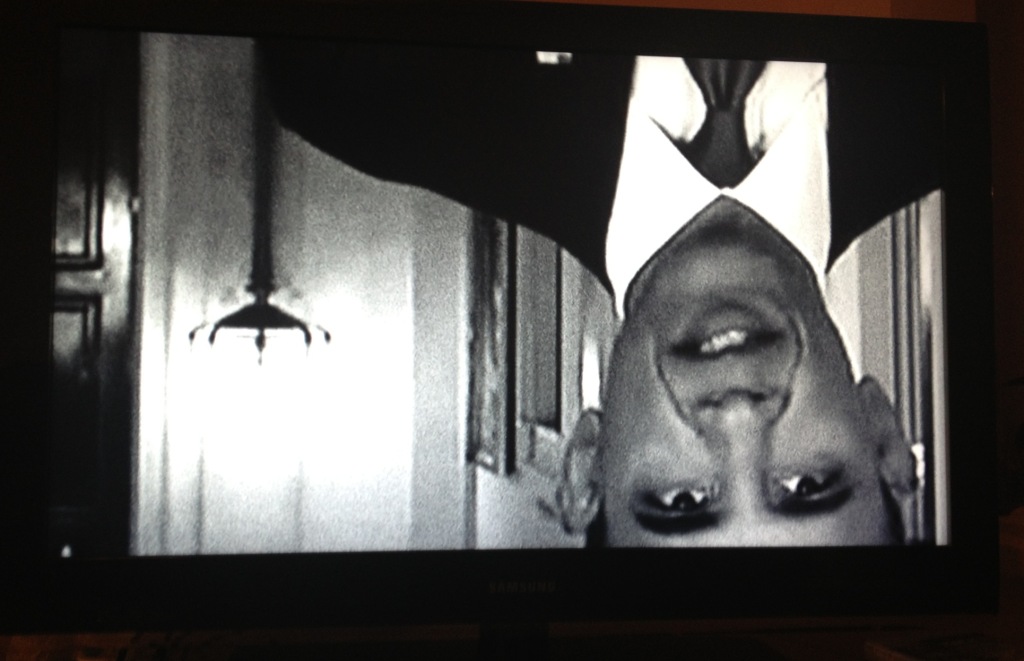
Title sequences are promises that whether fulfilled or neglected by the rest of the programme remain pleasurable on their own terms. Homeland may well already be a shadow of its former self at close of Season 2 play but somehow it’s impossible to entirely dismiss a programme which begins so beautifully. There’s enough to dig around in during those first few minutes to keep worries about underdeveloped sub-plots and writers’ knowledge of their dramatic endgame at bay. The producers might want you to wonder what Carrie and Brody will do next. I’m still questioning why Obama is upside down.