Archive for the Reviews Category

Murder 1 24:7 Damages

Posted in American TV (General), American TV Shows, BiogTV, Reviews, TV History with tags , , , , , , , , , , , , , , , , , , , on February 17, 2013 by Tom Steward

G: Is he dirty?


T: You’re not supposed to know either way yet.


G: Is she dirty?


T: You find out later.


G: Oh…Is he dirty?


T: They want you to think that now but he might not be.


G: So she’s dirty?


T: Yes!


G: I knew it.


And so it goes, the Abbott and Costello routine that accompanies G and I’s 24 marathon, a programme predicated on not knowing if the characters are traitors. Having seen these episodes many times over I know full well that without the promise of these mysteries being solved there’s absolutely no reason to stay through to the end of each season. G needs something to hang on to in order to get through the shark-jumping contest the series bi-annually stages. Without the mirage of end-of-season plot twists, there’s no way she’ll make it through Season 1’s amnesia storyline, by which I mean the storyline written by people who have forgotten the last 20 years of TV drama. There’s even less chance of her surviving Season 2’s surprise wild animal attack, or indeed any of the disproportionately perilous adventures a certain blonde teenager experiences in a post-nothing-actually-happening Los Angeles.

Happy Day!

These frustrations were the price we’d have to pay. We needed story stimulus and audio-visual distraction to prop up our day-long sessions of Uno which, thanks to my filibustering strategy of hoarding +4 wild cards, usually consist of 1 or 2 games. With our playing reserve  extended to two packs (misguidedly introduced to reduced game time!), our short-term recall seemingly non-existent, and our below Jenga-code surfaces, we had played enough Uno to whip through the first season of legal soap Murder One in less than two days. This is a series with a reputation for quick conversion, a mere 2 or 3 episodes into the run enough for discipledom. But I’ve never seen anyone so utterly brainwashed by a programme as G was by this show. The initial 45 minutes of endless exposition and prevarication which for most people is simply the salesman lowering your resistance until you let him into your home was for G the Jehovah’s Witness being invited to stay for dinner. I’m sure this had something to do with it being the perfect sideways-glance television. If anything important is about to happen, the French-door clattering and microphoned drone bee sound effects will let you know in advance. Plus, the screen will turn a different colour.
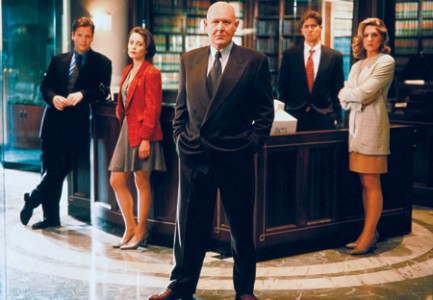
Luther and Associates

Like any TV hand-me-down, the joy is always the first-time viewer’s observations that have never crossed your mind. I’d never thought to ask what Teddy Hoffman, played by Lex Luther-in-waiting Daniel Benzali, was always looking at out of the blinds of his office windows (our consensus was squirrel) or why the county court had employed a harpsichordist rather than a stenographer. It’s also good to come at a show without your blinkers of pure reverence. Thanks to G’s unfazed eyes, I could see how our continuing fascination with the ambiguous motives and behaviour of businessman Richard Cross is not simply down to the fine character work of trans-generationally-underrated actor Stanley Tucci but also the script refusing to show us anything of his world beyond his mini-operetta performances in Hoffman’s office. I have an unflinching admiration for Benzali’s performance which may well be tinged with sadness at his subsequent lack of fame and being replaced as the series lead by Daphne’s brother from Frasier. This precluded me from seeing-as G did-the actor’s delusion that he was in a Mario Puzo mini-series and that in the scenes with his young daughter, his interpretation of paternal warmth is genuinely disturbing to watch. In fact, if you turned down the sound on the TV in those scenes and had to write one word on a post-it note to stick on his face, chances are it would be ‘paedo’.jko

Danson in the Dock

Just as soon as we’d cleared Murder One we were into the dregs of 24 Season 1. Do we dare plumb the depths of Murder Two, the hard-to-believe-it-exists second season based on the assumptions that what was holding the series back was its beloved lead actor and breakthrough storytelling and that everyone wanted more of the nervy Jewish guy who prepares writs? Was it too soon to plough through 48, the unnecessary-but-surprisingly-competent sequel which at least keeps the super-violent interrogations to an alternate-episode minimum, and thereby sacrifice the last morally justifiable season of this literally tortuous programme? Lest our faith in the foresight of TV writers is Lost we couldn’t let our lasting impression be these failures in planning for a sustainable future. Something had to fill the gap. G was adamant it had to be another one-season wonder with a continuing storyline that wrapped things up in a neat little package…give or take a couple of loose ribbons.


G: I’m gonna find out what happens this season, right?


T: Yeah, it all gets resolved. A couple of threads are left hanging, but nothing important.


G: Good, I don’t want to do all this work for nothing.


I petitioned for Damages. I’d always thought this off-courtroom legal drama should have been kept as a mini-series and this was confirmed in subsequent seasons where the writers can’t think of a good reason to bring Ted Danson back into the show. It seemed perfect for our casino cabaret purposes. Despite Glenn Close’s Cruella de Overkill performance which grates almost immediately, there’s enough intrigue in the sub-plots involving the TV movie Tom Cruise Peter Facinelli and quality TV’s J T Walsh Zeljko Ivanek to make a two-deck shuffle go a little faster. It was also a welcome reminder of the unique screen presence of the silver horse that is Ted Danson. His series-stealing turn as morally suspect millionaire Arthur Frobisher veers beautifully between the effortlessly comic and the unnervingly understated with a douse of inimitable idiosyncrasy. And so it went as quickly as it came. And so did G, with 24 Season 2 as inappropriate in-flight viewing. Everything else was just too damn consistent!


An Engagement with a Tiny Box

Posted in American TV (General), American TV Shows, BiogTV, Reviews, TV Culture with tags , , , , , , , , , , , , , , , , , , , on February 10, 2013 by Tom Steward

Those of you who follow my personal life, which for any amateur blogger is typically their core readership along with those who are sent to your site accidentally by their specialist porn fetish search terms, will already know that over the New Year I proposed to G and she is now my fiancée. I couldn’t be happier with how the proposal went, following lunch on a bench in Kew Gardens instead of dessert and within maiming distance of some geese (it must be love!). Like anything in life which I have no direct experience of, I looked to American TV for advice on how best to handle the situation. For the first time ever, I got nothing back. Going it alone without televisual aids is the reason I’m still alive and out of trouble and G is not in prison and burn-free. Consider an engagement scene in Season 1 of Damages, an anti-courtroom drama which could be subtitled The Devil’s Advocate Wears Prada. Prodigal lawyer (and former musical project leader) Ellen Parsons (Rose Byrne) is proposed to by Supermanesque junior doctor boyfriend David Connor (Noah Bean) in their New York apartment. Ellen is emptying department store bags from her Manhattan shopping spree when she finds a small carrier with a tiny box inside. Despairing at taking home someone else’s shopping, she opens the box, sees the engagement ring and David casually asks her to be his wife. On the surface, this is the kind of intimate, surprising, fun and spontaneous proposal I’d aspire to. However, soon after this David is killed and Ellen becomes the prime suspect in his murder (thanks to the show’s elaborate flashback structure neither of these are spoilers). The message couldn’t be clearer; go informal on the proposal and death and incarceration are sure to follow.


Maybe I’m in the wrong genre. Surely sitcoms-which are sentimental and romantic by nature-would give me a better idea of a proposal that tugs at the heart strings (not that you should ever do that to your arteries). Well, not the ones I watch, apparently. Take the proposal of middle-aged widow Marty Crane (John Mahoney) to girlfriend Ronee (Wendy Malick) in the final season of the touching but never mawkish psychiatrist sitcom Frasier. After arguing about Marty failing to tell Ronee about his heart attack, they competitively snipe and grumble to each other continually until Marty lets his proposal slip and Ronee accepts in retribution. They spitefully settle on it. It’s brilliant piece of writing sidestepping your expectations that proposals in sitcoms will always be warm and fuzzy moments. But what the hell use is that to me?! No self-respecting woman would let their boyfriend get away with proposing in the heat of an argument just to get one over on them. Even the most marriage-affirming couple on American TV, Homer and Marge Simpson, got engaged in a way that could never be repeated in real life with success. The poverty-stricken Homer, now a lowly trainee at a fast-food outlet, puts an onion ring on pregnant Marge’s finger before she asks him to take it off before the grease burns her. Homer, of course, eats the onion ring seconds after removing it. The poignancy of The Simpsons can make unglamorous moments like these seem like the ending of Casablanca, but in the five-fingered world you’d be opening a door to recrimination like never before. Not only would you have to answer for the lack of thought and effort in the gesture but also explain why a wide greasy hole of  high calorie fast-food seems to complement your loved one’s fingers.

In the back of my mind was Michael Scott (Steve Carell) proposing to girlfriend Holly (Amy Ryan) in The Office: An American Workplace, partly because it is such a beautiful scene and partly because they are the couple G and I are most like. Their secret language of annoying voices, unfunny private jokes and impressions of 1930s film gangsters is virtually identical to ours. Michael takes Holly around the office, pointing out all the memories of her that are superimposed on every inch of the floor plan. After all the male employees in the office propose and get rebuffed, Michael draws Holly into her candle-covered cubicle before popping the question and setting off the sprinkler system. This proposal has everything; intimacy, simplicity, stupidity and laughter. Unfortunately, it was still no help to me. Firstly, the idea that John Kransinski could propose to G and she’d still be a free woman by the time I got on my knees is preposterous. Secondly, it has an understated quality that can only come with an overshoot in ring pricing by 33 months (‘3 years’ salary, right?’/‘I think you can keep the proposal simple’). Like most of my generation, the image of Chandler (Matthew Perry) and Monica from Friends proposing on their knees to each other looms large over the imagination. I doubt, however, that you can ever count on instantaneous applause and weight loss seconds after becoming engaged. But what I’m trying to say in an endlessly roundabout way, as per usual, is that I’m glad American TV gave me nothing to live up or down to, that there was no foolproof formula or pie-in-the-sky ambition to distract me, or perfect moment that made everything else look ordinary. This way, G and I don’t have to share the memory with millions of viewers.

Christmas TV: The low-low-lows

Posted in American TV (General), American TV Shows, Americans watching British TV, BiogTV, Reviews, TV Culture, TV History with tags , , , , , , , , , , , , , , , , , , , on December 15, 2012 by Tom Steward

Christmas is a time for being trapped at home. Naturally, the choice medium of the housebound-the television-comes into play to provide mental escape from physical confines, as a side dish to gluttony, and because, like Eat-Me Dates, it is there and demands to be consumed. Demographically-desperate TV channels are sure to know about this literally captive audience and yet it often seems schedulers pay less attention to the festive period than they do their nightscreens (even the test card changes its kid and midget clown during puberty and pantomime season). It’s a response to the crisis in broadcast television reminiscent of the Fiscal Cliff; ignoring opportunities to prevent impending austerity until the situation gets so desperate that either television ceases airing at Christmas or the stations compromise and show a torn-out magazine photograph of Bing Crosby for two weeks. So how has TV cancelled Christmas? Here’s some of the low-low-lows:

1. Shows about old comedy

When G was here last Christmas every comedy programme we saw was a) a documentary b) about comedy from at least twenty years ago and c) featured men dressing up as women. If funds were directed towards making memorable new seasonal comedy instead of commissioning tribute shows that are the television equivalent of trapped wind, then perhaps we’ll have something other than nostalgia to be nostalgic for in twenty Christmases time. In an episode of King of the Hill, Peggy tries to explain the sophistication of British comedy to Bobby, whose response is ‘Why’s that man wearing a dress?’. G may well have asked the same question. It is not one I can answer, having been born in the 1980s.

2. Channel 5’s Scrooge

Scrooge in the form of a colouring book.

After showing every single made-for-TV movie version of Dickens’ A Christmas Carol during the Christmas holidays, including one starring Kelsey Grammer that looks like a Frasier dream sequence, the UK’s leading Hitler documentarians Channel 5 try to redeem themselves every Christmas Eve by showing the 1951 Alastair Sim original. However, to add insult to injury, they choose every year to show a colourised Turnervision version of the film where the colour schemes have been taken from a box of Quality Street. The haunting black-and-white of the film is lost to garishly misjudged colours that would seem gaudy in Yellow Submarine. It’s been so many years now it can’t be an oversight, just a slight tantamount to putting lipstick on Dickens’ corpse.

3. Christmas line-ups

Christmas is a ritual of ruttish repetition and the line-up of programmes on TV tends to follow suit. Now I’m not saying we should have Adam Curtis documentaries about caged turkey farming in the middle of Christmas day but since we know the kinds of programmes that are going to turn up each year, why not re-jig them a little for the sake of novelty? They’ll doubtless be a seasonal special of an obsolete sitcom, a premiere of a film that has been watched in every conceivable medium (including cave art), and a freak edition of a programme re-formatted to include singing. Can’t we have once have a different set of names to make the purchase of a Christmas Radio Times worthwhile?

4. Christmas advertising

‘You may leave the kitchen to present the turkey but return immediately or I’ll lamp you’

If you’re boxed in for Christmas, chances are you’ll have to witness some hefty seasonal TV advertising. These are all-or-nothing flagship campaigns for British stores, brimming with celebrity, extraneous art direction and turkey ham-fisted attempts at cinematic grandeur. Or at least they were. The theme this year has been budget-consciousness, with high-end supermarket Waitrose giving us a bare set and donating filming money to charity and middle-range shop Asda giving us snapshots of everyday family life at Christmas. Except Waitrose’s spread-the-wealth ethos says nothing about reducing advertising costs to make food more affordable and Asda’s vision of family life is so horribly sexist it could be storyboarded from a Victorian manual for women. Extravagant or sincere, TV advertising still loses the public.

5. No Christmas Ghost Stories

Midnight Mass will never be the same again!

Britain has a long, weird and slightly sadistic tradition of using Christmas TV to scare the shit out of people. Throughout the 1970s BBC’s Ghost Stories for Christmas with its adaptations of classic supernatural yarns delivered with brutal realism chilled the nation to the bone and some later homages to these ho-ho-horror stories, such as The League of Gentleman Christmas Special showed that at Christmas we need to be afraid, no matter what Bob Geldof and Midge Ure might say. But alas, and thanks in part to a frankly rubbish revival of Ghost Stories that looked like it was filmed on a special camera left over from the CSI set, they are deceased and haunt us from a DVD afterlife.


Tarantino on TV

Posted in American TV (General), American TV Shows, Reviews, TV Culture, TV History, Unsung Heroes with tags , , , , , , , , , , , , , , , , , , , on December 9, 2012 by Tom Steward

Like a racist American businessman announcing self-deportation after Obama’s re-election or an old-school British entertainer forewarning a one-man emigration movement in wake of a 1990s Labour landslide, Quentin Tarantino has threatened to quit cinema. In a roundtable interview with The Hollywood Reporter, the director discussed his desire to retire because of the industry conversion to digital cameras and projection. But what debased metaphor could possibly capture the dire straits that the film industry now finds itself in? ‘I mean, it’s television in public’, said QT, as if there was nothing less dignified. To add insult to injury, Tarantino may have to lower himself to actually working in television. ‘If I’m gonna do television in public, I’d rather just write one of my big scripts as a miniseries for HBO’, he said, declaring his intention to slum it with such mediocre fare as The Wire, The Sopranos and Six Feet Under.

I quit says QT!

I’ll admit I expected more than bald TV-bashing from Tarantino, a director who has never been embarrassed to borrow influences from TV-see his adaptation of the Alfred Hitchcock Presents episode ‘Man from the South’ for the portmanteau film Four Rooms or his use of a refrain from the Ironside theme tune as a leitmotif in Kill Bill. Besides, he always seemed entirely comfortable with the prospect of directing for television. Let’s not forget that Tarantino directed a formative episode of lauded medical series ER called ‘Motherhood’ which not only saw his signature style and imagery seamlessly interweave with the fabric of 90s TV drama but also pioneered many of the show’s representational strategies, not least its handling of gore and casual violence. Tarantino also managed to direct an episode of CSI in which you actually cared about the characters and somehow managed to artfully deploy the series’ egregious audio-visual excesses.

A QT word in your ear!

Using TV to flagellate cinema runs contrary to what I think of as Tarantino’s egalitarian approach to popular culture. The usual snobbery you find from film directors about the aesthetically inferior nature and lack of artistic worth of television always seemed alien to QT, who appeared to recognise that it was at the heart of the popular, commercial Western imagery he was so fond of reappropriating, like a modern-day Lichtenstein. This makes his belligerent reluctance to making ‘a miniseries for HBO’ harder to swallow, especially as an announcement such as this deserves to be accompanied with enthusiasm and pride. Tarantino even admitted that this change of medium could solve a number of problems with producing his work as cinema. Speaking of the extended running and production time of HBO’s series, he said ‘I don’t have the time pressure I’m usually under, and I get to actually use all the script’.

Tarantino hangovers some nurses!

I’m sympathetic to Tarantino’s rage against the digital takeover of cinema and, as someone who finds that the signal beamed on to his television works far better than the digital projector at his local picturehouse, empathise with his feeling that television provides a better platform for a director than a medium that is now ‘film’ in name only. But he should take comfort in knowing that veteran film directors can use TV networks like HBO to reach artistic heights that their later-period movies continually fail to achieve. Mike Nichols hasn’t been able to make an above-average romantic comedy in decades and yet his HBO miniseries Angels in America was a transcendent delight. Scorsese hasn’t done a gangster movie in the last 20 years that could compete with Boardwalk Empire. Even an indie-hack like Gus van Sant looks like Ken Loach when surrounded by the hard-hitting political drama of Starz’s Boss.

CSI’s in Grave Danger of giving a damn!

Not to sound too much like a tele-fundamentalist but quite frankly Tarantino’s work has gotten too big for cinema. Since the two-part Kill Bill franchise, QT’s films have tended towards the epic and become distinguishable by their languor. This has protracted his cinematic vision and also compacted it at times, as in cases of cut-downs such as Death Proof. Like his beloved generational family martial arts TV sagas that spawned Kill Bill, television’s massive and never-ending texts and perma-fashion for serial storytelling can accommodate Tarantino’s expansive scale and indulgent timekeeping without a hint of bloat. A smaller screen it might be but it’s also a lot more elastic than the 3-hour radius of the silver one. At a purely PR level, Tarantino’s announcement might not have invoked the desired shock and dismay. For a director not exactly at his creative peak, the prospect of a TV afterlife looks positively heavenly.


Hallow’s TV

Posted in American TV (General), American TV Shows, British Shows on American TV, Reviews, TV History with tags , , , , , , , , , , , , , , , , , , , on November 3, 2012 by Tom Steward

It occurred to me while watching the excellent Halloween special of one of the best new sitcoms on the block The Mindy Project how rarely I enjoy them. I think what bothers me is how wardrobe tends to take over and all other departments seem to take a week off. The Mindy Project kept its (hilarious) costume reveal to the last possible moment and didn’t buy into the holiday wholesale thanks to the eponymous lead character’s wariness and cynicism about Halloween rituals. There were storylines that could have been in any episode and the fancy dress aspects were invested with the show’s usual wit, imagination and absurdity. This is a far cry from the gagless and story-devoid episodes of (often great) US sitcoms like Roseanne or The Cosby Show which let the outfits do all the work. That said, it’s been a lot better since sitcoms lost their studio audiences. At one time a sitcom would move its live spectators to rapturous applause and accentuated laughter for being the on-the-spot witnesses of an inventive costume, albeit one which usually played off knowledge of the character, leaving the home viewer out of the joke rather than sweeping them along with the fun, as was more usually their function. Watching a Halloween-themed sitcom used to be like watching film footage of Hitler’s speeches; unimpressive and kind of shambolic and yet those in the crowd seem to be going wild for it. Fourth-wall sitcoms now recognise they have to do something more than catwalk a costume to get a laugh, hence The Office’s running gag about the surplus of Heath Ledger Joker costumes in the Halloween special the year The Dark Knight was released. This year Parks and Recreation even sneaked a huge story event into their Halloween special to counter the frivolity.


‘Tinkerbell, Tailor, Soldier, Spy’

British TV, like the country, came to Halloween late, and begrudgingly. Given British culture’s longstanding propensity for wanting to scare people in otherwise non-horrific periods of the year, like Christmas, it’s unsurprising that we narrow in on the ghostly and ghoulish connotations of Halloween in how we celebrate the occasion. And because we’ve never fully got the American way of celebrating a supernatural and spiritual event through soft porn dress sense and celebrity impersonations, we tend to stick to the reassuringly frightening arena of the macabre. Hence why our Halloween television is horror, plain and simple. Well, not quite. Over the last twenty years, Halloween has been a great excuse to make groundbreaking fantasy television in Britain. Through one-off Halloween specials, we’ve been attempting to make horror TV the equal of the movies that zombie-infect the schedules around October time but playing specifically to the effect of getting scared in our homes watching TV. This almost fell at the first hurdle with Ghostwatch, a 90-minute filmed drama shown on BBC 1 on Halloween in 1992 which posed as a live factual investigative programme about Britain’s most haunted house using real-life TV presenters playing themselves. Viewers claimed they had been duped, accused the BBC of betraying its values of trust and reliability, and a case of suicide was linked to the programme. It unsettled a nation of viewers who, unlike today, were unaccustomed to TV parodying its programming, and prickled cultural anxieties about paedophilia with its child-abusing poltergeist. The BBC never repeated or tried anything like this again, but in 2007 TV writer and critic Charlie Brooker made Dead Set, a mini-series shown over Halloween week on Channel 4 in which a zombie outbreak hits the Big Brother house, and suddenly horror had white-wormed its way back into our favourite TV shows.

Ghostwatch: please have nightmares

If I want good Halloween TV, though, I generally go to animated comedies. Crafting elaborate costumes and turning characters into ghoulish versions of themselves can be done so fluently in animation and with such minimal effort compared to live action that they’re free to explore Halloween in whatever way they wish. For The Simpsons this has meant annually becoming a contemporary equivalent of Rod Serling’s Night Gallery with their Halloween episodes portmanteaus of horror, fantasy and science-fiction stories which play into the well-worn conventions of spooky storytelling and with the naturalist style of the programme. These seasonal specials serve to enrich the programme conceptually by placing its characters and settings an alternative universe with infinite story and scenario possibilities. The producers of The Simpsons take this responsibility so seriously that over the years they’ve produced some of the most powerful, intricate and intelligent fantasy TV the US has ever seen. Mike Judge’s Chekhovian sitcom King of the Hill has also had some of its finest moments during Halloween. One particularly memorable special called appropriately ‘Hilloween’ concerns the cancellation of Halloween celebrations in the Texas small town of Arlen after pressure on local government from a conservative Christian fundamentalist. The episode was about the evangelistic brainwashing of locals and the resistance that takes back the holiday irregardless of its satanic imagery, because it makes being a kid fun. Fun is also had at the expense of the creationist movement, with a didactic anti-evolution spin on the haunted house. Addressing the religious boycotting of Halloween in devout parts of the American South, the series put an original spin on the concept, and made it relevant to the people and places the show is interested in. I guess what I’m saying is the Halloween special has to be special, not just themed.


Rod Serling would have been proud