Archive for the Reviews Category

Sunday Day Recorded

Posted in American TV (General), American TV Shows, Behind-The-Scenes, Reviews, TV channels, TV History, Unsung Heroes, Watching TV with tags , , , , , , , , , on February 25, 2015 by Tom Steward

‘For a lot of people, their favourite part of the show is the short films, which makes you wonder why don’t they just do the whole show that way. They’ve been doing the show wrong for 40 years. The sketches, they’re nice but they’re long.’

Louis C.K. has made a career out of hitting the nail on the head – and inducing involuntary laughter from the brain – but in as many words as there’s been years of Saturday Night Live, the comedian summed up the fatal (surely tragic by now) flaw of NBC’s late-night sketch show, which celebrated 4 decades on the air this month. C.K. was introducing a compilation of shorts on the SNL anniversary special, scheduled on a Sunday and in primetime (who says American don’t get irony?) and may well have been feeding in to the inverted back-slapping that was pungent throughout the evening. But as soon as the clips rolled, and names like Jim Jarmusch, Mike Judge, Albert Brooks and Paul Thomas Anderson filled the screen, C.K.’s roast zinger becomes an unarguable truism. I myself once had a similar thought before when watching the late-90s British daily sketch programme The 11 O’Clock Show which was written on the day of broadcast and wondering why they didn’t just spend more time on the jokes and make them funny.

Crapping on SNL!

Crapping on SNL!

The more you think about it, the more damning C.K.’s accusations become. Who honestly prefers to watch an SNL sketch featuring The Blues Brothers instead of just watching The Blues Brothers? Where’s the pervert that would endure SNL’s fake public access show ‘Wayne’s World’ as anything other than the intro to Wayne’s World (or Wayne’s World 2)? SNL cast members try to make out that movies based on their sketches are duds (presumably for fear someone might decide to cut out the middleman) but its filmed elements are the only great comic art the show has ever contributed the world. And a sketch worth of Coneheads feels like an hour-and-a-half movie anyway, so you might as well watch the feature spin-off. C.K. might be biased since his sitcom has the finesse of art cinema, but we’re not talking about a group of comedy Oliviers with rave live notices that seem hopeless on film. Every SNL legend has proven themselves masters of screen comedy and the mythical thrill of live TV shouldn’t distract us from that.

Unless I’m severely underestimating Lorne Michaels’ command of irony, I don’t think the inflated length of the anniversary special – coming in at four-and-a-half hours – was meant as a poke at SNL’s reputation for overlong sketches. Again, C.K. was on point (why don’t I just marry him?) and the underwhelming reaction he received was not simply audience fatigue, but a nervous titter of cold, hard realization. The amount of sketches (if you can call them that) and appearances on the night looks impressive on paper, and yet SNL has that amazing ability to appear stretched even when pushed for time. It doesn’t help that so many of the most famous sketches which were revived for the afternoon/evening are based on repetition; Celebrity Jeopardy, The Californians, Weekend Update, The Bass-O-Matic Infomercial. What start out as parodies of overly-formatted TV programming end up using that format as padding. It’s a mistake for SNL to assume that everyone finds their overlength endearing. Like their very own Drunk Uncle, the nostalgic surface hides a multitude of outmoded beliefs and behaviours.
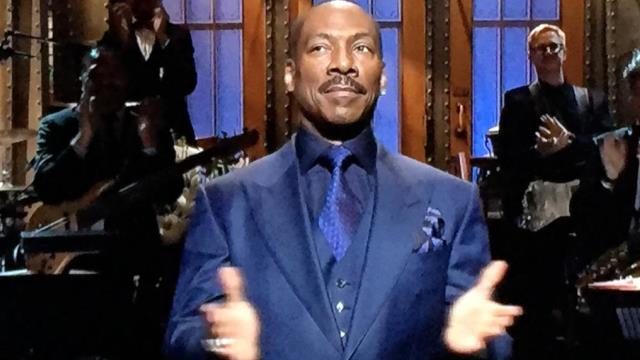
Eddie Murphy doing for real what he does in his mind.

Eddie Murphy doing for real what he does in his mind.

For a sketch show that invests such capital in the idea of shedding its history as soon as it qualifies, the current SNL cast were rather conspicuous by their absence on the anniversary special. Perhaps it’s not so much about them as the greatest generation that fought for their freedom to pretend to be Justin Bieber, but what this sketch comedy version of Apocalypse Now (minus Brando mumbling about snails – that was cut so Eddie Murphy could applaud himself) somehow failed to acknowledge was continuity. It’s a slap in the face that a cast who may be in the process of getting SNL’s shit together for the first time in quite a while should be passed over in a four-hour show and made to look like the weakest links in the chain. Given that Eddie Murphy has only just forgiven SNL after former cast member David Spade ridiculed his career on-air, despite Murphy single-handedly keeping the show on the air (like 1986 World Cup Maradona), they’re clearly not the ones who should have been asked to clean boots that night/day.
Bad Morning Television

Posted in American TV (General), American TV Shows, Behind-The-Scenes, BiogTV, Internet TV, Reviews, TV advertising, TV channels, TV History, Watching TV with tags , , , , , , , , , on February 18, 2015 by Tom Steward

It was upon returning to my hotel room at 5 in the morning after seeing some of the best and oldest bluesmen in Chicago and celebrating the existence of an L-train with a trip to a 7-11 to get some cheese-filled-bread (or bread-filled-cheese) with a side dish of whatever was left on the room service tray a few doors down and being confronted with the blurry, blobby outline of Tony Danza that I came to a grave realisation. In the land of 24-hour business, late licensing, and all-night dining, there’s nothing on TV in the middle of the night. So why have two major TV events recently debuted in the early hours of the morning?

Last November the comedy short Too Many Cooks aired around 4am during the infomercial block on Adult Swim, the late night version of Cartoon Network. A parody of both the opening credits of 1980s sitcoms and the insanely dark and genre-bending possibilities of TV comedy in that decade (and before you dismiss it as exaggerated, remember that ALF was dissected by the government in the finale), Too Many Cooks became a viral video smash and was repeated each day at midnight for the next week. The perverse choice of a graveyard slot more or less guaranteed the short’s success, not only because re-run and internet re-circulation was necessary, but also because there was no competition.

Adult Swim seemed to cotton on to the fact that there’s an undiscovered country of television between the hours of 1 and 6 in the morning. I understand why they’d want to be the pioneers, but I don’t understand why there’s not a frontier-style rush to claim territory from every other producer in TV. If the entertainment market is so damn saturated, why not get a head-start by putting out your show in the vast wasteland of unused hours in the TV day? For once, having a variety of media platforms to re-play TV on is a blessing, since audiences will need and want to see your show again once they hear they’ve missed out.

It’s surprising that the networks haven’t come to these conclusions already, since they’ve had such great success by pushing their best programming later and later in the evening. The 11 o’clock talk show is an institution that has spread to virtually every channel in the schedule and their midnight sister programmes aren’t far behind. This weekend NBC celebrated 40 years of Saturday Night Live (ironically on Sunday and in primetime), a show which begins at 11.30pm and runs to 1.30 in the morning. This isn’t, as I once thought, because Americans stay out or go to bed later, but because it’s untapped resources. In Britain at this hour, they start playing movies starring Eric Roberts.

And what if you actually need to bury a show? There was surprise in early February when FXX aired a pilot for a series based on the popular Wheel of Time fantasy novels by Robert Jordan at 1.30am. Not only do the books have a huge fan-base, but with Game of Thrones still going strong, there’s a deep well of fantasy (probably with a goblin in it) that everyone in TV can draw water from. It soon became clear, however, that the air time wasn’t a stunt to get the show ahead of the competition but to keep it firmly under the radar, being the best all-round solution to legal issues facing such a project.

The television rights to the books were to revert to a new owner on February 11 (two days after airing) and so the previous owners were probably trying to get something based on the books out on TV before that happened. Author Jordan’s widow has contested the claims of the producers to the rights and they are threatening legal action. Interestingly, FXX were able to offload responsibility by treating the pilot as ‘client-supplied programming’ i.e. an infomercial. If you’ve got a show mired in legal trouble, 1.30 in the morning is clearly the place for it. The Wheel of Time pilot used the early-morning hours as a dumping ground for toxic material but it still shares similarities with Too Many Cooks’ deployment of late TV.

Both programmes traded on the idea that anyone watching at that hour can’t be sure of what they’ve seen; one for comic effect, the other for legal protection. With each one, being mistaken for a promo or infomercial actually helped. It makes financial and creative sense. Why still the hesitation?

Box Spin

Posted in American TV (General), American TV Shows, Reviews, TV Acting, TV channels, TV History with tags , , , , , , , , , on February 11, 2015 by Tom Steward

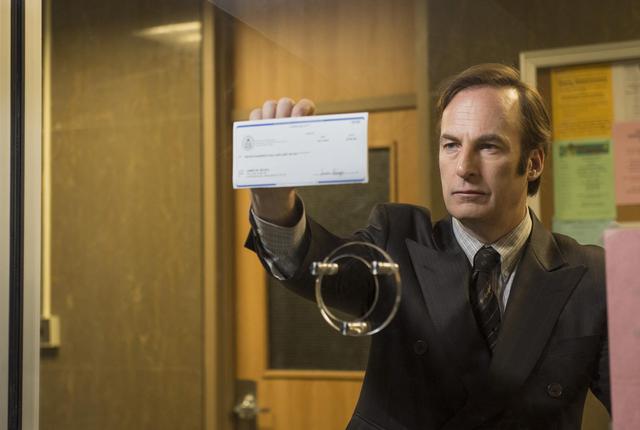
On Sunday and Monday, as part of a 2-night event (isn’t everything these days?) AMC debuted Better Call Saul, a spin-off from its corner-turning drama series Breaking Bad based around Walter White’s kitschily corrupt lawyer Saul Goodman. For reasons that can only lead to spoilers, Better Call Saul is a prequel. Despite the unabated popularity of Breaking Bad and the character, there’s still the risk that a spin-off would damage the reputation of the programme, especially one that promotes to protagonist a character who mainly functioned as much-needed comic relief in one of the bleakest shows on television. AMC needn’t have worried because, as with all good long-form television, Saul grew into a much more rounded character as Breaking Bad went on (lest we forget that Walt started out as a clown) and it’s this version of the character that Better Call Saul has inherited. But in TV the odds aren’t against them (or as against them) since there’s nothing to say a spin-off show won’t be as good as or even better than the original.

Check out Better Call Saul!

Check out Better Call Saul!

As Steve Coogan self-reflexively observes in The Trip to Italy there are only ever one or two movies anybody ever quotes when arguing that sequels can be better than the original. Of course, TV has its go-to canon of superior spin-offs (Frasier and anything produced by Norman Lear, who understood the value of maintaining a universe of characters decades before Marvel Studios cottoned on to the idea) but the medium has a pretty good hit rate when it comes to franchises. TV is so generically nebulous (modern quality TV even more so) that it barely matters when a spin-off is more or less comic than its predecessor. In today’s TV when series take so long to hit their stride, their spin-offs may even pick up a show when the quality’s still good and perhaps before they’ve had time to peak. This seems to be what’s happening with Better Call Saul which reaches heights in its first two episodes that it took Breaking Bad (despite its calculated seriality) three seasons to achieve.

But what we’ve seen of Better Call Saul isn’t free of the pitfalls of spin-offs either. Gratuitous cameos from former cast members are one of the biggest obstacles to spin-offs being able to fly solo, and this one has them in spades. The re-appearance of gnome-faced security man Mike in the unfamiliar role of a car park attendant is not at all the problem. We know that history will draw the two men together, so we expect to see him enter Saul’s life somehow. But running into loose-cannon drug dealer and Walt’s former distributor Tuco in a coincidence that would make Dickens blush (plus members of his gang who also appeared in Breaking Bad) really is a step too far. Although some of this is the problem of prequels. Prompted by the none-too-subtle nods of the writers, we’re constantly anticipating moments from Breaking Bad instead of enjoying what the new ones have to offer. Despite the pleasing evocation of middle-America at its most moribund in opening black-and-white images recalling Alexander Payne’s Nebraska (which star Bob Odenkirk also featured in), it may have been a mistake to start at the end.

Aside from these distractions, which may have been the result of the writers sensibly trying to break Bad fans in, we’re left with a series whose name may one day be called without company. It will never completely transcend Breaking Bad, especially with original creator Vince Gilligan at the helm here too, but I’m confident we’ll soon be able to consider them separately. It’s possible to foresee Better Call Saul doing for the portrayal of lawyers what Breaking Bad did for scientists. Like Walt, Saul is not just the grumpy maverick we’re used to when confronted with so-called ‘antiheros’; he’s a criminal with a deviant moral code. That said, while we always suspected that Walt was acting out of pure self-interest (which was confirmed by the finale), there’s the irony that the earlier incarnation of villain Saul comes across far more nobly and altruistically than ‘good-guy-turned-bad’ Walt ever did. We can still think about Walt without making Saul any less interesting.

One of these is not like the other.

One of these is not like the other.

If I’m jumping the gun here, it’s because TV history tells me there’s nothing to worry about. When a spin-off is terrible it’s usually because there’s nothing left in the tank. Breaking Bad’s by-the-numbers finale always felt like it was holding something back. It was. A sequel. A prequel. A new modern monster.

The Rest Of The Year’s TV

Posted in American TV (General), American TV Shows, British Shows on American TV, Reality TV, Reviews, TV advertising, TV channels, TV Criticism, TV History, Unsung Heroes, Watching TV with tags , , , , , , , , , on December 31, 2014 by Tom Steward

There’s a formula for writing annual ‘Best Of’ TV lists. First it’s compulsory to observe how pointless a task it is making such a list for a vast and varied medium like television, then talk about how your criteria will be completely different, before naming the SAME EXACT shows as every other critic. Well, I don’t think it’s pointless, at least no more futile than doing it for books or films (where critics don’t seem to have the same anxieties about habitually omitting factual and lifestyle titles). I have no wish to create an opaque ratings system that will lead me back to shows which come pre-ordained as the best of TV. But I do want to ensure that the titles I choose won’t appear on anyone else’s list, something which gets harder and harder as critics begin to fawn over the nichest possible television. So don’t consider this the year’s best TV (see I’m doing it in spite of myself!) but rather good TV that has been overlooked simply because it doesn’t get listed.

Botched (E!)

...what if he dies first?

…what if he dies first?

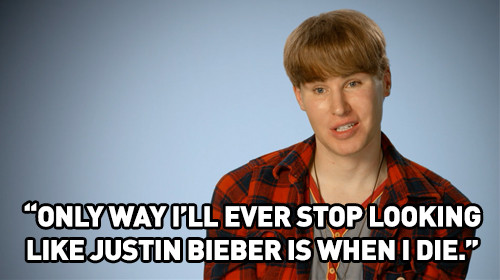
Real Husbands Dr. Paul Nassif (disguised as Moe Syslak from The Simpsons for ease of viewer identification) and Dr. Terry Dubrow (other two-quarters of Heather Dubrow, who must always be named twice) are L.A. plastic surgeons who specialize in fixing botched jobs. There’s some emotional hard luck stories but basically it’s the best excuse ever for social voyeurism and with patients like a Human Ken Doll and a 33-year old man with the face of an early-teen Justin Bieber it’s about as visually mesmerizing as reality TV gets. The show is also indispensable body horror, with its drop-in circus of malfunctioning and distorted anatomy. Even E’s glossification can’t mask the raw psychological distress.

90-Day Fiancé (TLC)

A show close to mine and G’s hearts, since I arrived in the US on a marriage visa. This observational documentary follows six couples during the 90-day window for visitors to the US to marry on the K-1 visa. It’s as compelling for its cartoon parodies of loving marriage as it is for reaffirming the borderless beauty of the institution. So extraordinary and bizarre is the experience for these culture-clash couples that the network barely needs to meddle in the melodrama, as it does for its other reality shows, giving it a more natural (if no less extreme) flow of real events than heavily devised TLC docu-soaps like Here Comes Honey Boo-Boo.

Muppets Most Wanted (Disney)

Variety at heart!

Variety at heart!

Probably more likely to be dismissed on grounds of not being a TV show, this was nonetheless the movie that in 2014 most thoroughly blurred distinctions between film and television. The Muppets are a creation of television, stars Ricky Gervais, Ty Burrell and Tina Fey are all television personalities, and the legacy of The Muppet Show is privileged at the expense of the movie franchise (the latter self-consciously in comic acknowledgements of the diegetic amnesia around popular movie characters and sequels). The movie is a joyous celebration of the achievements and talents of television past and present, reminding us of how far the medium has come. And it’s full of commercials!

LIVE With Kelly And Michael! (ABC)

A show that will doubtless elude recognition for its monotony and ubiquity, but this doesn’t change the fact that host Kelly Ripa is by several miles of open country the funniest, smartest, wittiest and most multi-dimensional presenter in daytime. Her work in morning television is more akin to what Conan, Colbert and Craig Ferguson have done with the late-night form than the platitudinous moron-making of virtually everybody else on TV at that time, and until about 11 in the evening. This is an everyday occurrence, which makes it all the more startling, but her essential impersonation of Laura Linney in the Halloween parody of PBS Masterpiece Theater speaks volumes.

The Late Late Show With Craig Ferguson (CBS)

Not like any other late night show!

Not like any other late night show!

Dare I say that Craig Ferguson’s departure from late-night talk shows will leave an even bigger hole than David Letterman? While Letterman innovated within the format, Ferguson created a new late-night form that was genuinely subversive, avant-garde and experimental, importing a brand of British vaudeville surrealism reminiscent of Reeves & Mortimer and The Mighty Boosh. Like those acts, Ferguson meshed light entertainment with serious art, carved out an absurd fantasy using television grammar, and delivered alternative culture disguised as broad comedy. It was a rejection of all that was bland and formulaic about one of American TV’s most intransigent genres, and a complete reinvention of its possibilities.

King Of The Chill

Posted in American TV (General), American TV Shows, Reviews, TV channels, TV History, Unsung Heroes with tags , , , , , , , , , on October 29, 2014 by Tom Steward

‘Horror has not fared particularly well on TV, if you except something like the 6 o’clock news, where footage of black GIs with their legs blown of, villages and kids on fire, bodies in trenches, and whole swathes of jungle being coated with good old Agent Orange.’

That was writer Stephen King in 1981, talking about putting horror on television (thanks to my mentor and go-to for gothic television Helen Wheatley for the quote!). Despite King’s reservations, his horror stories have found a natural home in TV as series, miniseries, and made-for-TV movies in the last four decades. Ironically, it is precisely because television is so ‘full of real horrors’ that King’s work fits so well there. Perhaps it’s not vivid images of war on the news anymore, but there are still certainly plenty of reports of murderous violence, human cruelty and sexual abuse on an array of primetime infotainment programmes. King is particularly valid in this context since he is perhaps the writer most famous for bringing horror into touch with the contemporary world.

Anyone lose their childhood down here?

Anyone lose their childhood down here?

King has been adapted for the cinema significantly, but none of those movies quite captures the lingering terror of his writing as the miniseries versions. Something about having to stop and resume watching episodes of It and Salem’s Lot offers a prolonged, almost masochistic quality of fear unavailable in all but the books themselves, which, as Joey Tribiani has shown, are best stored in the freezer when not being read. Television has such affective qualities as a medium – many of which are connected to horror – that merely the act of televising can induce dread. What Pennywise the Clown can do to you in the cinema is no match for the monkeyshines he gets up to in and around your living rooms each and every night.

Genre aside, TV adaptations of King’s books give us pause to consider which visual medium is best suited to accommodate the novel. For best-selling authors like King, the natural route is feature films, not necessary because they are the best platform for his work but due to their popularity and potential (at one time!) for box-office success. But the bulkier novels suffer inside the constraints of a two to three-hour movie, and the best film adaptations of King’s writing have generally been those extrapolated from his short stories. TV series that want to appear classy and cultured often compare themselves to novels with episodes the equivalent of chapters. But when applied to King’s shlockier fare, we can see it’s about what fits not what elevates.

The symbiotic relationship between Stephen King and television was on my mind as I watched the Lifetime movie Big Driver based on his novella. The network that once bore the slogan ‘television for women’ doesn’t necessarily seem like the place for Stephen King adaptations but the subject matter complimented Lifetime’s penchant for celebrities, scandals and sex crimes in its programming perfectly. The target audience, which still more or less holds today, ensured that none of the rape scenes ever approached the voyeurism or perverse pleasure they achieve in many horror movies. Though fiction, it was fluent with the showbusiness biography strand of original movies on Lifetime. In fact, it’s quite striking how King’s work seems malleable to a wide range of TV genres and formats.

The Biggest driver of a Lifetime!

The Biggest driver of a Lifetime!

King’s novel Under the Dome has been adapted and expanded into a primetime CBS TV series, which blended into the current fashion for fantasy and science-fiction television in the network schedules. A decade ago, King developed a re-make of Lars Von Trier’s surreal medical drama Riget called Kingdom Hospital which heralded a trend for American versions of European (mainly Scandinavian) TV series that has yet to see an end. King’s short stories were regularly fodder for half-hour dramas in the revived series of The Twilight Zone and The Outer Limits during the fantasy anthology renaissance in the ‘80s and ‘90s. His contribution to the modern gothic even came full circle as King penned an original screenplay for Fox’s paranormal detective series The X-Files in 1998. The tribute is fitting as we can see the influence of Stephen King miniseries in contemporary TV horror such as the self-contained first season of The Walking Dead or the season-long anthology dramas that comprise American Horror Story. It might not be an affinity King is particularly proud to boast – although now would be the time to jump on the pioneer bandwagon – but it’s one that, like the repressed, will always return to haunt him.