Archive for the Reviews Category

Live Day-to-Day

Posted in American TV (General), American TV Shows, Reality TV, Reviews, TV channels, TV Culture, TV History, Watching TV with tags , , , , , , , , , on March 25, 2014 by Tom Steward

It’s been a long time since American television was purely live but it’s still an everyday part of broadcasting. Amidst the cycle of breakfast shows, daytime chat shows, primetime entertainment and 24-hour rolling news and shopping, there doesn’t seem to be an hour of the day that there isn’t some kind of live TV on the air. We know from experience that live broadcasting can be one of the most powerful, significant and thrilling forms of TV. Live television has been agent and witness to cataclysmic political changes. It made and then ruined Nixon, and then made and ruined him again. We saw the Republicans’ chances of electoral success in 2012 vanish in real time at the GOP conference as Clint Eastwood decided to go off-script and do X-rated versions of his Bob Newhart and Jimmy Stewart impressions. There are other world and universe-changing events witnessed on live TV I should mention – like 9/11 and the Moon landings – but…dude was talking to a chair! There’s no greater potential for surprise, shock and error in television than in a live broadcast, and that unpredictability carries a nervous energy that is utterly exhilarating. And we get it uncensored and first-hand.

I’m reminding myself of what live TV is capable of because, if the past week is anything to go by, American TV has forgotten. Last Monday morning, news anchors on the local Los Angeles TV station KTLA breakfast show reacted to a mid-size earthquake that happened live-on-air by panicking, shouting ‘Earthquake!’ and diving under a desk until it had subsided. Now, I’m not going to pretend that I would have done anything different in this situation, even if I had been trained to keep going. But is there any point continuing to broadcast live if all we’re going to get is dead air, an empty studio and the terrified ramblings of presenters so shaken up by the event they can offer no meaningful information about it? Anchors on the other affected TV stations may have stayed calmer, but they didn’t do much better reporting the earthquake. Deprived of information, hindsight and proportion, presenters on Fox 5 and CBS 2 were left with the remnants of a child’s vocabulary. It was ‘big’. It was ‘large’. Some over-achiever even called it ‘strong’. They might have learned something about the conditions that Fox News anchors work under every day, but we learnt nothing.

If you wanted to watch the television equivalent of muscle-wastage, then you needn’t have looked further than what CNN put on in relation to the search for missing Malaysian Airlines flight MH370 last week. Either the ‘Breaking News’ button was being used as a coaster for an unwanted drink for the past week, or the network genuinely thought the FBI acquisition of a flight simulator recording from the pilot’s home was some kind of crucial development in the story. Cue hours and hours of wild speculation about the significance of the simulator’s data, even after repeated protestation from the featured experts that conjectures about the pilot’s role in the hi-jacking could be argued any which way. It took former Boeing engineer Bill Nye the Science Guy, who is used to breaking things down for people with the minds of children, to tell us that the only thing we all could do was to guess. At one point, a pilot sat in a flight simulator and took viewers step-by-step through a scenario that he had entirely invented in his head. Not even the ‘Screen of Souls’ had an answer to free them from their suspended animations in a video monitor bank.

CNN imprisons aviation experts in screen bank until flight is found.

CNN imprisons aviation experts in screen bank until flight is found.

Maybe the problem is that news reporting has too big a burden of information for continuous live coverage to carry. If so, then putting on a 2-hour entertainment programme that’s been on TV for years live should be a doddle, right? Well, not if it’s Dancing with the Stars. ABC’s primetime dance competition returned for a new season last Monday night with a re-booted format. But it was the basics of live television that the show tripped up on. The studio audience couldn’t be subdued for long enough to hear the judges’ notes on the dances. New co-host Erin Andrews comes from live stadium sportscasting and you would expect her to be adept handling live TV in the presence of spectators, but she kept overrunning, miscuing and recoiling from the audience’s spontaneous reactions. When live TV runs up against the clock and threatens to fall apart, we get a certain thrill as viewers. But it’s a fine line that if overstepped results in sheer incomprehensibility. It’s one of the qualities that makes TV so much more special than other forms of entertainment; yet live broadcasting in America is languishing. Abused, misused, and squandered, live TV barely deserves the name anymore.

Remote Possibilities

Posted in American TV (General), Internet TV, Reality TV, Reviews, TV advertising, TV channels, Watching TV with tags , , , , , , , , , on March 4, 2014 by Tom Steward

After months of watching TV on instant video applications like Netflix and HuluPlus, G and I have subscribed to cable. This meant shouldering an extra financial burden to meet the inflated monthly service costs but in both our eyes it was worth it. When we watch television, we want to watch television not find a programme to watch. We’re far more interested in watching television just because we can than seeing something specific. Internet TV was supposed to free viewers from the unwanted content of on-air broadcast (advertising, interstitials, filler programming) but to G and I TV only makes sense when they put the crap back in. I, for one, had no idea that the fake commercials in Portlandia appear in the middle of ad breaks where they serve a greater satirical purpose than popping up mid-episode. Also, the choice afforded to viewers by instant video had become a burden on us. So much so that we’d rather leave it to the bigoted, money-grubbing idiots who programme the TV schedules to decide what we watch.

Local advertising during IFC’s Portlandia.

The change isn’t as drastic as you might imagine. The notion of bingeing and marathons has now become so ingrained in the way TV schedules are created that you often find networks showing the same programme back-to-back throughout the day. As such, cable TV sometimes resembles a protracted version of what you might do on Netflix if given the chance. Perhaps the biggest difference is the licence cable TV gives you to stumble upon some of the strangest programmes you’ll encounter outside of a parallel reality. These are not programmes you would ever seek out or patiently endure buffering for, but when they are handed to you as samples that come free just for touching a button repeatedly you don’t feel you’re losing anything to give them a try. But don’t think these programmes are abnormal. They are indicative of precisely what television does when it’s not a one-in-a-million show like True Detective or Justified. It’s the act of filling time with a formula that works entirely on its own terms. That’s why we have…

Rev Run’s Renovation (DIY Network, Saturdays)

Rev Run’s Renovation: Not exactly Cribs!

A programme seemingly pitched on the basis of alliteration and anagram possibilities, Rev Run’s Renovation follows Run DMC rapper Rev Run as he renovates his New Jersey home. I know what you’re thinking. It’s a stylised reality show about the ridiculous and extravagant re-modelling that rappers do on their property a la MTV’s Cribs. Think again. It’s a completely matter-of-fact home improvement programme where the ins and outs of house renovation are laid out for viewers with an eye to budget and practicality. What does Rev Run have to do with renovation? Beats me.

Vanilla Ice Goes Amish (DIY Network, Saturdays)

Spot the Amish guy in this photograph.

Aside from being the perfect audience since it’s guaranteed they haven’t heard his music, Vanilla Ice Goes Amish is the feeblest juxtaposition of topics since Ted Nugent tried to fight Obamacare with Dr. Seuss. It’s not even that much of a mismatch. Vanilla Ice doesn’t programme code for Apple, he’s a rapper from the last century. He’s anachronistic enough now to have more in common with the Amish than differences from them. And it seems the Amish people aren’t as dated as we think. It should be called Vanilla Ice Does Nothing Different.

Wahlburgers (A & E, Wednesdays)

A 12-inch Wahlburger!

You know those businesses founded on a pun (‘Hair We Are Barbers’, ‘The Codfather Fish & Chips’ etc.) that won’t be there the next time you pass by? Well, this is a reality show about one of those businesses and the television equivalent of it. Wahlburgers is a chain of burger restaurants run by Chef Paul Wahlberg and his celebrity brothers Mark and Donnie. Wahlburgers is a show about Wahlburgers. The show and the restaurant are called Wahlburgers because they are Wahlbergs who make burgers. Expect nothing more complicated than this and you’ll be fine.

Unknown (Can’t Remember, Saturdays I think)

It’s not often I make an appeal to readers but as with many shows you encounter while channel hopping I only have a very sketchy memory of its name and where and when it aired and I’ve not been able to find it again nor any mention of it in the public domain. So please send me a comment or tweet (@wtvamericans) if you know what show I mean. It’s a tone-perfect, late-night digital cartoon parody of a morning news show which featured a location report from Legoland depicting it as an independent nation.

TV in Short

Posted in American TV (General), American TV Shows, Behind-The-Scenes, British Shows on American TV, Reviews, TV channels, TV Criticism, TV Culture, TV History, Watching TV with tags , , , , , , , , , on January 29, 2014 by Tom Steward

The significance and impact of American TV shows are usually measured by longevity since it takes an inordinate amount of public will, critical favour and cultural reputation to dodge cancellation year after year. But every so often a programme with a relatively short life on the air ends up being hugely influential in TV, art and culture. Premature cancellation often becomes part of the show’s cult – see Josh Whedon’s Firefly – or masks a rapid decline in quality that makes another season seem deeply undesirable. Either way, these programmes tend not to be cancelled before their time but are just way ahead of their time. It’s hard to see how many of these shows could go on but harder to imagine what future denizens of popular culture would have done without them as inspiration. Here are some TV shows with small runs that ended up being a big deal:

Freaks and Geeks (NBC, 1999-2000)

The future of American popular culture

A Wonder Years for the remaining 99.99999% of the American population that didn’t draw a life lesson from every single incident of their education, this stripped-back yet heart-warming look at high school from the perspectives of its most marginalised students lasted only one season on the air. But the show has sent ripples through American popular culture ever since. Producer Judd Apatow and stars Seth Rogen, James (Di optional) Franco and Jason Segal have completely sewn up US movie and TV comedy in the 15 years since the show aired and they now rank as some of the biggest names in Hollywood. Moreover, Freaks and Geeks incorporation of the socially outcast and physically different into mainstream teen television made a cultural phenomenon like Glee possible and the show’s unglamorous depiction of young Americans is the essence of Apatow and Lena Dunham’s hit HBO series Girls.

Twin Peaks (ABC, 1990-1991)

Like Laura Palmer Twin Peaks dies young.

Widely credited as the show that brought American TV into touch with fine art, David Lynch and Mark Frost’s sci-fi procedural super-soap also heralded a revolution in television storytelling. Melodramas such as Dallas and Dynasty had already shown that ongoing stories and cliffhanger endings weren’t an anathema to primetime popularity but Twin Peaks demonstrated that a single storyline could captivate audiences over a year of television. The question of ‘Who killed Laura Palmer?’ would have normally been answered in as little as 60 minutes of television but took over a year and half to be settled. Now detective programs all over the world from Denmark’s Forbrydelsen to Britain’s Broadchurch wear the season-long mystery as a badge of quality. In fact, it was only when Twin Peaks tied up the Laura Palmer case and pursued half-baked replacement storylines that the program was cancelled following its second season.

Cop Rock (ABC, 1990)

Cops Rock!

By 1990, producer Steven Bochco was already established as someone who mixed television genres but this medley of musical and police procedural was a step too far for most people when it aired. How times have changed. One of the biggest TV hits of recent years has been Glee, a high school dramedy liberally peppered with musical numbers and – as witnessed by Buffy the Vampire Slayer and How I Met Your Mother – it’s long been considered de rigueur for TV shows to have a musical episode. Of course, it’s one thing to have a show whose premise falls naturally into song and another to try to crowbar music into a decidedly spoken-word genre. It’s also worth remembering that what viewers enjoy about one-off musical episodes is their novelty and Cop Rock was relentlessly musical. It’s maybe why the show never lasted beyond 11 episodes.

Doctor Who: The Movie (Fox, 1996)

Before Dr. Phil there was…

The long-running cult UK science-fiction series had been off the air for 7 years when Fox decided to revive it as a show that could live in America and alongside stylish adult science-fiction like The X-Files. The feature-length pilot tried to keep one foot in both camps, playing as a continuation of the series rather than an American re-make while changing some of the key aspects of the programme’s mythology. Consequently, the revival alienated both the fan base and new audiences and the pilot was never picked up. The people behind the re-launched UK version of the program were obviously not as turned off as viewers at the time. New Doctor Who has taken on many of the US re-vamps, including its romantic predilections, focus on special effects and elaborate set design, and these have helped make it the international hit it is today.


Opening the Box

Posted in American TV (General), American TV Shows, Reviews, TV advertising, TV channels, Watching TV with tags , , , , , , , , , on January 15, 2014 by Tom Steward

In the last few weeks I’ve watched more game shows than at any time in my life. Some of this is pure accident. I’ve been going to the gym at 9 the morning just as the mounted screens capture the moment that network TV is taken over by previously respected comedians taunting hysterical kleptomaniacs dressed as food. Now that I’m working out regularly I can sit through The Biggest Loser without feeling I should be doing so from inside an exercise wheel. It’s also partly about the age of television that we live in. The contestification of reality TV means that if you want to watch a cooking programme you have to endure some laborious competition while foraging for crumbs of culinary information under the table. Plus The Bachelor is back, which is the slowest game of Guess Who? ever played. Here’s some of the winners, losers and returning contestants:


Let’s Make a Deal/The Price is Right (CBS, mornings)

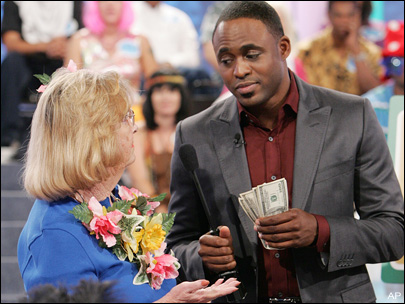
Wayne Brady withholds money from old white lady-you make up the caption!

Essentially the same programme from two parallel dimensions where the only difference is who people liked more on Whose Line is it Anyway?, these two shows feature audiences whose enthusiasm wouldn’t look out of place at the Nuremberg rally attempting to turn their capitalist pre-conditioning into prizes. In the former, incest love-child of Uncle Ben and Aunt Jemima Wayne Brady sells the public toxic assets while looking offscreen for his credibility. The latter has the master of weight-to-spectacle ratio Drew Carey rewarding conspicuous consumption. Brady’s fancily dressed studio audience appear to have been plucked from a Twilight Zone episode where it’s Halloween every day and Carey’s contestants are so elated by being selected you’d think the alternative was The Running Man.

The Winner is: Free enterprise.

The Loser is: Market regulation.

Returning Contestant?: Until the gym shows something other than Bones.


The Taste (ABC, Thursdays)

‘Ok is it an animal that flies or grazes?’

It’s quicker to replace the word ‘voice’ with ‘taste’ and apply everything you know about NBC’s The Voice than to describe this primetime cooking competition. Plagiarism aside, The Taste is closer to the spirit of the blind judging concept than its sensually conjoined twin, which has ironically produced more conventional-looking winners than the image-obsessed American Idol. The judges continue to taste blind even after selecting their teams, which often results in publicly humiliating their protégés. It also reveals the astoundingly poor palettes of those in the food industry, as they bemoan the lack of protein in desserts and consistently lose at ‘guess the animal’. The lack of prejudice in the selection process is offset by the judges’ freely expressing their sexism and dietary bigotry.

The Winner is: Whoever gets the leftovers.

The Loser is: Any vegetarian.

Returning Contestant?: For as long as Anthony Bourdain is there.


The Biggest Loser (NBC, Tuesdays)

‘Why do I have to have my shirt off again?’

One mustn’t scoff at an American game show where the prize is better health instead of more stuff. But don’t be naïve enough to think this is public service television. Underneath the noble purpose is a ‘watch fatty jiggle’ voyeurism which forces contestants to turn their bodies into freakshow curiosities before losing weight. The show is padded with needless challenges and needlessly complicated rules tenuously linked to some sort of obesity fable that only makes weight loss harder and more arbitrary. And if the thing you need to lose weight isn’t made by a sponsor, forget it. The ongoing weight loss is undoubtedly a serial hook here, and the perverse satisfaction of seeing a body waste away is what keeps you coming back.

The Winner is: Subway.

The Loser is: Whoever Subway’s competitors are.

Returning Contestant?: Either that or my TV’s screen ratio keeps changing.


The Bachelor (ABC, Mondays)

‘I need that in the form of a question’

If the holiday you won on a game show turned out to be to a leper colony or the games room you risked everything for was just Ker-Plunk in a box, you probably wouldn’t go back as a contestant. However, despite former ‘winners’ chalking up an abysmal tally of estrangements, broken engagements and divorces, people keep wanting to be and wanting to be on The Bachelor(ette). Even having been a contestant seems to be life-threatening these days. Unlike other game shows, The Bachelor(ette) likes to invite its losing contestants back to occupy more senior roles in the programme, like Juan Pablo who was sent home in a previous season and is now the bachelor. It’s like losing Final Jeopardy and then next day replacing Alex Trebek.

The Winner is: Rose-growers.

The Loser is: Divorce statistics.

Returning Contestant?: I’ve watched so much I’ll be the next bachelor.

Orange is the New Flashback

Posted in American TV (General), American TV Shows, Internet TV, Reviews, TV channels, Watching TV with tags , , , , , , , on January 7, 2014 by Tom Steward

In retrospect Lost ruined American television storytelling. Despite the unbeatable meat locker premise of plane crash survivors trapped on a desert island, the series was an exercise in turning story back to front. Each episode was padded with extensive flashbacks detailing the lives and backgrounds of each character which would routinely distract the series from its primary location and central conceit. In periodic flashback, the writers had discovered a structural ploy that could get them out of having to do character development and exposition in the screenplay. US TV writers have been using these throwbacks ever since the success and acclaim of Lost made it acceptable to do so and they are now synonymous with quality. Today you’d be hard pushed to find an American TV drama (and non-studio comedy, for that matter) that doesn’t have flashback hard-wired into its format. Lurching into the past occurs so regularly in the course of coveted TV series such as Breaking Bad and The Walking Dead that it begins to look like a sophisticated way to tell stories.

Lost in the past?

Flashback-in-the-pan storytelling has reached new extremes in the Netflix original series Orange is the New Black. Like Lost, the series has a genre setting-the prison-which can create a self-enclosed world for the drama to play out in. And Jenji Kohan’s series seems equally determined to throw away this potential with lengthy origin stories for each prisoner propping up the episodes. But Orange is the New Black puts the cart before the horse like never before. We’re barely allowed to glimpse inside the walls of the prison before we’re in the televisual time tunnel witnessing protagonist Piper’s road to incarceration. To add insult to injury the life events we’re seeing are not so idiosyncratic as to be completely unimaginable by the (presumably free-thinking) audience. I can figure out in my head what Piper coming on to the idea to make and sell artisanal bath products with her sister looks and sounds like as a dramatic scene. All I need is the knowledge of it. Most subsequent episodes begin with prisoner origin stories instead of the prison.

You’ll see more of the prison here than in the pilot!

This is undoubtedly the culmination of nearly a decade of bumping backstory upfront but it’s also a by-product of Netflix viewing practices. With Netflix series, all of a season’s episodes are released to subscribers at once. Producers and writers have to assume that there are significant numbers of viewers who will consume the episodes in one go. With this in mind, it might be deemed more important to give the audience something to go on to rather than something to go on. With a week (or more) separating each episode of a network-aired series, single instalments must deliver a gain or development of substance to keep viewers going in the meantime. Not so much for Netflix which puts no delays in front of ongoing viewing and hence never has to get anywhere by the ends of episodes. Orange is the New Black can then afford to indulge in flashback as the prison story may be told piecemeal without incurring the same frustration it would in a series where viewers have to wait for new episodes.

Cards on the table. I’m prejudiced against TV using flashbacks to tell stories. It’s so normalised in American TV now that most viewers probably don’t notice, or don’t find it that disagreeable. But I don’t like it because I think it’s a cheat. To put something back in that’s been forgotten about or not properly realised at a later date is fine, as long as it’s a heartfelt apology. To do it with the pretence of complex storytelling, as if it is somehow a better alternative to writing a screenplay properly in the first place, is just dishonest. Used sparingly and as a last resort for conveying information, I think flashback can be massively effective. The governor of all prison dramas Oz had flashbacks to the crimes of all the inmates as they were introduced, but in uninterruptive 10-second blips with startling power and minimum story drag. The Sopranos saved flashbacks for life events that had just been recovered in memory or for moments too painful for characters (or viewers) to endure at the time.

Oz: a prison drama…in prison.

Now that flashbacks are inextricably bound up in what we think of as good television and are favoured in the ascendant Netflix model of TV viewing, American television storytelling is only going to get worse. My only hope is the linear becomes fashionable again when TV flashbacks finally become passé.