Archive for the TV Acting Category

In With The Who

Posted in Americans watching British TV, British Shows on American TV, TV Acting, TV History, Unsung Heroes with tags , , , , , , , , , on October 1, 2014 by Tom Steward

Here we go again! In August, Peter Capaldi replaced Matt Smith in the iconic title role of the British family science-fiction series Doctor Who, a programme that’s changed actors more times than a Mindy Project midseason re-tool. Capaldi is joint-oldest to play the part with the Sean Connery of Doctors William Hartnell. His age, along with his otherworldly physicality and fannish investment in the history of Doctor Who have led some to assume that Capaldi will resurrect some of the mystery, mastery and manipulation seen in the earliest incarnations of the character. While this is undoubtedly the case, it forgets that Matt Smith’s performance – an actor nearly half Capaldi’s age – was always pushing in that direction, even if the writing for him was not. Smith had managed to convince us that age was no obstacle to playing The Doctor. Now it seems the show is happy to pass The Eleventh Doctor off as some reckless young buck to help viewers come to term with an older Twelfth. It’s double standards, and a very dangerous game!

Who Needs You?

Who Needs You?

Capaldi is probably the best actor to have played the role, and I don’t say that lightly. Unlike Christopher Eccleston – another actor I admire greatly – he also seems a comfortable fit for the role. But essentially this is a repeat of what Doctor Who did in introducing Colin Baker as The Sixth Doctor; a more sinister, less personable variation on the character. Despite Baker’s best (and loudest!) efforts, it was a sea change they were never really able to pull off. So is the show making the same mistakes as before? Short answer: No. Long answer: They’re making different mistakes. This time, the writers have remembered to round out the edges of the character early on, rather than leave character development for a time that may never come. However, somebody needs to tell Steven Moffat that the moral ambiguity of a character is best represented in their actions not in constantly talking about how morally ambiguous they are. Hence, genre pieces like ‘Robot of Sherwood’ and ‘Time Heist’ have been this season’s most successful episodes.

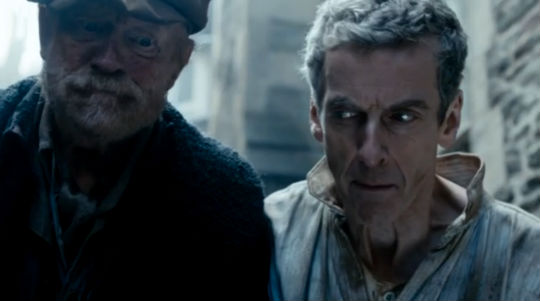
We’re halfway through Capaldi’s first season and it’s hard not to notice the discrepancy between the quality of his performance and the material he’s given. As the absurdist, Godot-like vignette between The Doctor and a Victorian tramp in debut ‘Deep Breath’ indicated, Capaldi’s actorly flow offers new dramatic possibilities for the programme (and puts the show’s use of Eccleston to shame!). But there’s only so much even the finest actor can do when compelled to speak in Moffat-ese baby talk for the majority of episodes, although the head writer has shown some restraint in contracting his idiomatic ‘thingy’ to ‘thing’. Moffat presents the biggest obstacle to Capaldi’s success. Now micro-managing most of the season’s scripts, in addition to several of his own sole pen, the same laziness and hackery that beset Smith’s tenure is already starting to permeate Capaldi’s after only five hours of television. While Capaldi is completely fresh, Moffat’s schtick after five years as showrunner is tired, and tiresome; never more evident than in laborious, tenuous allusions to a familiarly mechanical-looking season arc.
Waiting for Who?

Waiting for Who?

There’s dead weight in the cast too. I sincerely hoped that the character and performance of companion Clara would improve once she was released from her status as story point in the ill-advised ‘impossible girl’ arc. But between the clipped, garbled diction of the dialogue and exponentially annoying inflections of actress Jenna-Louise Coleman (and the smugness…can’t get over the smugness), she’s a lost cause. I’m glad the writers haven’t resorted to the bickering married couple dynamic that made The Doctor and Peri’s TARDIS scenes so unwatchable, and I’m grateful for the buffer that teacher Danny Pink (a considered performance by Samuel Anderson) provides – yes, if there’s one thing Moffat can write well it’s awkward men! But as long as Clara’s the main focus of Doctor Who, which she is more and more since the show revived the autonomy of The Doctor’s companions, it’ll always feel like there a little Moffat running around in the world of the programme. It also doesn’t help Capaldi that the writers insist on keeping the spectre of Matt Smith around.

Doctor Who has always surrounded new Doctors with familiar elements of the series to cushion viewers in times of transition. Indeed, this season began with a Victorian-set adventure featuring the ‘Paternoster Gang’ who were regulars in Smith’s era. But Moffat went so far as to have Smith in the episode (calling Clara from the past) and allusions to the actor in later episodes. As wonderful and apposite as these moments are – because they feature Smith – they’re holding viewers back from really embracing Capaldi’s Doctor. You begin to suspect that Moffat’s vanity is partly behind this effort to build a dramatic whoniverse unified around his time as showrunner. Prior to his debut, I suspected that Capaldi, an Oscar-winning director no less, might excise a little more control over the show than befits his brief, as did auteur Orson Welles who liked to put scare quotes around the term ‘actor’. I can see Capaldi’s influence on the change in pace, the contraction of melodrama, and even the language…in that it sounds like language! Long may it contin-who.

One Pundred Hosts (Without Typos Or Cheap Puns)!!!!

Posted in American TV (General), American TV Shows, Americans watching British TV, Behind-The-Scenes, BiogTV, British Shows on American TV, Reality TV, Reviews, TV Acting, TV advertising, TV channels, TV Culture, TV History, TV Sports, Watching TV with tags , , , , , , , , , on September 3, 2014 by Tom Steward

We’re into syndication! With 100 blogs under my belt, I can now sell the rights to the A.V. Club who will publish the same three posts over and over again – with every third sentence removed – for the next twenty years. In the true spirit of American TV, I’ve decided against celebrating this milestone with a piece of considered, original writing (why break with tradition now?) and instead hastily assembled and artlessly compiled a list of extracts representing the best (or at least most comprehensible out-of-context) of the blog…and split it into two parts. Thanks for watching and enjoy!

A specially-created TV series just for this milestone!

A specially-created TV series just for this milestone!

‘Years previously I used to run on the spot along to chase sequences in cartoons like a dwarf soothsayer doing a dance prophesising the age of TV interactivity’

‘My friend openly admitted to finding the slapdick (my term) comedy of the three hosts hilarious, commenting that “we don’t have people like Clarkson on American TV”. “Fox News” I thought, but didn’t say’

‘So shifting viewing an hour or two to make way for a pizza is not exactly the end of television’

‘Yes, Chantix is apparently not just a wonder-drug but a porthole into an alternative universe of Marxist dialectic or, if that’s too posh a reference for you, the Bizarro World’

‘All my morning shows on the day of the Royal Wedding were attended or discussed by the hosts with a bizarre royalty-envy that ill fits a country founded on telling the King of England to fuck off’

‘After weeks of sounding like a malfunctioning motivational speaker robot, Celebrity Apprentice contestant and consecutive mental-of-the-week Gary Busey was appointed project manager on a task’

‘For G, it was as if Britons had collectively decided to substitute a working TV set in the corner of the room for a 19th Century ventriloquist dummy with its mouth sprung to repeatedly gawp the word “Mummy”’

‘When war “came to Downton Abbey” it went by so fast that it seemed to have actually been fought in the grounds of the building, like a game of Risk gone awry’

‘Now I’m starting to think that I was in some sort of hallucinogenic fever state the night before because I could’ve sworn I saw Hollywood actor-director Clint Eastwood hold a conversation with a chair while an audience of magenta elephants cheered him on’

‘TV Land is where sitcoms and their stars go to die’

'Memba them?

‘Memba them?

‘After prolonged exposure to American TV news, however, I now long for a token alternative viewpoint and the masquerade of even-handed commentary’

‘Watching a Halloween-themed sitcom episode used to be like watching film footage of Hitler’s speeches; unimpressive and kind of shambolic and yet those in the crowd seem to be going wild for it’

‘Like anything in life which I have no direct experience of, I looked to American TV for advice on how best to handle the situation’

‘All I found on The Travel Channel were programmes about the excessive intake of high-calorie foods which make Americans less able to move. When I turned over to The Learning Channel I saw wall-to-wall programming about people without formal educations’

‘I’m sure Harry Enfield will be relieved to know that after decades of writing and performing some of the best character comedy and social satire in Britain he is finally known in America…as a talking gnome with goggles’

‘But a 3 hour serialised pilot? It’s like the feeling you get ordering a starter of garlic bread with tomato and cheese in a pizza restaurant. It’s enjoyable and you wanted a starter but it’s also what you’re getting for the main course’

‘I mean, what exactly is gained showing Goodfellas at 2 in the afternoon?’

‘It seems that if reality TV was more like reality, with all its loose ends and uneven surfaces, fans of the genre wouldn’t necessarily want to watch it’

‘Early in his career, artist Roy Lichtenstein produced a series of paintings based on advertisements. In one of the great cultural ironies of our times, advertising started appropriating Lichtenstein’s paintings. Something similar is going on with Mad Men

‘To those who know football from the European or Latin American leagues, watching a US soccer team play feels like the moment in Futurama where Fry finds that in the 30th Century baseball has become ‘Blernsball’, a barely recognisable Twilight Zone twist on the sport where spectators try to catch players instead of balls and giant spiders roam free through the diamond’

‘It’s a perfectly normal road to marriage…if you’re James Bond’


Robin’s Best

Posted in American TV (General), American TV Shows, BiogTV, TV Acting, Unsung Heroes with tags , , , , , , , , , on August 20, 2014 by Tom Steward

Since the untimely death of comic and actor Robin Williams last week, I’ve been looking back at his performances on television. I’ve been continually surprised and impressed at how as a sitcom actor, guest star and chat show guest he was able to take command of the medium, especially as Williams’ talents were always thought best suited to the dynamic scope of cinema and unbridled spontaneity of the live stage. I was struck by how he accommodated his manic act and style to the contours of the small screen, used television to test his mettle as a character actor, and realised TV’s capacity for intimacy to bring his audience closer to Williams the man. The passing of James Garner, Lauren Bacall and Robin Williams in the past weeks is worsened by the knowledge that all were unusually good at doing television and have been lost to more than art form.

Mork Who?

Mork Who?

The significance of science-fiction sitcom Mork & Mindy to Williams’ career seems to have been regarded by most obituaries I’ve encountered as simply his stepping stone to popular exposure. This assumption drastically underestimates how important the role of Mork was to Williams’ development as an actor. In it, he learned to temper his aggressive bombardment of the audience with pathos thanks to the show’s romantic core and fable quality, a balance that would come to define his movie persona (and one that when tipped would sink him artistically). The sitcom wasn’t always the lightweight fantasy people perhaps remember, more Twilight Zone than Bewitched (if Williams’ catchphrase humming of the anthology’s theme tune wasn’t enough to sway you). There was hard science-fiction in there, unsettling biological imagery, and hard-hitting issues like mental illness and addiction. Seen now, Mork & Mindy prepared Williams for darker material he later turned his hand to.

Williams’ portrayal of Mork had an enduring impact on science-fiction television. Watching episodes of the series now, particularly when Mork is in his formal bow-tie and suspenders, I couldn’t help but think of Matt Smith’s incarnation of time-travelling extra-terrestrial The Doctor in Doctor Who. Common to both performances is the essential idea of a character who is not alien in appearance but in his social naivety, fashion missteps and absurd physicality. The success Williams achieved in depicting an otherworldly strangeness and difference without the aid of make-up, prosthetics or effects must have been a boon to anyone wanting to make science-fiction within a budget-dependent TV format. It took a concept as extreme as alien visitation to contain a freestyling comedian like Williams within a studio sitcom, but at its heart Mork & Mindy nailed that mix of the fantastical and the mundane that distinguishes all good and great science-fiction TV.

Williams was deep into his acting career before he started to take on purely dramatic parts, even though the ability to play emotion straight in his early movies was crucial to their appeal. However, years before his acclaimed deadpan turns in Good Will Hunting, Insomnia and One Hour Photo, Williams played a tourist whose wife is shot on the streets of Baltimore in an episode of complex cop show Homicide: Life on the Street. Williams’ demonstrated ability to completely disappear into a character without a trace of his conspicuous comic persona left really opened the industry’s eyes to his value as a serious actor. The gut-wrenching emotions experienced by his character were performed credibly, and without fuss, which undoubtedly marketed his ability to do strong emotion well. Thought something he and his directors did not always taken advantage of, it nonetheless signalled that he was a rounded actor of range.

Robin, Robin, Robin, Robiiiiiin!

Robin, Robin, Robin, Robiiiiiin!

I’m grateful to OWN for repeating full versions of interviews with Williams from the ‘80s and ‘90s on The Oprah Winfrey Show. Not only is it apparent that Williams’ could transcend limitations of television space and time, no matter how cardboard the set and videographic the production values, it is also notable that when disarmed with Oprah’s frank questions about his personal life (she was a different proposition as interviewer in those days!), he can exploit the potential for television to be a confessional medium to admit to a darker side to the always-joking persona he presented in public. Clearer than in any other medium, TV was privy to the qualities of Williams’ personality that would eventually consume him. One of William’s last TV appearances on Louis C.K.’s signature sitcom Louie cemented his legacy as a character actor, playing a fictional creation in a show full of comics playing themselves.

Garner, But Not Forgotten

Posted in American TV (General), American TV Shows, TV Acting, TV advertising, TV History, TV News, Unsung Heroes with tags , , , , , , , , , on August 6, 2014 by Tom Steward

Sometimes I think I shouldn’t stop writing this blog as it seems that whenever I do someone significant to TV dies. This time, though, ‘significant’ doesn’t cut it, and all superlatives are understatements. It’s difficult to quantify what James Garner – who died of natural causes this July at the age of 86 – meant to television. Not only was he around during TV’s formative years and helped the medium come of age, he had the rare distinction of playing two of the greatest characters to ever grace the small screen. Obituaries both written and forthcoming will doubtless talk about what an incredible movie star Garner was (and indeed he was) but I always thought there was a certain dailiness about his performances that made him perfect for television, and may help explain why he kept returning to TV while his film roles continually deflated the grandiosity of the cinema.

A TV Maverick.

A TV Maverick.

Garner’s first major television role was drifter gambler Bret Maverick in Warner Brothers’ western dramedy series Maverick, which he played throughout the late fifties. The show is a one-word argument against FCC chairman Newton Minnow’s notion of TV in that era as a ‘vast wasteland’. It was anti-formulaic, adult, challenging and irreverent, and Garner’s humour, bathos and moral ambiguity in the part had a lot to do with that. Essentially a thinking man’s riposte to the branding-iron western TV series (they didn’t have cookie-cutters on the frontier!) that overpopulated the networks at the time, Maverick was an early indication of the quality of television that could be achieved working within popular genres. While Bret Maverick certainly paved the way for television antiheroes like Tony Soprano and Walter White, Garner saw him more as a ‘reluctant hero’ and played it accordingly. It was that kind of nuance that made the difference.

In Garner’s 2011 autobiography The Garner Files – itself a classic in literary understatement – the actor’s usually low-key prose cannot downplay the importance of Maverick to the TV of its day:

‘In its own way, Maverick was “anti-establishment”. It gave voice to viewers’ dissatisfaction with the predictable, button-down TV of the ‘50s, with its black-and-white morality. Maverick explored gray areas by questioning the authority of the conventional Western hero. After Maverick, it was hard to watch those steely-eyed cowboys without laughing.’

It’s worth remembering that fifties American TV was highly praised for its character drama in anthology form like Philco Television Playhouse and Studio One, and so to offer this kind of psychological complexity in the form of a western series – more often regarded as the cultural antithesis of the anthology drama – was radical. It also showed that TV could do something worthwhile with the western formula.

That would be enough for most actors, but unbelievably Garner did it all over again as every-slob private eye Jim Rockford in Universal’s detective series The Rockford Files which ran throughout the late seventies. One of the most perfectly-made shows in television history, Garner’s lastingly lovable lead performance put it over the top, and into perpetual syndication. The actor’s iron rule over his Cherokee Productions also ensured that Universal never dragged the show back to the studio lot, and kept it as freewheeling as the Southern California locations we saw onscreen. The Rockford Files’ tone-perfect medley of comedy, drama and thriller was a template for quality US television to come, and all that was there in Garner’s performance. Never humourless nor too frivolous; a hero you could believe in because he didn’t believe in it himself. Unlike most sanctimonious American TV protagonists, Garner never pretended Rockford wasn’t out for himself.

Rockford of Ages.

Rockford of Ages.

Despite a string of memorable and game-changing performances in a host of movies, Garner always went back to TV in the end. Whether it was the Rockford Files TV movies (which, oddly, didn’t disgrace the original), a series of beloved Polaroid commercials with actress Mariette Hartley harking back to the repartee of romantic screwball comedies, or replacing the late John Ritter as the patriarch on sitcom 8 Simple Rules. Rather than trashing television as so many Hollywood movie stars have, he decided instead to make it better, either by seeking out the best material or improving drastically on the worst. After Garner was through with television, it didn’t look like there was a distinction between TV and the movies any more. It would be impossible to find two better performances in television than Bret Maverick and Jim Rockford, but James Garner always meant more than the sum of his parts.

Jumping Jacks & Sharks and Recreation

Posted in American TV (General), American TV Shows, TV Acting, TV channels, TV Culture, TV History, TV News, Watching TV with tags , , , , , , , , , on May 8, 2014 by Tom Steward

Recently I’ve been thinking about the phrase ‘jumping the shark’, which is TV-speak for when something happens in a TV series that precludes any subsequent developments from being taken seriously. The term derives from a scene in the fifth-season premiere of 1950s-set American nostalgia sitcom Happy Days in which Dad-aged TV surrogate of cool The Fonz jumps over a shark on water-skis. The phrase did not come into popular usage until the late 1990s – twenty years after the episode aired – when radio and web personality Jon Hein compiled a list of TV shows that declined badly in quality on his website jumptheshark.com. It’s been on my mind because the condition seemed to be peculiar to television series, especially the American ones that go on too long, and yet lately I’ve heard ‘jumping the shark’ used in connection to all walks of life. Also, there are some shows currently on the air that reminded me how easy it is to ‘jump the shark’. Can shark-jumping apply to anything but television and what does it mean for a TV show when that fin appears above the water?

Choppy Days!

Choppy Days!

First of all, it’s unfair to implicate Happy Days in this phraseology. People didn’t watch Happy Days for realism but rather nostalgia, kitsch and fun. The series always had room for flights of fancy, like the special science-fiction episode which introduced Robin Williams’ alien Mork to TV. If we were to go back and coin another phrase that better describes what we’re talking about, we might go instead with a reference to a show that genuinely lost its way. We could talk about TV shows that ‘found a dead man in the shower’, recalling the time that super-soap Dallas made an entire season worth of episodes a dream in order to bring star Patrick Duffy back from the dead as Bobby Ewing. The producers of Dallas forgot that just because melodrama isn’t always convincing, it can’t simply be nonsense. We might even say that a series has ‘won the Illinois lottery’ in lieu of the lottery win which made the working-class Conner family in the sitcom Roseanne into millionaires for the entirety of the final season, duly sabotaging the show’s uniquely stark and undiluted portrayal of blue-collar life.

A couple of weeks ago I heard Dancing with the Stars host Tom Bergeron use ‘jumping the shark’ in reference to social media when describing the show’s ‘shirt on/shirt off’ Twitter voting campaign for one of its male dancers but not, strangely, when discussing the tanking ABC series Agents of Shield. In his casually amazing stand-up special Obsessed shown on Comedy Central over Easter, comedian Jim Gaffigan accused Yum Yum Donuts of ‘jumping the shark’ on business names. Apparently, the phrase has been widespread in media, business and politics for years now. There’s not really much you can do once a phrase has infiltrated popular culture (or we’d have redacted ‘selfie’ from history by now), but we should remember its roots in TV. TV shows don’t ‘jump the shark’ intentionally but as a symptom of a worn-out format, a capitulation of principles or a desperate need to survive. So much of American TV is about keeping shows on the air at any price and prolonging their natural lifespan that ‘jumping the shark’ is inevitable, and much more so than in other forms of culture.

Sitcom of the Future?

Sitcom of the Future?

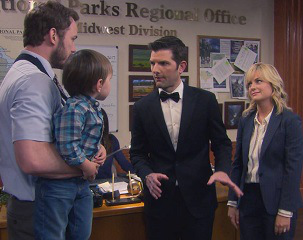
Season six of docu-sitcom Parks and Recreation recently had its finale and in its final few seconds arguably lost all credibility as a sitcom grounded in contemporary reality. From this point on, we’ll be watching a sitcom set in the projected near future, and nothing can undo that. This all happened for the sake of resolving story problems that the writers had themselves created and a few discontinuity gags. It’s pretty clear that a TV show doesn’t need a grandstanding spectacle to ‘jump the shark’; it can do it casually under viewers’ noses. This week marks the return of 24, which probably holds the water-speed record on shark-jumping throughout its previous eight seasons of amnesia, faked deaths, nukes and conspiracies. Yet audiences still bestow the show with the legitimacy that graced its first, and only truly believable, season. There are even websites that count the number of times a TV show has ‘jumped the shark’ during its run. Even though we may assume a show can’t come back from ‘jumping the shark’, clearly it can and we might just have to accept that it’s something that happens organically to TV shows.