Archive for the TV advertising Category

Mad Men, Crazy People And Invented Lies

Posted in American TV (General), American TV Shows, TV advertising, TV History with tags , , , , , , , , , on April 9, 2015 by Tom Steward

When I’m put in mind of advertising – which this week’s return of Mad Men for the final time has done – I think about two great gags in two terrible movies. The first is the direly offensive mental illness comedy Crazy People in which an advertising executive played by Dudley Moore is sent to an institution after writing honest campaigns for clients’ products. These include ‘Buy Volvos. They’re boxy but they’re good’, ‘Jaguar: For men who’d like hand jobs from women they hardly know’ and ‘United: Most of our passengers get there alive’. The second is Ricky Gervais’ tedious The Invention of Lying about a parallel reality where everyone tells the truth. So the TV spots for Coke have spokespeople saying ‘it’s basically brown sugar water’ and bus ads for Pepsi read ‘When there’s no Coke’. The use of real brands suggests this is as much a creative solution to product placement as a satire of it (and The Invention of Lying has plenty of unchallenged advertising throughout). On one level the joke is simple irony; ads tend to be dishonest so inverting this is subversively funny. But on another, the gag rests on the fact that these are legitimate alternatives to deceptive advertising. The twist in Crazy People is that the public prefer this style of advertising, and Dudley Moore is quickly hauled back from the institution. Depicting the products self-critically doesn’t make them off-putting in any way or at all harm the brands, and real advertising executives know this.

...except Dudley Moore

…except Dudley Moore

The delivery chain Domino’s Pizza based an entire campaign around apologizing for the poor quality of their product, even including negative comments from social media in their ads. Dated electronics store Radio Shack launched a series of ads called ‘The ‘80s want their store back’ in which various celebrities from the spandex decade, such as ALF, Hulk Hogan and Cliff from Cheers tear the antiquated shop floor apart. Where these campaigns differ from the ones in Crazy People and The Invention of Lying is that the former insist things are going to change, while the drawbacks of the products advertised in the latter are inherent, tolerable and even desirable. The notion that ad executives can pull off this complex interplay of tone and address is at the heart of Mad Men’s somewhat utopian vision of the advertising industry. Yes, only a handful of creatives who work at an agency containing the names ‘Sterling Cooper’ seem to get it, but from the beginning Matthew Weiner always insisted that the art of advertising was to turn disadvantage into a unique selling point. In the pilot, Don Draper tells the Lucky Strike owners that federal rulings on the dangers of smoking put them on a level playing field with their competitors since no-one can brand their cigarettes as safe anymore.

In honour of Mad Men and its comic forbearers, here are a few of my own campaign slogans telling the truth about a brand in a way that makes you admire their forthrightness:

Peroni: Disgusting with anything but pizza.

Taco Bell: We do to Mexican food what Robocop did to Officer Murphy.

Wells Fargo: With ATM charges like this, you know your money’s safe.

McDonald’s: There’s too many reasons to hate us, so save yourself the trouble.

Cox: The alternative is just as bad.

Little Caesar’s: Working around the craft of pizza-making since 1959.

Amazon: We’re going to send you a package anyway, so you might as well order it.

Disneyland: Once upon a time…when infant mortality was higher.

Carl’s Jr.: Women lose rights in every bite.

Uncle Ben’s: For when convenience beats out white guilt.

Nescafe: What’s the use of ethics if you’re not awake to have them?

Amtrak: Inconvenient and expensive but what else would we do with the tracks?

Stella Artois: For the continental wife-beater in you [this is only marginally more honest than the brand’s real slogan ‘Reassuringly expensive’]

Chik Filet: You have homophobes in your family whose chicken you eat!

Google: The thing you type because it’s the thing you type.

San Pellegrino: Brine never tasted so good.

Apple: You buy it, you break it.

Starbuck’s: Hatred for us distracts you from worse inequalities.

PayPal: We won’t tell you how we make money if you don’t.

Bud Light: It works better as a light than a beer.

Esurance: We stopped John Krasinski from making more shitty movies…you’re welcome!

Yahoo: You have an email with us to get an extra Twitter account.

Twitter: Keeping Yahoo in business since 2008
Equal Opportunity Knocks

Posted in American TV (General), American TV Shows, Behind-The-Scenes, British Shows on American TV, Reality TV, TV advertising with tags , , , , , , , , , on March 25, 2015 by Tom Steward

If there’s one thing Dancing with the Stars is in dire need of – apart from a decent house band, a competent co-host and, y’know, stars – it’s an equal opportunities seminar. I don’t know how many sensitivity courses you’ve been on, but they’ll all tell you (and if they don’t you should) that equality isn’t about treating everyone the same. One of the best teachers I ever had, the film writer and sociologist Richard Dyer, once explained equality to me using male and female public toilets. Men rush in and out, while women take longer. So while giving men and women a bathroom each with the same number of facilities might superficially seem to be giving them identical resources, the sexes are not being treated equally.

I'll give it 5.

I’ll give it 5.

This struck me two seasons ago when Judge Len Goodman told contestant Amy Purdy, who has prosthetic limbs below both knees, that he was going to score her like everyone else in the competition, and that she’d prefer it that way. For the entire competition, Purdy was judged against able-bodied dancers (and Billy Dee Williams) rather than on a scale of achievement that befitted her unique body type. It wouldn’t have been easy for the judges, especially as Purdy herself kept changing the rules of what was possible with her body week by week, but they never had any intention of taking her different abilities into account. To not even attempt this, and to assume Purdy wanted this kind of judging, is to ignore equality.

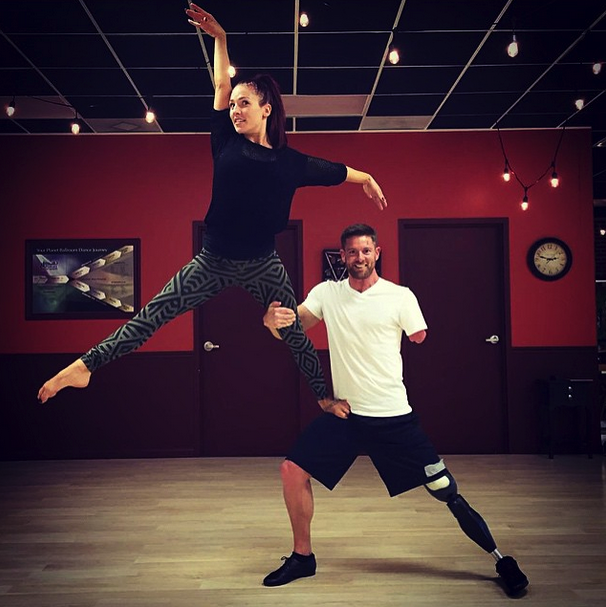
The Judges have continued to score disabled contestants in this fashion, even when they are physically prevented from competing at the same level as the other dancers. This season features Noah Galloway, who has both his left leg and arm missing. While the Judges are happy to gush and cry for the cameras over Galloway’s overcoming of the odds (and he’s a veteran too, so nothing but conspicuous sentimentality will do), they give him decidedly average scores, reminding us that that they are painting two more limbs on his body in their minds. The Judges’ rhetoric seems to have some idea of how equality works. Carrie Ann Inaba talked of how Galloway ‘challenged’ her judging. But there’s no evidence of this in the competition itself.

But Dancing with the Stars is already a show that seems designed to give Shami Chakrabarti nightmares. It asks people of different ages, genders, bodies and professional dance experience to compete against each other, with no consideration given to how there should be different judging criteria for each group. Doubtless there is some ideological undercurrent of the cream rising to the top regardless of adversity here and whoever said entertainment was a level playing field? However, if the show wishes to bask in the glory of giving a national TV platform to minorities and a diverse range of people (as it has referred to itself doing on several occasions) it cannot simply work around the fact that democracy is just as much about positive discrimination.

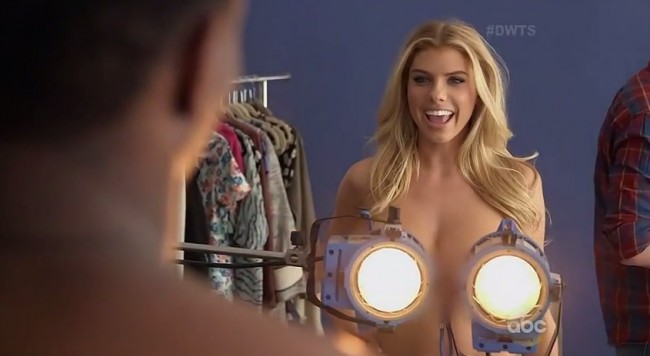
I’ve talked about the show’s objectification of female bodies before – and it’s getting no better – but in recent weeks we’ve actually seen feminist perspectives on Dancing with the Stars being written off live on air as ‘cyber-bullying’. Contestant Charlotte McKinney received harsh criticism and, let’s face it, personal abuse from social media after the star of sexist Carl’s Jr. commercials appeared in the season premiere. Her experience was the basis of the pre-dance ‘package’ (although why we have to all use the industry term here, I don’t know) in Week 2 and following her dance, the negative Twitter comments read-out on air were all dismissed as body jealousy by the judges Julianna Hough and Bruno Tonioli and then as body fascism by co-host Erin Andrews.

Benny Hill guest-judges on DWTS!

Benny Hill guest-judges on DWTS!

Now, I’m not saying that the sinister forces of the internet comments feed weren’t at work here and I don’t approve of targeting someone who is as much a victim of the sexist culture as the women it leaves out (as opposed to, say, the people who sit down and write the Carl’s Jr ads). That said, it’s clear to me that many of those comments, however personally directed they were, were aimed at McKinney’s participation in advertising that demeans and degrades women, and to disregard all the criticism directed at her as troll-grudge is to silence a protest against television’s ongoing celebration of women as sexual objects. Dancing with the Stars cannot continue to swim in these choppy waters without changing its body politics.

Bad Morning Television

Posted in American TV (General), American TV Shows, Behind-The-Scenes, BiogTV, Internet TV, Reviews, TV advertising, TV channels, TV History, Watching TV with tags , , , , , , , , , on February 18, 2015 by Tom Steward

It was upon returning to my hotel room at 5 in the morning after seeing some of the best and oldest bluesmen in Chicago and celebrating the existence of an L-train with a trip to a 7-11 to get some cheese-filled-bread (or bread-filled-cheese) with a side dish of whatever was left on the room service tray a few doors down and being confronted with the blurry, blobby outline of Tony Danza that I came to a grave realisation. In the land of 24-hour business, late licensing, and all-night dining, there’s nothing on TV in the middle of the night. So why have two major TV events recently debuted in the early hours of the morning?

Last November the comedy short Too Many Cooks aired around 4am during the infomercial block on Adult Swim, the late night version of Cartoon Network. A parody of both the opening credits of 1980s sitcoms and the insanely dark and genre-bending possibilities of TV comedy in that decade (and before you dismiss it as exaggerated, remember that ALF was dissected by the government in the finale), Too Many Cooks became a viral video smash and was repeated each day at midnight for the next week. The perverse choice of a graveyard slot more or less guaranteed the short’s success, not only because re-run and internet re-circulation was necessary, but also because there was no competition.

Adult Swim seemed to cotton on to the fact that there’s an undiscovered country of television between the hours of 1 and 6 in the morning. I understand why they’d want to be the pioneers, but I don’t understand why there’s not a frontier-style rush to claim territory from every other producer in TV. If the entertainment market is so damn saturated, why not get a head-start by putting out your show in the vast wasteland of unused hours in the TV day? For once, having a variety of media platforms to re-play TV on is a blessing, since audiences will need and want to see your show again once they hear they’ve missed out.

It’s surprising that the networks haven’t come to these conclusions already, since they’ve had such great success by pushing their best programming later and later in the evening. The 11 o’clock talk show is an institution that has spread to virtually every channel in the schedule and their midnight sister programmes aren’t far behind. This weekend NBC celebrated 40 years of Saturday Night Live (ironically on Sunday and in primetime), a show which begins at 11.30pm and runs to 1.30 in the morning. This isn’t, as I once thought, because Americans stay out or go to bed later, but because it’s untapped resources. In Britain at this hour, they start playing movies starring Eric Roberts.

And what if you actually need to bury a show? There was surprise in early February when FXX aired a pilot for a series based on the popular Wheel of Time fantasy novels by Robert Jordan at 1.30am. Not only do the books have a huge fan-base, but with Game of Thrones still going strong, there’s a deep well of fantasy (probably with a goblin in it) that everyone in TV can draw water from. It soon became clear, however, that the air time wasn’t a stunt to get the show ahead of the competition but to keep it firmly under the radar, being the best all-round solution to legal issues facing such a project.

The television rights to the books were to revert to a new owner on February 11 (two days after airing) and so the previous owners were probably trying to get something based on the books out on TV before that happened. Author Jordan’s widow has contested the claims of the producers to the rights and they are threatening legal action. Interestingly, FXX were able to offload responsibility by treating the pilot as ‘client-supplied programming’ i.e. an infomercial. If you’ve got a show mired in legal trouble, 1.30 in the morning is clearly the place for it. The Wheel of Time pilot used the early-morning hours as a dumping ground for toxic material but it still shares similarities with Too Many Cooks’ deployment of late TV.

Both programmes traded on the idea that anyone watching at that hour can’t be sure of what they’ve seen; one for comic effect, the other for legal protection. With each one, being mistaken for a promo or infomercial actually helped. It makes financial and creative sense. Why still the hesitation?

Bonus Ball

Posted in American TV (General), TV advertising, TV channels, TV Sports, Watching TV with tags , , , , , , , , , on February 6, 2015 by Tom Steward

I’m sure most of you are over The Super Bowl for another year (this really should be called ‘Watching TV after Americans’) but I’m far more interested in an aspect of the event that doesn’t change each year – although even for someone to whom ‘football’ means round balls and bad pies it was a pretty great game – which is the TV generated around it. The Super Bowl on TV seems never to start or end, making it the perfect metaphor for the medium. As it’s assumed that large portions of the nation are watching, which is no mean feat these days, The Super Bowl is a bat-signal for advertising. For the same reason, counter-programming decides to take one for the team, but those networks that try to take on The Super Bowl must do so in the most ruthless ways possible to even get noticed. This year, however, there were some added satirical bonuses.

http://www.youtube.com/watch?v=4WTA_8waxTo

I’m used to televised sporting events starting a few minutes later than advertised to sneak in a commercial break while everyone’s watching, but I was not prepared to be sitting on the couch at 3.30 still waiting for the game to begin. And for what? John Travolta’s Adele Dazi trying to break Bleedin’ Gums Murphy’s record for the longest rendition of ‘Star Spangled Banner’? The presentation of the NFL’s annual ‘didn’t rape or hit anyone’ award? Don’t we have a pre-show for this? The mechanics of modern television have manoeuvred themselves so that we are continually watching prelude. The Super Bowl goes one better and expects we will enjoy it. It’s moments like this which remind us that commercial television form is an integral part of the way that a game of American football is structured, rather than the British kind which is merely pricked around the edges by commercial interruption.

http://www.youtube.com/watch?v=hJou3cPN-NA

Commercials broadcast during The Super Bowl are notorious for being sexist, portentous and counter-intuitive. Half-time act Katy Perry clearly wanted to take some of the heat off the sexist commercials, but they were out in full force, not as well-disguised by nob gags as the advertisers clearly thought. Carl’s Jr. has even managed to turn gender discrimination into a branding mechanism for its Super Bowl ads. But this year they didn’t go unchallenged. Feminine health company Always ran a semantic deconstruction of the gender assumptions and discourses behind the phrase ‘Like a Girl’ while Saturday Night Live staged a fake Totino’s ad exposing the unbelievably narrow gender stereotypes and chauvinistic divisions of Super Bowl ads, particularly the archetypal representation of women as child-minded homemakers. Somewhere in the middle was Fiat’s ‘Viagra’ campaign which unironically presented pumped-up virility and machismo as a draw but also satirised male sexual prowess and the idealised feminine body.

Part of the fun of watching Super Bowl commercials is trying to figure out what product the pretentious pre-amble will eventually advertise (clue: anything combining ‘hard’ and ‘soft’ is deodorant). But sometimes the logic of ad writers is beyond even those who dissect media images for a living. A ghost-child commercial is the perfect vehicle for a leukaemia or cancer charity, but it does nothing to ameliorate the ghoulish undertones of an insurance company. Another insurance company, Esurance, seems intent on using circular logic and specious reasoning similar to the Johnny Cochran O.J. glove defence to convince consumers of its superiority to established rival Geico, but as long as that involves Walter White as a drugstore pharmacist I don’t much mind. If you tire of the commercials, you can switch over to The Puppy Bowl, Animal Planet’s re-imagining of The Super Bowl through the imagery of illegal competitive dog-fighting. For cute read irresponsible.

http://www.youtube.com/watch?v=7lcc62nrl9Y

As with SNL, the most authentic example of Super Bowl television was the least genuine. Key & Peele have always satirized American sport and its coverage, but with their simulated Super Bowl pre-show staged as a real network broadcast, it was far more than a send-up. There was plenty to ridicule: the ill-fitting suits of the former-pro presenters, the passive-aggressive banter, the live-action footer trails of network sitcoms always starring ‘Alison Janney’, and of course the beyond-hyperreal graphics with overly phallic connotations. But the real-time flow and denouement in which the digital robot mascot achieves self-awareness and propels humanity into a state of oblivion identifies The Super Bowl and its live, ongoing broadcast with a dystopian terror effect that reminded me of another piece of faked factual horror television, the one-off BBC drama Ghostwatch. There is something inherently wrong and otherworldly about TV’s broadcast of The Super Bowl, the same something as television itself.

The Music Box

Posted in American TV Shows, Behind-The-Scenes, TV advertising, TV channels, TV Dreams, TV History with tags , , , , , , , , , on January 15, 2015 by Tom Steward

Getting the music right is one of the biggest challenges in television. Sound itself is already incredibly important to the medium, having – unlike cinema – been built in to the experience of watching television from the get-go and, thanks to a broadcasting pre-history in radio, figuring just as if not more strongly than the image. What’s more, over the years we’ve relied more and more on theme music to arouse and sustain our interest in series, especially as they advance in years. With the title sequence becoming a developed art form in itself in the past decade or so, theme music becomes ever more important to what we make of individual shows. Attributing more creative license and worth to titling does, however, increase the capacity for error, and while the shows themselves can grow out of their teething troubles, misfiring opening credits will more than likely be there forever, as they are rarely overhauled, even in the most loathed cases. In this sense, HBO have produced both the best and worst TV music of all time.

God only knows why they picked that song!

God only knows why they picked that song!

There’s no question that HBO revolutionised title sequences in original programming like The Sopranos and Six Feet Under and helped to cultivate the evocative, expressive and complex opening credits we have today on other networks, such as the ones introducing AMC’s Mad Men and Showtime’s Homeland. But by inflating the status of the form, the network has also permitted some of the more indulgent and self-congratulatory examples of theme music, namely the excessively long and needlessly rocky fret-wanking that begins Boardwalk Empire. Normalising the elaborate title sequence has actually harmed the use of music in many shows. The Mormon marriage drama Big Love begins with a dreamlike title sequence employing the fantastic celestial imagery characteristic of the Church of Latter-Day Saints set to ‘God Only Knows’ by The Beach Boys. Both song and sequence are wonderful, but the images, and the polygamous culture behind it, corrupt the sincerity of what is perhaps the most elegantly direct statement of love in the history of pop music, retro-fitting it with unbecoming connotations not implied by the song.

Though I have yet to encounter anyone who has a problem with it, the theme music to Veep really annoys me. For such a sophisticated satire to perform such a perfunctory send-up of the sounds of televised US politics – like one of those Casio-keyboard comics of the last decade – is unacceptable to me, particularly given the Altmanesque sound editing in the rest of the episode. So brilliant is the sitcom in every other aspect that it shouldn’t matter, but that’s the curse of bad music in a good TV show. It’s unlikely to change or go away any time soon. You’re going to have to accept it as a penalty for every viewing. While shows can supplement their titles, it is unusual for them to be abandoned altogether regardless of their success, partly because of the greater and greater expense associated with devising them and also because it is the spearhead of the show’s branding and can no more easily be changed than its entire marketing campaign. It’s clear why pilots tend not to bother!

A lot of what music you hear depends on where and how you watch a TV show. If you saw medical drama House outside the States, you wouldn’t have had the pleasure of hearing Massive Attack’s ambient masterpiece ‘Teardrop’ over the opening credits but rather the tail-end music of each episode transferred to the top. It’s an international rights issue, not an aesthetic choice, but the power and beauty of that title sequence lies largely unsung without it. If you were watching an internet version of NBC’s Parenthood you wouldn’t always get the irreplaceable, class-setting theme song of Bob Dylan’s ‘Forever Young’ but a preview of the hipster warbling that haunts the annals of the incidental soundtrack. Without this introduction, it seems a show deficient in history or culture beyond a few ephemeral local musicians on the present scene. What is even sadder than the deprivation is that you are unaware of the loss until educated otherwise. It’s an audio version of how TV – by its own machinery – prevents viewers from witnessing the true text.

May you stay forever Dylan!

May you stay forever Dylan!

The more that title sequences become indispensable to the shows they herald, the more that theme music is going to matter. Unlike the ever-evolving series that follow on, theme music needs to be pinned down immediately or worn as a stain until the show ends. Or we tire of listening.