Archive for the TV advertising Category

Garner, But Not Forgotten

Posted in American TV (General), American TV Shows, TV Acting, TV advertising, TV History, TV News, Unsung Heroes with tags , , , , , , , , , on August 6, 2014 by Tom Steward

Sometimes I think I shouldn’t stop writing this blog as it seems that whenever I do someone significant to TV dies. This time, though, ‘significant’ doesn’t cut it, and all superlatives are understatements. It’s difficult to quantify what James Garner – who died of natural causes this July at the age of 86 – meant to television. Not only was he around during TV’s formative years and helped the medium come of age, he had the rare distinction of playing two of the greatest characters to ever grace the small screen. Obituaries both written and forthcoming will doubtless talk about what an incredible movie star Garner was (and indeed he was) but I always thought there was a certain dailiness about his performances that made him perfect for television, and may help explain why he kept returning to TV while his film roles continually deflated the grandiosity of the cinema.

A TV Maverick.

A TV Maverick.

Garner’s first major television role was drifter gambler Bret Maverick in Warner Brothers’ western dramedy series Maverick, which he played throughout the late fifties. The show is a one-word argument against FCC chairman Newton Minnow’s notion of TV in that era as a ‘vast wasteland’. It was anti-formulaic, adult, challenging and irreverent, and Garner’s humour, bathos and moral ambiguity in the part had a lot to do with that. Essentially a thinking man’s riposte to the branding-iron western TV series (they didn’t have cookie-cutters on the frontier!) that overpopulated the networks at the time, Maverick was an early indication of the quality of television that could be achieved working within popular genres. While Bret Maverick certainly paved the way for television antiheroes like Tony Soprano and Walter White, Garner saw him more as a ‘reluctant hero’ and played it accordingly. It was that kind of nuance that made the difference.

In Garner’s 2011 autobiography The Garner Files – itself a classic in literary understatement – the actor’s usually low-key prose cannot downplay the importance of Maverick to the TV of its day:

‘In its own way, Maverick was “anti-establishment”. It gave voice to viewers’ dissatisfaction with the predictable, button-down TV of the ‘50s, with its black-and-white morality. Maverick explored gray areas by questioning the authority of the conventional Western hero. After Maverick, it was hard to watch those steely-eyed cowboys without laughing.’

It’s worth remembering that fifties American TV was highly praised for its character drama in anthology form like Philco Television Playhouse and Studio One, and so to offer this kind of psychological complexity in the form of a western series – more often regarded as the cultural antithesis of the anthology drama – was radical. It also showed that TV could do something worthwhile with the western formula.

That would be enough for most actors, but unbelievably Garner did it all over again as every-slob private eye Jim Rockford in Universal’s detective series The Rockford Files which ran throughout the late seventies. One of the most perfectly-made shows in television history, Garner’s lastingly lovable lead performance put it over the top, and into perpetual syndication. The actor’s iron rule over his Cherokee Productions also ensured that Universal never dragged the show back to the studio lot, and kept it as freewheeling as the Southern California locations we saw onscreen. The Rockford Files’ tone-perfect medley of comedy, drama and thriller was a template for quality US television to come, and all that was there in Garner’s performance. Never humourless nor too frivolous; a hero you could believe in because he didn’t believe in it himself. Unlike most sanctimonious American TV protagonists, Garner never pretended Rockford wasn’t out for himself.

Rockford of Ages.

Rockford of Ages.

Despite a string of memorable and game-changing performances in a host of movies, Garner always went back to TV in the end. Whether it was the Rockford Files TV movies (which, oddly, didn’t disgrace the original), a series of beloved Polaroid commercials with actress Mariette Hartley harking back to the repartee of romantic screwball comedies, or replacing the late John Ritter as the patriarch on sitcom 8 Simple Rules. Rather than trashing television as so many Hollywood movie stars have, he decided instead to make it better, either by seeking out the best material or improving drastically on the worst. After Garner was through with television, it didn’t look like there was a distinction between TV and the movies any more. It would be impossible to find two better performances in television than Bret Maverick and Jim Rockford, but James Garner always meant more than the sum of his parts.


Mexican Stand-Off

Posted in American TV (General), American TV Shows, Reality TV, TV advertising, TV channels, TV Criticism, Watching TV with tags , , , , , , , , , on May 11, 2014 by Tom Steward

This is a post about an episode of a TV show and an open letter responding to that episode. Please watch the episode and read the letter before reading the post, as my editorialising of the episode and the letter will not be sufficient exposure to form an opinion on them and it would be unfair to base a response to the episode on what this post and the letter have to say about it.

On Sunday night, CNN aired a new episode of the travel documentary series Anthony Bourdain: Parts Unknown about Mexico City. The following day, travel blogger W. Scott Koenig published an open letter to Anthony Bourdain about the episode on his website agringoinmexico.com. Though the letter is reverent towards Bourdain’s writing and journalism in general, Koenig strongly contested the portrayal of Mexico in Sunday’s episode of the chef-writer-presenter’s signature travel show, now in its third season. Koenig accused Bourdain of a disproportionate emphasis on the drug-related violence and killing that takes place in the country and overlooking the richness of the culture, history, art and gastronomy in the regions he visited on the show. Koenig also hinted strongly at potential interference from the network and the programme’s advertisers to scaremonger about visiting Mexico and lumped in the episode with inaccurate press reporting on Mexican drug violence, with comparative statistics to boot.

A Body-Blow in Mexico!

A Body-Blow in Mexico!

Koenig has already swathed Bourdain in the kind of praise that I would have given him, so I don’t feel the need to defend for the latter’s impeccable record in TV, journalism and prose in both non-fiction and fiction. I do, however, feel the need to intercede somewhere between apologist and critic on his behalf. Koenig is right to be disturbed, unsettled and disappointed with the Mexico City episode, but perhaps not for the reasons the blogger outlines. Firstly, I do have to point out a disparity in quality between the two works, lest you think I’m creating a false equivalency between an intricately constructed TV documentary and a hastily-written blog post. If you are going to offer a riposte to such an artfully made and powerfully written piece of television, blogger’s ellipsis and internet grammatology isn’t going to cut it. Right or wrong, this was proof-correction of artistic meditation.

My initial reaction to the Mexico City episode of Parts Unknown was that Bourdain was trying to dispel some of the comforting myths people tell themselves about countries in the grip of violence and under the yoke of organised crime. The perception that gangster rule – in this case the cartels – protects the innocent from harm because of their predominantly internal conflicts was fundamentally altered with the stories of Mexican journalists, protestors, artists and bystanders who had perished or lived in fear for their lives. Any sense that the cartels are a rogue criminal element in Mexico was immediately quashed by the episode connecting the dots between drug operations and Mexican business and government. These are important distinctions, and not to be taken or shown lightly. If I had this as a documentarian, I’d feel obliged to lead with it, even if it meant a few less restaurants onscreen.

While Koenig (or wife Ursula, whom he credits with the bald synopsis) is not wrong about a motif of ‘bodies’ in the episode, I think they may have misjudged where this darkness is coming from. Rather than a SPECTRE-like network-advertiser conspiracy to inadvertently profit from tourism, the emphasis on violence and killing was more likely motivated by Bourdain’s anger and outrage at what’s going on in his backyard. As we saw in last season’s episode of Parts Unknown in Detroit, Bourdain is at his most livid when faced with the ruin of places closest to his home and heart, in parts of the world where remedy is within reach. It is not contempt but fear for Mexico that seems to drive this episode, the unjust feeling that a place of such beauty and brilliance doesn’t have the system it deserves, but also that a good neighbour needs a good turn.

Bourdain in Baja.

Bourdain in Baja.

I don’t think the episode should have sacrificed this raw, seething depiction of social problems for local culture any more than The Wire should have gone to more Baltimore crab shacks (Koenig is loath to admit that there is a great deal of food and drink in the episode). I would take issue with Bourdain’s attitude to Mexico, however. In the Baja episode of No Reservations a couple of years ago, Bourdain wore his ignorance about Mexico on his sleeve and let the natives surprise him. Here, he seems very certain of how the country can solve its problems, and doesn’t mind telling the locals. Crucially, we don’t see what the Mexicans he meets think of his suggestions! I was taken aback by the episode, if only because Bourdain has made more upbeat programmes about worse-off places (Libya, for example). Unbalanced, maybe. Sensationalist, never. Violent? Yes, but not without motive.

Remote Possibilities

Posted in American TV (General), Internet TV, Reality TV, Reviews, TV advertising, TV channels, Watching TV with tags , , , , , , , , , on March 4, 2014 by Tom Steward

After months of watching TV on instant video applications like Netflix and HuluPlus, G and I have subscribed to cable. This meant shouldering an extra financial burden to meet the inflated monthly service costs but in both our eyes it was worth it. When we watch television, we want to watch television not find a programme to watch. We’re far more interested in watching television just because we can than seeing something specific. Internet TV was supposed to free viewers from the unwanted content of on-air broadcast (advertising, interstitials, filler programming) but to G and I TV only makes sense when they put the crap back in. I, for one, had no idea that the fake commercials in Portlandia appear in the middle of ad breaks where they serve a greater satirical purpose than popping up mid-episode. Also, the choice afforded to viewers by instant video had become a burden on us. So much so that we’d rather leave it to the bigoted, money-grubbing idiots who programme the TV schedules to decide what we watch.

Local advertising during IFC’s Portlandia.

The change isn’t as drastic as you might imagine. The notion of bingeing and marathons has now become so ingrained in the way TV schedules are created that you often find networks showing the same programme back-to-back throughout the day. As such, cable TV sometimes resembles a protracted version of what you might do on Netflix if given the chance. Perhaps the biggest difference is the licence cable TV gives you to stumble upon some of the strangest programmes you’ll encounter outside of a parallel reality. These are not programmes you would ever seek out or patiently endure buffering for, but when they are handed to you as samples that come free just for touching a button repeatedly you don’t feel you’re losing anything to give them a try. But don’t think these programmes are abnormal. They are indicative of precisely what television does when it’s not a one-in-a-million show like True Detective or Justified. It’s the act of filling time with a formula that works entirely on its own terms. That’s why we have…

Rev Run’s Renovation (DIY Network, Saturdays)

Rev Run’s Renovation: Not exactly Cribs!

A programme seemingly pitched on the basis of alliteration and anagram possibilities, Rev Run’s Renovation follows Run DMC rapper Rev Run as he renovates his New Jersey home. I know what you’re thinking. It’s a stylised reality show about the ridiculous and extravagant re-modelling that rappers do on their property a la MTV’s Cribs. Think again. It’s a completely matter-of-fact home improvement programme where the ins and outs of house renovation are laid out for viewers with an eye to budget and practicality. What does Rev Run have to do with renovation? Beats me.

Vanilla Ice Goes Amish (DIY Network, Saturdays)

Spot the Amish guy in this photograph.

Aside from being the perfect audience since it’s guaranteed they haven’t heard his music, Vanilla Ice Goes Amish is the feeblest juxtaposition of topics since Ted Nugent tried to fight Obamacare with Dr. Seuss. It’s not even that much of a mismatch. Vanilla Ice doesn’t programme code for Apple, he’s a rapper from the last century. He’s anachronistic enough now to have more in common with the Amish than differences from them. And it seems the Amish people aren’t as dated as we think. It should be called Vanilla Ice Does Nothing Different.

Wahlburgers (A & E, Wednesdays)

A 12-inch Wahlburger!

You know those businesses founded on a pun (‘Hair We Are Barbers’, ‘The Codfather Fish & Chips’ etc.) that won’t be there the next time you pass by? Well, this is a reality show about one of those businesses and the television equivalent of it. Wahlburgers is a chain of burger restaurants run by Chef Paul Wahlberg and his celebrity brothers Mark and Donnie. Wahlburgers is a show about Wahlburgers. The show and the restaurant are called Wahlburgers because they are Wahlbergs who make burgers. Expect nothing more complicated than this and you’ll be fine.

Unknown (Can’t Remember, Saturdays I think)

It’s not often I make an appeal to readers but as with many shows you encounter while channel hopping I only have a very sketchy memory of its name and where and when it aired and I’ve not been able to find it again nor any mention of it in the public domain. So please send me a comment or tweet (@wtvamericans) if you know what show I mean. It’s a tone-perfect, late-night digital cartoon parody of a morning news show which featured a location report from Legoland depicting it as an independent nation.

Viewer Discretion Televised

Posted in American TV (General), American TV Shows, Internet TV, Reality TV, TV advertising, Watching TV with tags , , , , , , , , , on February 5, 2014 by Tom Steward

There can be little doubt that the internet has become the established medium for pornography or that TV with its subscription-based, restricted-run porn provision wouldn’t rival its online competitor which boasts free use and plentiful content. But as we’ve seen with TV’s co-opting of Twitter as an advertising platform, television is not above appropriating an online success story to secure its place in the ever-growing media marketplace, and there’s no success as runaway as internet porn. Because of the moral, political and religious imperatives of broadcasting regulations, putting pornography on television has always been problematic. It might slip through the net as the accidental by-product of experimental art or adult drama or a moment of bravado in a piece of titillating entertainment, but would rarely go unchecked or unchallenged. The more serious pursuit of pornography can be found in the pay TV channels available on the much less regulated satellite, cable and digital services as well as some of the content on graveyard networks at an appropriately late time of day, although this is porn in a modified form suitable for TV that’s much lighter on the graphic side that the equivalent in other media. In short, pornography is always fighting a losing battle with TV. Of course this doesn’t preclude TV from taking lessons in how the porn industry puts bare bums in seats.

This is about as pornographic as it gets on Showtime Preview!

Why am I talking so much about porn? It’s because I’ve started to notice how much American TV takes from pornography. For all the reasons listed above, most TV is not explicitly pornographic but neither is it free from the influence of porn in how it advertises, entertains and lures its audience. I have an internet TV hub and recently noticed there was an application called ‘Showtime Preview’ which ran free season premieres from the subscription network. I wanted to watch the first episode of Season 3 of the industry sitcom Episodes. Since this was a promotional device designed to draw me in to starting a series and getting a network subscription to keep watching, I was surprised when the episode was edited to remove all violence, sex, nudity and swearing, which you might say are Showtime’s unique selling points. But I was taken aback when a sex scene with blurred images of nudity and intercourse bore a caption at the bottom of the screen saying ‘Want to see what you’re missing?’ followed by a subscription link. The very point was to withhold all the explicit content of Showtime’s programmes that couldn’t be aired on network or basic cable TV and then wield it as capital for subscribing. This is exactly how the porn industry incites users to upgrade from softcore teasers to hardcore features.

It’s not TV it’s HB-ho!

The more I thought about, the less right I had to be surprised. Hadn’t HBO – the city on the hill of quality TV – pulled exactly the same trick when wooing subscribers? The difference between HBO and other TV wasn’t just quality and sophistication of programming but explicit representations of sex, violence, nudity and swearing. Often there isn’t even the cultural cache to justify such excess. For every self-legitimating spectacle of obscenity like the artful, challenging The Sopranos there’s pure exploitation like sex industry documentary G-String Divas. HBO is hardly ashamed. The title sequence to prison drama Oz packed as much blood, gore, sex acts and intimate body parts as it could into a minute and a half montage. There’s even an in-joke in Oz making it clear the network are aware of their pornographic reputation, as inmates start receiving HBO and cheer in unison as G-String Divas airs.

ABC launches new Bachelor sex cam.

Networks like HBO and Showtime operate in a very similar way to subscription porn channels so we shouldn’t be too surprised when their marketing techniques overlap. But what about network TV, which claims to disavow any resemblance to pornography with its excessive and self-righteous censorship of content? The Bachelor: Sean and Catherine’s Wedding in which two former contestants were married live on air did all it could within broadcasting regulations to make viewers at home visualise the couple’s wedding night in graphic detail. A live camera feed reminiscent of a sex webcam was set on the bed in Sean and Catherine’s honeymoon suite throughout the ceremony. The pre-recorded wedding build-up centred on the wedding night, including Sean shopping for titillating lingerie and Catherine posing for a wedding gift of boudoir photographs. The strong feeling was that if ABC could have kept the cameras rolling into the night, they definitely would.

Opening the Box

Posted in American TV (General), American TV Shows, Reviews, TV advertising, TV channels, Watching TV with tags , , , , , , , , , on January 15, 2014 by Tom Steward

In the last few weeks I’ve watched more game shows than at any time in my life. Some of this is pure accident. I’ve been going to the gym at 9 the morning just as the mounted screens capture the moment that network TV is taken over by previously respected comedians taunting hysterical kleptomaniacs dressed as food. Now that I’m working out regularly I can sit through The Biggest Loser without feeling I should be doing so from inside an exercise wheel. It’s also partly about the age of television that we live in. The contestification of reality TV means that if you want to watch a cooking programme you have to endure some laborious competition while foraging for crumbs of culinary information under the table. Plus The Bachelor is back, which is the slowest game of Guess Who? ever played. Here’s some of the winners, losers and returning contestants:


Let’s Make a Deal/The Price is Right (CBS, mornings)

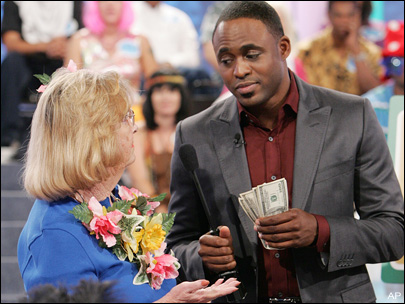
Wayne Brady withholds money from old white lady-you make up the caption!

Essentially the same programme from two parallel dimensions where the only difference is who people liked more on Whose Line is it Anyway?, these two shows feature audiences whose enthusiasm wouldn’t look out of place at the Nuremberg rally attempting to turn their capitalist pre-conditioning into prizes. In the former, incest love-child of Uncle Ben and Aunt Jemima Wayne Brady sells the public toxic assets while looking offscreen for his credibility. The latter has the master of weight-to-spectacle ratio Drew Carey rewarding conspicuous consumption. Brady’s fancily dressed studio audience appear to have been plucked from a Twilight Zone episode where it’s Halloween every day and Carey’s contestants are so elated by being selected you’d think the alternative was The Running Man.

The Winner is: Free enterprise.

The Loser is: Market regulation.

Returning Contestant?: Until the gym shows something other than Bones.


The Taste (ABC, Thursdays)

‘Ok is it an animal that flies or grazes?’

It’s quicker to replace the word ‘voice’ with ‘taste’ and apply everything you know about NBC’s The Voice than to describe this primetime cooking competition. Plagiarism aside, The Taste is closer to the spirit of the blind judging concept than its sensually conjoined twin, which has ironically produced more conventional-looking winners than the image-obsessed American Idol. The judges continue to taste blind even after selecting their teams, which often results in publicly humiliating their protégés. It also reveals the astoundingly poor palettes of those in the food industry, as they bemoan the lack of protein in desserts and consistently lose at ‘guess the animal’. The lack of prejudice in the selection process is offset by the judges’ freely expressing their sexism and dietary bigotry.

The Winner is: Whoever gets the leftovers.

The Loser is: Any vegetarian.

Returning Contestant?: For as long as Anthony Bourdain is there.


The Biggest Loser (NBC, Tuesdays)

‘Why do I have to have my shirt off again?’

One mustn’t scoff at an American game show where the prize is better health instead of more stuff. But don’t be naïve enough to think this is public service television. Underneath the noble purpose is a ‘watch fatty jiggle’ voyeurism which forces contestants to turn their bodies into freakshow curiosities before losing weight. The show is padded with needless challenges and needlessly complicated rules tenuously linked to some sort of obesity fable that only makes weight loss harder and more arbitrary. And if the thing you need to lose weight isn’t made by a sponsor, forget it. The ongoing weight loss is undoubtedly a serial hook here, and the perverse satisfaction of seeing a body waste away is what keeps you coming back.

The Winner is: Subway.

The Loser is: Whoever Subway’s competitors are.

Returning Contestant?: Either that or my TV’s screen ratio keeps changing.


The Bachelor (ABC, Mondays)

‘I need that in the form of a question’

If the holiday you won on a game show turned out to be to a leper colony or the games room you risked everything for was just Ker-Plunk in a box, you probably wouldn’t go back as a contestant. However, despite former ‘winners’ chalking up an abysmal tally of estrangements, broken engagements and divorces, people keep wanting to be and wanting to be on The Bachelor(ette). Even having been a contestant seems to be life-threatening these days. Unlike other game shows, The Bachelor(ette) likes to invite its losing contestants back to occupy more senior roles in the programme, like Juan Pablo who was sent home in a previous season and is now the bachelor. It’s like losing Final Jeopardy and then next day replacing Alex Trebek.

The Winner is: Rose-growers.

The Loser is: Divorce statistics.

Returning Contestant?: I’ve watched so much I’ll be the next bachelor.