Archive for the TV channels Category

Bumping The Shark

Posted in American TV (General), American TV Shows, Reality TV, Reviews, TV channels, TV Culture, TV History, TV News, Watching TV with tags , , , , , , , , , on August 13, 2014 by Tom Steward

Last week was Shark Week, Discovery’s incredulously popular annual event consisting of 7 days of continuous shark-themed programming, sandwiched neatly inbetween the network’s other 358 days of continuous shark-themed programming. Now in its 27th year, the ripple effect of Shark Week across TV is staggering, with a shoal of cable networks attempting to take a bite out of Discovery’s ratings with concurrent themed programming alternatives created under the fin of Shark Week. While some satirise the inflated phenomenon of Shark Week, others are brazenly capitalising on its currency. Here’s some of the counter-attacks, and a few suggestions for next year:

Jaws Week:

Steven Seagal movie marathon and quality TV gamut-running network AMC showed a Jaws movie every night, a prospect that got increasingly less attractive as the week went on. The appeal of the original movie passes me by, even though I think Spielberg is a great cinematic illusionist (in that he’s tricked people into thinking he’s a good director), but it and its no-frills sequel are both perfectly serviceable potboilers. Jaws 3-D would be a condescend-a-minute romp through the annals of hilariously dated visual gimmicks were it not now the desired look for all of Hollywood’s blockbusters. Jaws: The Revenge is a movie so contrived that even the info button on my cable box couldn’t help but have a pop at its hopeless storyline.
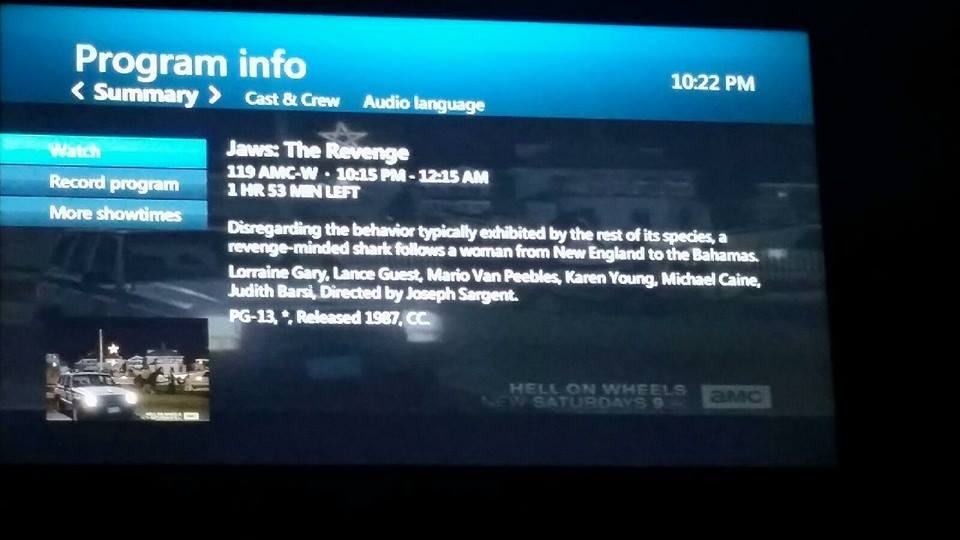
The ghost of Roger Ebert haunts my info button!

The ghost of Roger Ebert haunts my info button!

Snark Week:

Quantitative data-led camp reality and comedy network WEtv spent a week filleting its programming – I’ll stop the sea puns eventualgae – for the snarkiest (‘bitchiest’ in old and perfectly legal tender) cuts to assemble a ‘snark-a-thon’. Re-runs of Roseanne and Will and Grace were predictable but apparently the sunglass-deflected verbal garbage spewed by douchetective Horatio Kane in cold opens of CSI: Miami has been reclaimed as snark. Making use of its rolling reality repertory, the network launched (seemingly in a word document with an unstandardized font) David Tutera’s CELEBrations where the celebrity event planner plans events…for celebrities. Snark is obviously also reality-speak for ‘palindrome’. All this was accompanied by an onscreen ‘snark-o-meter’ because you know how reality TV fans love their maths.

Shart Week:

Comedy Central, a network dedicated to the lifetime incarceration of Jon Stewart, took a break from its correctional duties last week to show some shit, or at least more shit than usual. In one of the more anarchic responses to Shark Week, the network drained its sewer system (also known as Comedy Central before noon) to find the most scatological episodes of its many and clearly-not-that-varied programmes. Not only did they manage to find enough programming to last 7 days from noon to midnight, there were entire episodes on the subject, like South Park’s ‘Mr Hanky, the Christmas Poo’. A great way to dump on Discovery, I maintain that if this isn’t a sign there’s too many men on a network, nothing is.
Jumping the Shart

Jumping the Shart

Sharknado Week:

Probably the closest rival to Shark Week since it primarily airs fictional programming about sharks with no basis in science whatsoever; spelling-free telefantasy network Sy-Fy premiered Sharknado: The Second One, the sequel to its bottom-feeding 2013 original TV movie, and filled out the airwaves with movies of similar or worse quality about sharks and one other thing. It could also have been dubbed ‘Son of Shark Week’ as it’s hard to imagine this monstrosity (and that’s the closest you’ll get to a compliment from me) existing without 25 years of dumb stuff being said about sharks softening up the American public for these pixel-thin piss-takes. As spoof-proof television, it’ll give your sarcasm glands a much-needed rest after a day of Shark Week ‘documentaries’.

Shark Week Alternatives 2015:

TV Land should launch Jump-The-Shark Week where the network only shows re-runs of episodes broadcast after it became impossible to take a show seriously. This would include all the post-lottery win episodes of Roseanne and any Dallas after 1986 starring the ghost of Bobby Ewing. FX can do Stark Week where primetime consists of airings of the Iron Man movies – actually the FX execs can just let nature take its course on this one. The Food Network could run Chard Week featuring all the best appearances of the vegetable in the mystery box on Chopped, including the time someone drizzled it with a gummiworm-infused vinaigrette. The Biography Channel should host Narc Week in which all the interviews with blacked-out faces and altered voices of cops who’ve squealed on the Mafia are edited together and begin to resemble one endless Peter Frampton concert in the dark.
Box Jumps

Posted in American TV (General), American TV Shows, Behind-The-Scenes, TV channels, TV History with tags , , , , , , , , , on June 24, 2014 by Tom Steward

With the possible exception of serial killing, the part of our culture most likely to produce copycats is television. Each idea that has any kind of success with or impact on viewers will be re-circulated more or less unmodified until the imitation has paled to the point it recalls the scene in Moulin Rouge where Nicole Kidman pretends to be Madonna pretending to be Marilyn Monroe. This is why there are currently five series airing on US television (that I can name!) about software developers and why so many recent TV dramas use flashback, even though it runs counter to the logic of television’s simultaneous time. A particularly alarming television trend doing the rounds at the moment is arbitrary jumps in time that leave huge gaps in series timelines. Rather than heralding a new style of TV storytelling, these flashforwards seem more like afterthoughts designed to resolve awkward continuity problems.

Fargo the year!

Fargo the year!

It was recently announced that the final season of HBO’s prohibition-era gangster drama Boardwalk Empire would take place in 1931, seven years after the end of the previous season, which had covered the late teens and early twenties in its first four seasons. The final few minutes of the latest season of docu-sitcom Parks and Recreation jumped three years ahead, omitting Leslie Knope’s pregnancy, the birth of her triplets, and the first years of her new job. FX’s thriller mini-series Fargo skipped a year in its last few episodes, this time allowing police Deputy Molly to get pregnant and criminal conspirators Lester and Lorne to start new lives. After nine episodes out of twelve, we’re still waiting for the belated revival of 24, Live Another Day, to jump a few hours to get us to the end of the day before the season ends, as promised by the show’s producers.

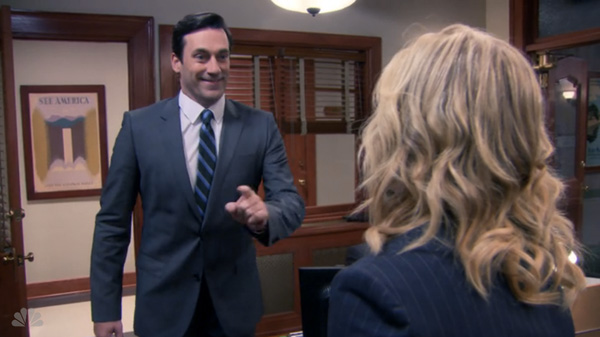
When TV shows did this in the past, it always smacked of desperation. It was no coincidence that Desperate Housewives jumped five years in its fifth season the same time as viewers were leaving the show in droves. Nor was a secret that One Tree Hill’s skip ahead four years halfway through its run was a thinly veiled attempt to bring characters’ ages into touch with the actors playing them. The time jump might be being deployed in a slightly smarter way these days, with Parks and Recreation’s implication that the nation has missed out on a three-year recurring guest role from Mad Men’s Jon Hamm, who is fired from Leslie’s office seconds after the ellipsis. But if you look at where the jumps are situated in the runs of these series, and think about why they should happen at that exact point, you’ll see they are no less crude.

As with flashbacks, part of the problem is that time jumps upset the way time works in television. It’s conventional that TV time runs concurrently with the time in which we live out our lives, and pleasurably so since much of the joy of watching TV is the way it syncs with what we’re doing. Time jumps invariably put a show ahead of the time of viewing, which makes it a kind of science-fiction, and would be fine if that’s what the programme-makers were going for. Aside from problems of realism and plausibility caused by the time jump, it also puts viewers at odds with programmes rather than it seguing with their daily and weekly lives. It’s also more of a placebo for story problems than a panacea. Things take time to work themselves out in television, and television should remain a record of that not a remedy for it.

Look what we missed!

Look what we missed!

A time jump might have relieved Parks and Recreation viewers of another pregnancy storyline but it also cheated them of character development. It’s very much a self-written corner since no-one asked the writers to put two pregnancies back-to-back. The loss of a full year in Fargo deprived the series of the suspenseful and tightly-knit storytelling that held the show together, resulting in a deeply unsatisfying denouement. We’ve yet to see how 24 will skip ahead to later hours of the day, but it’s bound to disrupt the real-time orthodoxy of the premise. The producers of Boardwalk Empire may feel they have more justification to move forward in time since it is a historical piece. My initial thoughts are that the 1930s is a very different animal historically, and that Boardwalk Empire can’t help but become a different programme. Can we jump forward to a time when TV doesn’t time jump?


Window on the World Cup

Posted in American TV (General), Touring TV, TV channels, TV Sports with tags , , , , , , , , , on June 19, 2014 by Tom Steward

This is the first time I’ve not been in Britain during a World Cup. The point would be moot were I virtually anywhere else in the world, be it Europe, Africa or even Latin America. But I’m in the United States, where the following for football/soccer (delete as inappropriate) is cult at best. The US team did well in their World Cup qualifiers and they’ve started the tournament with a big win over bogey team Ghana (if you’re not sure what I’m taking about at this point, it’s probably not worth going on…) so they’ll be some bandwagoning, but, unlike most nations, it will be driven more by patriotism than love of the game. But I’m starting to realise that television makes a World Cup.

ESPN replaces match coverage with cooking shows!

ESPN: football in the wrong place!

You might wonder what the difference is since a game’s content doesn’t change depending on where you watch it. It’s not some animated blockbuster that has local celebrities dubbing the characters’ voices. Except it sort of is. I don’t need commentary and coverage by my countrymen any more than I need an Englishman coaching the national team (because that always works out so well for us) but I need pundits who can talk about the game with some degree of sophistication. That’s not to say that British TV guarantees this. ITV’s nickname-driven football bloke-in always fell short yet the statistic-based monotone of Spanish language network Univision’s World Cup commentary hits the spot. So let’s call a spade a spade, or let’s just call ESPN shit!

In some ways, ESPN’s World Cup coverage feels very familiar. Commentator Ian Darke is English and previously worked for Sky Sports, and has that voice that only British football pundits and inflammatory talk radio DJs have the rights to. He’s backed up by a renowned ex-Premier League player, Liverpool’s Steve McManaman, whose years in the sport somehow haven’t resulted in the ability to read a match. Just like ITV, the coverage is heavily commercialised and avowedly lowest common denominator, with a line in metaphor that makes the poetry written by contestants on The Bachelorette seem avant-garde. But if this were all that was wrong, it wouldn’t be any more disappointing than being forced to watch football in the company of Adrian Chiles, Britain’s highest-paid pumpkin.

But it is much worse. The commentary is idiot-friendly to the point of baby-talk. During USA vs. Ghana, pundits referred to the US closing the game down as ‘parking the bus’ so many times, I actually thought the handbrake on the team coach was off. Conversely, the self-evident rules of the game are discussed with a depth and ambiguity that wouldn’t look out of place in The Wire. Behind this I’m sure there’s some nobly futile effort to broaden the appeal of football to US sports fans, but it insults our intelligences from ear to ear. The studio segments are so short they’re more like game shows where pundits have to come up with a repeatable three-syllable analogy before the clock runs out. Reports from the city have been replaced by pseudo-Steinbeckian monologues.

The other culture-shock (although does it count if it’s just one country holding out?) is that ESPN’s coverage of the World Cup doesn’t include all the tournament’s games and events. The opening ceremony featuring a kidnapped Jennifer Lopez was shunned in favour of the US Open and though I’m not one for race-baiting, it does tend to be the games featuring the whiter parts of the world that are covered. In cultures where football is taken seriously, TV channels broadcast a continuous World Cup flow but ESPN’s coverage is sandwiched in-between Nascar races and miscellaneous college sports tournaments. It’s jarring not to have every broadcaster on TV crowbarring the World Cup into every studio segment. Never have I longed more for a bloated pre-match show.

Univision: football coverage you can count by!

Univision: football coverage you can count by!

Hispanic TV networks have been my sanctuary. I may only understand a quarter of what’s said but the pundits’ innate football knowledge and enthusiasm is palpable. All possible scenarios within the match have their own catchphrases, bellowed in one continuous breath by the commentator. Seemingly every show on Univision, regardless of genre, cuts away to live coverage in Brazil like a transmission test card and it’s not uncommon to see news being presented in football strips. It’s not a home away from home; it’s an extended stay with a mad moustached uncle. I never thought there was anything worse than ITV Football, but there is and it’s ITV Football for beginners. I’m just grateful there’s enough Latinos in the US to give me an alternative.

Channelling History

Posted in American TV (General), American TV Shows, Reality TV, TV channels, TV History, Watching TV with tags , , , , , , , , , on June 5, 2014 by Tom Steward

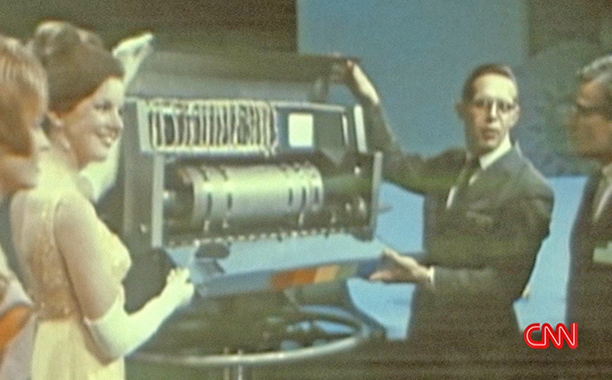
Doing television history on TV is a daunting task. It’s hard enough trying to convey how television connects with social and political events of the past, not to mention avoiding ending up saying TV is a ‘window on the world’ (hall-of-mirrors more like) or making it a medium of communication rather than art. And how do you talk about the history of broadcasting without it becoming a dry recital of telecommunications regulation of the kind John Oliver parodies or a series of backslapping celebrity anecdotes? This is before having to package all this into an inevitably narrow television format that’s supposed to have a broad appeal. So I’m not at all surprised that CNN’s The Sixties: Television Comes of Age was a failure but I am surprised that AMC’s Mad Men, a piece of historical fiction with only a passing interest in sixties television, managed to do so much with the idea.

The Sixties: Television Comes a Cropper.

The Sixties: Television Comes a Cropper.

Recently, Jon Stewart has been using rather a lot of his daily timeslot to attack CNN with the kind of scrutiny and vigour the network never exhibits in its news coverage. He’s been forsaking more gratifying targets, such as Fox News, because CNN’s bloated, ignorant and downright incompetent news reporting is such an insult to journalism and yet still poses as a legitimate news outlet, rather than just an extended campaign ad like Fox or MSNBC. The decline in CNN’s journalistic practices seems to be inversely proportionate to the rise of their original documentary films and series. A mixed bag, to be sure, but with some real highlights, like Anthony Bourdain’s myth-busting travelogue Parts Unknown and archaeological verite Our Nixon. Consequently, I was enthused about the network doing a documentary series on America in the sixties and encouraged that the first episode would be about television. So what’s my problem?

Well, first of all, Tom Hanks. Clearly a selling point for the series if the roadside spinning-sign branding of his producer credit is anything to go by, Hanks has also enlisted himself as a talking head for the show. The actor’s irrelevance to his own industry continues into the documentary, with his inarticulate babbling at the camera about his (unprocessed) memories of watching TV as a child which even a Den-of-Geek editor would call fanboyish. I’m not exactly smitten with the talking heads format anyway. From talking to people who’ve done them, it seems that their words aren’t chosen on their own merits but as a grammatical bridge in the programme’s narration. This pretty much does for anyone who might have a critical stance, but the majority of guests worked in sixties television or now work in the industry and are unlikely to offer much in the way of perspective.

But if this were the only problem with the series, you’ll be inclined to forgive since the researchers and editors have done such a masterful and artful job of finding and fitting together footage from sixties’ television shows. After all, there can’t be many clips out there of Orson Welles winding Dean Martin’s head 360 degrees with a handle. I know it’s not the way things are done now but it’s a great shame that the footage wasn’t left to speak for itself, as it really tells its own story and a better one than the narration. The fundamental problem here is that it doesn’t say anything about what it would have been like to watch television in the sixties, or any other time for that matter. We know what people watched, when they watched it, and some of what it was trying to say. But did audiences get it?

Mad Men: Better Than a Documentary

Mad Men: Better Than a Documentary

This is where Mad Men steps in. In the recent mid-season finale, the characters are all trying to catch as much as they can of the ongoing TV coverage of the Moon Landings. Ad executive Peggy has to follow this with a client pitch the morning after men walked on the moon. Struggling for a segue, she – and writer Weiner – manage to distil the essence of the dial and bandwidth-restricted TV viewing of the time as ‘everyone doing the same thing at the same time’. If that weren’t profoundly elegant enough, Peggy goes on to talk about how this rare moment of unity (and possibly television itself) masks the social disharmony of late sixties America. This isn’t even for our benefit, but for that of fast-food executives looking to cash in on a conservative backlash. Any documentary about American TV history is going to have to beat that.

Live Another UK

Posted in American TV (General), American TV Shows, Behind-The-Scenes, Reality TV, Reviews, Touring TV, TV channels, TV Criticism, TV History, TV News with tags , , , , , , , , , on May 15, 2014 by Tom Steward

Perennial bad penny of television 24 returned to our screens last week, four years after the show’s cancellation, which everyone – other than flagging network Fox it seems – felt was already long overdue. Along with being cut in half (12 must not be a sellable number these days), one of the more remarkable changes to the series, sub-titled Live Another Day, is its re-location to London. In the later years of the series proper, 24 left America’s centre of terrorist activity L.A. to tour the East Coast with seasons seven and eight set in Washington and New York respectively. The show only ever ventured from U.S. shores when its many presidents would harangue middle-eastern statesmen by phone to reveal their country’s official secrets in order to avert a nuclear attack they know nothing about. African-set spin-off TV movie 24: Redemption is the exception here, but everyone concerned would I’m sure like to write that abomination out of the show’s history along with ER’s excursion into the dark continent of television. Besides, 24 was always characterised more by rampant xenophobia than cosmopolitanism. So why on earth would the producers of 24 want to re-launch the series in The Big Smoke?

24 solves mystery of London's traffic problem.

24 solves mystery of London’s traffic problem.

Well, the official explanation is that setting Live Another Day in London pays tribute to the UK TV audiences and critics who championed 24 in its early years when the US was still ambivalent. The first and second seasons of 24 were essential cult viewing when they aired on the free-to-air channel BBC Two in the early 2000s, gaining a large and devoted viewership, incessant national media attention and even a digital BBC sister show in a mould recently revived by AMC’s Talking Dead. The Guardian’s TV critic Charlie Brooker even had to be asked by his editors to stop writing about the show in his weekly column. 24 was lost to the nation as a watercooler show once premium satellite channel Sky One bought the exclusive rights to air the series from season three onwards, but Britain doubtless helped to ensure renewal in the years before the show was a signature Fox mainstay, and became too big to cancel. If this is the case, then speaking for the entirety of the UK – which as an ex-pat I do daily – we’re flattered. But will Britain end up resenting 24 in a manner previously reserved for Dick Van Dyke?

Three episodes in, it’s too early to tell but the signs are encouraging. Live Another Day has so far conspicuously avoided the axis of bobbies, minis and red phone-boxes that still dominates the representation of Britain in American popular culture. Sometimes, it even looks like it was conceived by someone who knows London, or has at least obsessively Google-street-viewed it. The season premiere opened with an East-London street market scene that authentically captured the area’s large Asian population, a fact of our diversity that Americans often miss. Whether or not the Prime Minister would have been a caricature of the privileged classes anyway I’m not sure, but that’s what we currently have, and Stephen Fry’s neckless bumbler is a suitably Cameronesque figure. Apart from some tourist traps like assuming that someone could pursue a Tube train through Central London by driving, the show is pretty faithful to the city’s geography and infrastructure and, at the time of writing, we’ve seen way more of London’s liminal council estates and industrial wastelands than its tourist hardware. We don’t see natives often, but when we do they have the sarcasm and cynicism towards America’s intelligence melodrama that I expect from my fellow Britons.

Jack's in a pickle again!

Jack’s in a pickle again!

Sadly, the cinematographers have CSI’d the show’s colour palette, making London more grey than it actually is, which I didn’t think possible. As revelations about the origin of the attacks unfold, I’m beginning to worry that we’re about to be portrayed as a country that harbours and sympathises with middle-eastern terrorism, rather than one that benignly questions the motives of US foreign wars from time-to-time. Given 24’s scapegoating of anyone East of Alaska, I’m not sure those Asian and Eastern-European Londoners are going to stay innocent bystanders for long. Of course, this London layover is symptomatic of a broader reverse-colonization of American television by UK popular culture, with a quota of British acting in every new show. It comes at a time when Bravo is launching the reality show Ladies of London looking at the city’s transatlantic socialites. As self-appointed visual archive of the rich and famous, Bravo is hardly likely to offer us a London in accordance with social realities. Preview material of a barrow boy speaking entirely in cockney rhyming-slang more or less confirms this. So at a time when American TV is obsessing over Britain without ever attempting to understand it, should we be grateful for Jack?