Archive for the TV channels Category

Info a Treat

Posted in American TV (General), American TV Shows, TV channels, TV Criticism, Watching TV with tags , , , , on June 17, 2015 by Tom Steward

TBS’ late-night talk show Conan features a segment called ‘What am I Watching?’ in which titular host O’Brien flips through the cable channels with the aid of the info button on his remote. Pressing the button reveals skewed descriptions of each show encountered, such as ‘Entertainment Tonight: Two lifelike cyborgs are programmed to think everything Hollywood does is fantastic’ and ‘Diners, Drive-ins and Dives: Guy Fieri plays an out-of-work party clown who is addicted to lard’. There are two diametrically opposed laughs here. One is the absurd – yet entirely truthful – inversions of the straight-faced synopses that info buttons on cable remotes give us about TV shows. The other (which sadly nowadays may be as socio-economically discriminatory as those jokes in The Sopranos about Kierkegaard) is about people who have cable recognizing how close these summaries come to the real thing.

All you need to know...

All you need to know…

The descriptions contained on info buttons are not as openly critical as the fake ones on Conan but they do often make you wonder who the authors are and what their criteria is. Whatever possessed the person that wrote the digital synopsis for Jaws: The Revenge to question the scientific plausibility of the storyline when they wrote ‘Disregarding the behaviour typically exhibited by the rest of its species, a revenge-minded shark follows a woman from New England to the Bahamas’? What is to be gained from listing the events that take place in the 1920s surrealist avant-garde short Un Chien Andalou – including a woman’s eye being cut and ants spilling from a wound in someone’s hand – as if it were an episode of Columbo? And these are the ones that actually get the descriptions right.

The buttons struggle noticeably with anything resembling emotional complexity. They can’t seem to get around the fact that Jackie Peyton from Nurse Jackie isn’t a good person and doesn’t find redemption each week. TCM’s button writer needs an education in film noir – one incidentally that the network will provide in association with Ball University – if it thinks that anyone in The Glass Key is in any way moral or decent. As misleading as they can be, info buttons are impossible to do without. With shows on cable now mired in the mud of endless re-runs and encores (which are re-runs that run on from the first run, like a bad sequel), it’s essential to have something to distinguish individual episodes, and sometimes the description on the info button is the only way to be sure.

This new technology has created a completely different experience of watching television, one that we’re perhaps less willing to recognize because it doesn’t involve a computer screen. It’s just on our TV rather than our phones and devices but that in itself is significant. We have much less need for TV listings or paper guides, which means that journalistic commentaries on TV shows has been supplanted by anonymous synopses. While before, viewers would read a critics’ review to get a sense of whether they wanted to watch a programme or not, now they have to go off the plot, and be less informed about the success of the project than its aims. Maybe it’s clearer now why the description of Jaws: The Revenge was so unfavourable. Button writers don’t rate TV, but nor should they have blood on their hands.

Info buttons only skim the surface of how cable remotes alter our perception of television. Every time I try to erase an episode of Conan, the remote asks me ‘Are you sure you want to erase Conan?’ as if the host himself will be vanquished from history once I press ‘Ok’. Whenever I do, I genuinely believe that Conan O’Brien has disappeared into the ether. All right, that’s not true. But making me think twice about whether I want to keep a show or not has made me re-evaluate what in TV is worthy of a second or third viewing.

I’ve made lots of assumptions here about the people who write the descriptions on info buttons – as well as assuming that this is a dedicated profession and not an intern’s copy-and-paste job – so anyone who knows anything about how these show summaries get written, please get in touch with me and I’ll write another post about it, with whatever level of anonymity you wish. Poverty and convenience may one day render cable obsolete, so I want to learn what I can about this phase of TV history while I can. I also want to know who wrote that Jaws blurb!
Sense of Schumer

Posted in American TV (General), American TV Shows, Reality TV, TV Acting, TV advertising, TV channels with tags , , , , , , , , , on May 27, 2015 by Tom Steward

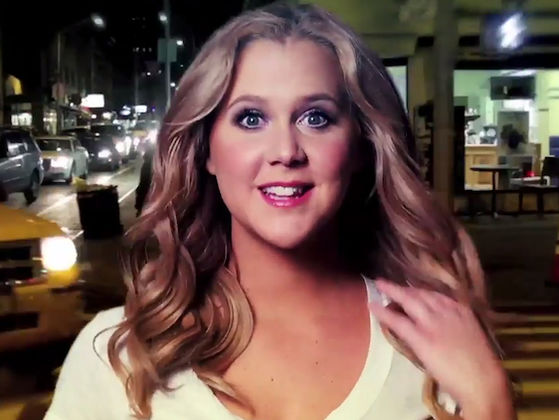
If you have to get sick of seeing someone’s face on TV, make it Amy Schumer’s. Why? Well, firstly because being sick of seeing Schumer’s face seems to be part of her schtick. Every sketch on her Comedy Central show Inside Amy Schumer is preceded and followed by a close-up of Schumer’s face quick-scanning the streets of New York before the camera CSI zooms into her eye. Her face is the lifeblood of every sketch, and even the (mandatory) Twelve Angry Men parody episode in which she did not feature begins with her face dominating the screen. It’s also because Amy Schumer’s face is interesting to watch. Eschewing the hyperreal expressionism of her peers (not that there’s anything wrong with that – Key & Peele are as cartoonish as they come), Schumer’s face is a flickering deadpan, oscillating between irony and approval of the characters she plays and those she interviews.

Facial Schumer!

Facial Schumer!

Which is good news because Amy Schumer is everywhere. In fact, it would be perfectly possible to watch nothing but Amy Schumer on TV these days. There’s her weekly Comedy Central show which seemingly plays throughout the night (uncensored) on the network, her guest appearances on every late-night talk show around, her work on The Bachelorette (which ABC executives want to expand into a regular thing), and trailer-length promos for her upcoming movie vehicle Trainwreck in the ad breaks. We’ve seen this kind of momentary ubiquity before, of course, but rarely with a performer of such substance. That may be because Schumer is able to do provocative and powerful material while making it sound like a bunch of harmless Seinfeldisms. She even makes light of the issue-based thrust of her comedy, passing off most sketches as a PSA-gone-wrong, while underlining just how culturally urgent her intervention into modern life is.

Last night, Schumer confronted the alleged crimes of Bill Cosby. The heavily corroborated sexual assault allegations against the veteran comic seem fair game for comedians now and indeed it may be easier for a white female comic to talk about this topic than, say, the black male one who broke the story. It was the level of discussion that was remarkable. Refusing to debate the existence of the crimes (for, as she points out, there is no debate to speak of, despite all legal disclaimers), the court-based sketch was instead a more sophisticated exploration of how nostalgia and cultural comfort food (both real and symbolic, since this was the man who advertised Jell-O pudding pops) interfere with our sense of justice and gender equality. This is really what we struggle to reconcile, not crime and perpetrator. But this isn’t the first time Schumer has put her finger on the problem.

She coolly and pleasantly took on perceptions of women ageing with Tina Fey and Patricia Arquette celebrating Julia Louis-Dreyfus’ ‘last fuckable day’ as decided by the media. She did an almost Sesame Street-esque scatological number on pop culture’s fetish for women’s sticky-out asses with a hip-hop music video set to the rhyme ‘milk, milk, lemonade, round the corner fudge is made’. Schumer was there to pinpoint the pathetic paradoxes of middle-class women pole dancing while condescending to women who work as strippers as well as female employees being obliged to be ‘cool with’ whatever their male counterparts want to do while being paid half the salary. Bravely she slayed a sacred cow of American comedy, the borderline-rapist late-night talk show host, and perversely she’s seemed to increase her appearances on these kinds of programmes as a result. She’s so popular that even her targets want to be seen with her.

Amy Schumer's parody of late-night...oh wait, that's just her on Letterman!

Amy Schumer’s parody of late-night…oh wait, that’s just her on Letterman!

It would be too easy to say that Amy Schumer’s success is down to the sugar-coating she puts on her social criticism, but it’s hard to deny that her self-aware baby-face mannerisms (see, the face again!) makes what she does much more palatable. But it’s not the cutesy-girl disguise that comedians like Sarah Silverman have used to deflect attention from their obscenity and controversy. It’s more direct than that, like having a conversation with someone who seems perfectly nice and you realise hours late they completely destroyed you. That’s what translates into mainstream entertainment so well. On The Bachelorette, she exposed the egregious insecurities of a male contestant without ever saying a cross word to him. She’s also not afraid of plumbing the lowest depths of entertainment, like dirty jokes and toilet humour, to get what she wants. The time of overkill will come, so enjoy her just killing it.

Hidden Jenner

Posted in American TV (General), American TV Shows, TV channels, TV News with tags , , , , , , , , , on April 29, 2015 by Tom Steward

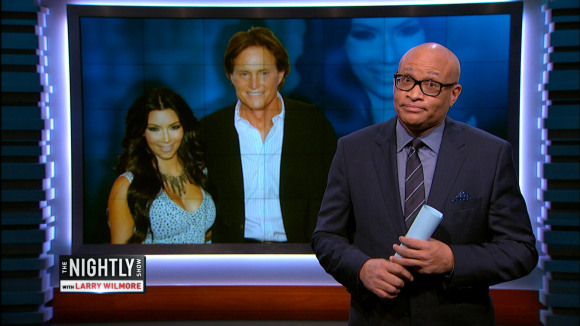
There was an unexpected role reversal in the world of TV news this past week. News satire – an institution that regularly attacks the bigotry and ignorance of network and cable news coverage – was itself accused of bigotry and ignorance in regards to transphobia, while a primetime network news special about transgender issues (albeit in the form of an interview with Bruce Jenner, hence why TV is interested in the first place) was widely praised for its sensitive handling of the topic. On Monday, The Nightly Show with Larry Wilmore – Comedy Central’s bland replacement for The Colbert Report – aired a segment ridiculing Jenner’s identification as a woman and chosen sexual orientation as abnormal, which were made to seem even more grotesque by comparing her to Pinnochio. This was responding to Friday evening’s 20/20 special on ABC, in which the former Olympian and Kardashian was interviewed by Diane Sawyer about being a man trapped in a woman’s body her entire life and her decision to transition to a woman, which she has been doing piecemeal for years.

Methinks Larry doth protest too much!

Methinks Larry doth protest too much!

At the heart of the controversy surrounding The Nightly Show was Wilmore’s apparent confusion about Jenner’s desire to become a woman yet having male genitalia and preferring women sexually. Now, if this seems to be representative of the billions of people around the globe who have spent their lives knowing they are a different gender than the one assigned to them and have, for reasons too numerous to mention, yet to make their (complete) transition, it’s because that’s exactly what it is. It’s hard to see where the confusion, or indeed the comedy, lies in pointing out these tragedies. If anything, this information helps us make sense of Jenner’s personal (mostly surgical) life choices in recent years, and there is, of course, the little known fact that what Bruce Jenner wants to be or do in her life is none of anyone’s fucking business. Even more appalling was Wilmore’s hetero-bullying tone, which seemed to suggest that this particular combination of gender and sexuality was above and beyond an average straight guy’s understanding of the world.

But 20/20 didn’t miss the opportunity to turn the tables on news satire either. Clips from Saturday Night Live and Conan making jokes at the expense of Jenner’s gender instability were featured in the programme. She was fair game when she was altering her appearance for reasons of vanity, but the punchlines were directed at gender. Conan O’Brien’s monologue jibe seemed to be urging Jenner to hurry up and pick a gender, as if that were somehow easy or necessary for us to recognise her as human. In defence of news satire – which I believe to be essential not only as a critical commentary on the news but also a superior alternative to it – these are atypical moments that in no way represent the genre’s treatment of such issues. It’s hard to imagine The Nightly Show’s tone of reporting on its forerunner The Daily Show which draws Arsenio-style primal screams at the mere mention of Elizabeth Warren. The Conan monologue gag seems unusually cruel, especially for a late-night talk show with a notably liberal following.

Hindsight is 20/20!

Hindsight is 20/20!

It is, however, possible to imagine Wilmore’s segment on The Colbert Report, with the thinly veiled prejudice cloaked in the self-negating irony of Colbert’s fake conservative newsman persona. But there’s no evidence here that we’re supposed to think of what Wilmore is saying as anything other than genuine (and if you ever suspected that Wilmore is capable of comedy that is less than obvious, remind yourself he is the creator of Black-ish!). If the problematic representation of transgender issues in news satire has been reported correctly, we should also note that the success of TV news coverage in dealing with the same issues has been greatly exaggerated. Perhaps the overwhelmingly positive reaction to the Bruce Jenner 20/20 special was motivated by relief that it wasn’t the most hideously offensive piece of journalism ever aired. But interviewer Diane Sawyer adopted the persona of a sceptical and disgusted parent, asking questions only the most hateful (and thus least important) person would. It’s insulting enough, even without the patronising implication that this is what the public would ask. We also have to take into account TV news’ much worse track record when it comes to reporting on the transgender community: Piers Morgan’s media war with Janet Mock, Katie Couric’s inappropriate intimacy interviewing Laverne Cox. Nobody’s getting it right but news satire is wrong less often than the news.

Party Like It’s 1990 Time

Posted in American TV (General), American TV Shows, Behind-The-Scenes, Reviews, TV channels, TV History, TV News with tags , , , , , , , , , on April 22, 2015 by Tom Steward

90s TV is back in vogue, appropriately enough. Twin Peaks is soon to be revived in such exacting detail that Showtime even sought to bring back David Lynch’s fights with the network. Cali has been fornicated enough by David Duchovny – and his series Californication has been cancelled – while Gillian Anderson appeared to be getting her life together but is going back to her abusive ex; thus The X-Files is returning to Fox, it now seems as a replacement for the network’s all-too-rare new-thing-that-people-like Empire. Even The CW’s version of The Flash recently featured Mark Hamill reprising his role as The Trickster from the original early 90s live-action TV adaptation, now father to the heir to his title, allowing the Star Wars actor to cathartically wail the words that every kid in a Darth Vader mask has been saying to him since 1980.

That the decade that time did not give us time to forget is coming back to TV doesn’t come as much of a surprise. The 90s was when the cup of quality American television first runneth over, never to be empty again. Contemporary Hollywood is increasingly dependent on rebooting classic pop iconography. In fact, Hamill was filming his scenes as The Trickster at virtually the same time he was reviving Luke Skywalker for Star Wars: The Force Awakens. But the choice of series has so far been disappointing. The 25-year gap in Twin Peaks was always part of the story, but in truth much of the second final season was completely unwatchable, with the Lynch-helmed finale the only saving grace (and he may not even be directing this time round). If the cast continue to protest Lynch’s absence, we may be looking at a spin-off about The Log Lady’s Log.

Everyone has signed back on for The X-Files but the series was to TV sci-fi what Judd Apatow is to movie comedy. The original series was a good few years too long, and that’s even before Billy Connolly came into the picture! Yes, TV needs more X-Files about as much as literature needs more books about killing heads of state written by Bill O’Reilly. Maybe it’s my comic apathy or that The CW’s demographic version of the flashing lifeclock from Logan’s Run has already gone off in the palm of my hand, but I found nothing to enjoy in The Flash to enjoy apart from Hamill’s scenery-chewing performance (forever to be known as ‘Hamillery’). So if there are any TV executives out there reading (either this blog or just in general) here are some 90s TV shows that are far more worthy candidates for revival:

Murder Three

'My blinds...LaPaglia!'

‘My blinds…LaPaglia!’

The first season of Steven Bochco’s Murder One was a compelling, narratively experimental, impeccably cast piece of TV drama. The second, which I will call Murder Two – not because the crimes prosecuted were lesser but because the quality was – proved altogether more formulaic, B-casted and conventional. Murder Three could right these wrongs. I foresee a pre-credits teaser in which respective season one and two leads Daniel Benzali and Anthony LaPaglia fight Sunshine Boys-like over the configuration of the furniture in the firm’s office, culminating in Benzali’s Teddy Hoffman throwing LaPaglia’s not-Teddy Hoffman out of the window, before lowering the blinds…and then peering through them ominously. We would revive the first season’s 23-episode serial arc, with a case that begins as Murder Three…and ends up as Murder One!

The Critic (Or It’s Not That Tough Being a Film Cricket)

Together at last!

Together at last!

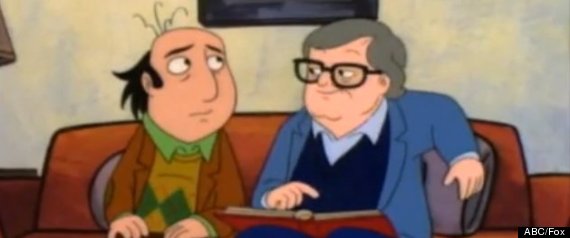
At the time we might have thought that the 90s were the summit of all that was ridiculous about Hollywood movies. But given how extra inflated and predictable blockbusters have become since, surely Al Jean and Mike Reiss’ animated comedy about a TV film critic would now have plenty of kindling for the movie parody fire. Cancelled after one season, there’s still plenty to do with the format and reviving the character of the Ebert-like Jay Sherman would be a greater tribute to the late film critic than any statue.

Murder She Wrote

History's greatest serial killer!

History’s greatest serial killer!

Still alive and acting…all I’m saying.

Cop Rock: Laboured Musical Premise Unit

A spin-off of the quickly-cancelled musical police drama about a special team of cops who investigate off-colour musical episodes in other TV series.

Paulie Loves Pussy

A buddy comedy featuring Paulie Walnuts and Pussy Bonpensero from The Sopranos based on this HBO commercial:

We’d figure out the timeline stuff later!

The Cosby Show

I drank from the wrong glass...

I drank from the wrong glass…

Worth pitching just to see the look on the executives’ faces. ‘Drink this, Mr. Greenblatt’.

It’s Not What You Know, It’s HBO

Posted in American TV (General), American TV Shows, TV channels, TV History, TV News with tags , , , , , , , , , on April 15, 2015 by Tom Steward

It’s one of the great cultural shames that people are denied access to works of art based on their income. For decades now, premium cable network HBO has been in the business of producing some of the finest television in the medium’s history and preventing large swathes of the American population from seeing them. Consumers (for that is what they are) need to be above a certain socio-economic line in order to pay HBO’s monthly subscription fee – historically between 6 and 15 dollars – along with the exorbitant cable company charges and, y’know, food and shelter, stuff like that. Of course, quality television in the US has always implicitly discriminated on socio-economic grounds by wielding cultural capital. Put very simply (and no doubt wrongly to some), cultural capital relates to the idea that what we judge as artistic or culturally worthy is determined by the social exposure that class, wealth and educational background permits, and so the elites have a collateral advantage when interpreting works of art and culture. When advertising executives in the 1980s discovered it was more profitable to target the high-spending TV viewer than the mass-audience, TV like Northern Exposure and Hill Street Blues went after educated professionals with a litany of fine art references and allusions. But whereas visiting libraries and museums would be enough to crack that code, there’s no getting around the bare economic fact that you either have the subscription money or you don’t, and if you don’t you have to actively steal culture.

The most educational show since 'Sesame Street'

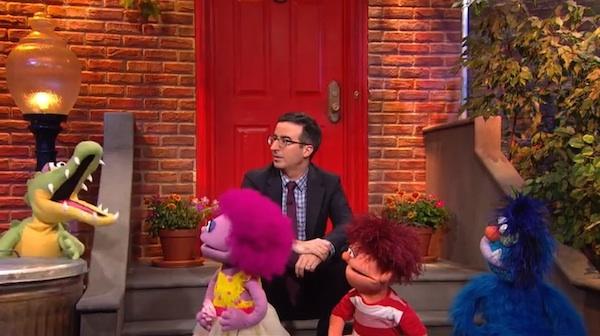
The most educational show since ‘Sesame Street’

There’s no shame in that. As HBO’s own John Oliver commented, ‘A good way to know which side of the income equality gap you’re on is if you’re currently paying for HBO or stealing it’. But HBO was making great television long before fluid internet theft of television was the desirable option, and I know from experience that HBO (for obvious reasons) are more militant than most TV networks at shutting down piracy of their programmes. This is bad but it’s what HBO has been doing forever, and in the back of our minds we secretly know that the quality of the TV they produce is proportional to the number of Americans it excludes from watching. What concerns me more these days is that those without HBO are being left out of the cultural conversation. News-with-a-side-of-comedy series Last Week Tonight with John Oliver is informing and engaging Americans on political issues and debates that mainstream media and government have left too intangible for the average person to unravel, whether that’s taxes, government espionage, or the system of electing judges. As such, it’s more like Sesame Street than The Daily Show. Yes, you can find out what John Oliver discovered on your own (he did!) but he makes politics accessible without compromising their labyrinthine complexity, which is rather rarely telling you what you need to know without what to think. You can pirate Last Week Tonight and even legally watch key highlights piecemeal on YouTube, but this is only the beginning.

While the LAPD will tell you they’ve been looking into accusations of murder against Robert Durst for years, it’s hard to see how The Jinx, HBO’s documentary mini-series about the real estate heir and his alleged past crimes hasn’t at least catalysed his arrest in March while the series was still airing. The series had audio of Durst seeming to confess – somewhat sensationally reserved for the season finale – and provided evidence of a handwriting match that many think was the trigger for the LAPD to make an arrest. TV investigative reporting like CNN’s The Hunt with John Walsh has always had these aims of impacting on criminal justice – and often they do – but what’s special about The Jinx (despite its inherently lurid qualities of true crime entertainment) is that it’s a documentary about a subject that has yielded the capture of a suspected killer without that being the stated aim of the programme. Durst’s confession tape was stumbled upon during the rigorous process of compiling footage and wasn’t the result of a super-cloak of crime-fighting conservatism the show had shrouded itself in. This is because HBO has to appeal but it doesn’t have to pander. The network or basic cable equivalents of The Jinx and Last Week Tonight are significantly diluted by gestures to mainstream entertainment orthodoxy – sycophantic celebrity interviews, monster-of-the-week journalism – but the former spends a series on what would be an hour on any other channel and the latter expands a 5-minute news segment into a quarter-hour dissection.