Archive for the TV channels Category

The Apprentice’s Apprentice

Posted in American TV (General), American TV Shows, British Shows on American TV, Reality TV, TV channels, Watching TV with tags , , , , , , , , , on March 11, 2015 by Tom Steward

‘Don’t it always seem to go, that you don’t know what you’ve got ‘til it’s gone…’

I’m quoting Joni Mitchell not (only) because I’m reading Morrissey’s autobiography and have the urge to paste song lyrics into prose when I’ve run out of things to say but rather as a description of the way I feel about The Apprentice. It’s rare in our culture to prefer the re-make over the original but even rarer that we admit to preferring another country’s version of an idea to ours, regardless of which came first. It’s this paradoxical thinking that draws me to the BBC adaptation of The Apprentice and makes me resent the NBC original. Now that I live in America, the latter is my bread-and-butter and the former feels too distant from my daily existence to be relevant viewing anymore. As I sit writing this on a winter’s day with the sun beating my back, I don’t ask for sympathy. But I do rather feel like the person who bought the last painting before they discovered perspective.
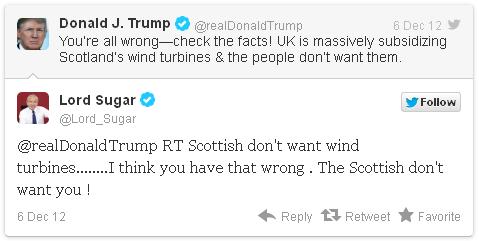
From the arse's mouth!

From the arse’s mouth!

Like most shows sold overseas, the format remains largely unchanged. But there’s something about the translation of American corporate-speak and aspirational diatribe into the laughably misjudged self-esteem of Britain’s business classes that gives The Apprentice on the BBC an ironic quality which bends a celebration of capitalism into a critique of the ideology. Goebbels once said that no-one could watch an Eisenstein film without becoming a communist. Well, I severely doubt anyone could sit through an episode of UK version of The Apprentice and still think capitalism is going to last. It’s not hard to believe we have economies based on nothing because The Apprentice UK tells us the people who front it are never less than vacuous. While the American original has the product placement and commercial saturation of a major US network in its arsenal, the BBC version is broadcast on a British public service station which prohibits advertising. The former is mired in a web of cross-marketing, while the latter seems inhospitable to the idea of a TV programme as a commodity.
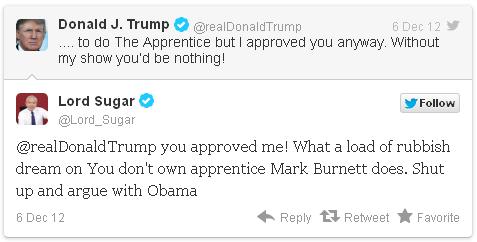
Go waste the President's time instead...

Go waste the President’s time instead…

This is not to say that The Apprentice UK is some sort of subversive attempt by the imagined leftist conspiracy at the BBC to undermine British entrepreneurship. It’s more accurate to call it ‘private service television’, a mode of broadcasting addressed to a society dominated by privatised industry and designed to make the best of it (even that is being a touch generous!). But neither does it use its airtime to consolidate a corporate empire through media exposure, like its forbearer. The Donald Trump Apprentice never misses a chance to tell you how powerful and glorious the various business enterprises of the Trump family are, whereas the Alan Sugar counterpart (which sounds like the greatest 80s garage band that never was!) makes his company look like a loosely connected network of 1940s-style spivs and barrow-boys. The tasks assigned by Trump are publicity-centric busywork (especially in the current Celebrity variant) but Sugar’s are about the hard graft of street selling and face-to-faces with customers. You’re the apprentice of a swindler learning how to avoid being swindled.
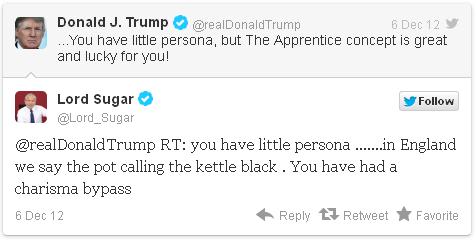
Sugar doing my job for me!

Sugar doing my job for me!

Perhaps this is because ivory-towerism doesn’t sit so well with the British public, while it taps into the ultimate aspirations of many Americans. The British version is certainly not intended as satire (though the directors do like to puncture with visual gags anyone who takes self-assessment as business elites too literally) but it is playing to a crowd who like sarcasm, wit and darkly awkward comedy. Sugar and his associates are fans of linguistically inventive cruelty, the directors eek every ounce of uncomfortable voyeurism out of the documentary filming (in a style borrowed from pioneering UK sitcom The Office), and the show itself is framed as a sadistic prank played on those who applied to appear. It’s marginally better now the prize is a sizeable investment in a business venture a la Dragon’s Den/Shark Tank (delete monster and monster holding cell as appropriate) but I remember when winners were rewarded by an internship at a digital signage company amid the electro-magnetic subjugation of Tottenham Court Road. Somnambulist losers of Touch the Truck have it better. No-one expects Donald Trump to say anything intelligent, funny or creative (even his racist metaphors lack flair) and the verbal garbage emerging from the Ridley Scott-alien mouths of his children is a generation stupider. Mavericks are praised not parodied and the mere act of aspiring is deemed worth the risk.

Sunday Day Recorded

Posted in American TV (General), American TV Shows, Behind-The-Scenes, Reviews, TV channels, TV History, Unsung Heroes, Watching TV with tags , , , , , , , , , on February 25, 2015 by Tom Steward

‘For a lot of people, their favourite part of the show is the short films, which makes you wonder why don’t they just do the whole show that way. They’ve been doing the show wrong for 40 years. The sketches, they’re nice but they’re long.’

Louis C.K. has made a career out of hitting the nail on the head – and inducing involuntary laughter from the brain – but in as many words as there’s been years of Saturday Night Live, the comedian summed up the fatal (surely tragic by now) flaw of NBC’s late-night sketch show, which celebrated 4 decades on the air this month. C.K. was introducing a compilation of shorts on the SNL anniversary special, scheduled on a Sunday and in primetime (who says American don’t get irony?) and may well have been feeding in to the inverted back-slapping that was pungent throughout the evening. But as soon as the clips rolled, and names like Jim Jarmusch, Mike Judge, Albert Brooks and Paul Thomas Anderson filled the screen, C.K.’s roast zinger becomes an unarguable truism. I myself once had a similar thought before when watching the late-90s British daily sketch programme The 11 O’Clock Show which was written on the day of broadcast and wondering why they didn’t just spend more time on the jokes and make them funny.

Crapping on SNL!

Crapping on SNL!

The more you think about it, the more damning C.K.’s accusations become. Who honestly prefers to watch an SNL sketch featuring The Blues Brothers instead of just watching The Blues Brothers? Where’s the pervert that would endure SNL’s fake public access show ‘Wayne’s World’ as anything other than the intro to Wayne’s World (or Wayne’s World 2)? SNL cast members try to make out that movies based on their sketches are duds (presumably for fear someone might decide to cut out the middleman) but its filmed elements are the only great comic art the show has ever contributed the world. And a sketch worth of Coneheads feels like an hour-and-a-half movie anyway, so you might as well watch the feature spin-off. C.K. might be biased since his sitcom has the finesse of art cinema, but we’re not talking about a group of comedy Oliviers with rave live notices that seem hopeless on film. Every SNL legend has proven themselves masters of screen comedy and the mythical thrill of live TV shouldn’t distract us from that.

Unless I’m severely underestimating Lorne Michaels’ command of irony, I don’t think the inflated length of the anniversary special – coming in at four-and-a-half hours – was meant as a poke at SNL’s reputation for overlong sketches. Again, C.K. was on point (why don’t I just marry him?) and the underwhelming reaction he received was not simply audience fatigue, but a nervous titter of cold, hard realization. The amount of sketches (if you can call them that) and appearances on the night looks impressive on paper, and yet SNL has that amazing ability to appear stretched even when pushed for time. It doesn’t help that so many of the most famous sketches which were revived for the afternoon/evening are based on repetition; Celebrity Jeopardy, The Californians, Weekend Update, The Bass-O-Matic Infomercial. What start out as parodies of overly-formatted TV programming end up using that format as padding. It’s a mistake for SNL to assume that everyone finds their overlength endearing. Like their very own Drunk Uncle, the nostalgic surface hides a multitude of outmoded beliefs and behaviours.

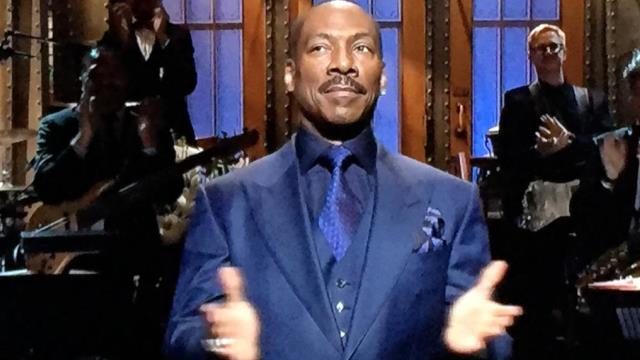
Eddie Murphy doing for real what he does in his mind.

Eddie Murphy doing for real what he does in his mind.

For a sketch show that invests such capital in the idea of shedding its history as soon as it qualifies, the current SNL cast were rather conspicuous by their absence on the anniversary special. Perhaps it’s not so much about them as the greatest generation that fought for their freedom to pretend to be Justin Bieber, but what this sketch comedy version of Apocalypse Now (minus Brando mumbling about snails – that was cut so Eddie Murphy could applaud himself) somehow failed to acknowledge was continuity. It’s a slap in the face that a cast who may be in the process of getting SNL’s shit together for the first time in quite a while should be passed over in a four-hour show and made to look like the weakest links in the chain. Given that Eddie Murphy has only just forgiven SNL after former cast member David Spade ridiculed his career on-air, despite Murphy single-handedly keeping the show on the air (like 1986 World Cup Maradona), they’re clearly not the ones who should have been asked to clean boots that night/day.

Bad Morning Television

Posted in American TV (General), American TV Shows, Behind-The-Scenes, BiogTV, Internet TV, Reviews, TV advertising, TV channels, TV History, Watching TV with tags , , , , , , , , , on February 18, 2015 by Tom Steward

It was upon returning to my hotel room at 5 in the morning after seeing some of the best and oldest bluesmen in Chicago and celebrating the existence of an L-train with a trip to a 7-11 to get some cheese-filled-bread (or bread-filled-cheese) with a side dish of whatever was left on the room service tray a few doors down and being confronted with the blurry, blobby outline of Tony Danza that I came to a grave realisation. In the land of 24-hour business, late licensing, and all-night dining, there’s nothing on TV in the middle of the night. So why have two major TV events recently debuted in the early hours of the morning?

Last November the comedy short Too Many Cooks aired around 4am during the infomercial block on Adult Swim, the late night version of Cartoon Network. A parody of both the opening credits of 1980s sitcoms and the insanely dark and genre-bending possibilities of TV comedy in that decade (and before you dismiss it as exaggerated, remember that ALF was dissected by the government in the finale), Too Many Cooks became a viral video smash and was repeated each day at midnight for the next week. The perverse choice of a graveyard slot more or less guaranteed the short’s success, not only because re-run and internet re-circulation was necessary, but also because there was no competition.

Adult Swim seemed to cotton on to the fact that there’s an undiscovered country of television between the hours of 1 and 6 in the morning. I understand why they’d want to be the pioneers, but I don’t understand why there’s not a frontier-style rush to claim territory from every other producer in TV. If the entertainment market is so damn saturated, why not get a head-start by putting out your show in the vast wasteland of unused hours in the TV day? For once, having a variety of media platforms to re-play TV on is a blessing, since audiences will need and want to see your show again once they hear they’ve missed out.

It’s surprising that the networks haven’t come to these conclusions already, since they’ve had such great success by pushing their best programming later and later in the evening. The 11 o’clock talk show is an institution that has spread to virtually every channel in the schedule and their midnight sister programmes aren’t far behind. This weekend NBC celebrated 40 years of Saturday Night Live (ironically on Sunday and in primetime), a show which begins at 11.30pm and runs to 1.30 in the morning. This isn’t, as I once thought, because Americans stay out or go to bed later, but because it’s untapped resources. In Britain at this hour, they start playing movies starring Eric Roberts.

And what if you actually need to bury a show? There was surprise in early February when FXX aired a pilot for a series based on the popular Wheel of Time fantasy novels by Robert Jordan at 1.30am. Not only do the books have a huge fan-base, but with Game of Thrones still going strong, there’s a deep well of fantasy (probably with a goblin in it) that everyone in TV can draw water from. It soon became clear, however, that the air time wasn’t a stunt to get the show ahead of the competition but to keep it firmly under the radar, being the best all-round solution to legal issues facing such a project.

The television rights to the books were to revert to a new owner on February 11 (two days after airing) and so the previous owners were probably trying to get something based on the books out on TV before that happened. Author Jordan’s widow has contested the claims of the producers to the rights and they are threatening legal action. Interestingly, FXX were able to offload responsibility by treating the pilot as ‘client-supplied programming’ i.e. an infomercial. If you’ve got a show mired in legal trouble, 1.30 in the morning is clearly the place for it. The Wheel of Time pilot used the early-morning hours as a dumping ground for toxic material but it still shares similarities with Too Many Cooks’ deployment of late TV.

Both programmes traded on the idea that anyone watching at that hour can’t be sure of what they’ve seen; one for comic effect, the other for legal protection. With each one, being mistaken for a promo or infomercial actually helped. It makes financial and creative sense. Why still the hesitation?

Box Spin

Posted in American TV (General), American TV Shows, Reviews, TV Acting, TV channels, TV History with tags , , , , , , , , , on February 11, 2015 by Tom Steward

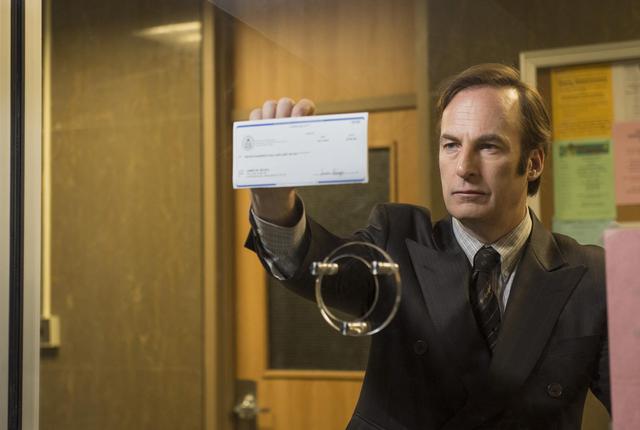
On Sunday and Monday, as part of a 2-night event (isn’t everything these days?) AMC debuted Better Call Saul, a spin-off from its corner-turning drama series Breaking Bad based around Walter White’s kitschily corrupt lawyer Saul Goodman. For reasons that can only lead to spoilers, Better Call Saul is a prequel. Despite the unabated popularity of Breaking Bad and the character, there’s still the risk that a spin-off would damage the reputation of the programme, especially one that promotes to protagonist a character who mainly functioned as much-needed comic relief in one of the bleakest shows on television. AMC needn’t have worried because, as with all good long-form television, Saul grew into a much more rounded character as Breaking Bad went on (lest we forget that Walt started out as a clown) and it’s this version of the character that Better Call Saul has inherited. But in TV the odds aren’t against them (or as against them) since there’s nothing to say a spin-off show won’t be as good as or even better than the original.

Check out Better Call Saul!

Check out Better Call Saul!

As Steve Coogan self-reflexively observes in The Trip to Italy there are only ever one or two movies anybody ever quotes when arguing that sequels can be better than the original. Of course, TV has its go-to canon of superior spin-offs (Frasier and anything produced by Norman Lear, who understood the value of maintaining a universe of characters decades before Marvel Studios cottoned on to the idea) but the medium has a pretty good hit rate when it comes to franchises. TV is so generically nebulous (modern quality TV even more so) that it barely matters when a spin-off is more or less comic than its predecessor. In today’s TV when series take so long to hit their stride, their spin-offs may even pick up a show when the quality’s still good and perhaps before they’ve had time to peak. This seems to be what’s happening with Better Call Saul which reaches heights in its first two episodes that it took Breaking Bad (despite its calculated seriality) three seasons to achieve.

But what we’ve seen of Better Call Saul isn’t free of the pitfalls of spin-offs either. Gratuitous cameos from former cast members are one of the biggest obstacles to spin-offs being able to fly solo, and this one has them in spades. The re-appearance of gnome-faced security man Mike in the unfamiliar role of a car park attendant is not at all the problem. We know that history will draw the two men together, so we expect to see him enter Saul’s life somehow. But running into loose-cannon drug dealer and Walt’s former distributor Tuco in a coincidence that would make Dickens blush (plus members of his gang who also appeared in Breaking Bad) really is a step too far. Although some of this is the problem of prequels. Prompted by the none-too-subtle nods of the writers, we’re constantly anticipating moments from Breaking Bad instead of enjoying what the new ones have to offer. Despite the pleasing evocation of middle-America at its most moribund in opening black-and-white images recalling Alexander Payne’s Nebraska (which star Bob Odenkirk also featured in), it may have been a mistake to start at the end.

Aside from these distractions, which may have been the result of the writers sensibly trying to break Bad fans in, we’re left with a series whose name may one day be called without company. It will never completely transcend Breaking Bad, especially with original creator Vince Gilligan at the helm here too, but I’m confident we’ll soon be able to consider them separately. It’s possible to foresee Better Call Saul doing for the portrayal of lawyers what Breaking Bad did for scientists. Like Walt, Saul is not just the grumpy maverick we’re used to when confronted with so-called ‘antiheros’; he’s a criminal with a deviant moral code. That said, while we always suspected that Walt was acting out of pure self-interest (which was confirmed by the finale), there’s the irony that the earlier incarnation of villain Saul comes across far more nobly and altruistically than ‘good-guy-turned-bad’ Walt ever did. We can still think about Walt without making Saul any less interesting.

One of these is not like the other.

One of these is not like the other.

If I’m jumping the gun here, it’s because TV history tells me there’s nothing to worry about. When a spin-off is terrible it’s usually because there’s nothing left in the tank. Breaking Bad’s by-the-numbers finale always felt like it was holding something back. It was. A sequel. A prequel. A new modern monster.

Bonus Ball

Posted in American TV (General), TV advertising, TV channels, TV Sports, Watching TV with tags , , , , , , , , , on February 6, 2015 by Tom Steward

I’m sure most of you are over The Super Bowl for another year (this really should be called ‘Watching TV after Americans’) but I’m far more interested in an aspect of the event that doesn’t change each year – although even for someone to whom ‘football’ means round balls and bad pies it was a pretty great game – which is the TV generated around it. The Super Bowl on TV seems never to start or end, making it the perfect metaphor for the medium. As it’s assumed that large portions of the nation are watching, which is no mean feat these days, The Super Bowl is a bat-signal for advertising. For the same reason, counter-programming decides to take one for the team, but those networks that try to take on The Super Bowl must do so in the most ruthless ways possible to even get noticed. This year, however, there were some added satirical bonuses.

I’m used to televised sporting events starting a few minutes later than advertised to sneak in a commercial break while everyone’s watching, but I was not prepared to be sitting on the couch at 3.30 still waiting for the game to begin. And for what? John Travolta’s Adele Dazi trying to break Bleedin’ Gums Murphy’s record for the longest rendition of ‘Star Spangled Banner’? The presentation of the NFL’s annual ‘didn’t rape or hit anyone’ award? Don’t we have a pre-show for this? The mechanics of modern television have manoeuvred themselves so that we are continually watching prelude. The Super Bowl goes one better and expects we will enjoy it. It’s moments like this which remind us that commercial television form is an integral part of the way that a game of American football is structured, rather than the British kind which is merely pricked around the edges by commercial interruption.

Commercials broadcast during The Super Bowl are notorious for being sexist, portentous and counter-intuitive. Half-time act Katy Perry clearly wanted to take some of the heat off the sexist commercials, but they were out in full force, not as well-disguised by nob gags as the advertisers clearly thought. Carl’s Jr. has even managed to turn gender discrimination into a branding mechanism for its Super Bowl ads. But this year they didn’t go unchallenged. Feminine health company Always ran a semantic deconstruction of the gender assumptions and discourses behind the phrase ‘Like a Girl’ while Saturday Night Live staged a fake Totino’s ad exposing the unbelievably narrow gender stereotypes and chauvinistic divisions of Super Bowl ads, particularly the archetypal representation of women as child-minded homemakers. Somewhere in the middle was Fiat’s ‘Viagra’ campaign which unironically presented pumped-up virility and machismo as a draw but also satirised male sexual prowess and the idealised feminine body.

Part of the fun of watching Super Bowl commercials is trying to figure out what product the pretentious pre-amble will eventually advertise (clue: anything combining ‘hard’ and ‘soft’ is deodorant). But sometimes the logic of ad writers is beyond even those who dissect media images for a living. A ghost-child commercial is the perfect vehicle for a leukaemia or cancer charity, but it does nothing to ameliorate the ghoulish undertones of an insurance company. Another insurance company, Esurance, seems intent on using circular logic and specious reasoning similar to the Johnny Cochran O.J. glove defence to convince consumers of its superiority to established rival Geico, but as long as that involves Walter White as a drugstore pharmacist I don’t much mind. If you tire of the commercials, you can switch over to The Puppy Bowl, Animal Planet’s re-imagining of The Super Bowl through the imagery of illegal competitive dog-fighting. For cute read irresponsible.

As with SNL, the most authentic example of Super Bowl television was the least genuine. Key & Peele have always satirized American sport and its coverage, but with their simulated Super Bowl pre-show staged as a real network broadcast, it was far more than a send-up. There was plenty to ridicule: the ill-fitting suits of the former-pro presenters, the passive-aggressive banter, the live-action footer trails of network sitcoms always starring ‘Alison Janney’, and of course the beyond-hyperreal graphics with overly phallic connotations. But the real-time flow and denouement in which the digital robot mascot achieves self-awareness and propels humanity into a state of oblivion identifies The Super Bowl and its live, ongoing broadcast with a dystopian terror effect that reminded me of another piece of faked factual horror television, the one-off BBC drama Ghostwatch. There is something inherently wrong and otherworldly about TV’s broadcast of The Super Bowl, the same something as television itself.