Archive for the TV History Category

One Pundred Hosts (Without Typos Or Cheap Puns)!!!!

Posted in American TV (General), American TV Shows, Americans watching British TV, Behind-The-Scenes, BiogTV, British Shows on American TV, Reality TV, Reviews, TV Acting, TV advertising, TV channels, TV Culture, TV History, TV Sports, Watching TV with tags , , , , , , , , , on September 3, 2014 by Tom Steward

We’re into syndication! With 100 blogs under my belt, I can now sell the rights to the A.V. Club who will publish the same three posts over and over again – with every third sentence removed – for the next twenty years. In the true spirit of American TV, I’ve decided against celebrating this milestone with a piece of considered, original writing (why break with tradition now?) and instead hastily assembled and artlessly compiled a list of extracts representing the best (or at least most comprehensible out-of-context) of the blog…and split it into two parts. Thanks for watching and enjoy!

A specially-created TV series just for this milestone!

A specially-created TV series just for this milestone!

‘Years previously I used to run on the spot along to chase sequences in cartoons like a dwarf soothsayer doing a dance prophesising the age of TV interactivity’

‘My friend openly admitted to finding the slapdick (my term) comedy of the three hosts hilarious, commenting that “we don’t have people like Clarkson on American TV”. “Fox News” I thought, but didn’t say’

‘So shifting viewing an hour or two to make way for a pizza is not exactly the end of television’

‘Yes, Chantix is apparently not just a wonder-drug but a porthole into an alternative universe of Marxist dialectic or, if that’s too posh a reference for you, the Bizarro World’

‘All my morning shows on the day of the Royal Wedding were attended or discussed by the hosts with a bizarre royalty-envy that ill fits a country founded on telling the King of England to fuck off’

‘After weeks of sounding like a malfunctioning motivational speaker robot, Celebrity Apprentice contestant and consecutive mental-of-the-week Gary Busey was appointed project manager on a task’

‘For G, it was as if Britons had collectively decided to substitute a working TV set in the corner of the room for a 19th Century ventriloquist dummy with its mouth sprung to repeatedly gawp the word “Mummy”’

‘When war “came to Downton Abbey” it went by so fast that it seemed to have actually been fought in the grounds of the building, like a game of Risk gone awry’

‘Now I’m starting to think that I was in some sort of hallucinogenic fever state the night before because I could’ve sworn I saw Hollywood actor-director Clint Eastwood hold a conversation with a chair while an audience of magenta elephants cheered him on’

‘TV Land is where sitcoms and their stars go to die’

'Memba them?

‘Memba them?

‘After prolonged exposure to American TV news, however, I now long for a token alternative viewpoint and the masquerade of even-handed commentary’

‘Watching a Halloween-themed sitcom episode used to be like watching film footage of Hitler’s speeches; unimpressive and kind of shambolic and yet those in the crowd seem to be going wild for it’

‘Like anything in life which I have no direct experience of, I looked to American TV for advice on how best to handle the situation’

‘All I found on The Travel Channel were programmes about the excessive intake of high-calorie foods which make Americans less able to move. When I turned over to The Learning Channel I saw wall-to-wall programming about people without formal educations’

‘I’m sure Harry Enfield will be relieved to know that after decades of writing and performing some of the best character comedy and social satire in Britain he is finally known in America…as a talking gnome with goggles’

‘But a 3 hour serialised pilot? It’s like the feeling you get ordering a starter of garlic bread with tomato and cheese in a pizza restaurant. It’s enjoyable and you wanted a starter but it’s also what you’re getting for the main course’

‘I mean, what exactly is gained showing Goodfellas at 2 in the afternoon?’

‘It seems that if reality TV was more like reality, with all its loose ends and uneven surfaces, fans of the genre wouldn’t necessarily want to watch it’

‘Early in his career, artist Roy Lichtenstein produced a series of paintings based on advertisements. In one of the great cultural ironies of our times, advertising started appropriating Lichtenstein’s paintings. Something similar is going on with Mad Men

‘To those who know football from the European or Latin American leagues, watching a US soccer team play feels like the moment in Futurama where Fry finds that in the 30th Century baseball has become ‘Blernsball’, a barely recognisable Twilight Zone twist on the sport where spectators try to catch players instead of balls and giant spiders roam free through the diamond’

‘It’s a perfectly normal road to marriage…if you’re James Bond’
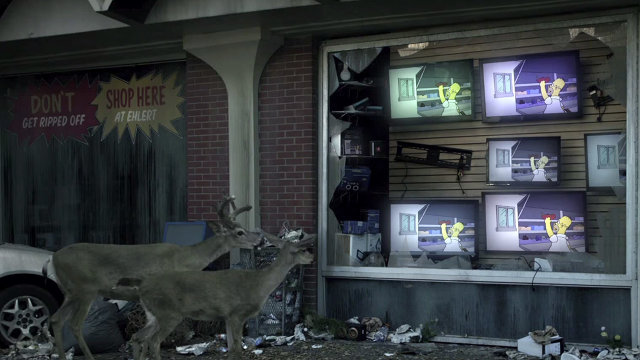
 

The Simpsons Are Going To Yellow Air!

Posted in American TV (General), American TV Shows, TV channels, TV Criticism, TV History with tags , , , , , , , , , on August 27, 2014 by Tom Steward

We’re currently halfway through the most embiggened television event of the summer. Every. Simpsons. Ever. is FXX’s 12-day marathon of all 552 episodes of The Simpsons in order, a feat which will require more than even a hundred tacos for adequate sustenance…and a bigger wheelbarrow. I refuse to rhapsodize about the quality of these episodes, partly because it is so astoundingly self-evident that anyone who can’t see it is already a lost cause and also because if you’re yet to be convinced it will take Hypnotoad therapy (it’s still Groening!) to convert you, not the arbitrary superlatives of a fan-blogger.

Doh! A deer. A female deer...

Doh! A deer. A female deer…

What struck me watching the series from the beginning is how fully-formed it arrived. A few episodes in and the refined notes of sitcom, satire, slapstick and emotion had already found a blended chemistry. I’ve always suspected the idea that series take place in a coherent fictional universe was just World of Warcraft for TV critics, but looking back it’s remarkable how every line of dialogue or character action is layered with a thousand future meanings and significances. The day is not far off when, as in Shakespeare or The Bible, a reference to everything in existence will be found in The Simpsons.

You don’t need me to remind you of this. In fact, I didn’t need to remind myself. I just did it because the TV told me to, and it’s hard not to listen because it spent so much time raising me. What I do need to remind you is that The Simpsons is still good and should not be cancelled. Whenever anyone involved in the show is asked whether they should call it an epoch – an inevitable question after 25 years on the air – they invariably defer to what is most unprecedented and unrepeatable about The Simpsons.

The show’s original contract with Fox contains a clause stipulating that the network cannot interfere in its production. This clause still holds today. To end the series would be to forsake a kind of creative freedom not seen before nor possible since in network television, or any other corporate media for that matter. Of course, if The Simpsons wasn’t doing anything valuable with their autonomy, then it shouldn’t be kept on the air just to make a point. But I would argue, fervently, that it is. Perhaps not as well as it once did, or as consistently, but cromulently enough.

In recent years, the abuse The Simpsons receives at the hands of the internet (eh?) has become so ritualised that the show even has a running gag about it (which is reason enough to keep the series on the air, if you ask me). I was probably in their camp a couple of years ago. But when I think about, the time I disliked the series most was when I was denied a steady flow of new episodes by Rupert Murdoch restricting UK premiere rights to channels I didn’t have (the Sith Lord giveth and the Sith Lord taketh away).

Since I moved to the US, I get daily back-to-back episodes of The Simpsons on my local station which are all from 2010 onwards and shown on a continuous loop. For some time now, this is what The Simpsons has been to me. Rather than experiencing melancholia for the show’s golden age, my appreciation and enthusiasm for the series has been renewed and revitalised. The writing remains acerbic, the satire of contemporary folly is as punchy and provocative as that of the first Bush administration, and contrary to popular belief there is as much feeling for the characters as ever.

Even The Simpsons refuse to pay to watch their show now!

Even The Simpsons refuse to pay to watch their show now!

Rupert Murdoch will no doubt need all 552 episodes of The Simpsons as evidence in his defence when he is eventually tried by The Hague but I only need one to defend the series against charges of loitering that may come its way. ‘Steal This Episode’ is the ninth episode of the 25th season of The Simpsons and aired this January. It is one of the most recent episodes and one of the overall best. It contains a nuanced and insightful commentary on the moral contradictions and hypocrisies of media piracy, spot-on critiques of Hollywood’s recent output (‘I like that James Bond is ugly now’), and pinpoint social observation (I have lived the Raiders’ fan with the baby at the 9pm screening!). It has an emotional centre and yet draws intelligent laughter from what we know of the characters and what is true of life. They’ll never stop The Simpsons.

Bumping The Shark

Posted in American TV (General), American TV Shows, Reality TV, Reviews, TV channels, TV Culture, TV History, TV News, Watching TV with tags , , , , , , , , , on August 13, 2014 by Tom Steward

Last week was Shark Week, Discovery’s incredulously popular annual event consisting of 7 days of continuous shark-themed programming, sandwiched neatly inbetween the network’s other 358 days of continuous shark-themed programming. Now in its 27th year, the ripple effect of Shark Week across TV is staggering, with a shoal of cable networks attempting to take a bite out of Discovery’s ratings with concurrent themed programming alternatives created under the fin of Shark Week. While some satirise the inflated phenomenon of Shark Week, others are brazenly capitalising on its currency. Here’s some of the counter-attacks, and a few suggestions for next year:

Jaws Week:

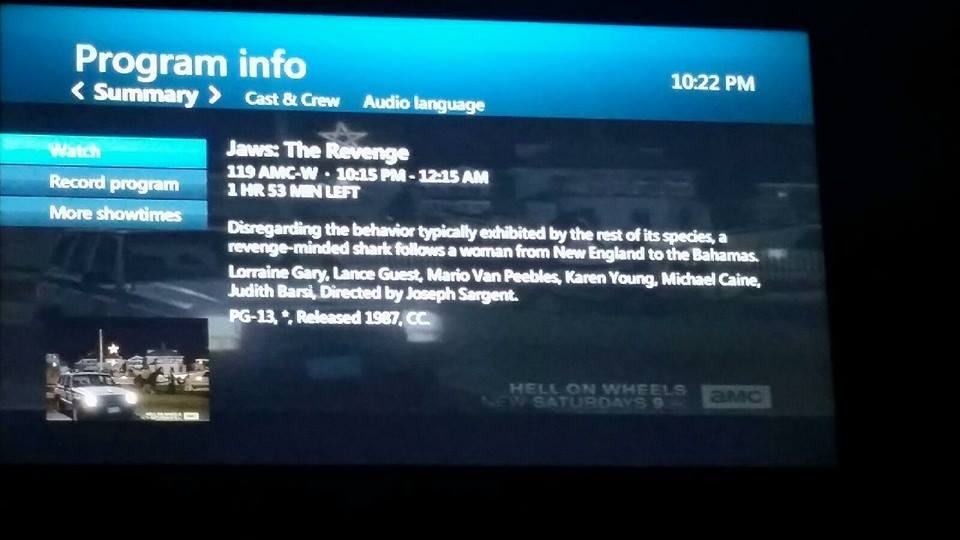
Steven Seagal movie marathon and quality TV gamut-running network AMC showed a Jaws movie every night, a prospect that got increasingly less attractive as the week went on. The appeal of the original movie passes me by, even though I think Spielberg is a great cinematic illusionist (in that he’s tricked people into thinking he’s a good director), but it and its no-frills sequel are both perfectly serviceable potboilers. Jaws 3-D would be a condescend-a-minute romp through the annals of hilariously dated visual gimmicks were it not now the desired look for all of Hollywood’s blockbusters. Jaws: The Revenge is a movie so contrived that even the info button on my cable box couldn’t help but have a pop at its hopeless storyline.

The ghost of Roger Ebert haunts my info button!

The ghost of Roger Ebert haunts my info button!

Snark Week:

Quantitative data-led camp reality and comedy network WEtv spent a week filleting its programming – I’ll stop the sea puns eventualgae – for the snarkiest (‘bitchiest’ in old and perfectly legal tender) cuts to assemble a ‘snark-a-thon’. Re-runs of Roseanne and Will and Grace were predictable but apparently the sunglass-deflected verbal garbage spewed by douchetective Horatio Kane in cold opens of CSI: Miami has been reclaimed as snark. Making use of its rolling reality repertory, the network launched (seemingly in a word document with an unstandardized font) David Tutera’s CELEBrations where the celebrity event planner plans events…for celebrities. Snark is obviously also reality-speak for ‘palindrome’. All this was accompanied by an onscreen ‘snark-o-meter’ because you know how reality TV fans love their maths.

Shart Week:

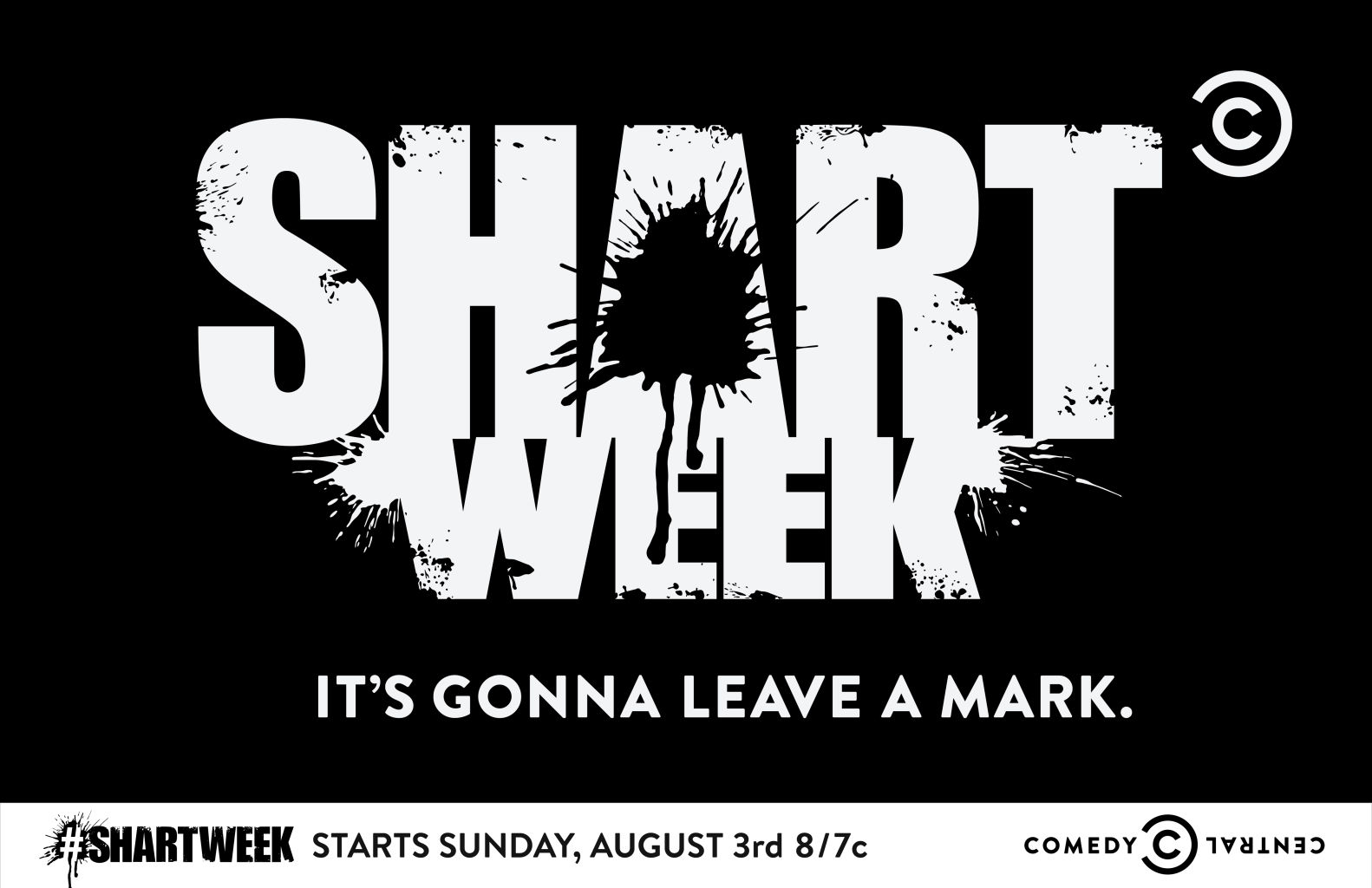
Comedy Central, a network dedicated to the lifetime incarceration of Jon Stewart, took a break from its correctional duties last week to show some shit, or at least more shit than usual. In one of the more anarchic responses to Shark Week, the network drained its sewer system (also known as Comedy Central before noon) to find the most scatological episodes of its many and clearly-not-that-varied programmes. Not only did they manage to find enough programming to last 7 days from noon to midnight, there were entire episodes on the subject, like South Park’s ‘Mr Hanky, the Christmas Poo’. A great way to dump on Discovery, I maintain that if this isn’t a sign there’s too many men on a network, nothing is.

Jumping the Shart

Jumping the Shart

Sharknado Week:

Probably the closest rival to Shark Week since it primarily airs fictional programming about sharks with no basis in science whatsoever; spelling-free telefantasy network Sy-Fy premiered Sharknado: The Second One, the sequel to its bottom-feeding 2013 original TV movie, and filled out the airwaves with movies of similar or worse quality about sharks and one other thing. It could also have been dubbed ‘Son of Shark Week’ as it’s hard to imagine this monstrosity (and that’s the closest you’ll get to a compliment from me) existing without 25 years of dumb stuff being said about sharks softening up the American public for these pixel-thin piss-takes. As spoof-proof television, it’ll give your sarcasm glands a much-needed rest after a day of Shark Week ‘documentaries’.

Shark Week Alternatives 2015:

TV Land should launch Jump-The-Shark Week where the network only shows re-runs of episodes broadcast after it became impossible to take a show seriously. This would include all the post-lottery win episodes of Roseanne and any Dallas after 1986 starring the ghost of Bobby Ewing. FX can do Stark Week where primetime consists of airings of the Iron Man movies – actually the FX execs can just let nature take its course on this one. The Food Network could run Chard Week featuring all the best appearances of the vegetable in the mystery box on Chopped, including the time someone drizzled it with a gummiworm-infused vinaigrette. The Biography Channel should host Narc Week in which all the interviews with blacked-out faces and altered voices of cops who’ve squealed on the Mafia are edited together and begin to resemble one endless Peter Frampton concert in the dark.

Garner, But Not Forgotten

Posted in American TV (General), American TV Shows, TV Acting, TV advertising, TV History, TV News, Unsung Heroes with tags , , , , , , , , , on August 6, 2014 by Tom Steward

Sometimes I think I shouldn’t stop writing this blog as it seems that whenever I do someone significant to TV dies. This time, though, ‘significant’ doesn’t cut it, and all superlatives are understatements. It’s difficult to quantify what James Garner – who died of natural causes this July at the age of 86 – meant to television. Not only was he around during TV’s formative years and helped the medium come of age, he had the rare distinction of playing two of the greatest characters to ever grace the small screen. Obituaries both written and forthcoming will doubtless talk about what an incredible movie star Garner was (and indeed he was) but I always thought there was a certain dailiness about his performances that made him perfect for television, and may help explain why he kept returning to TV while his film roles continually deflated the grandiosity of the cinema.

A TV Maverick.

A TV Maverick.

Garner’s first major television role was drifter gambler Bret Maverick in Warner Brothers’ western dramedy series Maverick, which he played throughout the late fifties. The show is a one-word argument against FCC chairman Newton Minnow’s notion of TV in that era as a ‘vast wasteland’. It was anti-formulaic, adult, challenging and irreverent, and Garner’s humour, bathos and moral ambiguity in the part had a lot to do with that. Essentially a thinking man’s riposte to the branding-iron western TV series (they didn’t have cookie-cutters on the frontier!) that overpopulated the networks at the time, Maverick was an early indication of the quality of television that could be achieved working within popular genres. While Bret Maverick certainly paved the way for television antiheroes like Tony Soprano and Walter White, Garner saw him more as a ‘reluctant hero’ and played it accordingly. It was that kind of nuance that made the difference.

In Garner’s 2011 autobiography The Garner Files – itself a classic in literary understatement – the actor’s usually low-key prose cannot downplay the importance of Maverick to the TV of its day:

‘In its own way, Maverick was “anti-establishment”. It gave voice to viewers’ dissatisfaction with the predictable, button-down TV of the ‘50s, with its black-and-white morality. Maverick explored gray areas by questioning the authority of the conventional Western hero. After Maverick, it was hard to watch those steely-eyed cowboys without laughing.’

It’s worth remembering that fifties American TV was highly praised for its character drama in anthology form like Philco Television Playhouse and Studio One, and so to offer this kind of psychological complexity in the form of a western series – more often regarded as the cultural antithesis of the anthology drama – was radical. It also showed that TV could do something worthwhile with the western formula.

That would be enough for most actors, but unbelievably Garner did it all over again as every-slob private eye Jim Rockford in Universal’s detective series The Rockford Files which ran throughout the late seventies. One of the most perfectly-made shows in television history, Garner’s lastingly lovable lead performance put it over the top, and into perpetual syndication. The actor’s iron rule over his Cherokee Productions also ensured that Universal never dragged the show back to the studio lot, and kept it as freewheeling as the Southern California locations we saw onscreen. The Rockford Files’ tone-perfect medley of comedy, drama and thriller was a template for quality US television to come, and all that was there in Garner’s performance. Never humourless nor too frivolous; a hero you could believe in because he didn’t believe in it himself. Unlike most sanctimonious American TV protagonists, Garner never pretended Rockford wasn’t out for himself.

Rockford of Ages.

Rockford of Ages.

Despite a string of memorable and game-changing performances in a host of movies, Garner always went back to TV in the end. Whether it was the Rockford Files TV movies (which, oddly, didn’t disgrace the original), a series of beloved Polaroid commercials with actress Mariette Hartley harking back to the repartee of romantic screwball comedies, or replacing the late John Ritter as the patriarch on sitcom 8 Simple Rules. Rather than trashing television as so many Hollywood movie stars have, he decided instead to make it better, either by seeking out the best material or improving drastically on the worst. After Garner was through with television, it didn’t look like there was a distinction between TV and the movies any more. It would be impossible to find two better performances in television than Bret Maverick and Jim Rockford, but James Garner always meant more than the sum of his parts.

Box Jumps

Posted in American TV (General), American TV Shows, Behind-The-Scenes, TV channels, TV History with tags , , , , , , , , , on June 24, 2014 by Tom Steward

With the possible exception of serial killing, the part of our culture most likely to produce copycats is television. Each idea that has any kind of success with or impact on viewers will be re-circulated more or less unmodified until the imitation has paled to the point it recalls the scene in Moulin Rouge where Nicole Kidman pretends to be Madonna pretending to be Marilyn Monroe. This is why there are currently five series airing on US television (that I can name!) about software developers and why so many recent TV dramas use flashback, even though it runs counter to the logic of television’s simultaneous time. A particularly alarming television trend doing the rounds at the moment is arbitrary jumps in time that leave huge gaps in series timelines. Rather than heralding a new style of TV storytelling, these flashforwards seem more like afterthoughts designed to resolve awkward continuity problems.

Fargo the year!

Fargo the year!

It was recently announced that the final season of HBO’s prohibition-era gangster drama Boardwalk Empire would take place in 1931, seven years after the end of the previous season, which had covered the late teens and early twenties in its first four seasons. The final few minutes of the latest season of docu-sitcom Parks and Recreation jumped three years ahead, omitting Leslie Knope’s pregnancy, the birth of her triplets, and the first years of her new job. FX’s thriller mini-series Fargo skipped a year in its last few episodes, this time allowing police Deputy Molly to get pregnant and criminal conspirators Lester and Lorne to start new lives. After nine episodes out of twelve, we’re still waiting for the belated revival of 24, Live Another Day, to jump a few hours to get us to the end of the day before the season ends, as promised by the show’s producers.

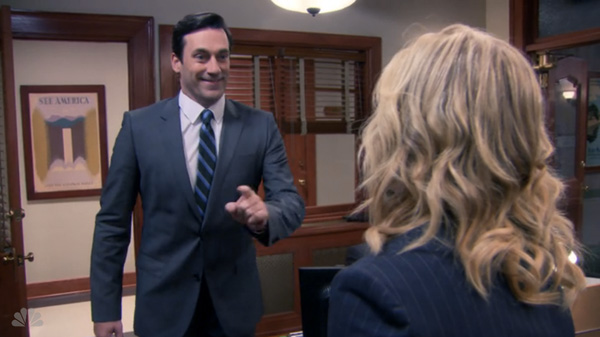
When TV shows did this in the past, it always smacked of desperation. It was no coincidence that Desperate Housewives jumped five years in its fifth season the same time as viewers were leaving the show in droves. Nor was a secret that One Tree Hill’s skip ahead four years halfway through its run was a thinly veiled attempt to bring characters’ ages into touch with the actors playing them. The time jump might be being deployed in a slightly smarter way these days, with Parks and Recreation’s implication that the nation has missed out on a three-year recurring guest role from Mad Men’s Jon Hamm, who is fired from Leslie’s office seconds after the ellipsis. But if you look at where the jumps are situated in the runs of these series, and think about why they should happen at that exact point, you’ll see they are no less crude.

As with flashbacks, part of the problem is that time jumps upset the way time works in television. It’s conventional that TV time runs concurrently with the time in which we live out our lives, and pleasurably so since much of the joy of watching TV is the way it syncs with what we’re doing. Time jumps invariably put a show ahead of the time of viewing, which makes it a kind of science-fiction, and would be fine if that’s what the programme-makers were going for. Aside from problems of realism and plausibility caused by the time jump, it also puts viewers at odds with programmes rather than it seguing with their daily and weekly lives. It’s also more of a placebo for story problems than a panacea. Things take time to work themselves out in television, and television should remain a record of that not a remedy for it.

Look what we missed!

Look what we missed!

A time jump might have relieved Parks and Recreation viewers of another pregnancy storyline but it also cheated them of character development. It’s very much a self-written corner since no-one asked the writers to put two pregnancies back-to-back. The loss of a full year in Fargo deprived the series of the suspenseful and tightly-knit storytelling that held the show together, resulting in a deeply unsatisfying denouement. We’ve yet to see how 24 will skip ahead to later hours of the day, but it’s bound to disrupt the real-time orthodoxy of the premise. The producers of Boardwalk Empire may feel they have more justification to move forward in time since it is a historical piece. My initial thoughts are that the 1930s is a very different animal historically, and that Boardwalk Empire can’t help but become a different programme. Can we jump forward to a time when TV doesn’t time jump?