I’m looking at the guide on the cable box. G is recording The Departed on FX. It is about noon.
G: I’ve never seen it.
T: You still won’t have.
Strict censorship of network and basic cable television in the US means that whenever movies are shown most or all of the obscenities are cut or overdubbed, extreme violence is pruned and ‘sexy scenes’ (for those of you who grew up in the 90s watching rented videos) are taken out. The networks make it worse for themselves by scheduling the most obscene movies in the morning and daytime.
This is as much as FX showed of ‘The Departed’
I mean, what exactly is gained showing Goodfellas at 2 in the afternoon? How does a movie that contains 300 fucks last longer than a few minutes after cuts? We’re not talking about movies where sex, violence and obscenity are gratuities and it plays just fine without them. These are movies where such excess is inextricable from the film’s style and embedded in the world they represent. It’s not even as though the filmmakers had a chance to work up creative solutions to tailor their work to the censorship regimes of network television, as the writers and producers of original programmes have.
Growing up in the UK in the 90s, I remember the BBC would stringently censor popular movies so that they could air in the primetime slot before the 9pm watershed, the time in Britain after which adult television becomes more acceptable to show. There are whole scenes of films I didn’t know existed, like Steve Martin’s hernia-inducingly funny ‘I want a fucking car’ routine from Planes, Trains and Automobiles. But I never felt these edited versions butchered the original in the same way that, say, AMC maimed Scarface, ironically by taking out the maimings. They just left me wanting more.
Like most things in television, it boils down to filling time. The network has purchased programming that’s been made suitable for a daytime timeslot by extensive editing and they’re going to use it to plug a gap in the schedules whenever they can. It’s just a terrible shame so many people will get such a glib first impression of all those wonderful movies. Or think they’ve seen a movie without knowing the half of it.
After weeks of speculation, as much of it on-air as off, NBC finally announced this week that Jimmy Fallon would take over hosting duties on The Tonight Show from Jay Leno. The network press release clearly stated that Leno had presented The Tonight Show uninterrupted for 21 years. But when interviewed Leno said ‘this time it feels right’ as if he had been replaced before and somehow managed to take back the host seat. Of course, if you’re not party to the Stalinistic effort to re-write late-night television history, you’d know there was a spindly-legged ginger elephant in the room.
The George Lazenby of late-night talk shows.
In late 2009 Fallon’s predecessor on Late Night with…Conan O’Brien took over from Leno as host of The Tonight Show having been promised the position years earlier by NBC while The Jay Leno Show began airing in primetime. In early 2010, the network attempted to move O’Brien from the current timeslot of 11.35pm to after midnight so that Leno could return to the original The Tonight Show spot with his new talk show following low ratings for both programmes. O’Brien naturally refused and left the network, leaving Leno free to return to his old job for four more years.
So who presents The Tonight Show?
Fallon taking over The Tonight Show only a few years after Leno resumed hosting is the latest in a series of slaps in the face for O’Brien, who after an aborted late-night talk show on Fox ended up with a signature 11pm vehicle on basic cable network TBS in late 2010. Prone to making light of his unexpected obscurity-his house musicians onConan are self-effacingly named ‘The Basic Cable Band’-the melancholy sometimes seeps through. While comically feigning ignorance during an interview with Kelsey Grammer following a discussion of not getting recognition for doing cable television, O’Brien starts seeming genuinely forlorn.
O’Brien may have been written out of the Tonight Show story but he remains legendary in the history of another great American TV institution, The Simpsons. As writer and producer for the series between 1991 and 1993, O’Brien scripted some of the most undisputedly superb episodes the show has seen in its 24 years on the air (and, let’s face it, will ever see). In particular, ‘Marge vs. the Monorail’ in which Springfield invests in an ill-advised public transport system was a satirical highpoint with probably the best-written celebrity cameo (a tediously anecdotal Leonard Nimoy) and unbeatable dialogue and song-writing.
Other canon-worthy Simpsons classics penned by O’Brien include ‘Homer Goes To College’ and ‘New Kid on the Block’ which pioneered a sophisticated, self-reflexive humour for the show without losing the emotional resonance synonymous with the series from the outset. In fact, Bart’s unrequited crush on teenage babysitter Laura (Sara Gilbert) is positively heart-breaking. He created several characters, such as Ruth Powers (Louise to Marge’s Thelma) and the college nerds, who would return in future episodes. He might even be able to sue the creators of The Big Bang Theory for plagiarism. Perhaps that’s why TBS wanted him at the network.
‘You’re a lot less funny in live-action’
Despite a criminal lack of exposure for a comedian of his calibre, TBS’ Conan is more excellent TV from O’Brien. His sketches remain thoroughly witty and laugh-out-loud funny, as recent spoof discussion segment ‘PopeTalk’, which evaluated the chances of various contenders for the papacy in the manner of a talk radio sports phone-in show, attested. Many recurring bits, such as ‘Celebrity Survey’ in which projected celebrity Q&A responses are collated, seem like they’ll be around for decades to come. After only a couple of years on the air, we’ve seen some memorable interviews, not least a weird-off with Harrison Ford.
Conan: You ever think with all your flying, what you would do if the plane starts to go down?/Ford: Shit and die.
I don’t want to disparage Fallon as much as I want to praise O’Brien. Fallon’s skits and impersonations are first class, as his performance of Neil Young singing the Fresh Prince of Bel-Air theme tune amply demonstrated. In The Roots, Fallon has at his disposal not only the coolest house band in late-night television but also one of the finest hip-hop/soul outfits of modern times. Fallon’s emphasis on music and sketch comedy undoubtedly gives the late-night talk show a new dimension. But while O’Brien is a skilled, engaging interviewer, Fallon seems more like a teenager who has won a competition.
Class act that he is, O’Brien broke his silence on Fallon’s appointment yesterday only to endorse him and wish him well. He’d have been within his rights to lambast Fallon for taking his job. And call Leno a massive dick…but then there’s never a bad time and place for that.
In the meta-textual disappearing act that is the season 4 finale of Seinfeld, real comedian Jerry Seinfeld introduces his fake eponymous sitcom in the world of his real one to a studio audience (who may or may not be real), asking ‘Does anyone know what a pilot is?’. A self-satisfied heckler responds ‘Yeah, he flies the plane’, receiving a half-laugh for a gag which is clearly meant to be funnier than anything in the butler and insurance themed meta-sitcom that follows. This self-referential scene makes a good point. Pilot episodes are generally made for the television industry not its audiences.
A show about butlering
Many pilot episodes are not even broadcast to the public but instead shown to executives to help them decide whether or not to commission a series. Those of you who are selling a house imminently or coming into an inheritance will be able to purchase the exorbitantly priced Twilight Zone box set where you can watch the non-broadcast pilot in which producer, writer and host Rod Serling does his best Don Draper in a filmed introduction that addresses network sponsors directly. He assures them the programme will hold audiences just long enough to decide which of their products to buy.
For those of you without a dowry, here’s the episode:
Making up that shop window for prospective buyers often detracts from what viewers will grow to love about a programme. It is why there’s too much Rob Lowe in the pilot of The West Wing at the expense of characters who will become the heart of the show, and crucially the President himself, here envisioned as an occasional speechifying Martin Sheen cameo. Going back to a pilot can also be a jarring and disconcerting experience for long-time viewers. The characters are uncooked, the details are all wrong, the tone is as yet uncertain. Sometimes the actors aren’t even physically identifiable.
‘Hold him there Toby while I deprive him of screen time’
Take the pilot of The Sopranos, for example. There’s no doubt it’s one of the best out there, for reasons I’ll go over later, but it’s still an incredibly alienating watch for fans. The lapse in time between filming the pilot and the series means that the actors look considerably younger than in even the first season. Star James Gandolfini still has a majority hairline and Nancy Marchand as his mother has yet to develop her decrepit ferocity. Jamie-Lynn Sigler as Tony’s daughter Meadow had a nose job before resuming season 1 filming and looks like her own sister here. Irksome differences from the series abound. The meat market Tony uses as a cover operation has a different name, Father Phil is played by another (more anonymous) actor and Silvio’s backstory is different from future episodes. The pilot needs resolution so the signature pleasures of serial narration are unavailable.
Of course it’s entirely possible to make a great pilot though a very different discipline from penning the perfect episode. Classic episodes thrive on their distinctiveness, their ability to transcend the humdrum of series fare, and fulfilment of the show’s potential. Pilots have the rather more onerous task of encapsulating the premises, ideas and tensions that will run through the entire series while hinting at the direction the show may take. Pilots have the additional burdens of doing all this work without guarantee that any of it will actually come to fruition and within a severely restricted episodic time frame.
The Sopranos pilot was originally a nature documentary
This last limitation is probably why so many pilots are in the form of feature-length episodes or prologue mini-series. Both are something of a cheat though I have sympathy in certain instances. How does Quantum Leap demonstrate the formula of Dr. Sam Beckett jumping into the bodies of different historical personages each episode in one instalment? The decision to stretch the pilot to two episodes with a short leap at the end of the second part was probably a good compromise. But why LA Law needed a 90-minute film (complete with Hitchcockian cameo from producer Steven Bochco) is beyond me.
Similarly I’ve got mixed feelings about starting a programme with an expository mini-series. Yes, in Battlestar Galactica a lot has to happen to get us to square one and being science-fiction more care is needed to introduce us to the laws of the fictional world, not to mention casting off the legacy of the campy 70s original. But a 3 hour serialised pilot? It’s like the feeling you get ordering a starter of garlic bread with tomato and cheese in a pizza restaurant. It’s enjoyable and you wanted a starter but it’s also what you’re getting for the main course.
It’ll be the future by the time the pilot’s over.
The Sopranos had an hour to establish the series (generous by network standards but still bound by the clock) and created one of finest pilots ever seen on TV screens. Every emotion, thought and theme expressed in the next 7 seasons of the programme is present in that first hour. It signals all the forthcoming character clashes and antagonisms first time round and invests the show with the tonal complexity that carries it to greatness. A mere 50 minutes is available to introduce Justified, a modern-day western law series based on the writing of Elmore Leonard. Frankly, it nails the tone of the piece before the opening credits have rolled. All good pilots have that ‘trigger’ moment, an event that brings the show into being and catalyses everything that follows. Here it is a ‘justified’ shooting that sends a federal marshal back to his hometown, racked with tension and inevitability.
Recently I’ve been very much enjoying Homeland. Don’t worry; you haven’t defaulted to the 2011 archive. There simply aren’t enough hours in the year to watch all the US TV I’d like to at the time of transmission. For some shows, then, I’m forced to take the quasi-paedophilic Sound of Music route of waiting a couple years for them to mature (by which time I’ll be a Nazi!). Anyway, back to Homeland.What struck me about the series, apart from the regularity with which characters say ‘Abu fucken’ Nazir’, was chiefly the title sequence. Thankfully, this isn’t a news blog!
Homeland takes on the conventions of the title sequence, offering viewers a succession of images, sounds, clips and quotations instead of the usual illustrated theme tune. It’s partly there to provide a synopsis of the Pilot episode, presumably so the early-adopter viewer you’re watching it with doesn’t have to, and partly to tell the biographical backstory of main character Carrie Matheson (Claire Danes), which the rest of the programme-to its credit-doesn’t want to waste its time with. The imagery is a cocktail of jazz and anti-terrorism, which are Carrie’s favourite hobbies, and extracts from America’s Greatest Foreign Policy Bloopers showreel.
Jazzing up Terrorism.
In the past decade, US TV title sequences have been pushed to extremes of utter gratuity and blink-length banality. Cable networks like HBO and AMC made title sequences seem like an art form on the back of triumphs like the tripodless New Jersey tourist board film that opens The Sopranos or the credits to Mad Men which features an advertising executive falling through Roy Lichtenstein’s mind. But the fashion for elaborate, extended titles was a curse too, compelling producers to artificially inflate sequences without enough content to back it up. Hence Boardwalk Empire’s beachcombing set to fret-wanking session musician travesty.
The flipside of that coin was network shows which opted out of doing title sequences altogether. Perhaps intimidated by the 3-minute masterpieces coming out of cable TV, or maybe just testing how low they could set the bar on introducing the programme, there were a spate of series in which the title sequence was the title. Better examples of this included the pushed-down-too-hard-on-the-screen digital watch effect in 24 which drew suspense and chaos out of a minimalist graphic. But then there was Lost which merely moved the title around like a mid-90s PC screensaver or Acorn Antiques without the irony.
Image grab longer than actual title sequence.
Amazingly, Homeland’s title sequencemanages to be both. Like other cable greats, it stands as a piece in its own right while introducing and summarising the programme effectively. It’s terribly self-indulgent (especially as there’s another couple of minutes re-cap directly afterwards introduced by what sounds like the ghost of Bill O’Reilly) but it complements the jazz motif and prevailing sense that the war on terror is endless. However, each season premiere and finale eschews the sequence for a lone title screen. Fortunately, it’s one of the good ones, with the words of the title scrambled and redacted like military intelligence.
Not only is the title sequence of Homeland reaching into parts of the show’s fictional world untouched by the episodes themselves, it is rich with a history and a life before and beyond the show. Footage of national TV addresses about terrorism made by US Presidents from Reagan onwards-excluding, critically, George W. Bush-drifts in and out of view and sight. Boldly, moving images of the Twin Towers attacks are interwoven into the fictional fabric of the sequence, a seed of truth from which a ludicrous plant will grow. The American legacy of big band jazz offsets the background of fear.
Jazz in a 9/11 beat, daddy-o!
Homeland wasn’t the first US TV title sequence that asked us to think about images and sounds outside the musical diegesis of the theme tune. The opening credits of Elizabethan theatre-meets-Dragnet police procedural NYPD Blue features an ongoing percussive sound that drives the sequence along like the speeding L-train which visually bookends the titles. The penultimate image is of a traditional Chinese drummer in the middle of a New-Year ceremony pounding on his instrument with rolling-pin sized sticks. It takes us out of the world created by the score and into the reality of New York life; kinetic, diverse and relentless.
I always think of verbal exposition in US TV title sequences as something found more in comedy than drama. There is, of course, the A-Team but that might be a case of the exception being the rule in disguise. This could be because comedies don’t mind being seen as on-the-nose as much as dramas or simply because having that burden of exposition in the episodes might be detrimental to the comedy. In fairness, Homeland doesn’t have a contextualising song or voiceover but instead plucks lines of dialogue from the Pilot episode and these are more character tensions than Facebook profiles.
Do not adjust your set!
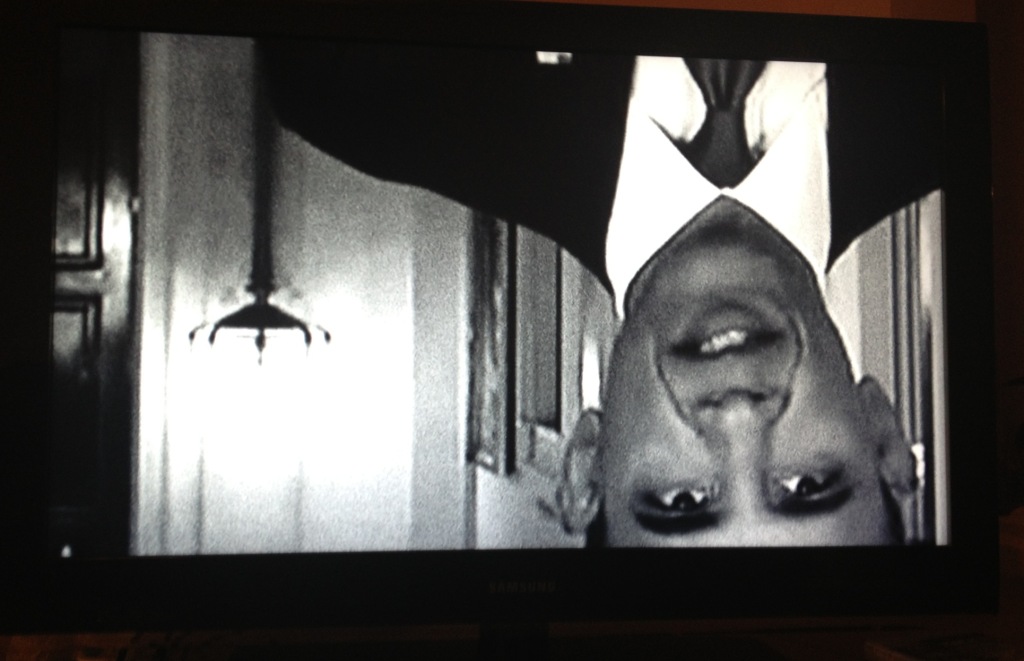
Title sequences are promises that whether fulfilled or neglected by the rest of the programme remain pleasurable on their own terms. Homeland may well already be a shadow of its former self at close of Season 2 play but somehow it’s impossible to entirely dismiss a programme which begins so beautifully. There’s enough to dig around in during those first few minutes to keep worries about underdeveloped sub-plots and writers’ knowledge of their dramatic endgame at bay. The producers might want you to wonder what Carrie and Brody will do next. I’m still questioning why Obama is upside down.
T: They want you to think that now but he might not be.
G: So she’s dirty?
T: Yes!
G: I knew it.
And so it goes, the Abbott and Costello routine that accompanies G and I’s 24 marathon, a programme predicated on not knowing if the characters are traitors. Having seen these episodes many times over I know full well that without the promise of these mysteries being solved there’s absolutely no reason to stay through to the end of each season. G needs something to hang on to in order to get through the shark-jumping contest the series bi-annually stages. Without the mirage of end-of-season plot twists, there’s no way she’ll make it through Season 1’s amnesia storyline, by which I mean the storyline written by people who have forgotten the last 20 years of TV drama. There’s even less chance of her surviving Season 2’s surprise wild animal attack, or indeed any of the disproportionately perilous adventures a certain blonde teenager experiences in a post-nothing-actually-happening Los Angeles.
Happy Day!
These frustrations were the price we’d have to pay. We needed story stimulus and audio-visual distraction to prop up our day-long sessions of Uno which, thanks to my filibustering strategy of hoarding +4 wild cards, usually consist of 1 or 2 games. With our playing reserve extended to two packs (misguidedly introduced to reduced game time!), our short-term recall seemingly non-existent, and our below Jenga-code surfaces, we had played enough Uno to whip through the first season of legal soap Murder One in less than two days. This is a series with a reputation for quick conversion, a mere 2 or 3 episodes into the run enough for discipledom. But I’ve never seen anyone so utterly brainwashed by a programme as G was by this show. The initial 45 minutes of endless exposition and prevarication which for most people is simply the salesman lowering your resistance until you let him into your home was for G the Jehovah’s Witness being invited to stay for dinner. I’m sure this had something to do with it being the perfect sideways-glance television. If anything important is about to happen, the French-door clattering and microphoned drone bee sound effects will let you know in advance. Plus, the screen will turn a different colour.
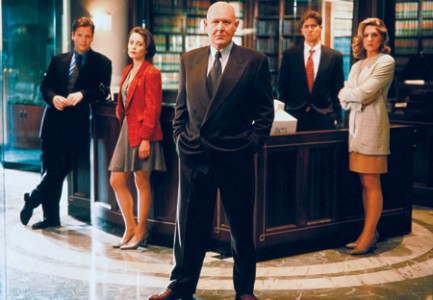
Luther and Associates
Like any TV hand-me-down, the joy is always the first-time viewer’s observations that have never crossed your mind. I’d never thought to ask what Teddy Hoffman, played by Lex Luther-in-waiting Daniel Benzali, was always looking at out of the blinds of his office windows (our consensus was squirrel) or why the county court had employed a harpsichordist rather than a stenographer. It’s also good to come at a show without your blinkers of pure reverence. Thanks to G’s unfazed eyes, I could see how our continuing fascination with the ambiguous motives and behaviour of businessman Richard Cross is not simply down to the fine character work of trans-generationally-underrated actor Stanley Tucci but also the script refusing to show us anything of his world beyond his mini-operetta performances in Hoffman’s office. I have an unflinching admiration for Benzali’s performance which may well be tinged with sadness at his subsequent lack of fame and being replaced as the series lead by Daphne’s brother from Frasier. This precluded me from seeing-as G did-the actor’s delusion that he was in a Mario Puzo mini-series and that in the scenes with his young daughter, his interpretation of paternal warmth is genuinely disturbing to watch. In fact, if you turned down the sound on the TV in those scenes and had to write one word on a post-it note to stick on his face, chances are it would be ‘paedo’.jko
Danson in the Dock
Just as soon as we’d cleared Murder One we were into the dregs of 24 Season 1. Do we dare plumb the depths of Murder Two, the hard-to-believe-it-exists second season based on the assumptions that what was holding the series back was its beloved lead actor and breakthrough storytelling and that everyone wanted more of the nervy Jewish guy who prepares writs? Was it too soon to plough through 48, the unnecessary-but-surprisingly-competent sequel which at least keeps the super-violent interrogations to an alternate-episode minimum, and thereby sacrifice the last morally justifiable season of this literally tortuous programme? Lest our faith in the foresight of TV writers is Lost we couldn’t let our lasting impression be these failures in planning for a sustainable future. Something had to fill the gap. G was adamant it had to be another one-season wonder with a continuing storyline that wrapped things up in a neat little package…give or take a couple of loose ribbons.
G: I’m gonna find out what happens this season, right?
T: Yeah, it all gets resolved. A couple of threads are left hanging, but nothing important.
G: Good, I don’t want to do all this work for nothing.
I petitioned for Damages. I’d always thought this off-courtroom legal drama should have been kept as a mini-series and this was confirmed in subsequent seasons where the writers can’t think of a good reason to bring Ted Danson back into the show. It seemed perfect for our casino cabaret purposes. Despite Glenn Close’s Cruella de Overkill performance which grates almost immediately, there’s enough intrigue in the sub-plots involving the TV movie Tom Cruise Peter Facinelli and quality TV’s J T Walsh Zeljko Ivanek to make a two-deck shuffle go a little faster. It was also a welcome reminder of the unique screen presence of the silver horse that is Ted Danson. His series-stealing turn as morally suspect millionaire Arthur Frobisher veers beautifully between the effortlessly comic and the unnervingly understated with a douse of inimitable idiosyncrasy. And so it went as quickly as it came. And so did G, with 24 Season 2 as inappropriate in-flight viewing. Everything else was just too damn consistent!





 Watching TV with Americans