Archive for the TV History Category

Got Milch?: Part 2

Posted in American TV Shows, BiogTV, Local TV, TV Acting, TV channels, TV History with tags , , , , , , , on September 13, 2015 by Tom Steward

It’s the longest-awaited sequel since Indiana Jones and The Kingdom of The Crystal Skull and probably just as underwhelming. The promise of a second part that never comes is one that resonates with what I’m going to talk about here, David Milch’s follow-up to Deadwood at HBO John from Cincinnati, which along with Luck lasted one season and is now freely available to stream on Amazon Prime Instant Video as part of their HBO collection – designed, no doubt, to take the edge off the company’s flagrant employee abuse. This is the David Milch series that means the most to me.

2 minutes to Mexico!

2 minutes to Mexico!

There are plenty of TV shows that have put places on the map. But what about the shows that failed to make their locations famous? Breaking Bad made Alberquerque a hub of tourism and yet John from Cincinnati did not do the same for Imperial Beach, a coastal community south of San Diego bordering Mexico, in which the series is exclusively set. Perversely, tourism has come to Imperial Beach without the help of John from Cincinnati only a few years after the series aired. And, to rub sea-salt in the wound, Imperial Beach attracted visitors by projecting an image contrary to the one presented in John from Cincinnati. Imagine Hobbiton becoming overrun with people only after a brutalist tower block was erected in the centre of downton (which is what I’m presuming they call downtown in Middle Earth). I know this not because I’m a good journalist but a resident.

Of San Diego, that is. But I did live in Imperial Beach briefly a couple of years ago when I first arrived in the states. Though on an upswing even then, the community felt more like the faded surfer haunt gently harbouring drug addicts and derelict motels that is depicted in John from Cincinnati than it does today. Now it is a prime beach destination replete with upscale hotels and restaurants. Apart from the most inconspicuous memorabilia in a few local establishments, there’s no sense that a TV show was ever filmed here, and certainly not as recently. I’d like to attribute that to the thoroughly dysfunctional portrayal of Imperial Beach, but I don’t think it’s as simple as that. After all, Breaking Bad made Alberquerque famous not attractive. Despite the esteemed creator and network, John from Cincinnati was not liked or known enough to front a campaign for tourism.

It’s depressingly easy to see why the show was not embraced. It is aggressively cryptic, with titular John not a protagonist in the conventional sense but a conduit who precipitates the actions of other characters and speaks only in the words of those he encounters. John is not human, or at least not mortal in the way we understand it. Others have unsubstantiated mystical ability. The writing and acting is egregiously ornate and portentous, even for a David Milch drama. In particular, Rebecca DeMornay proves herself the missing link between the Lifetime school of TV movie acting and the televisual avant-garde. On the other hand, it seems like John from Cincinnati is punished for the strangeness we conversely admire in shows like Twin Peaks. Milch’s previous drama Deadwood was universally praised, and yet was similarly impenetrable, but because it was linguistically rather than conceptually challenging, it was somehow more acceptable.

Coming after Deadwood may have been John from Cincinnati’s greatest error. Milch’s fanbase scapegoated the show for taking Deadwood off the air after only three seasons and – as I’m sure Nic Pizzolatto and David Simon will testify – critics have only one use for shows that follow TV of wide acclaim. I don’t want to be a John from Cincinnati apologist; at times it is too pretentious for its own good, and it would be hypocritical of me to boycott Steven Moffat’s Doctor Who for its incoherence and not at least mention it here. Much of my interest in the show is strictly geographical, although that does help me understand its intentions better than someone who’s never experienced Imperial Beach would. It is, however, one of the few shows I can’t think that transcends classification. You’ll have a hard time relating this to any format or genre of television out there.

Dayton Callie prepares for Sons of Anarchy

Dayton Callie prepares for Sons of Anarchy

John from Cincinnati is undoubtedly hard work, but if it’s elision of norms is not reward enough for you, then maybe its peerless cast, all of whom are given monologues equalling the best of Milch’s writing, should be. Among them are character giants Ed O’Neill, Dayton Callie and Jim Beaver.

The Endless Summer

Posted in American TV (General), American TV Shows, hiatus, Reviews, TV channels, TV Criticism, TV Culture, TV History with tags , , , , , on September 6, 2015 by Tom Steward

I’m back after being away for the summer…just like TV! Or so I thought. Summer used to be a dumping ground for cancellation fodder, but something has changed. Many of the year’s most important programmes now air over the summer and momentous TV events are just as likely to play in the spring and summer as fall and winter. No doubt some of this is down to cable channels disrupting the old network seasonality, but it’s becoming increasingly apparent that TV critics can’t take summer off any more if they want to stay current. So what’s been happening?

Colin Farrell after reading the reviews of True Detective Season 2

Colin Farrell after reading the reviews of True Detective Season 2

True Detective Season Two

Another reason why TV critics can’t go away for summer is because they’d all miss doing their favourite thing – bashing the follow-up to a universally praised piece of television with no particular motivation other than convention. Season Two of HBO’s anthological police procedural was torn to pieces by most critics, with so-called fans and lovers of quality television just as vociferously negative. It really has nothing to do with the season itself, just a tired old game that critics like to play, one that immunised us against the self-evident pleasures of Treme simply because it followed The Wire and even made us question the quality of The Wire when it entered its second season. Worryingly, it suggests critics and viewers of the serial age have serious trouble evaluating television when it deviates from formula, and really aren’t ready for the anthology revolution happening in TV.

Jon Stewart leaves The Daily Show

After fifteen years as host of The Daily Show on Comedy Central, Jon Stewart could simply be remembered as the person that brought the art of fake news – cultivated in Britain by Armando Iannucci and Chris Morris – to the US. But he leaves behind him an even greater legacy. When TV news polarised into partisan platforms with MSNBC on the left and Fox News on the right, Stewart’s Daily Show was just about the only source of news that had any semblance of objectivity (as rocky a term as that is) left to give. He was trumped by his own protégés. First Stephen Colbert, who transformed himself into a living doll of satire, viscerally exposing the ugliness of the media conservative while manifesting the winning naivety that makes them attractive. Then John Oliver who – with the help of HBO’s unsegmented formats – brought satirically slanted news reporting into the realms of investigative journalism and political activism.

Cilla Black/Rowdy Roddy Piper (delete as nationally appropriate) died

It’s only accident that these deaths occurred in summer, but taken together they are tantamount to transatlantic television tragedy. The British light entertainment host and Canadian WWF star died within a week of each other, which means nothing until you put together that their stretches as reigning TV personalities from the 1980s to the early 2000s is virtually identical and that they generate the same fuzzy nostalgia (in warmth and confusion alike) from the generations that grew up watching them. For me, it was a sharp reminder of how separate American and British cultures can be. Nobody mentioned Cilla – a contemporary of America’s beloved Beatles – stateside. Roddy Piper remains unfamiliar to me…and to all 90s British kids who didn’t have Sky.

Netflix Summer

The charms of hyper-inflective prison comedy-drama Orange is the New Black continues to elude me, but it’s Netflix’s most valuable commodity and the June release of its third season was not an anomaly. The star-studded prequel series to cult comedy movie Wet Hot American Summer was made available in July as was season two of the critically acclaimed cartoon BoJack Horseman. Orange is the New Black was even streamed a few days early, just to remind Netflix subscribers that they can do shit like that. It’s pretty cocky behaviour, and somewhat backfired when fans who had booked time off work to binge-watch the season found themselves in a socially impossible situation. I don’t think this surge of summer activity at Netflix (nor the summer-theming of its releases) is at all a coincidence, more an attempt to dominate TV distribution in these months of the year. For all their talk of liberating viewers from the tyranny of scheduling, Netflix keeps subscribers under the yoke of its idiosyncratic calendar.

Fear The Walking Dead is set in LA...it's going to be a short show!

Fear The Walking Dead is set in LA…it’s going to be a short show!

Fear the Walking Dead Series Premiere

The unwanted spin-off of AMC’s The Walking Dead debuted in the last days of summer. As True Detective also switched from a rural southern locale to the L.A. metropolitan sprawl, I wouldn’t expect any glowing reviews forthcoming…

Deadliest Watch

Posted in American TV Shows, Behind-The-Scenes, Reality TV, TV Acting, TV channels, TV History with tags , , , , on June 26, 2015 by Tom Steward

Next time you’re wondering why broadcast television still matters, consider A Deadly Adoption. This perfectly pitched pastiche of Lifetime original movies would entertain if accessed from any platform, but aired on Lifetime during the Saturday evening timeslot reserved for premieres of genuine original movies it pushes the limits of hoax or even cultural terrorism. As a Brit with an interest in the history of television, A Deadly Adoption reminded me of Ghostwatch, a pre-recorded BBC TV horror drama from the early 90s styled as a live factual special of the kind that were popular on the BBC around those years.

Nothing funny about this.

Nothing funny about this.

Ghostwatch and A Deadly Adoption exploited their network and timeslot to convince audiences of their veracity, the former as a piece of primetime public service television and the latter as a legitimate original movie ‘inspired by a true story’. Both programmes used, at cross-purposes, a mixture of familiar faces from the genre they were approximating and those that you wouldn’t expect to see. In both cases, the anomalies were supposed to tip off the audience as to the subterfuge. But while widely-known comic actors Will Ferrell and Kristen Wiig nudge the viewers in the direction of parody, the same couldn’t be said for the jobbing BBC character actors that Ghostwatch’s producers naively assumed would lead a Saturday evening audience to conclude it was a drama. Ghostwatch recruited actual BBC presenters of the moment to play themselves while A Deadly Adoption called upon veterans of the casts of Lifetime movies. Again, this had mixed results. The agency of presenters affiliated with a broadcaster reputable for its trustworthiness contributed to viewers becoming disturbed, confused and angry while watching. Having Erik Palladino play the cop he always plays asking the questions he always asks increased the plausibility but was also a satirical detail.

Perhaps the most striking similarity between the two programmes lies in the execution of the deception. Neither seems to let the mask drop, and yet they seem to be pointing you to the inauthenticity all the time. Crucially there is no over-acting, at least none outside the conventions of infotainment or TV movies. In Ghostwatch, direct address to the camera is a two-way street. It’s part of the fraud and also tells viewers to their faces that what they’re doing is tantamount to a hoax. It even has the audacity (and foresight) to pre-emptively chide parents for letting their children stay up to watch. Like any skilled comic actor (I’m put in mind of Jerry Lewis in The King of Comedy here too), Wiig and Ferrell’s faces can simultaneously pay lip service to the earnest drama around them while sporting an inner smirk that lets the audience know they’re in on the joke. While they (wonderfully) break character in the final scene, the leads in A Deadly Adoption are generally content to merely stand near the entrenched clichés and overwrought conventions of the Lifetime movie canon and gesture to them discreetly. The comic agenda, like Ghostwatch’s dramatic one, is effaced.

Another lesson that A Deadly Adoption learnt from Ghostwatch is that the most effective spoof is the one that runs like the real thing. Ghostwatch should have been by rights shot on film but the choice was to make it as if it were at every stage a piece of factual television broadcast live from a studio. That meant both the audience and the ‘actors’ were reacting as they would to the very thing it was not. I think this is also why Police Squad! is such an exquisite send-up of Dragnet, largely because it wasn’t much different in production values. Apparently, some BBC executives didn’t get what the Ghostwatch directors were trying to do and rejected some of the shots as cheap and amateur. A Deadly Adoption is going for the clunky symbolism and magazine-plate portraiture of the Lifetime in-house style, not trying to improve on it. To expect A Deadly Adoption to live up to the cinematic comedy of Ferrell, Wiig and director Adam McKay’s previous work is to miss the point. It’s a clever move, and one that demonstrates confidence in the art, that the movie was poised to allow audiences to occasionally forget it was parody.

He ain't 'fraid of no disgruntled viewers.

He ain’t ‘fraid of no disgruntled viewers.

Ferrell and Wiig’s IFC mock-miniseries The Spoils of Babylon played a similar game, invoking a phony industry backstory through trailers and faking-of documentaries, and playing on a network that revives obscure cult media. However, I stick with my Ghostwatch comparison. The aim is never truer when you become your target.

Controvers-TV

Posted in American TV (General), American TV Shows, Reviews, TV History with tags , , , , on June 19, 2015 by Tom Steward

One of the historic functions of American sitcoms has been to deal with taboo issues in the society of the time. This purpose has been all but forgotten as network television becomes increasingly more conservative, both on the production and audience side. Although, it’s not as if cable TV is stepping into the breach. Cable channels tend to use their license to push boundaries on representation for infantile laughs rather than a progressive cause. I suspect that increased conglomerate ownership of TV stations has something to do with this too. If you’re appealing to the same judges, you’re bound to get the same verdict. I bring this up because I just happened to come across episodes of two 1980s sitcoms based around controversial topics on TV recently, although the rate of re-run on some channels does rather push the odds in favour of that happening. I was first struck by how committed each sitcom was to serious treatment of the issue in question, as opposed to today when it would need to be discussed by proxy. Then what stayed with me was the contrast between the ways the sitcoms handled delicate subjects, though neither seemed to proceed with much delicacy.

Yes, this really happened...

Yes, this really happened…

The first was a two-part episode of Different Strokes called ‘The Bicycle Man’. It’s a notorious episode of an already pretty notorious sitcom. You may think there’s nothing creepier than a grown man with an ageing disorder being made to play a child but there is, and it’s a grown man with an ageing disorder being made to play a child being pursued by a paedophile. It’s a classic case of wanting to have your cake and eat it, appropriately enough as that’s what the child molester uses to try and get into Arnold’s pants. The sitcom is earnest about educating the audience (especially children) on the dangers of paedophilia, and the final scene, which seems to go on forever, is basically a PSA. But the producers are also clearly reluctant to disturb the conventions of the studio sitcom, and so we still have a laughter track and one-liners about paedophilia. Some of this works in regards to the molester himself, who uses comedy to cosy up to children, but most of the time it feels like the episode is pulling in different directions. That said, the pathological profiling of the paedophile is the most sophisticated I’ve seen in television.

The second was an episode of The Golden Girls called ’72 Hours’ in which Rose is informed she may have contracted HIV from a blood transfusion and has a three-day wait to find out. Unlike Different Strokes which doubled its length and set aside screen time to outline the issue, Rose’s predicament is a subplot of a normal episode rather than an issue-based special. This underlines the fact that the sitcom dealt with taboo topics like racism, sexism and homophobia all the time but was also indicative of how the writers wanted the audience to calm down about HIV rather than obsessing over it. This was 1990, so it’s not exactly typical at this point to portray HIV as an everyday part of contemporary society that affects straight as well as gay people, yet that’s exactly the jumping-off point of this episode. Not that the writers are in any way idealistic about how people of an older generation respond to the threat of HIV. Rose is understandably scared and turns to scapegoating promiscuous gay men while Sophia starts labelling her cups and using different bathrooms. No-one is condemned for acting irrationally here but no-one is let off the hook either.

HIV and The Golden Girls

HIV and The Golden Girls

It’s a shame these episodes stand out in today’s TV. Look at Modern Family. We have a gay couple at the heart of the show yet the Christian ownership of ABC by Disney means that we’ve never had a storyline which draws attention to their struggles in society. We only got a kiss between them after gay marriage became culturally acceptable, five seasons in. You might argue that the permanent presence of previously marginalised characters in a sitcom is a bigger step forward than a devoted storyline to issues in their community, but, again, take Modern Family. Have any of the clichés or misconceptions about gay men disappeared by having Mitch and Cam as protagonists? When it comes to taboo issues in sitcoms, I think concept and execution are polarising. Many sitcoms like The Middle address agonising social problems because of what they are and not what they talk about.

Peak Viewing Time

Posted in American TV (General), American TV Shows, TV Criticism, TV Culture, TV Dreams, TV History, Unsung Heroes with tags , , , , , , , , , on May 13, 2015 by Tom Steward

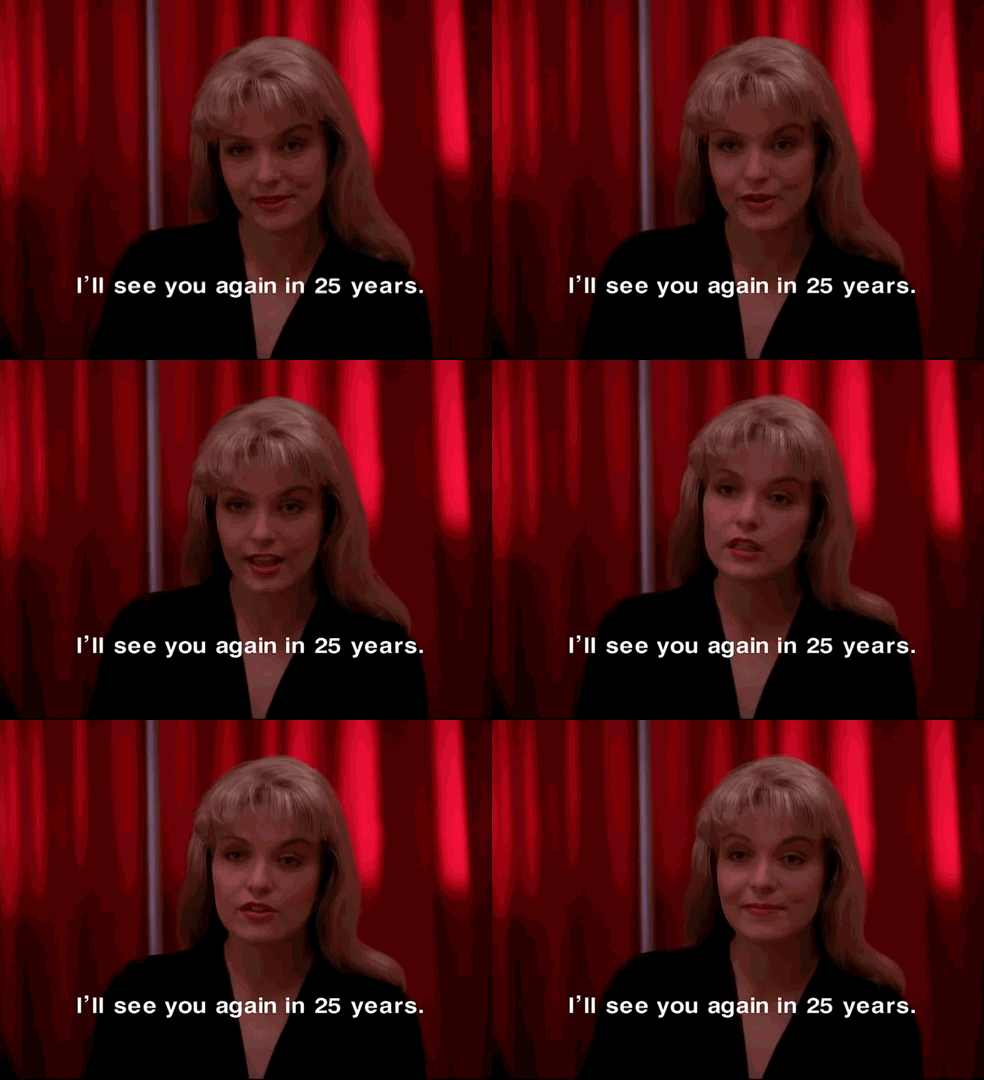
There are TV shows we talk about too much. But Twin Peaks isn’t one of them. I’d say the endless chatter about David Lynch and Mark Frost’s early 90s ABC drama by those besotted of the show (whom I suspect have cherry-pie-picked episodes and not endured the interminably drawn-out final quarter) was better spent on less-discussed yet equally worthy TV from this era…if it weren’t for how crucial Twin Peaks is in the history of television. Unusually for a show that ran for only two years and thirty episodes, no-one has ever shut up about it. The supreme production values and self-conscious artistry have ensured that there is never a reason not to re-air and re-box set the programme. Even compared to other 90s TV shows, which generally stand up well visually (especially compared to the previous decade), the colour, focus and cinematography are configured in such a way that HD could not possibly improve upon it. There’s been more talk recently because it’s the 25th anniversary of the series (although there always seems to be an excuse for a retrospective!) and plans are afoot for a revival of Twin Peaks on Showtime. However, if the public statements of Lynch and most of the cast are anything to go by, the revival might have as much to do with Twin Peaks as 10 Things I hate about you does with The Taming of the Shrew.

A title colour only used in 90s television!

A title colour only used in 90s television!

Twin Peaks set in motion models of television storytelling that have been influential ever since it was on the air. Small-town quirk and paranormal procedural would dominate American TV throughout the 90s, through the ‘twin peaks’ of Northern Exposure and The X-Files. The legacy endures to this day with series like Parks and Recreation, Wayward Pines, Fringe and Grimm. The long-form murder mystery has been a staple of quality television internationally in recent years, with Denmark’s Forbrydelsen, Britain’s Broadchurch and America’s True Detective. Indeed, if HBO opened the floodgates of American quality television with The Sopranos, then Twin Peaks’ dream states and cine-literacy were an important precedent for the show. More broadly, Twin Peaks cemented many ideas that we now take for granted. It showed us that fantasy and realism can live alongside one another in TV without contradiction and that every character in an ensemble (no matter how ridiculous) deserved an inner life and a separate storyline to boot. Twin Peaks remains the benchmark for what constitutes good television. When Louis C.K. tried to generate an art movie feel for his sitcom Louie, he went to none other than David Lynch as guest star (and director in spirit) for a 3-part season finale. In 2010, mystery drama Psych aired an episode called ‘Dual Spires’ featuring cast members and storylines from Twin Peaks, acknowledging the longevity of the show’s mythology as TV to aspire to.

If we dwell too much on the originality of Twin Peaks (as a recent Radio 4 documentary did), we are in danger of forgetting how much the show took from television. References abound to classic American series from Dragnet to The Fugitive (complimenting the mid-century Hollywood intertextuality). As the meta-show Invitation to Love indicates, the characters and storylines in Twin Peaks could have easily come out of a daytime soap. But Twin Peaks was also acknowledging how soaps had graduated to primetime in the previous decade, with shows like Dallas and Knots Landing. In fact, the season one cliffhanger bears an uncanny resemblance to the ‘Who Shot J.R.?’ storyline in Dallas that captivated TV audiences exactly a decade before. For all that is made of David Lynch’s ‘cinematic’ influence on the show, Twin Peaks was co-created by Mark Frost, whose formative experience had been writing for television, notably on Steve Bochco and Michael Kozoll’s soap copera Hill Street Blues. Twin Peaks is as remarkable for its adept handling of serial narrative arcs and gradual character development as for its experimental audio-visual style, and there is a clear lineage from Frost’s work on the continuing ensemble drama Hill Street Blues to his teleplays for Twin Peaks. But Lynch and his signature composer Angelo Badalamenti clearly understood the importance of sound to television, creating a soundscape that both compliments perfectly and stands terrifyingly alone from the image.

...or sooner!

…or sooner!

For better or worse, Twin Peaks stands for something bigger than it is. It is the nucleus of a fine art television and a prism through which to see the medium. Laura Palmer said she’d see us in 25 years. She was 25 years over.