Archive for the TV History Category

Man and Nimoy

Posted in American TV (General), American TV Shows, TV History, Unsung Heroes with tags , , , , , , , , , on March 4, 2015 by Tom Steward

The tragedy of the TV actor is that they are haunted by one character for their entire life. For Leonard Nimoy, who died of end-stage chronic obstructive pulmonary disease last Friday at 83, the character of Mr. Spock overshadowed fine performances in many of the defining TV series of the 1960s and 1970s. But popular culture would never allow his empirically-minded alien starship science officer from Gene Roddenberry’s Star Trek to die, and if the onscreen death of the character and demise of the movie franchise didn’t finish him off, then it’s unlikely that Nimoy’s passing will do it either.

Finding Nimoy.

Finding Nimoy.

Spock will continue as a character in J.J. Abrams’ rebooted Star Trek movies and will continue to be played by Leonard Nimoy, albeit as an impersonation by Zachary Quinto. TV characters are so much their actors that for a replacement to offer an original interpretation would be as detrimental as casting them in the wrong age or gender. Rather than passing the gauntlet, the movie prequel to the original Star Trek series (and I suppose sequel to Enterprise if you put it that way) concocted a scenario in which Quinto’s Spock was a younger version of the character as played by Nimoy – who also appeared in the movie because time travel heals all continuity wounds – and thus had to customise his mannerisms and delivery according to his predecessor. This freely admitted in plot terms that no-one but Nimoy could play Spock. Technically, re-setting the clock allowed Quinto to go his own way with the character but if anything his performance became more like Nimoy’s in the sequel Star Trek into Darkness, attested to by another appearance by Nimoy as Spock’s future self. Without Nimoy to play off in future films, I fully expect Quinto to compensate further with thorough mimicry.

Looking back from the Spock-themed obituaries, it’s hard to imagine that there was a time when Nimoy would have played Spock for only three years. Of course, three years is another ten in re-runs, and the re-circulation of Star Trek (as much in off-air audio recordings shared between fans as repeats) is what brought Nimoy back to play Spock, first in the astonishingly comparable animated series spin-off that ran in the mid-70s and then in a series of continuation movies that ran from 1979 to 1991, or between Shatner’s third and seventh girdle, whichever way you care to think about it. After that, Spock made his way back onto TV featuring in two episodes of Star Trek: The Next Generation, before he became the missing link between Gene Roddenberry and J.J. Abrams. Spock was the Jack Bauer of his day, unkillable by man or logic. Neither death, nor time, not even the series not being about him anymore, would stop him appearing in it. And this doesn’t even begin to include the times Nimoy performed Spock outside of Star Trek, perhaps most poignantly as a disembodied head reviving the Vulcan for the entertainment of an omniscient teenage alien in Futurama.

Nimoy was already a face in American television by the time he took the role of Spock, and good television at that. He already had a Twilight Zone and an Outer Limits under his belt, which gave the actor anthology pedigree to add to his generic bow of westerns and detective shows. Nimoy had a knack for finding his way into the most accomplished shows of the 1960s, including The Man from UNCLE (which has no reboot forthcoming, regardless of what ANYONE says) and Mission: Impossible, his first TV role after Star Trek was cancelled. Even into the 70s, he was on Rod Serling’s horrific(ally underrated) Night Gallery and Columbo, because no American actor is allowed in SAG without it. His was a face for television, betraying nothing and letting whatever fine piece of screenwriting he was bestowed do the work. It was a time on American TV when emotions were optional, but class was not. Sci-fi TV is his, and it owes him a living. He returned to The Outer Limits when it re-appeared in the 90s, in a re-make of the same episode he had starred in during the 60s. A role was waiting for him on Fringe.

Nimoy also did pro-bono legal work for robots

Nimoy also did pro-bono legal work for robots

There’s more to Leonard Nimoy than Spock (and there’s at least two of his careers I haven’t mentioned) but the character presented him with limitless possibilities for remaining in the zeitgeist long after he ceased playing him on TV. He lived longer and more prosperously than even Spock could predict.

Sunday Day Recorded

Posted in American TV (General), American TV Shows, Behind-The-Scenes, Reviews, TV channels, TV History, Unsung Heroes, Watching TV with tags , , , , , , , , , on February 25, 2015 by Tom Steward

‘For a lot of people, their favourite part of the show is the short films, which makes you wonder why don’t they just do the whole show that way. They’ve been doing the show wrong for 40 years. The sketches, they’re nice but they’re long.’

Louis C.K. has made a career out of hitting the nail on the head – and inducing involuntary laughter from the brain – but in as many words as there’s been years of Saturday Night Live, the comedian summed up the fatal (surely tragic by now) flaw of NBC’s late-night sketch show, which celebrated 4 decades on the air this month. C.K. was introducing a compilation of shorts on the SNL anniversary special, scheduled on a Sunday and in primetime (who says American don’t get irony?) and may well have been feeding in to the inverted back-slapping that was pungent throughout the evening. But as soon as the clips rolled, and names like Jim Jarmusch, Mike Judge, Albert Brooks and Paul Thomas Anderson filled the screen, C.K.’s roast zinger becomes an unarguable truism. I myself once had a similar thought before when watching the late-90s British daily sketch programme The 11 O’Clock Show which was written on the day of broadcast and wondering why they didn’t just spend more time on the jokes and make them funny.

Crapping on SNL!

Crapping on SNL!

The more you think about it, the more damning C.K.’s accusations become. Who honestly prefers to watch an SNL sketch featuring The Blues Brothers instead of just watching The Blues Brothers? Where’s the pervert that would endure SNL’s fake public access show ‘Wayne’s World’ as anything other than the intro to Wayne’s World (or Wayne’s World 2)? SNL cast members try to make out that movies based on their sketches are duds (presumably for fear someone might decide to cut out the middleman) but its filmed elements are the only great comic art the show has ever contributed the world. And a sketch worth of Coneheads feels like an hour-and-a-half movie anyway, so you might as well watch the feature spin-off. C.K. might be biased since his sitcom has the finesse of art cinema, but we’re not talking about a group of comedy Oliviers with rave live notices that seem hopeless on film. Every SNL legend has proven themselves masters of screen comedy and the mythical thrill of live TV shouldn’t distract us from that.

Unless I’m severely underestimating Lorne Michaels’ command of irony, I don’t think the inflated length of the anniversary special – coming in at four-and-a-half hours – was meant as a poke at SNL’s reputation for overlong sketches. Again, C.K. was on point (why don’t I just marry him?) and the underwhelming reaction he received was not simply audience fatigue, but a nervous titter of cold, hard realization. The amount of sketches (if you can call them that) and appearances on the night looks impressive on paper, and yet SNL has that amazing ability to appear stretched even when pushed for time. It doesn’t help that so many of the most famous sketches which were revived for the afternoon/evening are based on repetition; Celebrity Jeopardy, The Californians, Weekend Update, The Bass-O-Matic Infomercial. What start out as parodies of overly-formatted TV programming end up using that format as padding. It’s a mistake for SNL to assume that everyone finds their overlength endearing. Like their very own Drunk Uncle, the nostalgic surface hides a multitude of outmoded beliefs and behaviours.

Eddie Murphy doing for real what he does in his mind.

Eddie Murphy doing for real what he does in his mind.

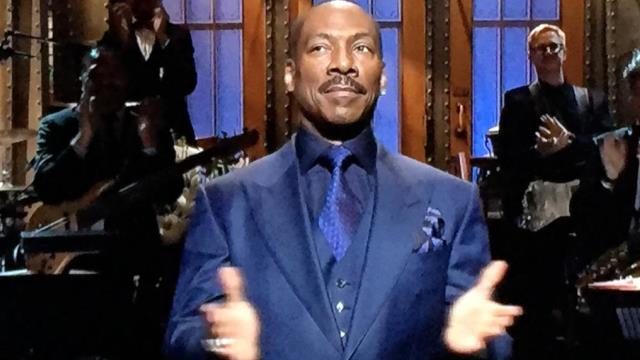
For a sketch show that invests such capital in the idea of shedding its history as soon as it qualifies, the current SNL cast were rather conspicuous by their absence on the anniversary special. Perhaps it’s not so much about them as the greatest generation that fought for their freedom to pretend to be Justin Bieber, but what this sketch comedy version of Apocalypse Now (minus Brando mumbling about snails – that was cut so Eddie Murphy could applaud himself) somehow failed to acknowledge was continuity. It’s a slap in the face that a cast who may be in the process of getting SNL’s shit together for the first time in quite a while should be passed over in a four-hour show and made to look like the weakest links in the chain. Given that Eddie Murphy has only just forgiven SNL after former cast member David Spade ridiculed his career on-air, despite Murphy single-handedly keeping the show on the air (like 1986 World Cup Maradona), they’re clearly not the ones who should have been asked to clean boots that night/day.

Bad Morning Television

Posted in American TV (General), American TV Shows, Behind-The-Scenes, BiogTV, Internet TV, Reviews, TV advertising, TV channels, TV History, Watching TV with tags , , , , , , , , , on February 18, 2015 by Tom Steward

It was upon returning to my hotel room at 5 in the morning after seeing some of the best and oldest bluesmen in Chicago and celebrating the existence of an L-train with a trip to a 7-11 to get some cheese-filled-bread (or bread-filled-cheese) with a side dish of whatever was left on the room service tray a few doors down and being confronted with the blurry, blobby outline of Tony Danza that I came to a grave realisation. In the land of 24-hour business, late licensing, and all-night dining, there’s nothing on TV in the middle of the night. So why have two major TV events recently debuted in the early hours of the morning?

Last November the comedy short Too Many Cooks aired around 4am during the infomercial block on Adult Swim, the late night version of Cartoon Network. A parody of both the opening credits of 1980s sitcoms and the insanely dark and genre-bending possibilities of TV comedy in that decade (and before you dismiss it as exaggerated, remember that ALF was dissected by the government in the finale), Too Many Cooks became a viral video smash and was repeated each day at midnight for the next week. The perverse choice of a graveyard slot more or less guaranteed the short’s success, not only because re-run and internet re-circulation was necessary, but also because there was no competition.

Adult Swim seemed to cotton on to the fact that there’s an undiscovered country of television between the hours of 1 and 6 in the morning. I understand why they’d want to be the pioneers, but I don’t understand why there’s not a frontier-style rush to claim territory from every other producer in TV. If the entertainment market is so damn saturated, why not get a head-start by putting out your show in the vast wasteland of unused hours in the TV day? For once, having a variety of media platforms to re-play TV on is a blessing, since audiences will need and want to see your show again once they hear they’ve missed out.

It’s surprising that the networks haven’t come to these conclusions already, since they’ve had such great success by pushing their best programming later and later in the evening. The 11 o’clock talk show is an institution that has spread to virtually every channel in the schedule and their midnight sister programmes aren’t far behind. This weekend NBC celebrated 40 years of Saturday Night Live (ironically on Sunday and in primetime), a show which begins at 11.30pm and runs to 1.30 in the morning. This isn’t, as I once thought, because Americans stay out or go to bed later, but because it’s untapped resources. In Britain at this hour, they start playing movies starring Eric Roberts.

And what if you actually need to bury a show? There was surprise in early February when FXX aired a pilot for a series based on the popular Wheel of Time fantasy novels by Robert Jordan at 1.30am. Not only do the books have a huge fan-base, but with Game of Thrones still going strong, there’s a deep well of fantasy (probably with a goblin in it) that everyone in TV can draw water from. It soon became clear, however, that the air time wasn’t a stunt to get the show ahead of the competition but to keep it firmly under the radar, being the best all-round solution to legal issues facing such a project.

The television rights to the books were to revert to a new owner on February 11 (two days after airing) and so the previous owners were probably trying to get something based on the books out on TV before that happened. Author Jordan’s widow has contested the claims of the producers to the rights and they are threatening legal action. Interestingly, FXX were able to offload responsibility by treating the pilot as ‘client-supplied programming’ i.e. an infomercial. If you’ve got a show mired in legal trouble, 1.30 in the morning is clearly the place for it. The Wheel of Time pilot used the early-morning hours as a dumping ground for toxic material but it still shares similarities with Too Many Cooks’ deployment of late TV.

Both programmes traded on the idea that anyone watching at that hour can’t be sure of what they’ve seen; one for comic effect, the other for legal protection. With each one, being mistaken for a promo or infomercial actually helped. It makes financial and creative sense. Why still the hesitation?

Box Spin

Posted in American TV (General), American TV Shows, Reviews, TV Acting, TV channels, TV History with tags , , , , , , , , , on February 11, 2015 by Tom Steward

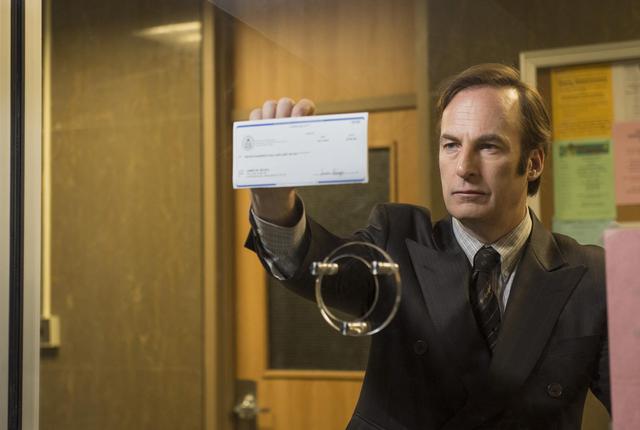
On Sunday and Monday, as part of a 2-night event (isn’t everything these days?) AMC debuted Better Call Saul, a spin-off from its corner-turning drama series Breaking Bad based around Walter White’s kitschily corrupt lawyer Saul Goodman. For reasons that can only lead to spoilers, Better Call Saul is a prequel. Despite the unabated popularity of Breaking Bad and the character, there’s still the risk that a spin-off would damage the reputation of the programme, especially one that promotes to protagonist a character who mainly functioned as much-needed comic relief in one of the bleakest shows on television. AMC needn’t have worried because, as with all good long-form television, Saul grew into a much more rounded character as Breaking Bad went on (lest we forget that Walt started out as a clown) and it’s this version of the character that Better Call Saul has inherited. But in TV the odds aren’t against them (or as against them) since there’s nothing to say a spin-off show won’t be as good as or even better than the original.

Check out Better Call Saul!

Check out Better Call Saul!

As Steve Coogan self-reflexively observes in The Trip to Italy there are only ever one or two movies anybody ever quotes when arguing that sequels can be better than the original. Of course, TV has its go-to canon of superior spin-offs (Frasier and anything produced by Norman Lear, who understood the value of maintaining a universe of characters decades before Marvel Studios cottoned on to the idea) but the medium has a pretty good hit rate when it comes to franchises. TV is so generically nebulous (modern quality TV even more so) that it barely matters when a spin-off is more or less comic than its predecessor. In today’s TV when series take so long to hit their stride, their spin-offs may even pick up a show when the quality’s still good and perhaps before they’ve had time to peak. This seems to be what’s happening with Better Call Saul which reaches heights in its first two episodes that it took Breaking Bad (despite its calculated seriality) three seasons to achieve.

But what we’ve seen of Better Call Saul isn’t free of the pitfalls of spin-offs either. Gratuitous cameos from former cast members are one of the biggest obstacles to spin-offs being able to fly solo, and this one has them in spades. The re-appearance of gnome-faced security man Mike in the unfamiliar role of a car park attendant is not at all the problem. We know that history will draw the two men together, so we expect to see him enter Saul’s life somehow. But running into loose-cannon drug dealer and Walt’s former distributor Tuco in a coincidence that would make Dickens blush (plus members of his gang who also appeared in Breaking Bad) really is a step too far. Although some of this is the problem of prequels. Prompted by the none-too-subtle nods of the writers, we’re constantly anticipating moments from Breaking Bad instead of enjoying what the new ones have to offer. Despite the pleasing evocation of middle-America at its most moribund in opening black-and-white images recalling Alexander Payne’s Nebraska (which star Bob Odenkirk also featured in), it may have been a mistake to start at the end.

Aside from these distractions, which may have been the result of the writers sensibly trying to break Bad fans in, we’re left with a series whose name may one day be called without company. It will never completely transcend Breaking Bad, especially with original creator Vince Gilligan at the helm here too, but I’m confident we’ll soon be able to consider them separately. It’s possible to foresee Better Call Saul doing for the portrayal of lawyers what Breaking Bad did for scientists. Like Walt, Saul is not just the grumpy maverick we’re used to when confronted with so-called ‘antiheros’; he’s a criminal with a deviant moral code. That said, while we always suspected that Walt was acting out of pure self-interest (which was confirmed by the finale), there’s the irony that the earlier incarnation of villain Saul comes across far more nobly and altruistically than ‘good-guy-turned-bad’ Walt ever did. We can still think about Walt without making Saul any less interesting.

One of these is not like the other.

One of these is not like the other.

If I’m jumping the gun here, it’s because TV history tells me there’s nothing to worry about. When a spin-off is terrible it’s usually because there’s nothing left in the tank. Breaking Bad’s by-the-numbers finale always felt like it was holding something back. It was. A sequel. A prequel. A new modern monster.

The Music Box

Posted in American TV Shows, Behind-The-Scenes, TV advertising, TV channels, TV Dreams, TV History with tags , , , , , , , , , on January 15, 2015 by Tom Steward

Getting the music right is one of the biggest challenges in television. Sound itself is already incredibly important to the medium, having – unlike cinema – been built in to the experience of watching television from the get-go and, thanks to a broadcasting pre-history in radio, figuring just as if not more strongly than the image. What’s more, over the years we’ve relied more and more on theme music to arouse and sustain our interest in series, especially as they advance in years. With the title sequence becoming a developed art form in itself in the past decade or so, theme music becomes ever more important to what we make of individual shows. Attributing more creative license and worth to titling does, however, increase the capacity for error, and while the shows themselves can grow out of their teething troubles, misfiring opening credits will more than likely be there forever, as they are rarely overhauled, even in the most loathed cases. In this sense, HBO have produced both the best and worst TV music of all time.

God only knows why they picked that song!

God only knows why they picked that song!

There’s no question that HBO revolutionised title sequences in original programming like The Sopranos and Six Feet Under and helped to cultivate the evocative, expressive and complex opening credits we have today on other networks, such as the ones introducing AMC’s Mad Men and Showtime’s Homeland. But by inflating the status of the form, the network has also permitted some of the more indulgent and self-congratulatory examples of theme music, namely the excessively long and needlessly rocky fret-wanking that begins Boardwalk Empire. Normalising the elaborate title sequence has actually harmed the use of music in many shows. The Mormon marriage drama Big Love begins with a dreamlike title sequence employing the fantastic celestial imagery characteristic of the Church of Latter-Day Saints set to ‘God Only Knows’ by The Beach Boys. Both song and sequence are wonderful, but the images, and the polygamous culture behind it, corrupt the sincerity of what is perhaps the most elegantly direct statement of love in the history of pop music, retro-fitting it with unbecoming connotations not implied by the song.

Though I have yet to encounter anyone who has a problem with it, the theme music to Veep really annoys me. For such a sophisticated satire to perform such a perfunctory send-up of the sounds of televised US politics – like one of those Casio-keyboard comics of the last decade – is unacceptable to me, particularly given the Altmanesque sound editing in the rest of the episode. So brilliant is the sitcom in every other aspect that it shouldn’t matter, but that’s the curse of bad music in a good TV show. It’s unlikely to change or go away any time soon. You’re going to have to accept it as a penalty for every viewing. While shows can supplement their titles, it is unusual for them to be abandoned altogether regardless of their success, partly because of the greater and greater expense associated with devising them and also because it is the spearhead of the show’s branding and can no more easily be changed than its entire marketing campaign. It’s clear why pilots tend not to bother!

A lot of what music you hear depends on where and how you watch a TV show. If you saw medical drama House outside the States, you wouldn’t have had the pleasure of hearing Massive Attack’s ambient masterpiece ‘Teardrop’ over the opening credits but rather the tail-end music of each episode transferred to the top. It’s an international rights issue, not an aesthetic choice, but the power and beauty of that title sequence lies largely unsung without it. If you were watching an internet version of NBC’s Parenthood you wouldn’t always get the irreplaceable, class-setting theme song of Bob Dylan’s ‘Forever Young’ but a preview of the hipster warbling that haunts the annals of the incidental soundtrack. Without this introduction, it seems a show deficient in history or culture beyond a few ephemeral local musicians on the present scene. What is even sadder than the deprivation is that you are unaware of the loss until educated otherwise. It’s an audio version of how TV – by its own machinery – prevents viewers from witnessing the true text.

May you stay forever Dylan!

May you stay forever Dylan!

The more that title sequences become indispensable to the shows they herald, the more that theme music is going to matter. Unlike the ever-evolving series that follow on, theme music needs to be pinned down immediately or worn as a stain until the show ends. Or we tire of listening.