Archive for the Watching TV Category

Jumping Jacks & Sharks and Recreation

Posted in American TV (General), American TV Shows, TV Acting, TV channels, TV Culture, TV History, TV News, Watching TV with tags , , , , , , , , , on May 8, 2014 by Tom Steward

Recently I’ve been thinking about the phrase ‘jumping the shark’, which is TV-speak for when something happens in a TV series that precludes any subsequent developments from being taken seriously. The term derives from a scene in the fifth-season premiere of 1950s-set American nostalgia sitcom Happy Days in which Dad-aged TV surrogate of cool The Fonz jumps over a shark on water-skis. The phrase did not come into popular usage until the late 1990s – twenty years after the episode aired – when radio and web personality Jon Hein compiled a list of TV shows that declined badly in quality on his website jumptheshark.com. It’s been on my mind because the condition seemed to be peculiar to television series, especially the American ones that go on too long, and yet lately I’ve heard ‘jumping the shark’ used in connection to all walks of life. Also, there are some shows currently on the air that reminded me how easy it is to ‘jump the shark’. Can shark-jumping apply to anything but television and what does it mean for a TV show when that fin appears above the water?

Choppy Days!

Choppy Days!

First of all, it’s unfair to implicate Happy Days in this phraseology. People didn’t watch Happy Days for realism but rather nostalgia, kitsch and fun. The series always had room for flights of fancy, like the special science-fiction episode which introduced Robin Williams’ alien Mork to TV. If we were to go back and coin another phrase that better describes what we’re talking about, we might go instead with a reference to a show that genuinely lost its way. We could talk about TV shows that ‘found a dead man in the shower’, recalling the time that super-soap Dallas made an entire season worth of episodes a dream in order to bring star Patrick Duffy back from the dead as Bobby Ewing. The producers of Dallas forgot that just because melodrama isn’t always convincing, it can’t simply be nonsense. We might even say that a series has ‘won the Illinois lottery’ in lieu of the lottery win which made the working-class Conner family in the sitcom Roseanne into millionaires for the entirety of the final season, duly sabotaging the show’s uniquely stark and undiluted portrayal of blue-collar life.

A couple of weeks ago I heard Dancing with the Stars host Tom Bergeron use ‘jumping the shark’ in reference to social media when describing the show’s ‘shirt on/shirt off’ Twitter voting campaign for one of its male dancers but not, strangely, when discussing the tanking ABC series Agents of Shield. In his casually amazing stand-up special Obsessed shown on Comedy Central over Easter, comedian Jim Gaffigan accused Yum Yum Donuts of ‘jumping the shark’ on business names. Apparently, the phrase has been widespread in media, business and politics for years now. There’s not really much you can do once a phrase has infiltrated popular culture (or we’d have redacted ‘selfie’ from history by now), but we should remember its roots in TV. TV shows don’t ‘jump the shark’ intentionally but as a symptom of a worn-out format, a capitulation of principles or a desperate need to survive. So much of American TV is about keeping shows on the air at any price and prolonging their natural lifespan that ‘jumping the shark’ is inevitable, and much more so than in other forms of culture.
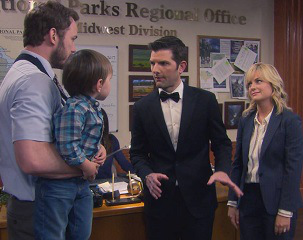
Sitcom of the Future?

Sitcom of the Future?

Season six of docu-sitcom Parks and Recreation recently had its finale and in its final few seconds arguably lost all credibility as a sitcom grounded in contemporary reality. From this point on, we’ll be watching a sitcom set in the projected near future, and nothing can undo that. This all happened for the sake of resolving story problems that the writers had themselves created and a few discontinuity gags. It’s pretty clear that a TV show doesn’t need a grandstanding spectacle to ‘jump the shark’; it can do it casually under viewers’ noses. This week marks the return of 24, which probably holds the water-speed record on shark-jumping throughout its previous eight seasons of amnesia, faked deaths, nukes and conspiracies. Yet audiences still bestow the show with the legitimacy that graced its first, and only truly believable, season. There are even websites that count the number of times a TV show has ‘jumped the shark’ during its run. Even though we may assume a show can’t come back from ‘jumping the shark’, clearly it can and we might just have to accept that it’s something that happens organically to TV shows.

Dog Shows and Cat Boxes

Posted in American TV (General), American TV Shows, Reality TV, TV Criticism, TV History, Watching TV with tags , , , , , , , , , on April 22, 2014 by Tom Steward

I begin with a broadcasting history anecdote but bear with me. In Britain in the late ‘80s, a debate was held on what constituted quality television ahead of a broadcasting White Paper proposing the introduction of television outside public service regulation in the form of a satellite service to the UK. Unsurprisingly given what would go on to happen with Downton Abbey, business won over art and the agreed-upon definition of British quality television was pseudo-literary period drama with an easily exportable ideal of British national identity based on our imperial past. But during the debate, a definition of quality television offered by scholar Geoff Mulgan was ‘usable stories’, an idea consonant with broadcasting that television should tell its viewers something that could help them personally or collectively in their society. This understanding of quality in television has always stuck with me and it’s come to mind recently as a way of defending several American TV programmes I’ve been watching that are otherwise badly made, poorly written and artlessly executed. But is that justification enough?

Dog Daytime TV

Dog Daytime TV

I’m a dog-owner and I used to be a cat-owner. Hence I’ve been watching a lot of Nat Geo Wild’s The Dog Whisperer and Animal Planet’s cartoon riposte My Cat from Hell. Both shows tackle the same premise but are – quite literally – very different animals. In each, pet-owners call in behavioural specialists or PWCs (Psychologists Without Credentials) for their animal, Cesar Millan for the dogs and (apparently on return from the 23rd Century) Jackson Galaxy for the cats. The pets in question are usually engaging in dysfunctional behaviour, although the sub-Scooby Doo twist is always that it’s the owners who are really screwed up. Cesar controls the dogs by making them more obedient, calm and submissive and Jackson makes the cats easier to live with by compelling owners to hand over the entirety of their house to their new feline landlords. Different strokes for different pets. Both programmes are shoddily constructed, replete with ham-fisted set-ups, and full of duplication, laboriously eeking out a handful of choice moments into an hour of blink-and-you’ll-never-miss-it television.

That said, there’s more here that’s relevant to my daily life than in all the shows I’ve ever feted as quality TV. And I’m not just speaking selfishly. I’m a better citizen because of these shows, and with the possible exception of The Wire there’s not many ‘quality’ programmes you can say that about. My dog (by marriage) A is by no means a handful but nor is he entirely obedient, and sometimes he has to be because he’s a big boy and a breed that ignorant people (and that’s large sections of the public) mistakenly think of as a vicious dog and so there’s less chance any harm will come to him if he’s never out of our control. Thanks to The Dog Whisperer, I know that I can subdue A in any situation by calming myself first and that dogs need to respect as well as love you before they obey. Thanks to My Cat from Hell, I know that if I get a cat, I should just hand them the house keys.

Marriage Boot Camp is a truly awful TV show by anyone’s reckoning. Everyone involved is a horrid caricature (self-made or portrayed) of their social type and their relationships ugly distortions of what marriage is really like. The format and its ‘exercises’ (we should say games) don’t help anyone, and the whole debacle is thickly lacquered in anesthetized self-help dross. G and I recently celebrated our first wedding anniversary and we’re both ecstatic about each other and the institution. So whereas once I would see Marriage Boot Camp as a simple lie perpetuated by a periodically lazy medium, I now see it as a cautionary fable of what happens when married couples become grotesque circus-mirrors of loving unions. It’s the same old shit but my relationship to it has changed. Perversely, the show may even help our marriage, not because of the guidance it offers but because I now have a high-definition image in my mind of what a bad marriage looks like and I refuse to ever let myself resemble one single pixel of it.

Balls and Chains!

Balls and Chains!

I never thought I was that concerned with the use-value of the TV shows I watched. Then I think how little British TV I now watch compared to when I lived in Britain. Sure, it’s harder to get British programmes here and much easier just to go with the flow (50 television academics just telepathically high-fived!) but frankly it’s very possible these days and the shows themselves are no less for me being here. It’s only because they don’t seem relevant to my life as it is now that I don’t watch them as regularly. Most of the British shows I’ve lost in translation are the ones I used to sync myself to the national calendar. You can tell that from the titles: The Great British Menu, The Great British Bake-Off, Coronation Street. What remains is everything I watch for content and style (Doctor Who, The Fall, Peep Show) not because they speak to me in my immediate surroundings. I don’t think I’ll ever completely confuse useful programming with good TV, but it’s tempting sometimes.


Letter Box

Posted in American TV (General), American TV Shows, TV channels, TV History, TV News, Watching TV with tags , , , , , , , , , on April 8, 2014 by Tom Steward

After 21 years as host of CBS’ Late Show and another 11 on NBC’s Late Night, David Letterman announced his retirement from late-night television last week. Letterman made the announcement on last Thursday’s Late Show in a characteristically loose and ambling stream-of-consciousness monologue full of pathos, bathos, self-deprecating humour and sardonic wit. It was a welcome contrast from Jay Leno’s mawkish farewell and crocodile tears on the eve of his (second!) departure from The Tonight Show in February. Even in goodbyes, the gulf in class between the two late-night hosts is palpable. Because while Leno’s conservatism (both political and comedic) kept late-night talk shows rooted in the past, Letterman opened up the genre, overturning conventions from within and dispensing with formality in favour of funny.

Don’t believe me? Ok, let’s consider how many people in television have ripped off Letterman since he started compared to Leno. And Bill O’Reilly doesn’t count, he just happens to be a disgusting Republican who’s bad at his job. When you see an entertainment show in which the crew, the audience and members of the public feature as prominently as the talent, Letterman did that. Plagiarism of Letterman was so rife, it even prompted an episode of talk show docu-satire The Larry Sanders Show in which host Larry tries to imitate Letterman’s ensemble of backstage performers against the stern warnings of traditionalist producer Artie’s about the ‘talent moat’. Conversely, Leno was all about heritage and keeping the talk show anonymous, bland and without formal innovation.

Letterman made the tone of late-night talk television casual, its humour offbeat and its attitude embracing of the alternative. His interactions with sidekick and band leader Paul Schaffer were parodies-cum-deconstructions of talk show traditions and his shows meandered in ways that seemed to defy their Draconian time restrictions. Leno’s Tonight Show looked like a corporate junket or infomercial in comparison. Sarcasm, irony and the surreal were Letterman’s calling cards not the flash-in-the-pan satire that Leno used to peddle to appear relevant. Letterman’s skits, like the infamous Top Ten List and Oprah Log, jabbed at the heart of American popular culture rather than superficially brushing it with cosy lampooning, and he incorporated cult and sideways figures (Bill Murray, Harvey Pekar) into the canon of celebrity guests.

Liberace returns from grave as Letterman's last guest!

Liberace returns from grave as Letterman’s last guest!

Leno’s safe, nostalgic version of late-night talk beat out Letterman in ratings for most of the 90s until the CBS host gradually eeked out a lead in the 2000s, consolidating his primacy during Conan O’Brien’s ill-fated tenure on The Tonight Show prior to Leno’s return. However America thought of him in the ‘90s, European TV saw Letterman’s style as the future of light entertainment. Kings of British primetime talk television entertainment throughout the 1990s and 2000s Jonathan Ross and Chris Evans imitated Letterman’s informal, self-referential and participatory approach to television to the letter. MTV Europe’s Most Wanted, an influential music talk show from the early 1990s presented by Ray Cokes, was undoubtedly guided by Letterman’s improvisatory technique and onscreen use of the crew and viewers.

It’s unsurprising that the template for a new generation of late-night TV hosts should come from Letterman not Leno. Leno’s successor Jimmy Fallon is defined by a Letterman-like breakdown of late-night talk show form rather than the previous era’s intransigence. Current CBS Late Late Show host – and legal heir to the Late Show host seat – Craig Ferguson takes Letterman’s leisurely variety of hosting to a new level with his near-formless set-wandering. From Letterman, comedy elite late-night hosts Conan O’Brien and Stephen Colbert take their spiky personas and dry interviewing style. Although, Letterman isn’t done yet. In the closest thing to a real-life episode of Columbo, Letterman’s 2012 interview with David Cameron exposed the British Prime Minister as the vapid, disinterested moron he is.

By contract and tradition, Letterman was supposed to inherit The Tonight Show following Johnny Carson’s exit from the host seat in 1992. Letterman was beaten out by Jay Leno who ruthlessly made himself NBC’s preferred choice in the course of brutal negotiations. Leno would deny another Late Night host the right of ascension after forcing out Conan O’Brien from a brief Tonight Show tenure in 2010. Currently, Letterman’s CBS late-night follow-up Craig Ferguson stands in the position Letterman did 23 years ago, with a contract specifying that he should take over his network forerunner but facing the possibility of being bought out and replaced by a ringer. For the sake of innovation, creativity and comedy, I hope that TV talk show history doesn’t repeat itself.

Watching Americans with TV

Posted in American TV (General), American TV Shows, British Shows on American TV, Reality TV, TV channels, TV History, Watching TV with tags , , , , , , , , , on April 1, 2014 by Tom Steward

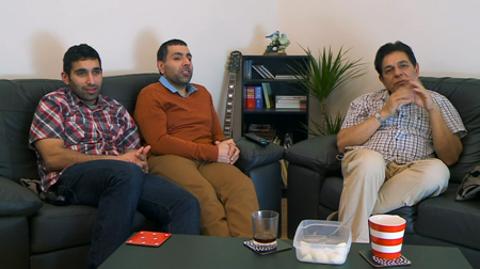
Last Christmas when I was back in the UK I became obsessed with Channel 4’s Gogglebox, a reality show where we watch people watching television. An unbeatable premise executed to perfection, it was just the right mix of sociology, sitcom, soap opera and vox pop. Upon returning to the US, I learnt Gogglebox was to be re-made in America as The People’s Couch by socialite reality cable network Bravo. Bravo has never cared about representing the American public before so it seemed a curious choice of import. Saying that, Channel 4 is not exactly a public service channel anymore either.

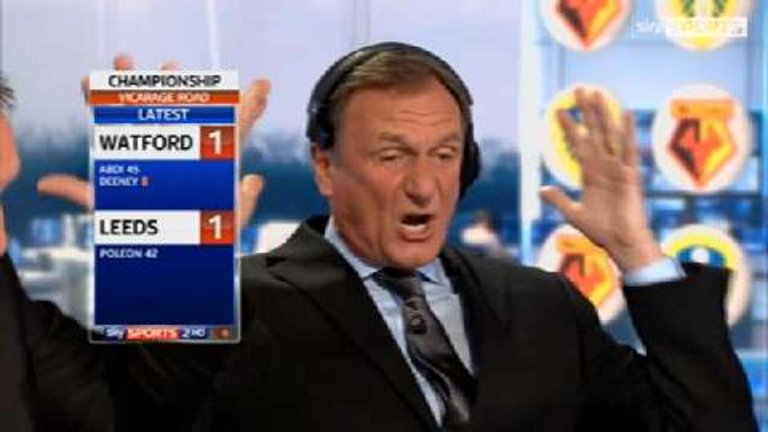
When Gogglebox starting airing last year, the idea of watching TV viewers on TV was already familiar to British audiences. The Royle Family, one of the most popular British sitcoms of the last 20 years, largely consisted of a family sitting in their living room with the TV on. Football fans have been watching pundits watch Premier League games on Sky Sports Soccer Saturday for decades now. The notion of TV re-capping TV wasn’t news either. One of our biggest comedies of recent years TV Burp was a retrospective of the week’s TV with irreverent commentary from offbeat entertainer Harry Hill.

Sky Sports Soccer Saturday: Watching pundits watch football.

Sky Sports Soccer Saturday: Watching pundits watch football.

Gogglebox wasn’t the first attempt at this idea on British television, just the first version of it that people wanted to watch and channels would want to commission. In the early 2000s, the live late-night Channel 4 panel show Flipside TV had celebrity guests providing running commentary on TV programmes airing at the same time. Its graveyard slot meant there was no danger of losing viewers to other channels, but Gogglebox eased the format into primetime by having it recount the previous week’s TV. Flipside TV also didn’t have two of Gogglebox’s prime draws; the public and TV clips.

The concept is not exactly unheard of in American TV either. The couch-potato sitcoms of the ‘80s and ‘90s such as Roseanne and The Simpsons added a layer of realism to the depiction of American family life by showing characters in front of the TV, although the shows they watched were largely invented or embellished. E!’s The Soup trawls through clips of the week’s TV with mocking commentary from comedian Joel McHale, in a format very similar to TV Burp. But it’s invariably a specific kind of bad and bizarre reality TV that’s always seen ironically and functions as material.

Who are we watching?

Who are we watching?

The format of The People’s Couch is virtually the same as Gogglebox. We watch reactions to and conversations about TV programmes of the past week from different sets of viewers (families, couples, friends) who re-appear each week. Participants all watch the same programmes; although we suspect some of them have been prompted to. Each segment centres on a specific show, which tends to be popular, new or somehow different. We flip between viewers depending on who has the most interesting or entertainment reaction, and we get substantial extracts from TV shows so we know specifically what they are reacting to.

There are, however, minor changes that make all the difference. Gogglebox tries to be as representative as possible of the diversity of British society in terms of class, race, age, ethnicity, sexuality and region. This is a legacy of Channel 4’s social concern and inclusivity as a broadcaster which it used to have in spades and still rears its head occasionally. The People’s Couch tries to be as representative as possible of the diversity of Bravo viewers, which means sassy women and gay men of more than one ethnicity. This is the difference between broadcasting and narrowcasting in a nutshell.

Before there were people's couches there was Gogglebox!

Before there were people’s couches there was Gogglebox!

Gogglebox shows viewers from all over the UK while The People’s Couch doesn’t stray far from the Hollywood axis preferred by TV producers for geographical convenience. It’s remarkable to see middle-class families on a network that typically won’t bother with people worth less than a million but there’s a socio-economic cut-off point in The People’s Couch that there isn’t in Gogglebox. This is probably more about the relative affordability of digital TV in Britain compared to exorbitant US cable costs, which prevents many lower-income homes from getting extensive TV service and disenfranchises them from participation in the national TV conversation.

The biggest mistake made by The People Couch was chopping Gogglebox’s running time of an hour in half and losing the original’s voiceover. Our attachment to and affection for the viewers we see every week is what makes Gogglebox so compelling and moving. Without a voiceover giving us backgrounds and biographies of the people featured and the time to get to know them, their relationships and routines, The People’s Couch only manages superficial glimpses of its real-life stars. It makes them seem shallower than their UK equivalents, which is regrettable because they’re not (necessarily), just represented without depth or empathy.

Live Day-to-Day

Posted in American TV (General), American TV Shows, Reality TV, Reviews, TV channels, TV Culture, TV History, Watching TV with tags , , , , , , , , , on March 25, 2014 by Tom Steward

It’s been a long time since American television was purely live but it’s still an everyday part of broadcasting. Amidst the cycle of breakfast shows, daytime chat shows, primetime entertainment and 24-hour rolling news and shopping, there doesn’t seem to be an hour of the day that there isn’t some kind of live TV on the air. We know from experience that live broadcasting can be one of the most powerful, significant and thrilling forms of TV. Live television has been agent and witness to cataclysmic political changes. It made and then ruined Nixon, and then made and ruined him again. We saw the Republicans’ chances of electoral success in 2012 vanish in real time at the GOP conference as Clint Eastwood decided to go off-script and do X-rated versions of his Bob Newhart and Jimmy Stewart impressions. There are other world and universe-changing events witnessed on live TV I should mention – like 9/11 and the Moon landings – but…dude was talking to a chair! There’s no greater potential for surprise, shock and error in television than in a live broadcast, and that unpredictability carries a nervous energy that is utterly exhilarating. And we get it uncensored and first-hand.

I’m reminding myself of what live TV is capable of because, if the past week is anything to go by, American TV has forgotten. Last Monday morning, news anchors on the local Los Angeles TV station KTLA breakfast show reacted to a mid-size earthquake that happened live-on-air by panicking, shouting ‘Earthquake!’ and diving under a desk until it had subsided. Now, I’m not going to pretend that I would have done anything different in this situation, even if I had been trained to keep going. But is there any point continuing to broadcast live if all we’re going to get is dead air, an empty studio and the terrified ramblings of presenters so shaken up by the event they can offer no meaningful information about it? Anchors on the other affected TV stations may have stayed calmer, but they didn’t do much better reporting the earthquake. Deprived of information, hindsight and proportion, presenters on Fox 5 and CBS 2 were left with the remnants of a child’s vocabulary. It was ‘big’. It was ‘large’. Some over-achiever even called it ‘strong’. They might have learned something about the conditions that Fox News anchors work under every day, but we learnt nothing.

If you wanted to watch the television equivalent of muscle-wastage, then you needn’t have looked further than what CNN put on in relation to the search for missing Malaysian Airlines flight MH370 last week. Either the ‘Breaking News’ button was being used as a coaster for an unwanted drink for the past week, or the network genuinely thought the FBI acquisition of a flight simulator recording from the pilot’s home was some kind of crucial development in the story. Cue hours and hours of wild speculation about the significance of the simulator’s data, even after repeated protestation from the featured experts that conjectures about the pilot’s role in the hi-jacking could be argued any which way. It took former Boeing engineer Bill Nye the Science Guy, who is used to breaking things down for people with the minds of children, to tell us that the only thing we all could do was to guess. At one point, a pilot sat in a flight simulator and took viewers step-by-step through a scenario that he had entirely invented in his head. Not even the ‘Screen of Souls’ had an answer to free them from their suspended animations in a video monitor bank.

CNN imprisons aviation experts in screen bank until flight is found.

CNN imprisons aviation experts in screen bank until flight is found.

Maybe the problem is that news reporting has too big a burden of information for continuous live coverage to carry. If so, then putting on a 2-hour entertainment programme that’s been on TV for years live should be a doddle, right? Well, not if it’s Dancing with the Stars. ABC’s primetime dance competition returned for a new season last Monday night with a re-booted format. But it was the basics of live television that the show tripped up on. The studio audience couldn’t be subdued for long enough to hear the judges’ notes on the dances. New co-host Erin Andrews comes from live stadium sportscasting and you would expect her to be adept handling live TV in the presence of spectators, but she kept overrunning, miscuing and recoiling from the audience’s spontaneous reactions. When live TV runs up against the clock and threatens to fall apart, we get a certain thrill as viewers. But it’s a fine line that if overstepped results in sheer incomprehensibility. It’s one of the qualities that makes TV so much more special than other forms of entertainment; yet live broadcasting in America is languishing. Abused, misused, and squandered, live TV barely deserves the name anymore.