Archive for the Watching TV Category

Reunited…and it feels so dud!

Posted in American TV (General), American TV Shows, Internet TV, TV Acting, TV Culture, TV History, Watching TV with tags , , , , , , , , on March 18, 2014 by Tom Steward

Last week, comedy legend Bill Cosby confirmed publicly that there would be no reunion for his hit 80s family sitcom The Cosby Show. This was a relief since the franchise had already been stretched thinner than Tyler Perry on Slimfast with a deluge of spin-offs and sequels and yet still remains dear to audience’s hearts. But where is the demand for TV reunion shows coming from? There’s never been more old TV available to viewers. A large chunk of cable is devoted to re-running classic programmes and internet TV services archive a range of older series for instant access. This reminiscence fuels the public’s nostalgia and brings archaic programmes back into cultural circulation, which in turn makes them ripe for reunion rumours. Classic shows have become so popular on some channels and services that they are now a part of their brand identity and company executives try to capitalise on this by creating new episodes under their banner. There’s also never been more ways to make and watch television. TV can now be made solely for internet distribution, or pass freely between broadcast TV and online video. This gives programme-makers a wider range of options for content and delivery, which makes reunions more attractive since it doesn’t necessarily mean going back into full-scale production any more. It also makes the reunion less official and thereby received more generously, with fans enjoying it as an indulgent treat rather than criticising it for not standing up to the rest of the canon.

Bill Cosby issues a threat to any comedians considering a TV reunion.

Bill Cosby issues a threat to any comedians considering a TV reunion.

But is a TV reunion ever a good idea? Some programmes are so completely synonymous with a moment in time that to attempt to revive them in any other era is absurd and the effect like an out-of-body experience. Often, so much time has elapsed between finale and reunion that cast and crew cannot – whether due to age, health or simply lost touch – re-capture that which viewers loved so much. Whether or not fans and former viewers are willing to buy into a reunion can come down to the motivations behind it. If a reunion is a genuine attempt to create new fiction based around familiar characters and situations because of interest in continuing the story, then audiences tend to give it a (finite) chance. If the motivations are purely monetary and a cynical attempt to exploit a commodity by prolonging it unnaturally, then how can its devotees feel anything but used? Larry David’s semi-autobiographical sitcom Curb your Enthusiasm faced the problem of reunions head-on. In the show, the cast and crew of celebrated sitcom Seinfeld reject the prospect of 10-year anniversary show on the basis of how pathetic and desperate it would make them all look. Larry selfishly convinces them to do it so he can cast his ex-wife and win her back, and we see parts of the reunion episode in the season finale. David gave Seinfeld fans what they wanted without desecrating their favourite show while demonstrating he was well-aware of the dangers of reuniting.

Just don’t ask about the finale…

Seinfeld staged another reunion this year with a trademark dinerlogue between protagonists Jerry Seinfeld and George Costanza shown on internet TV service Crackle as a video short for Seinfeld’s Comedians in Cars Getting Coffee and on Fox at the Superbowl half-time. Again, the makers of Seinfeld made a big deal of reuniting but had deniability if it didn’t take, a sage move judging by the decidedly mixed reaction. Internet TV reunions have had fairly ambivalent receptions in general, not least Netflix’s revival of cult sitcom Arrested Development. Coming seven years after the series finale, this was a reunion sought after by fans following the show’s abrupt cancellation after only three seasons. Virtually all the cast returned and the fifteen-part series played on longstanding themes, storylines and characterisations with a new ‘story-maze’ concept complimenting Netflix’s instant delivery of all episodes. The innovative storytelling was necessary, but the rest felt too much like fan-fiction, a grotesque re-imagining of the original deviating from and souring its memory in unpleasant ways. It brought critical derision on the stars, creator Mitchell Hurwitz and Netflix executives, the latter appearing to be cashing in more than creating. If there’s a lesson here, it’s that people want reunions more than they ever want to see them happen. That’s why commercials are a happy medium for reuniting TV shows. The Danone Full House cast reunion and Radio Shack tribute to 80s TV shows bring programmes back and then move on to the next – hopefully new – show.

Oscar The Couch

Posted in American TV (General), American TV Shows, Internet TV, TV Acting, TV Criticism, Watching TV with tags , , , , , , , , , on March 11, 2014 by Tom Steward

Last Sunday was the first time I’ve watched the Academy Awards ceremony on TV live and continuously from start to finish. In Britain, the time difference means that if you want to watch the Oscars you have to stay up all night, which sounds fun but in reality resembles an inventive form of torture designed to give the re-opening of Gitmo some Hollywood pizzazz. In recent years, the ceremony hasn’t even been broadcast live on any of the UK’s free-to-air channels but rather on subscription-only cable movie channels as if it were an experimental art film where people open envelopes for five hours.

This year’s Oscars were so chocked full of embarrassing gaffes and faux pas that I was able to see the value of watching the ceremony as it went out. Not that the cringing diminishes upon repeat viewing after the fact, far from it in the case of John Travolta, whose creation of an entirely new name for singer Idina Menzel was prefixed with ‘one and only…’. But there’s something uniquely thrilling about seeing these disasters as they unfold in front of the world in the knowledge that they cannot be taken back or censored (even though anything truly provocative would be edited out with delayed transmission).

But this year TV wasn’t just the relay of the Oscars, it was part of it. Host Ellen DeGeneres is a creature born of television, with her celebrity coming entirely from talk shows and sitcoms, and Best Actor winner Matthew McConaughey (not a typo, time travellers from the 1990s!) was awarded as much for his part in the celebrated HBO cop series True Detective than his underwhelming (in every sense of the word) performance in The Dallas Buyer’s Club. TV’s assured standing in America both culturally and artistically seems to be getting harder and harder for the Academy of Motion Pictures to ignore each year.

‘I’d like to thank television’

2014 also marked the year that the Oscars took note of the long-standing links between TV and the internet. Of course the web has been reporting news from the Oscars as it happens for decades now, but the Academy’s publicists are finally coming to realise that this is happening in tandem with the live TV coverage and not necessarily in a vacuum from it. This was the first year that Oscars’ coverage was offered as a live internet stream on the ABC website, a long overdue acknowledgement of how TV can be watched without a TV. DeGeneres’ Twitter-breaking celebrity selfie perfectly complimented the live-tweeting of the TV broadcast.

Even with the slightly more sociable option of live-pausing – for those that have a cable service – the five to six hours of television that the Oscars eats into can still be a slog if you’re going all the way to the Governor’s Ball. Television is medium of repetition to be sure, but even it cannot contain the mechanical monotony of the ceremony and the grinding formula of its acceptance speeches. The land of series marathons and genre channels is still not able to cope with the conformity that the Oscars produce. TV’s unending transmission is about the only way a bloated ceremony like the Oscars could be brought to the world but they’re still pushing at the limits of what even the most entrenched TV viewer can handle.

Oscars Admits Internet Exists!

TV gets its money’s worth either side of the ceremony as well. Hours of broadcast prior to the official start time of the Oscars are taken up with reporters transmitting live from the red carpet-lined entrance as stars rotate their bodies more slowly than a Virgin Trains toilet door and answer existential questions like ‘who are you wearing?’. Following the ceremony, various incarnations of Ryan Seacrest try to get the clearly traumatised Oscar guests to talk about what they witnessed before they repress it forever. Then there are the Oscar-themed talk shows and post-show analysis programmes. It’s past midnight before anyone in TV admits there is a world outside the Dolby Theatre. It’s surprising that politicians aren’t block-booking venues for press conferences on embarrassing indiscretions all day on Oscar Sunday.

Despite these torments, I’d watch the whole thing through again next year. It certainly beats trying to piece together fragments of information about what happened from rolling news stations the next day, which tends to take the same amount of time as the live coverage anyway. And now that TV is playing a far bigger role in the Oscars than ever before, it’s the obvious place to start.

Remote Possibilities

Posted in American TV (General), Internet TV, Reality TV, Reviews, TV advertising, TV channels, Watching TV with tags , , , , , , , , , on March 4, 2014 by Tom Steward

After months of watching TV on instant video applications like Netflix and HuluPlus, G and I have subscribed to cable. This meant shouldering an extra financial burden to meet the inflated monthly service costs but in both our eyes it was worth it. When we watch television, we want to watch television not find a programme to watch. We’re far more interested in watching television just because we can than seeing something specific. Internet TV was supposed to free viewers from the unwanted content of on-air broadcast (advertising, interstitials, filler programming) but to G and I TV only makes sense when they put the crap back in. I, for one, had no idea that the fake commercials in Portlandia appear in the middle of ad breaks where they serve a greater satirical purpose than popping up mid-episode. Also, the choice afforded to viewers by instant video had become a burden on us. So much so that we’d rather leave it to the bigoted, money-grubbing idiots who programme the TV schedules to decide what we watch.

Local advertising during IFC’s Portlandia.

The change isn’t as drastic as you might imagine. The notion of bingeing and marathons has now become so ingrained in the way TV schedules are created that you often find networks showing the same programme back-to-back throughout the day. As such, cable TV sometimes resembles a protracted version of what you might do on Netflix if given the chance. Perhaps the biggest difference is the licence cable TV gives you to stumble upon some of the strangest programmes you’ll encounter outside of a parallel reality. These are not programmes you would ever seek out or patiently endure buffering for, but when they are handed to you as samples that come free just for touching a button repeatedly you don’t feel you’re losing anything to give them a try. But don’t think these programmes are abnormal. They are indicative of precisely what television does when it’s not a one-in-a-million show like True Detective or Justified. It’s the act of filling time with a formula that works entirely on its own terms. That’s why we have…

Rev Run’s Renovation (DIY Network, Saturdays)

Rev Run’s Renovation: Not exactly Cribs!

A programme seemingly pitched on the basis of alliteration and anagram possibilities, Rev Run’s Renovation follows Run DMC rapper Rev Run as he renovates his New Jersey home. I know what you’re thinking. It’s a stylised reality show about the ridiculous and extravagant re-modelling that rappers do on their property a la MTV’s Cribs. Think again. It’s a completely matter-of-fact home improvement programme where the ins and outs of house renovation are laid out for viewers with an eye to budget and practicality. What does Rev Run have to do with renovation? Beats me.

Vanilla Ice Goes Amish (DIY Network, Saturdays)

Spot the Amish guy in this photograph.

Aside from being the perfect audience since it’s guaranteed they haven’t heard his music, Vanilla Ice Goes Amish is the feeblest juxtaposition of topics since Ted Nugent tried to fight Obamacare with Dr. Seuss. It’s not even that much of a mismatch. Vanilla Ice doesn’t programme code for Apple, he’s a rapper from the last century. He’s anachronistic enough now to have more in common with the Amish than differences from them. And it seems the Amish people aren’t as dated as we think. It should be called Vanilla Ice Does Nothing Different.

Wahlburgers (A & E, Wednesdays)

A 12-inch Wahlburger!

You know those businesses founded on a pun (‘Hair We Are Barbers’, ‘The Codfather Fish & Chips’ etc.) that won’t be there the next time you pass by? Well, this is a reality show about one of those businesses and the television equivalent of it. Wahlburgers is a chain of burger restaurants run by Chef Paul Wahlberg and his celebrity brothers Mark and Donnie. Wahlburgers is a show about Wahlburgers. The show and the restaurant are called Wahlburgers because they are Wahlbergs who make burgers. Expect nothing more complicated than this and you’ll be fine.

Unknown (Can’t Remember, Saturdays I think)

It’s not often I make an appeal to readers but as with many shows you encounter while channel hopping I only have a very sketchy memory of its name and where and when it aired and I’ve not been able to find it again nor any mention of it in the public domain. So please send me a comment or tweet (@wtvamericans) if you know what show I mean. It’s a tone-perfect, late-night digital cartoon parody of a morning news show which featured a location report from Legoland depicting it as an independent nation.

Braking Bad

Posted in American TV (General), American TV Shows, Touring TV, TV Culture, Watching TV with tags , , , , , , , , , on February 25, 2014 by Tom Steward


We’ve got some haz-mat suits in the van’


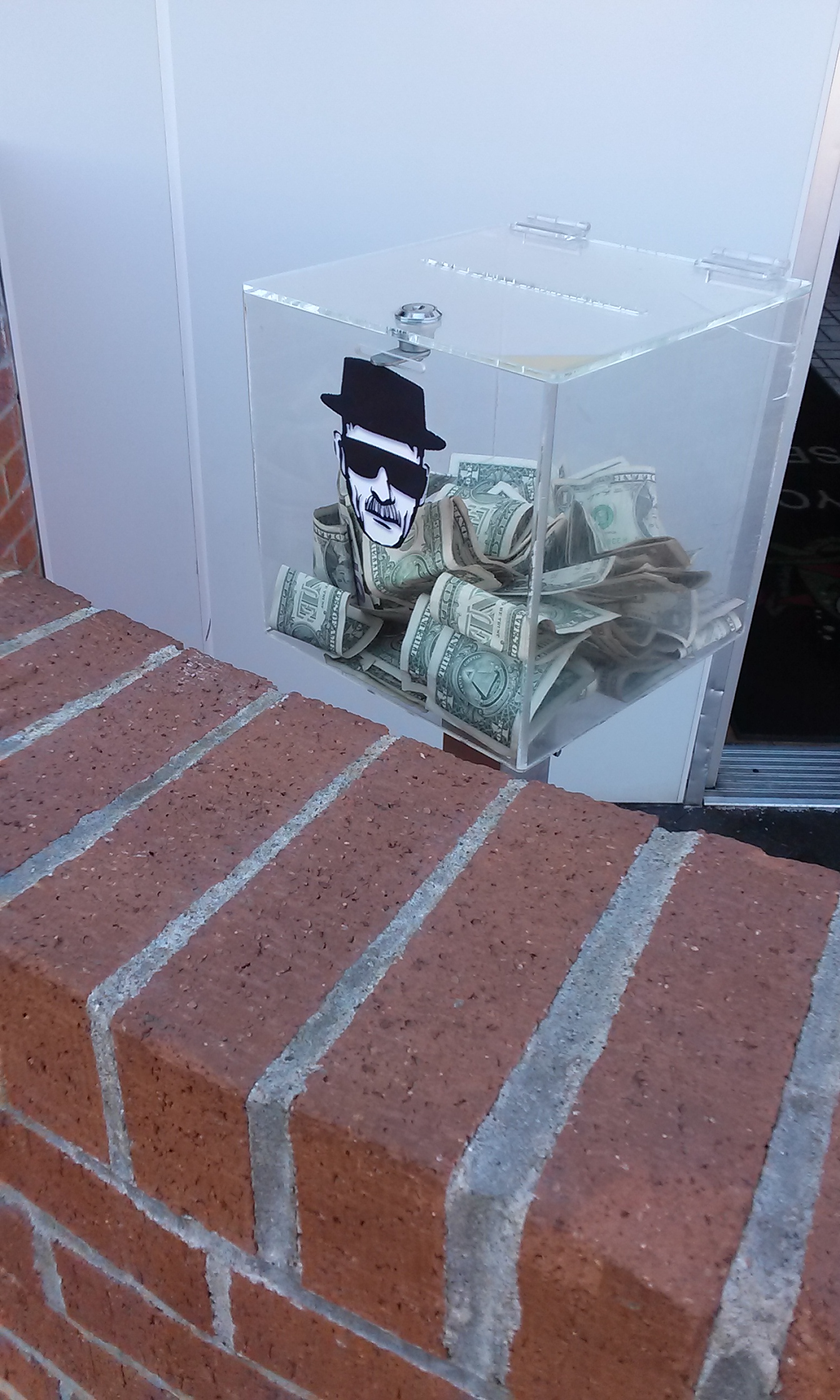
Last week I was in Albuquerque, New Mexico, where the celebrated AMC crime drama Breaking Bad was set and shot. During my time there I went on a tour of the show’s locations. This consisted of an informal convoy of cars parading the city which, with its walkie-talkies, cyclical movement and talk of ‘herding’ and ‘getting separated’, reminded me of another AMC series, The Walking Dead. The show is so ingrained in the city that it’s entirely possible to take a Breaking Bad tour of Albuquerque without even knowing. It turned out I had been to several of the locations earlier in the week, including The Grove Restaurant, one of the recurring set-pieces in Season 5, which just happened to be opposite my hotel. In that instance, I was there not as a fan but as an aficionado of oversized baked goods.

Making Mad Money!

Making Mad Money!

Everyone on the tour was struck by how close the locations were to each other. Film and TV locations are usually discontinuous – even if they are supposed to be within the same area – and tend to be arbitrarily stitched together to form an entirely new map that suits the logic of the programme or movie. Except for a few jarring instances, Breaking Bad seems to choose its locations according to the geography of Albuquerque. That doesn’t mean, however, that the show’s directors weren’t adept at transforming locations to fit the tone and meaning of the story. In Breaking Bad, The Grove is a soulless, empty corporate coffee shop whereas the real spot is a bustling, cheery local produce market and café. The Whites’ family home always reeked of lower-middle class suburban compromise but in life it is a desirable piece of real estate in a pretty, upscale neighbourhood.

What soap are they using at the car wash?

What soap are they using at the car wash?

It was clear from the array of visitors to the Breaking Bad locations that the show has created a demand for tourism in Albuquerque. It was less clear how interested the natives of Albuquerque are in making a fully-fledged tourist industry out of it. We were chased off a couple of properties, both politely and impolitely, and in other places which were working businesses you got the impression that they didn’t mind having you look around but nor did they particularly care you were there. A few plaques and souvenirs from the show were scattered here and there, like the gloriously kitsch sign for the fictional Los Pollos Hermanos restaurant in the branch of Twister’s which subbed for it, but nothing extravagant or mercenary. I applaud their effort to maintain identities and existences independent from their appearances in Breaking Bad and I liked being in them more because of that.

love 125

The sign is there, the restaurant is not.

As we saw with mixed local reactions to Alexander Payne’s Nebraska, it’s not how much a place is onscreen that matters, it’s how that place is represented. Breaking Bad certainly gestures to what makes Albuquerque a place of beauty – its inspiring urban murals, its mountain-lined vista landscapes – but it’s somewhat undermined by being identified as a run-down, crime-ridden city where an opera of meth and death can credibly play out. This may be at the root of the locals’ ambivalence. It’s no coincidence that the most adverse reaction we got from a local was from the owner of The Crossroads Motel, depicted as a hangout of meth addicts, dealers and hookers in the show where it is nicknamed ‘The Crystal Palace’. The most business-sensible of the proprietors use Breaking Bad as a hook. At Twister’s, I arrived thinking about Breaking Bad and left dreaming about their breakfast burrito.

The Nazi compound.

The Nazi compound.

Albuquerque is a far-cry from Hobbiton or Highclere Castle though in some ways Breaking Bad is more rooted in the reality of the city than either The Hobbit or Downton Abbey is in their tourist-trap theme parks. At the disused rail-lined storage facility that housed the Nazi compound in which the denouement of Breaking Bad takes place, there are the remnants of a public-made shrine to Walter White. But however much you wish to imagine it a place of fiction and imagination, it remains a place of foreboding and sinister feeling irrespective of its meaning in the show. Being there you fear real Nazis, or worse. Turning around – and crucially away from the show for a second – you’re faced with a scene of Albuquerque in all its natural southwestern glory. That’s the difference. It’s Breaking Bad, for sure, but something else, and something just as effective, maybe more.

And Finale…

Posted in American TV (General), American TV Shows, Reality TV, TV channels, TV Culture, TV History, TV News, Watching TV with tags , , , , , , , , , on February 13, 2014 by Tom Steward

American TV seems to be in a permanent state of finale. The average season has more false endings than a Hobbit trilogy. Before the Christmas break, there’s the mid-season finale, which desperately tries to manufacture a television event out of a show taking a brief holiday. Some shows have started to invent finales and talk about them as if we somehow know what they’re supposed to signify. Fox’s The Mindy Project has just had its Winter Finale, which is apparently what you now call putting the show on hiatus for a couple of months at the end of January. Season finales only seem like a big deal because all a show’s stories build towards it as a point of climax. In reality, it’s only a matter of months before the show is back on again. Even series finales don’t preclude a show returning through revivals, spin-offs, movie sequels and reunions. The cast of Seinfeld have managed to reunite twice since the sitcom went off the air, firstly in a fictional reunion episode within the world of Curb your Enthusiasm and then in a sketch for this year’s Superbowl coverage. That’s a lot of endings for shows that never quite finish.

Seinfeld cast reunite at superbowl, which is also the name of Jason Alexander’s haircut.

I’ve been thinking about finales because American TV has just had a big one. After 23 years in the host seat, last week Jay Leno finally said goodbye to The Tonight Show. Like most finales, however, nothing is really ending. Jimmy Fallon will take over as host, which has been a forgone conclusion for years now given the high-profile and staggering popularity of his late-night NBC talk show. Few people would be prepared to believe that Leno is even giving up the show. Leno first left the job in 2010 ceding hosting duties to Conan O’Brien. Within a few months, he had clawed back the job from his successor, as acknowledged in O’Brien’s Olympic-themed jab at his predecessor on the eve of Leno’s departure. Yet everyone acted as if something was in fact ending. Leno cried, celebrities queued up to say goodbye, and Garth Brooks played – which really is the nuclear option. The Tonight Show is going back to its home in New York and is now hosted by someone capable (though bafflingly so!) of gaining consistently huge ratings for a show whose popularity has balked in the last decade. Sounds more like a salvage operation than a send-off.

You can never come back from Garth Brooks.

Another American TV finale was in the news recently. The latest season of weight-loss game show The Biggest Loser held its final weigh-in last week, with the winning contestant having undergone a loss of weight so severe that she appeared to have another kind of eating disorder. The usual Muppet-mouthed looks of aghast pride from the trainers were replaced by horror, concern and confusion when they laid their eyes on her emaciated body. The show has always been self-righteous about the good it does for public physical and mental health. Yet by incentivising maximum possible weight loss without any healthy weight caps and filling its contestants’ heads with cod psychobabble in motivational-speak, The Biggest Loser falls prey to the pitfalls of many reality shows in neglecting its responsibilities of care to the members of the public it features. The season finale is usually a cause for self-congratulation as the show parades its reduced-sized versions of that year’s contestants and pats itself on the back for helping them, all the while of course revelling in sensational images of obese people eating cake naked. But this year’s finale revealed the dangerous and unhealthy extremes that the show’s premise could be taken to.

Trainers on The Biggest Loser react to body-shock win!

It’s good to have an end in sight. TV is such a massive and sprawling thing that it’s helpful to set limits and boundaries now and again. But rarely do they actually represent something that could be actually be called an ending. Finales help TV continue, renew and keep track of itself but all their talk of being done for good needs to be taken with a grain of salt. Like The Tonight Show goodbye might just mean adieu and as we’ve seen with The Biggest Loser finales might take you further than ever wanted to go in too short a time. And with that, Watching TV with Americans enters its Valentine’s Finale followed by its mid-mid-year finale. It’s time for me to say an emotional, longwinded goodbye as I leave you…for a couple of weeks. Remember to eat in the meantime and only play Garth Brooks while I’m away.