Info a Treat

Posted in American TV (General), American TV Shows, TV channels, TV Criticism, Watching TV with tags , , , , on June 17, 2015 by Tom Steward

TBS’ late-night talk show Conan features a segment called ‘What am I Watching?’ in which titular host O’Brien flips through the cable channels with the aid of the info button on his remote. Pressing the button reveals skewed descriptions of each show encountered, such as ‘Entertainment Tonight: Two lifelike cyborgs are programmed to think everything Hollywood does is fantastic’ and ‘Diners, Drive-ins and Dives: Guy Fieri plays an out-of-work party clown who is addicted to lard’. There are two diametrically opposed laughs here. One is the absurd – yet entirely truthful – inversions of the straight-faced synopses that info buttons on cable remotes give us about TV shows. The other (which sadly nowadays may be as socio-economically discriminatory as those jokes in The Sopranos about Kierkegaard) is about people who have cable recognizing how close these summaries come to the real thing.

All you need to know...

All you need to know…

The descriptions contained on info buttons are not as openly critical as the fake ones on Conan but they do often make you wonder who the authors are and what their criteria is. Whatever possessed the person that wrote the digital synopsis for Jaws: The Revenge to question the scientific plausibility of the storyline when they wrote ‘Disregarding the behaviour typically exhibited by the rest of its species, a revenge-minded shark follows a woman from New England to the Bahamas’? What is to be gained from listing the events that take place in the 1920s surrealist avant-garde short Un Chien Andalou – including a woman’s eye being cut and ants spilling from a wound in someone’s hand – as if it were an episode of Columbo? And these are the ones that actually get the descriptions right.

The buttons struggle noticeably with anything resembling emotional complexity. They can’t seem to get around the fact that Jackie Peyton from Nurse Jackie isn’t a good person and doesn’t find redemption each week. TCM’s button writer needs an education in film noir – one incidentally that the network will provide in association with Ball University – if it thinks that anyone in The Glass Key is in any way moral or decent. As misleading as they can be, info buttons are impossible to do without. With shows on cable now mired in the mud of endless re-runs and encores (which are re-runs that run on from the first run, like a bad sequel), it’s essential to have something to distinguish individual episodes, and sometimes the description on the info button is the only way to be sure.

This new technology has created a completely different experience of watching television, one that we’re perhaps less willing to recognize because it doesn’t involve a computer screen. It’s just on our TV rather than our phones and devices but that in itself is significant. We have much less need for TV listings or paper guides, which means that journalistic commentaries on TV shows has been supplanted by anonymous synopses. While before, viewers would read a critics’ review to get a sense of whether they wanted to watch a programme or not, now they have to go off the plot, and be less informed about the success of the project than its aims. Maybe it’s clearer now why the description of Jaws: The Revenge was so unfavourable. Button writers don’t rate TV, but nor should they have blood on their hands.

Info buttons only skim the surface of how cable remotes alter our perception of television. Every time I try to erase an episode of Conan, the remote asks me ‘Are you sure you want to erase Conan?’ as if the host himself will be vanquished from history once I press ‘Ok’. Whenever I do, I genuinely believe that Conan O’Brien has disappeared into the ether. All right, that’s not true. But making me think twice about whether I want to keep a show or not has made me re-evaluate what in TV is worthy of a second or third viewing.

I’ve made lots of assumptions here about the people who write the descriptions on info buttons – as well as assuming that this is a dedicated profession and not an intern’s copy-and-paste job – so anyone who knows anything about how these show summaries get written, please get in touch with me and I’ll write another post about it, with whatever level of anonymity you wish. Poverty and convenience may one day render cable obsolete, so I want to learn what I can about this phase of TV history while I can. I also want to know who wrote that Jaws blurb!
Remote Viewing

Posted in American TV (General), American TV Shows, TV Dreams with tags , , , , on June 12, 2015 by Tom Steward

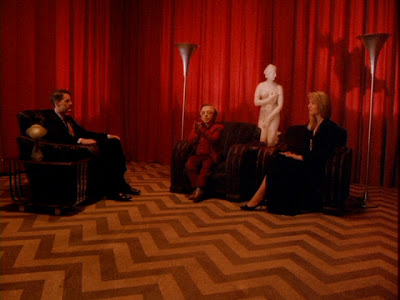
Quite often, my dreams take the form of anticipating event television. If the finale of Mad Men had played out according to my subconscious, the series would have ended with an elderly Don Draper boarding a Concorde in a Madison Avenue version of the last scene from Kubrick’s 2001: A Space Odyssey. I had a vision of the new season of Twin Peaks picking up from the season two cliffhanger, with Agent Dale Cooper suddenly exorcising Bob and then explaining to Sheriff Harry Truman how he deliberately trapped the serial killing spirit inside him to draw him out into the open and destroy him forever. If Showtime were hesitant about giving David Lynch a generous budget for making the season, I doubt they’d be willing to fork out for circa-1991 digital avatars of Kyle MacLachlan and Michael Ontkean. This is where dreams become necessary. Sometimes they’re simply an improvement on what we eventually got in reality. My dream projection of the Season 8 premiere of Doctor Who was something akin to Peter Greenaway’s film of The Tempest, with Peter Capaldi Toyah Wilcoxing it in full new romantic regalia. At least it was portentousness done well and not by Steven Moffat.

Have you ever had a dream with a midget?

Have you ever had a dream with a midget?

Stranger still is when dreams you have had appear on television. Louie recently aired an episode in which the comedian is pursued in his dreams by a naked man with invisible eyes who charges at him from the darkness. I’m sure everyone will recognise the dream-like pacing and movement that Louis C.K. managed to cultivate in these sequences, and it’s about the best simulation of a dream state I’ve seen since Jonathan Miller’s Whistle and I’ll Come to You. But Louie and I have the same Freddy Krueger as I’m frequently stalked by the same figure in exactly the same way night after night. It once became so vivid that I started screaming uncontrollably in bed. But the experience of seeing the inner-workings of my subconscious laid out onscreen was actually rather therapeutic. I laughed the laugh of recognition that usually accompanies my viewing of Louie but with greater hysteria and mania, as if repelling a demon. Louis C.K. and I are so evenly matched in looks, outlook and social reaction that I shouldn’t really be surprised that we dream the same dreams. We want the same thing…lots of bad food to eat quickly! It’s better than a support group.

Sometimes I think there is method to my madness. My dreams honed in on the one aspect of Twin Peaks that could not be done in a revival 25 years later, while acknowledging that whatever I dreamt was almost certain to be less weird than what will air in 2016. The finale of Justified consumed my thoughts perhaps more than any other show has or will, and yet it never intruded into my dreams. Perhaps it’s because there was no anxiety or insecurity about how fulfilling it was going to be, whereas I couldn’t say the same for Mad Men and Doctor Who. I don’t want you to think that there’s a TV set in my head (but wouldn’t that be lovely?) and that my dreams are broken down into life and TV shows. Often the two merge. The other night I was in a car with Manny from Modern Family at the wheel, trying to stop an irresponsible relative (no-one specific) from letting him drive us to our death. Now a lot of the kids on my street look exactly like Manny so I don’t know which part of my memory my subconscious was laundering at that particular moment.

There's a horse loose aboot this hoose!

There’s a horse loose aboot this hoose!

I’m aware of the futility and irony of dreaming about shows that are already dreamy or fantastic. Neither Twin Peaks nor Doctor Who adhere to any real-world logic (though the latter is supposed to nod to it from time to time) and Mad Men was always going to end on a note of ambiguity rather than come to any definite conclusion. I’ve yet to see that endless passive flow of dreaming captured in a TV show, which is odd since endless passive flow is exactly what TV is. Even Louie’s dream is a temporary psychological condition caused by guilt at abandoning a divorcee in need, rather than an ongoing haunting. The Sopranos came close with an episode-length dream sequence which drifted in and out of real-life and popular fiction, but the pat Freudianness of everything we saw made it somehow unappealing to watch. It’s as easy as going to sleep.

Sense of Schumer

Posted in American TV (General), American TV Shows, Reality TV, TV Acting, TV advertising, TV channels with tags , , , , , , , , , on May 27, 2015 by Tom Steward

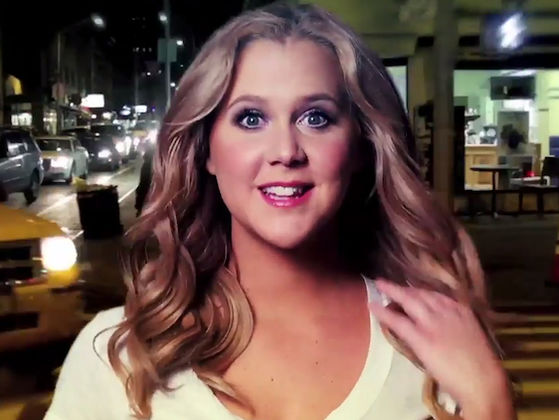
If you have to get sick of seeing someone’s face on TV, make it Amy Schumer’s. Why? Well, firstly because being sick of seeing Schumer’s face seems to be part of her schtick. Every sketch on her Comedy Central show Inside Amy Schumer is preceded and followed by a close-up of Schumer’s face quick-scanning the streets of New York before the camera CSI zooms into her eye. Her face is the lifeblood of every sketch, and even the (mandatory) Twelve Angry Men parody episode in which she did not feature begins with her face dominating the screen. It’s also because Amy Schumer’s face is interesting to watch. Eschewing the hyperreal expressionism of her peers (not that there’s anything wrong with that – Key & Peele are as cartoonish as they come), Schumer’s face is a flickering deadpan, oscillating between irony and approval of the characters she plays and those she interviews.

Facial Schumer!

Facial Schumer!

Which is good news because Amy Schumer is everywhere. In fact, it would be perfectly possible to watch nothing but Amy Schumer on TV these days. There’s her weekly Comedy Central show which seemingly plays throughout the night (uncensored) on the network, her guest appearances on every late-night talk show around, her work on The Bachelorette (which ABC executives want to expand into a regular thing), and trailer-length promos for her upcoming movie vehicle Trainwreck in the ad breaks. We’ve seen this kind of momentary ubiquity before, of course, but rarely with a performer of such substance. That may be because Schumer is able to do provocative and powerful material while making it sound like a bunch of harmless Seinfeldisms. She even makes light of the issue-based thrust of her comedy, passing off most sketches as a PSA-gone-wrong, while underlining just how culturally urgent her intervention into modern life is.

Last night, Schumer confronted the alleged crimes of Bill Cosby. The heavily corroborated sexual assault allegations against the veteran comic seem fair game for comedians now and indeed it may be easier for a white female comic to talk about this topic than, say, the black male one who broke the story. It was the level of discussion that was remarkable. Refusing to debate the existence of the crimes (for, as she points out, there is no debate to speak of, despite all legal disclaimers), the court-based sketch was instead a more sophisticated exploration of how nostalgia and cultural comfort food (both real and symbolic, since this was the man who advertised Jell-O pudding pops) interfere with our sense of justice and gender equality. This is really what we struggle to reconcile, not crime and perpetrator. But this isn’t the first time Schumer has put her finger on the problem.

She coolly and pleasantly took on perceptions of women ageing with Tina Fey and Patricia Arquette celebrating Julia Louis-Dreyfus’ ‘last fuckable day’ as decided by the media. She did an almost Sesame Street-esque scatological number on pop culture’s fetish for women’s sticky-out asses with a hip-hop music video set to the rhyme ‘milk, milk, lemonade, round the corner fudge is made’. Schumer was there to pinpoint the pathetic paradoxes of middle-class women pole dancing while condescending to women who work as strippers as well as female employees being obliged to be ‘cool with’ whatever their male counterparts want to do while being paid half the salary. Bravely she slayed a sacred cow of American comedy, the borderline-rapist late-night talk show host, and perversely she’s seemed to increase her appearances on these kinds of programmes as a result. She’s so popular that even her targets want to be seen with her.

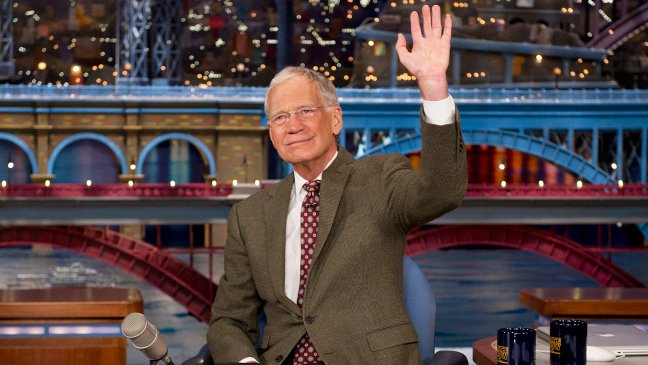
Amy Schumer's parody of late-night...oh wait, that's just her on Letterman!

Amy Schumer’s parody of late-night…oh wait, that’s just her on Letterman!

It would be too easy to say that Amy Schumer’s success is down to the sugar-coating she puts on her social criticism, but it’s hard to deny that her self-aware baby-face mannerisms (see, the face again!) makes what she does much more palatable. But it’s not the cutesy-girl disguise that comedians like Sarah Silverman have used to deflect attention from their obscenity and controversy. It’s more direct than that, like having a conversation with someone who seems perfectly nice and you realise hours late they completely destroyed you. That’s what translates into mainstream entertainment so well. On The Bachelorette, she exposed the egregious insecurities of a male contestant without ever saying a cross word to him. She’s also not afraid of plumbing the lowest depths of entertainment, like dirty jokes and toilet humour, to get what she wants. The time of overkill will come, so enjoy her just killing it.

Ending On A Bye

Posted in Uncategorized on May 20, 2015 by Tom Steward

It’s a year of endings in television. Shows that have defined television over the last decade like Justified and Mad Men are finishing fast and in the ones that continue people synonymous with that show are leaving, be it David Letterman, Jon Stewart or The SimpsonsHarry Shearer. We’re told to mourn yet there is no loss to speak of. Mad Men and Justified both judged the timing of their exits perfectly and those that are leaving do so because their creativity can’t keep up with the demand for more from the institutions they helped create. I’m not saying there isn’t cause for alarm. We can be reasonably confident that Steven Colbert will be as game-changing as Letterman was, but the untested Trevor Noah and whatever lamb to the slaughter (or, more accurately, shearer) will go on to voice characters like Mr. Burns and Ned Flanders may simply not reach the heights of their predecessors. It’s also unclear what new shows will step into the shadows, especially after a spate of cancellations which cut the cord on a few very interesting prospects, such as Battle Creek. But instead we should be grateful for the small mercy of timeliness in TV.

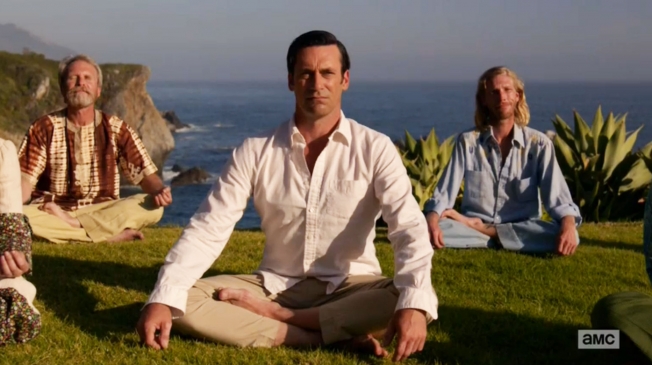
The Don of Man!

The Don of Man!

Justified never put a foot wrong in any department in its six years on the air, so it’s hardly surprising that the show was able to produce a sublime finale. What was surprising was that its final scene equalled the quality of the very first one, which has to be among the finest in television. I know many of those who love the series don’t have access to it, so I’ll spare them revealing descriptions and simply say that not a word is wasted (as if Elmore Leonard was script-editing from heaven) and yet all is said, in a way that changes everything we thought true while reminding us that nothing ever changes. I was somewhat less flabbergasted that Mad Men ended on a moment of ambiguity, given that Matthew Weiner was in charge of The Sopranos when it stopped believing in endings. Unlike the latter’s finale, however, whatever conclusion you took from the final scene was a rewarding one, either a statement of futility about the ability of counterculture to escape commercialisation or a reaffirmation of the curse of business sense in the mind of a true creative. Both had reached a crucial impasse of their own grand design.

Mad Men and Justified were on the verge of treading water creatively when they ended and the former was even in a danger of trying the audience’s patience with a final season split over two years, something that had worked marvellously for a carefully plotted drama like Breaking Bad but made the languorous style of Mad Men seem protracted. As he reported to viewers in on-air his retirement announcement, Letterman is leaving for fear that his mind is on other things and it’s the contractual handcuffs on doing other things that forced Harry Shearer to move on from The Simpsons after 26 years. We should be happy that these great artists have the sense and humility to not want to waste our time. The Daily Show has already been eclipsed by the provocative irony of The Colbert Report and lately the distillation of news satire into a fine art by John Oliver on Last Week Tonight, which ranks among the very best work (factual or otherwise) that has ever been aired on HBO. As both men are Daily Show alumni, Jon Stewart ensured his own slide into irrelevance in the genre he essentially created. That sounds like time to go.

Catch you on the other side!

Catch you on the other side!

I’m not saying you shouldn’t actively miss these traditions (I know I will) but I’m comforted by the knowledge that quality television has been on a roll for decades now and that whatever jewel in the crown you think you can’t live without is always soon to be matched (or trumped) by what comes next. With the cult of personality in full ceremony, it’s easy to forget that the jobs that are being vacated can be done by other people. Letterman is not the first talk show host, nor is Harry Shearer the only person that can do funny voices. The itchy plug-pulling fingers of network executives might mean that less and less people in TV are going to jump before they’re inevitably pushed, but calling it a day is still something to admire, especially when you have carte blanche to go on for as long as you choose to.

Peak Viewing Time

Posted in American TV (General), American TV Shows, TV Criticism, TV Culture, TV Dreams, TV History, Unsung Heroes with tags , , , , , , , , , on May 13, 2015 by Tom Steward

There are TV shows we talk about too much. But Twin Peaks isn’t one of them. I’d say the endless chatter about David Lynch and Mark Frost’s early 90s ABC drama by those besotted of the show (whom I suspect have cherry-pie-picked episodes and not endured the interminably drawn-out final quarter) was better spent on less-discussed yet equally worthy TV from this era…if it weren’t for how crucial Twin Peaks is in the history of television. Unusually for a show that ran for only two years and thirty episodes, no-one has ever shut up about it. The supreme production values and self-conscious artistry have ensured that there is never a reason not to re-air and re-box set the programme. Even compared to other 90s TV shows, which generally stand up well visually (especially compared to the previous decade), the colour, focus and cinematography are configured in such a way that HD could not possibly improve upon it. There’s been more talk recently because it’s the 25th anniversary of the series (although there always seems to be an excuse for a retrospective!) and plans are afoot for a revival of Twin Peaks on Showtime. However, if the public statements of Lynch and most of the cast are anything to go by, the revival might have as much to do with Twin Peaks as 10 Things I hate about you does with The Taming of the Shrew.

A title colour only used in 90s television!

A title colour only used in 90s television!

Twin Peaks set in motion models of television storytelling that have been influential ever since it was on the air. Small-town quirk and paranormal procedural would dominate American TV throughout the 90s, through the ‘twin peaks’ of Northern Exposure and The X-Files. The legacy endures to this day with series like Parks and Recreation, Wayward Pines, Fringe and Grimm. The long-form murder mystery has been a staple of quality television internationally in recent years, with Denmark’s Forbrydelsen, Britain’s Broadchurch and America’s True Detective. Indeed, if HBO opened the floodgates of American quality television with The Sopranos, then Twin Peaks’ dream states and cine-literacy were an important precedent for the show. More broadly, Twin Peaks cemented many ideas that we now take for granted. It showed us that fantasy and realism can live alongside one another in TV without contradiction and that every character in an ensemble (no matter how ridiculous) deserved an inner life and a separate storyline to boot. Twin Peaks remains the benchmark for what constitutes good television. When Louis C.K. tried to generate an art movie feel for his sitcom Louie, he went to none other than David Lynch as guest star (and director in spirit) for a 3-part season finale. In 2010, mystery drama Psych aired an episode called ‘Dual Spires’ featuring cast members and storylines from Twin Peaks, acknowledging the longevity of the show’s mythology as TV to aspire to.

If we dwell too much on the originality of Twin Peaks (as a recent Radio 4 documentary did), we are in danger of forgetting how much the show took from television. References abound to classic American series from Dragnet to The Fugitive (complimenting the mid-century Hollywood intertextuality). As the meta-show Invitation to Love indicates, the characters and storylines in Twin Peaks could have easily come out of a daytime soap. But Twin Peaks was also acknowledging how soaps had graduated to primetime in the previous decade, with shows like Dallas and Knots Landing. In fact, the season one cliffhanger bears an uncanny resemblance to the ‘Who Shot J.R.?’ storyline in Dallas that captivated TV audiences exactly a decade before. For all that is made of David Lynch’s ‘cinematic’ influence on the show, Twin Peaks was co-created by Mark Frost, whose formative experience had been writing for television, notably on Steve Bochco and Michael Kozoll’s soap copera Hill Street Blues. Twin Peaks is as remarkable for its adept handling of serial narrative arcs and gradual character development as for its experimental audio-visual style, and there is a clear lineage from Frost’s work on the continuing ensemble drama Hill Street Blues to his teleplays for Twin Peaks. But Lynch and his signature composer Angelo Badalamenti clearly understood the importance of sound to television, creating a soundscape that both compliments perfectly and stands terrifyingly alone from the image.

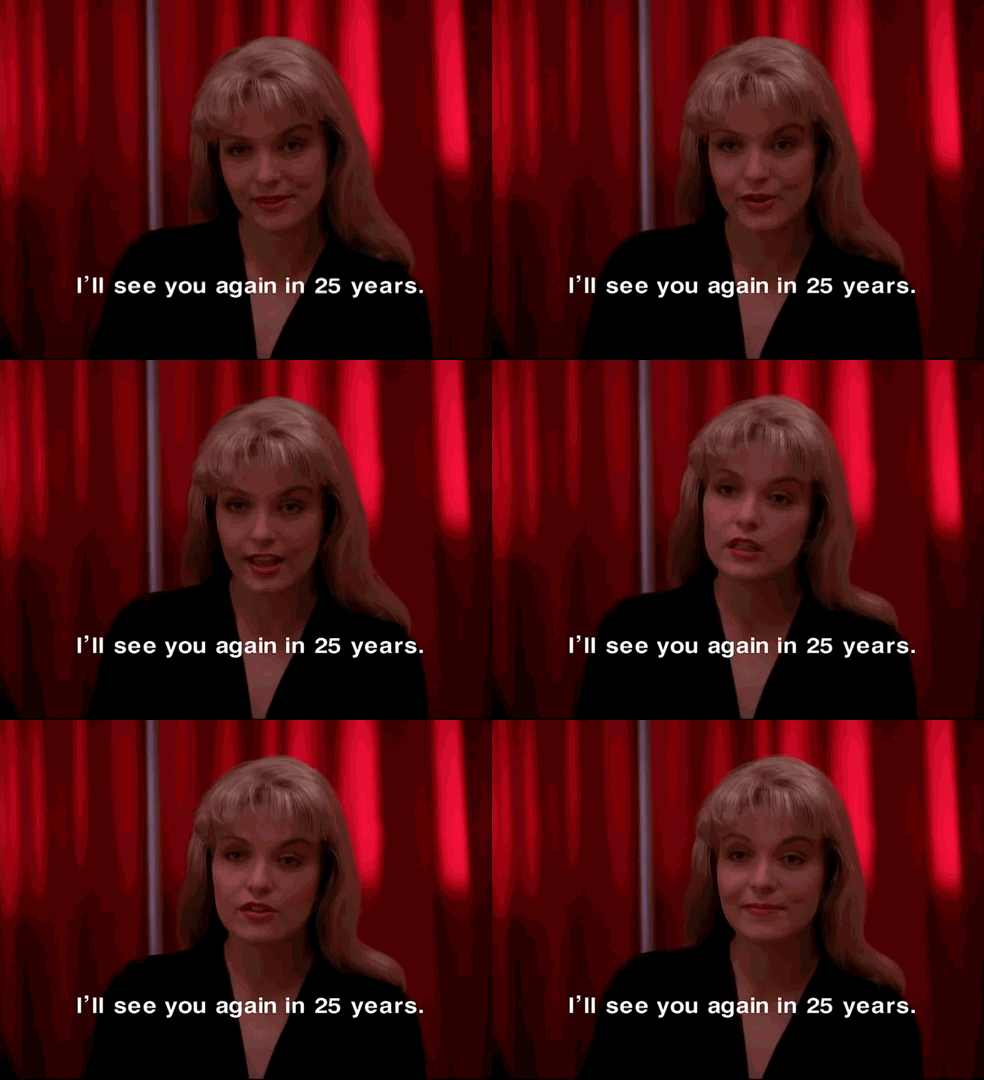
...or sooner!

…or sooner!

For better or worse, Twin Peaks stands for something bigger than it is. It is the nucleus of a fine art television and a prism through which to see the medium. Laura Palmer said she’d see us in 25 years. She was 25 years over.