In With The Who

Posted in Americans watching British TV, British Shows on American TV, TV Acting, TV History, Unsung Heroes with tags , , , , , , , , , on October 1, 2014 by Tom Steward

Here we go again! In August, Peter Capaldi replaced Matt Smith in the iconic title role of the British family science-fiction series Doctor Who, a programme that’s changed actors more times than a Mindy Project midseason re-tool. Capaldi is joint-oldest to play the part with the Sean Connery of Doctors William Hartnell. His age, along with his otherworldly physicality and fannish investment in the history of Doctor Who have led some to assume that Capaldi will resurrect some of the mystery, mastery and manipulation seen in the earliest incarnations of the character. While this is undoubtedly the case, it forgets that Matt Smith’s performance – an actor nearly half Capaldi’s age – was always pushing in that direction, even if the writing for him was not. Smith had managed to convince us that age was no obstacle to playing The Doctor. Now it seems the show is happy to pass The Eleventh Doctor off as some reckless young buck to help viewers come to term with an older Twelfth. It’s double standards, and a very dangerous game!

Who Needs You?

Who Needs You?

Capaldi is probably the best actor to have played the role, and I don’t say that lightly. Unlike Christopher Eccleston – another actor I admire greatly – he also seems a comfortable fit for the role. But essentially this is a repeat of what Doctor Who did in introducing Colin Baker as The Sixth Doctor; a more sinister, less personable variation on the character. Despite Baker’s best (and loudest!) efforts, it was a sea change they were never really able to pull off. So is the show making the same mistakes as before? Short answer: No. Long answer: They’re making different mistakes. This time, the writers have remembered to round out the edges of the character early on, rather than leave character development for a time that may never come. However, somebody needs to tell Steven Moffat that the moral ambiguity of a character is best represented in their actions not in constantly talking about how morally ambiguous they are. Hence, genre pieces like ‘Robot of Sherwood’ and ‘Time Heist’ have been this season’s most successful episodes.

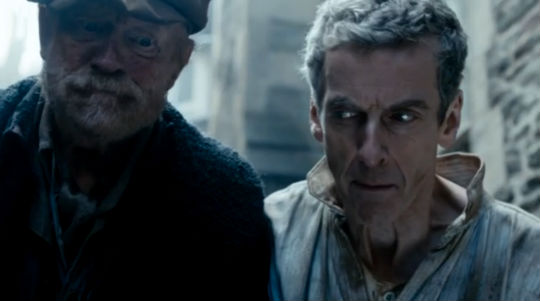
We’re halfway through Capaldi’s first season and it’s hard not to notice the discrepancy between the quality of his performance and the material he’s given. As the absurdist, Godot-like vignette between The Doctor and a Victorian tramp in debut ‘Deep Breath’ indicated, Capaldi’s actorly flow offers new dramatic possibilities for the programme (and puts the show’s use of Eccleston to shame!). But there’s only so much even the finest actor can do when compelled to speak in Moffat-ese baby talk for the majority of episodes, although the head writer has shown some restraint in contracting his idiomatic ‘thingy’ to ‘thing’. Moffat presents the biggest obstacle to Capaldi’s success. Now micro-managing most of the season’s scripts, in addition to several of his own sole pen, the same laziness and hackery that beset Smith’s tenure is already starting to permeate Capaldi’s after only five hours of television. While Capaldi is completely fresh, Moffat’s schtick after five years as showrunner is tired, and tiresome; never more evident than in laborious, tenuous allusions to a familiarly mechanical-looking season arc.
Waiting for Who?

Waiting for Who?

There’s dead weight in the cast too. I sincerely hoped that the character and performance of companion Clara would improve once she was released from her status as story point in the ill-advised ‘impossible girl’ arc. But between the clipped, garbled diction of the dialogue and exponentially annoying inflections of actress Jenna-Louise Coleman (and the smugness…can’t get over the smugness), she’s a lost cause. I’m glad the writers haven’t resorted to the bickering married couple dynamic that made The Doctor and Peri’s TARDIS scenes so unwatchable, and I’m grateful for the buffer that teacher Danny Pink (a considered performance by Samuel Anderson) provides – yes, if there’s one thing Moffat can write well it’s awkward men! But as long as Clara’s the main focus of Doctor Who, which she is more and more since the show revived the autonomy of The Doctor’s companions, it’ll always feel like there a little Moffat running around in the world of the programme. It also doesn’t help Capaldi that the writers insist on keeping the spectre of Matt Smith around.

Doctor Who has always surrounded new Doctors with familiar elements of the series to cushion viewers in times of transition. Indeed, this season began with a Victorian-set adventure featuring the ‘Paternoster Gang’ who were regulars in Smith’s era. But Moffat went so far as to have Smith in the episode (calling Clara from the past) and allusions to the actor in later episodes. As wonderful and apposite as these moments are – because they feature Smith – they’re holding viewers back from really embracing Capaldi’s Doctor. You begin to suspect that Moffat’s vanity is partly behind this effort to build a dramatic whoniverse unified around his time as showrunner. Prior to his debut, I suspected that Capaldi, an Oscar-winning director no less, might excise a little more control over the show than befits his brief, as did auteur Orson Welles who liked to put scare quotes around the term ‘actor’. I can see Capaldi’s influence on the change in pace, the contraction of melodrama, and even the language…in that it sounds like language! Long may it contin-who.

Cry Me A Rivers!

Posted in American TV (General), American TV Shows, Behind-The-Scenes, Reality TV, TV channels, TV History, TV News, Unsung Heroes with tags , , , , , , , , , on September 24, 2014 by Tom Steward

Look, I never said this was a news blog (except in applications for paid blogging positions!). Besides, I have to leave a period of time between a celebrity’s death and blogging about it so it doesn’t look like I’ve been knocking off television legends to give me something to write about. Three weeks ago, at age 81 comedian Joan Rivers died, as she lived…in surgery (don’t you dare tell me Joan wouldn’t appreciate a joke like that!). She will undoubtedly be remembered as a stand-up who, unlike many of her generation, was as relevant the day she died as when she first started out. Let’s not forget that Rivers was the comedian who said the unsayable about the widows of 9/11. But she had a real gift for television, and was particularly adept at using everyday formats – talk shows, entertainment news, red carpets – to sneak in provocative and edgy comedy.

Here's Joany!

Here’s Joany!

Rivers got her big break on Johnny Carson’s The Tonight Show in 1965, where she would continue to appear as guest and guest host until the mid-1980s when a rift between her and Carson caused her to be blacklisted from the talk show until this year. Her caustic manner and matter-of-fact handling of other personalities on this and her Fox talk show vehicle The Late Show Starring Joan Rivers was a refreshing departure from both the sycophantic hosting and demure women associated with the genre. It paved the way for her later television career spent trashing celebrities both to their faces and in absentia on the E! shows Live from the Red Carpet and Fashion Police. It also showed that Rivers could insert her brash, no-holds-barred comedy into regular television without ever disrupting it. She didn’t revolutionise late-night talk shows but made them far less deferential and more assertively direct.

Joan Rivers never seemed to be snobbish about what kind of television she was prepared to do. In later years, she would frequently appear on home shopping network QVC to hock her line of costume jewellery. In 1996, she became a reporter on E!’s Live from the Red Carpet, a job more usually reserved for young, up-and-coming, vacuum-brained celebrity enthusiasts. This was as much because she knew television was a business as it was to do something interesting and shocking with bland, formulaic TV. Playing herself on Louis C.K.’s artful sitcom Louie, Rivers castigates the stand-up for leaving a gig in a casino because of its corporate and commercial diktats, addressing her reputation as a ‘sell-out’. Her red carpet interviews are proof enough that Rivers could transform the most banal role into comic art. Acerbic, fast and wounding, she made it entertaining and intelligent with savage mockery replacing awed reverence.

Rivers has been on TV screens weekly since 2010 in E!’s panel show Fashion Police. The highlight of each episode, for both viewers and co-hosts it seemed, was the comedian’s throwaway similes about celebrity dress sense, which would frequently incorporate a ruthless and tasteless commentary on pop culture. No death appeared to be too soon to joke about, no disaster or ailment a taboo, no imperfection beyond satire. Year upon year, the show demonstrated perfectly how Rivers could condense her act into TV’s rigid dimensions without becoming any less sick and twisted. Her 2011 appearance on a Season 2 episode of Louie was a long overdue recognition of Rivers’ standing in comedy, as she becomes Svengali to the disillusioned comic. But she is represented according to a tension between commerce and art that has always been part of her persona, and one that she has managed to resolve without fuss.

The goon squad are coming to town!

The goon squad are coming to town!

Like most celebrities who want to survive in contemporary TV, Rivers allowed her life to be scrutinised onscreen in a reality series. Her relationship with daughter Melissa was the subject of Joan and Melissa: Joan Knows Best and her family dynamic was addressed in Celebrity Wife Swap where she swapped her daughter for Bristol Palin (for reasons best known to the producers). Perhaps her most unremarkable television work, if only for the foot-binding conventions of reality shows that do not permit idiosyncrasy, they are still testament to Rivers’ canny understanding of where to be in TV at the right time. With all the low-end TV she’s been involved in; some might be inclined to write off much of Joan Rivers’ time on the box. But she definitely found her niche in each genre she tackled, and never sacrificed what made her comedy special for the sake of being on television.

Watching Century With Americans

Posted in American TV (General), American TV Shows, BiogTV, Reality TV, Reviews, Touring TV, TV Criticism, TV Culture, TV History, Watching TV with tags , , , , , , , , , on September 10, 2014 by Tom Steward

You know when anniversary shows try to make out that the second part is different from the first, even though it’s just another set of clips with a new (but equally banal) gimmick? Well, now you get the point of this introduction. It’s somewhat fitting, however, as what I’m most proud of about this blog is that it is different from one week to the next, even if my obsessions do tend to re-surface like a pardoned 24 terrorist. It’s a freedom writing about American TV that you can’t have making it. Here’s some more re-runs before normal service resumes:

For the second of our hundred television posts celebration that's...erm...crazy like a fox?

For the second of our hundred television posts celebration that’s…erm…crazy like a fox?

‘Given that this is how I spend most of my days anyway, it seemed perverse to be treating a TV marathon as the novelty it was supposed to be for the majority of the population. But I’m also not going to miss a golden opportunity to sit in my pants morning, noon and night continuously watching TV on one of the rare occasions it’s been deemed socially permissible’

‘It’s the inverse relationship between the interest taken and the research done that makes American TV’s obsession with the British so bemusing to me’

‘The Food Network could run Chard Week featuring all the best appearances of the vegetable in the mystery box on Chopped, including the time someone drizzled it with a gummiworm-infused vinaigrette’

‘If there’s a lesson here, it’s that people want reunions more than they ever want to see them happen’

‘It seems bizarre that in a country where the mere mention of healthcare can cause the government to shut down, science is such a popular commodity. Yet again and again American TV shows flashing their scientific credentials like phosphorus in a Bunsen burner are more likely to succeed’

‘It occurred to me recently that TV talks to us as if we’re all amnesiacs’

‘Film critics can no more admit to the abysmal hit rate of current movie releases than TV critics can acknowledge that most of the time on-air television resembles an endless sewage pipe’

‘One of the places I was surprised to find TV on the air was in the air’

‘The show is so ingrained in the city that it’s entirely possible to take a Breaking Bad tour of Albuquerque without even knowing’

‘Unlike other game shows, The Bachelor(ette) likes to invite its losing contestants back to occupy more senior roles in the programme, like Juan Pablo who was sent home in a previous season and is now The Bachelor. It’s like losing Final Jeopardy and then next day replacing Alex Trebek’

‘Ok, let’s consider how many people in television have ripped off Letterman since he started compared to Leno. And Bill O’Reilly doesn’t count, he just happens to be a disgusting Republican who’s bad at his job’

‘It occurred to me recently that TV talks to us as if we’re all amnesiacs’

‘I often feel guilty about recommending shows that don’t warm up until a few seasons in. In essence you’re asking someone to commit all their free time to something that won’t pay off for months. It’s like getting someone to invest their life-savings in a niche restaurant that you know won’t make any money for the first few years’

‘American TV seems to be in a permanent state of finale. The average season has more false endings than a Hobbit trilogy’

‘Aside from being the perfect audience since it’s guaranteed they haven’t heard his music, Vanilla Ice Goes Amish is the feeblest juxtaposition of topics since Ted Nugent tried to fight Obamacare with Dr. Seuss’

‘After all, there can’t be many clips out there of Orson Welles winding Dean Martin’s head 360 degrees with a handle’

‘I often wonder how long reality shows would last if there were no repetitions or duplications. Chopped would probably end before it began!’

‘Hours of broadcast prior to the official start time of the Oscars are taken up with reporters transmitting live from the red carpet-lined entrance as stars rotate their bodies more slowly than a Virgin Trains toilet door and answer existential questions like “who are you wearing?”’

‘Can we jump forward to a time when TV doesn’t time jump?’

‘With the possible exception of serial killing, the part of our culture most likely to produce copycats is television’

‘It occurred to me recently that TV talks to us as if we’re all amnesiacs’

Vanilla Ice takes an Amish selfie...or as they call it a 'self-portrait'.

Vanilla Ice takes an Amish selfie…or as they call it a ‘self-portrait’.

‘At least we now have an idea of what Return of the Jedi would have been like had David Lynch directed it’

One Pundred Hosts (Without Typos Or Cheap Puns)!!!!

Posted in American TV (General), American TV Shows, Americans watching British TV, Behind-The-Scenes, BiogTV, British Shows on American TV, Reality TV, Reviews, TV Acting, TV advertising, TV channels, TV Culture, TV History, TV Sports, Watching TV with tags , , , , , , , , , on September 3, 2014 by Tom Steward

We’re into syndication! With 100 blogs under my belt, I can now sell the rights to the A.V. Club who will publish the same three posts over and over again – with every third sentence removed – for the next twenty years. In the true spirit of American TV, I’ve decided against celebrating this milestone with a piece of considered, original writing (why break with tradition now?) and instead hastily assembled and artlessly compiled a list of extracts representing the best (or at least most comprehensible out-of-context) of the blog…and split it into two parts. Thanks for watching and enjoy!

A specially-created TV series just for this milestone!

A specially-created TV series just for this milestone!

‘Years previously I used to run on the spot along to chase sequences in cartoons like a dwarf soothsayer doing a dance prophesising the age of TV interactivity’

‘My friend openly admitted to finding the slapdick (my term) comedy of the three hosts hilarious, commenting that “we don’t have people like Clarkson on American TV”. “Fox News” I thought, but didn’t say’

‘So shifting viewing an hour or two to make way for a pizza is not exactly the end of television’

‘Yes, Chantix is apparently not just a wonder-drug but a porthole into an alternative universe of Marxist dialectic or, if that’s too posh a reference for you, the Bizarro World’

‘All my morning shows on the day of the Royal Wedding were attended or discussed by the hosts with a bizarre royalty-envy that ill fits a country founded on telling the King of England to fuck off’

‘After weeks of sounding like a malfunctioning motivational speaker robot, Celebrity Apprentice contestant and consecutive mental-of-the-week Gary Busey was appointed project manager on a task’

‘For G, it was as if Britons had collectively decided to substitute a working TV set in the corner of the room for a 19th Century ventriloquist dummy with its mouth sprung to repeatedly gawp the word “Mummy”’

‘When war “came to Downton Abbey” it went by so fast that it seemed to have actually been fought in the grounds of the building, like a game of Risk gone awry’

‘Now I’m starting to think that I was in some sort of hallucinogenic fever state the night before because I could’ve sworn I saw Hollywood actor-director Clint Eastwood hold a conversation with a chair while an audience of magenta elephants cheered him on’

‘TV Land is where sitcoms and their stars go to die’

'Memba them?

‘Memba them?

‘After prolonged exposure to American TV news, however, I now long for a token alternative viewpoint and the masquerade of even-handed commentary’

‘Watching a Halloween-themed sitcom episode used to be like watching film footage of Hitler’s speeches; unimpressive and kind of shambolic and yet those in the crowd seem to be going wild for it’

‘Like anything in life which I have no direct experience of, I looked to American TV for advice on how best to handle the situation’

‘All I found on The Travel Channel were programmes about the excessive intake of high-calorie foods which make Americans less able to move. When I turned over to The Learning Channel I saw wall-to-wall programming about people without formal educations’

‘I’m sure Harry Enfield will be relieved to know that after decades of writing and performing some of the best character comedy and social satire in Britain he is finally known in America…as a talking gnome with goggles’

‘But a 3 hour serialised pilot? It’s like the feeling you get ordering a starter of garlic bread with tomato and cheese in a pizza restaurant. It’s enjoyable and you wanted a starter but it’s also what you’re getting for the main course’

‘I mean, what exactly is gained showing Goodfellas at 2 in the afternoon?’

‘It seems that if reality TV was more like reality, with all its loose ends and uneven surfaces, fans of the genre wouldn’t necessarily want to watch it’

‘Early in his career, artist Roy Lichtenstein produced a series of paintings based on advertisements. In one of the great cultural ironies of our times, advertising started appropriating Lichtenstein’s paintings. Something similar is going on with Mad Men

‘To those who know football from the European or Latin American leagues, watching a US soccer team play feels like the moment in Futurama where Fry finds that in the 30th Century baseball has become ‘Blernsball’, a barely recognisable Twilight Zone twist on the sport where spectators try to catch players instead of balls and giant spiders roam free through the diamond’

‘It’s a perfectly normal road to marriage…if you’re James Bond’


The Simpsons Are Going To Yellow Air!

Posted in American TV (General), American TV Shows, TV channels, TV Criticism, TV History with tags , , , , , , , , , on August 27, 2014 by Tom Steward

We’re currently halfway through the most embiggened television event of the summer. Every. Simpsons. Ever. is FXX’s 12-day marathon of all 552 episodes of The Simpsons in order, a feat which will require more than even a hundred tacos for adequate sustenance…and a bigger wheelbarrow. I refuse to rhapsodize about the quality of these episodes, partly because it is so astoundingly self-evident that anyone who can’t see it is already a lost cause and also because if you’re yet to be convinced it will take Hypnotoad therapy (it’s still Groening!) to convert you, not the arbitrary superlatives of a fan-blogger.

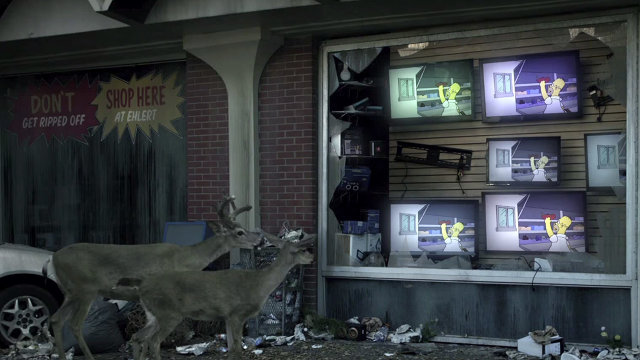
Doh! A deer. A female deer...

Doh! A deer. A female deer…

What struck me watching the series from the beginning is how fully-formed it arrived. A few episodes in and the refined notes of sitcom, satire, slapstick and emotion had already found a blended chemistry. I’ve always suspected the idea that series take place in a coherent fictional universe was just World of Warcraft for TV critics, but looking back it’s remarkable how every line of dialogue or character action is layered with a thousand future meanings and significances. The day is not far off when, as in Shakespeare or The Bible, a reference to everything in existence will be found in The Simpsons.

You don’t need me to remind you of this. In fact, I didn’t need to remind myself. I just did it because the TV told me to, and it’s hard not to listen because it spent so much time raising me. What I do need to remind you is that The Simpsons is still good and should not be cancelled. Whenever anyone involved in the show is asked whether they should call it an epoch – an inevitable question after 25 years on the air – they invariably defer to what is most unprecedented and unrepeatable about The Simpsons.

The show’s original contract with Fox contains a clause stipulating that the network cannot interfere in its production. This clause still holds today. To end the series would be to forsake a kind of creative freedom not seen before nor possible since in network television, or any other corporate media for that matter. Of course, if The Simpsons wasn’t doing anything valuable with their autonomy, then it shouldn’t be kept on the air just to make a point. But I would argue, fervently, that it is. Perhaps not as well as it once did, or as consistently, but cromulently enough.

In recent years, the abuse The Simpsons receives at the hands of the internet (eh?) has become so ritualised that the show even has a running gag about it (which is reason enough to keep the series on the air, if you ask me). I was probably in their camp a couple of years ago. But when I think about, the time I disliked the series most was when I was denied a steady flow of new episodes by Rupert Murdoch restricting UK premiere rights to channels I didn’t have (the Sith Lord giveth and the Sith Lord taketh away).

Since I moved to the US, I get daily back-to-back episodes of The Simpsons on my local station which are all from 2010 onwards and shown on a continuous loop. For some time now, this is what The Simpsons has been to me. Rather than experiencing melancholia for the show’s golden age, my appreciation and enthusiasm for the series has been renewed and revitalised. The writing remains acerbic, the satire of contemporary folly is as punchy and provocative as that of the first Bush administration, and contrary to popular belief there is as much feeling for the characters as ever.

Even The Simpsons refuse to pay to watch their show now!

Even The Simpsons refuse to pay to watch their show now!

Rupert Murdoch will no doubt need all 552 episodes of The Simpsons as evidence in his defence when he is eventually tried by The Hague but I only need one to defend the series against charges of loitering that may come its way. ‘Steal This Episode’ is the ninth episode of the 25th season of The Simpsons and aired this January. It is one of the most recent episodes and one of the overall best. It contains a nuanced and insightful commentary on the moral contradictions and hypocrisies of media piracy, spot-on critiques of Hollywood’s recent output (‘I like that James Bond is ugly now’), and pinpoint social observation (I have lived the Raiders’ fan with the baby at the 9pm screening!). It has an emotional centre and yet draws intelligent laughter from what we know of the characters and what is true of life. They’ll never stop The Simpsons.