The Twelve Days of Doctor Who: Days 1-6

Posted in Americans watching British TV, British Shows on American TV, Reviews, TV Acting, TV History, Watching TV with tags , , , , , , , , , on November 19, 2013 by Tom Steward

G and I are spending the twelve days before the 50th anniversary of Doctor Who watching stories from each Doctor in turn. I know what you’re thinking but it was actually her idea. I was being unusually gracious about the amount of time Gossip Girl and Revenge were on our TV and G smelt a rat. ‘Just you wait’, I said. ‘Why?’ said G. ‘Oh you want to watch old Doctor Who. Why don’t we do the twelve days of Doctor Who?’. I was thinking eleven – one for each Doctor – but I wasn’t going to protest. When Day 1 came I said to G ‘Are you ready for “An Unearthly Child”?. She said yes while rolling her eyes. ‘Why did you roll your eyes?’ I asked. ‘Oh you saw that?’ she replied. It was going to be a long twelve days. If this all sounds a bit familiar, it’s probably because the premise is unnervingly similar to the blog Adventures with the Wife in Space in which Neil Perryman recounts watching every classic Doctor Who story with wife Sue. I don’t wish to step on the toes of this superb blog – of which I was an avid reader – but instead offer a complimentary transatlantic version.


‘An Unearthly Child’ (G’s title: ‘Curiosity killed the Science Teacher’):

Welcome to The Price is Right!

G was taken aback at how much the original supporting cast of William Russell, Barbara Wright and Carole Ann Ford looked like contemporary TV actors. And then how much the inside of the TARDIS looked like a game show set. ‘Welcome to The Price is Right!’ she would bellow whenever the doors eased open. I’ve never seen anyone – including myself – as engrossed in the cave people story as G was, and the spell was only broken when she saw that the cavemen had underwear on.


‘Tomb of the Cybermen’ (G’s title: ‘Martin Short’s Dad in Space’):

The Mayans are coming!

Are you ready for ‘Tomb of the Cybermen’?, I shouted across the house. ‘Yes’ G shouted back. ‘Wait, I don’t know what that means’. G thinks that even the set travels back in time. ‘Wow, this looks even older that the last one. Are you sure that was before this?’. As the Doctor and his companions arrive at the tomb, G thinks she’s figured out who’s in there. ‘It’s the Mayans. Look at the pictures on the wall’. The Doctor’s witty undercutting of Krieg’s plans for world domination makes G happy: ‘After all, he’s still British’.


‘Spearhead from Space’ (G’s title: ‘Freaky Babies Take London’):

So what’s the threat?

‘He’s cool. I like his style’. G knows Jon Pertwee is my favourite Doctor but she seems genuinely charmed by him. The accents of the yokels are harder for her to get her head around. ‘I have no idea what he just said’ G admits as the poacher mumbles west country gibberish into his rabbit sack. The Autons don’t have much effect on her. ‘So what’s the threat?’ she asks whenever they’re on screen.


‘The Robots of Death’ (G’s title: ‘What’s Their Problem?):

I need my video console!

‘What do you think of Tom Baker?, I asked G, expecting the usual glowing praise. ‘There’s something I really don’t like about him. I don’t know why.’ Ok, that’s a new one. ‘The monsters are great, though. Are they playing Space Invaders?’.


‘The Caves of Androzani’ (G’s title: ‘Revenge of S & M Face’):
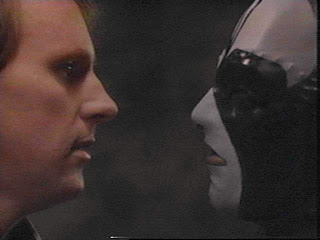
The Phantom of the Opera is here!

This takes us two days to get through. ‘It’s too 80s. I can tell when it’s made. With Matt Smith and the older Doctors, you can’t tell when they’re supposed to be from. It’s more magical that way’. If G thinks Peter Davison is too 80s, wait till she sees Colin Baker! We get our first glimpse of Peri. ‘Is that supposed to be an American?’, G asks. ‘The Phantom of the Opera is here’ she sings as the comparison becomes too vivid to deny. ‘Why is S & M face playing Dig-Dug? (I checked and the game came out that very year). G also sees her first regeneration: ‘It’s weird how they just sneak that in at the end of the episode’.


‘Vengeance on Varos’ (G’s title: ‘Willy Wonka and the Torture Factory’):
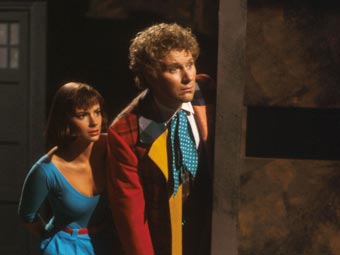
‘She needs a bra and I need a mirror’

‘He looks like a TV math teacher. I keep expecting him to sing “What is 4/Multiplied by 2?” and then pull an 8 out of his jacket’. Sil the slug-like tycoon appears on screen. ‘He’s freaking me out. He looks like a turd.’ The thought-provoking stuff gets through. ‘I wonder if we’ll go back to a society like that’ G asks seconds before observing ‘They need to get Peri a better bra’. ‘The tendrils! They’re poisoned…’, the Doctor explains. ‘…like the ones I just hit with my back’ G adds.


The Twelve Days of Doctor Who continues next week – or in Doctor Who cliffhangerese ‘Doctor! Noooooooooooo!!!!!!…’.

Politics comes to Downton Abbey

Posted in Uncategorized on November 13, 2013 by Tom Steward

Here’s a guest blog I wrote for the excellent blog site Watching Politics on Downton Abbey.

Greg Frame's avatarWatching Politics

By Dr. Tom Steward

DowntonAbbey

In spite of myself and my left-leaning politics, I rather like watching Downton Abbey. I have a predilection for television which traces out the mundane while lurching into melodrama, probably why I enjoyed The Sopranos so much (although Downton is not nearly as good). The series has also been a vessel of cultural exchange for me and my Latino-American wife, bringing English heritage in touch with the soap opera and telenovela. Critics clamour for Downton to show more of the politics of its day (the teens and early twenties thus far) but its attempts are always so ham-fisted that I generally prefer that they don’t. Season three’s conversation about women’s suffrage felt like one of those hastily scripted and filmed responses to current events you see in soap operas, like Eastenders’ reaction to the death of the Queen Mother.

However much it may try to…

View original post 605 more words

Telly-picking

Posted in American TV (General), American TV Shows, Reviews, TV Acting, TV channels, TV in a Word, Watching TV with tags , , , , , , , , , , , , , on November 12, 2013 by Tom Steward

As someone who has spent the best part of their life enthusing, studying and writing about television, I often get asked what’s best to watch, as if I have access to a secret channel that only the TV wing of Mensa are eligible to subscribe for. I’m always hesitant to answer. As a self-confessed TV snob, I know that whoever’s asking will have dipped their toes into far more shows than I ever have and experimented with titles I would have simply dismissed. When you teach the tube (if you’re doing it properly) you learn to embrace more of the spectrum of what we might call television. So I’m worried I would answer with something insane like CBS’ coverage of the NFL or a public access schools programme about surrealism. It’s also because there’s now so much choice in television that it’s possible (at least as a middle-class white man) to find a show that caters exclusively to you. I genuinely couldn’t say whether or not Boardwalk Empire is great TV since it features just about everything I love in this world (gangsters, American history, HBO, Steve Buscemi), achieving distinction in my eyes just by being made in my lifetime.

Boardwalk Empire: If you don’t like it, you’re not me.

When people ask I’m pretty sure they want a good drama to sink their teeth into and aren’t asking for advice on what rolling news service they should tune to. Givens that, (pun not typo) my go-to is always Justified which I can universally recommend with more, ahem, justification than my TV make-your-own pizza Boardwalk Empire. It’s a show that’s off a lot of people’s radar, or at the bottom of their list, so I feel I might actually be telling them something they don’t know rather than sounding like I’m reading from a list of trending tags. There’s plenty for me to get excited about as an Elmore Leonard aficionado and lover of TV westerns and cop shows but there’s something for everyone here. Every character from walk-on to lead is immaculately written and acted (even Bubba from Forest Gump) and there are beautiful men and women to gaze at, whether you like rough or smooth, or both. If you like your CSIs and your SVUs there’s a whole, complete and expertly crafted story each week. If you’re more of a long game person, behold the four seasons of onion-peel plot development and character works-in-progress like the ever-elusive Boyd Crowder (Walton Goggins). Without sounding like all the good things are in the past-to paraphrase Stevie Wonder-Justified represents a kind of television there’s a severe shortage of today. A medley of action, story, humour and character that’s entirely entertaining and yet never lacking in quality and complexity, not seen fully since The Rockford Files. With kicking dialogue and music to boot, you can’t go wrong. And you’ll be in love with from the first scene.

A Justified choice!

I often feel guilty about recommending shows that don’t warm up until a few seasons in. In essence you’re asking someone to commit all their free time to something that won’t pay off for months. It’s like getting someone to invest their life-savings in a niche restaurant that you know won’t make any money for the first few years. How can I tell someone to start watching Breaking Bad in full knowledge that nothing compelling will happen until the third season? Sons of Anarchy doesn’t even come together until the fifth season! That’s roughly fifty hours of television to tunnel through before seeing any kind of daylight. In all but the rarest cases, we’re talking about shows that you can’t tell someone to jump into already knee-deep in story so you’re really signing them up for work as much as enriching their lives. You see people that you’ve recommended slow-burning TV series to and you can see they’re worn down and trying to think of something nice to say in order to match your enthusiasm but sweating pure ambivalence. If I think someone has the strength of character to endure the grind, I may nod them in the direction of The Walking Dead purely because it’s only a mini-series worth of mediocrity before it all starts to fall in place, a comparative blink of the eye. Fancy a bet on a rank outsider? Try Portlandia. Ostensibly a location-specific sketch show, it’s actually more freely artistic and socially incisive than most TV comedy or drama. You can keep asking me what’s good but most of the time either you know or you don’t want to know.

No Sets Please, We’re British

Posted in American TV (General), American TV Shows, Behind-The-Scenes, British Shows on American TV, TV Acting, TV advertising with tags , , , , , , , , , , , , , , , , , on November 5, 2013 by Tom Steward

There are endless reasons why I’m happy to be with G but I’ve always been especially grateful that she’s not an Anglophile or fangirl of British pop culture. I find G’s nonplussed reaction to most things British, including accents and the sights of London, oddly comforting.  I suppose it’s just reassuring to know that it’s me she interested in not my country of origin. I say this because you Americans are obsessed with us Brits. Actually, it’s truer to say you’re obsessed with what you think we are. American television is fanning the fires of this fascination like a Pudding Lane bake-off…and you can’t get more British than that!

There’s not a show I’ve seen on American TV that doesn’t either have in it a British performer or someone pretending to be British, often both given the lax standards of background research for writing British characters. It doesn’t even have to be a show. Various American companies have British spokespeople and mascots in their TV advertising. Why am I not flattered? Because the fascination somehow never extends to actually finding out what the diverse and varied life and culture of Britain is like. Instead it’s an incredibly narrow, dated and ignorant version of our national culture (royalty, the swinging sixties, Victorian cockneys) that is continually reproduced across American television.

A Cockney lizard is the Geico mascot…for some season!

I’m sure all non-Americans (even ethnic-Americans) and American minorities have much the same beef and I’m not saying the British have any special claim to reductive racial stereotyping on TV. It’s the inverse relationship between the interest taken and the research done that makes American TV’s obsession with the British so bemusing to me. Why go to the trouble of inorganically adding a British person to the cast of an American-set show or concept and then not do the requisite due diligence to give them a chance of convincing at what they’re supposed to be?

A cynical answer would be that Americans know so little about Britain that TV viewers wouldn’t know the difference. But why then are Brits so prominently placed in American television as leads or major supporting characters, presenters and stars, and commercial representatives? Why are we not marginalised like so many other nationalities that American TV knows next to nothing about?

‘You make one more crack about pocket-rocket and I’ll paddle you!’

There are doubtless innumerable political and historical reasons for this (the need to keep us arcane and aristocratic seems pretty closely related to an age-old American view of the British as colonisers from the old world) but in the superficial now I think it has a lot to do with Britain being a major producer and exporter of TV to an extent not seen before. The US, traditionally a powerhouse of global TV distribution, has to find methods of coping with this new threat and slotting British actors and characters into TV shows (often for no good story reason) seems as good a way of joining the competition as any.

There’s also something about always having to laugh at or undermine British people appearing on TV that means however high up in the pecking order they are, their one-dimensionality will always be more important than their function. Think about how many American shows sacrifice character development for a couple of cheap shots at cross-cultural misidentification or excuses for vicarious swearing (the British obscenity ‘wanker’ frequently passes Broadcasting Standards unnoticed). On Dancing with the Stars, Len Goodman has been hired to impart his technical opinion on dancing, drum up the crowd and occasionally play the pantomime villain. Increasingly, however, he’s been there to provide British slang for the other presenters to mock.

The British wing of the CIA.

There’s a quieter British invasion going on (we don’t like to make a fuss) in TV casting. Most of your favourite American TV shows will boast British cast members, many or all passing as natives. I’ve never quite got over Mancunian Egg from This Life as an Atlantan sheriff’s deputy in The Walking Dead or Homeland’s marine double-agent Brody being as British as the head of the CIA. Often producers are calling on past prejudices about British actors to inject a note of taste but it’s also about an Anglicisation of the American acting workforce taking root over recent years.

All the way from Ian Fleming to yours truly, Brits have recognised that keeping your accent quiet is how to be taken seriously in America. British actors playing Americans may have blended in to TV without a trace but those who chose to wear Britishness on their sleeves will remain the rodeo clowns of television.

Serial Killers

Posted in American TV (General), American TV Shows, Behind-The-Scenes, Internet TV, Reviews, TV advertising, TV channels, TV Culture, TV History, TV News, Watching TV with tags , , , , , , , , , , , , , , , , , , , on October 29, 2013 by Tom Steward

It’s tempting to think that we live in an age of serial television, since virtually every programme we see features some kind of story development designed to keep viewers coming back week after week. Nowhere is this more evident than US TV drama. Critics have been telling us for years now that what distinguishes dramatic American TV from its British equivalents and cinematic competitors is the ability to tell stories over time. Yet very few US TV drama series have sustainable premises and even fewer have enough story arcs to outlast a shelf life of one season on the air.

This struck me while watching the early episodes of Season Three of Showtime’s Homeland, patiently waiting for the show to justify its continued existence. The series had the requisite twists and turns for a season of thrills and jolts and spent its second treading water by flipping the premise like a trick coin so that viewers basically watched the first season again in reverse. The third season has already drowned in its own uncertainty over the future trajectory of the show. I’m not at all averse to long-running programmes changing what they are, as long as they change into something!

Damian Lewis tries to hide from disgruntled Homeland viewers…

Homeland is a glorified mini-series but so are many of the contemporary dramas we treasure as serial television. Damages and 24 never deserved to get beyond a single season. The plausibility and novelty of both series is dependent on the events in the fictional world of the show never being repeated. Even TV dramas celebrated for their narrative complexity such as The Sopranos and The Wire barely made it past their first seasons. Both shows came to a story impasse at the end of their pilot runs and had to work hard at finding new characters and concerns to explore.

Let’s get some historical perspective here. The trend towards serial storytelling in US TV drama over the last thirty years didn’t arise from a need to tell stories more complexly and truthfully. As soap operas went primetime in the late ‘70s with Dallas and Dynasty, network executives and advertisers alike recognised that cliffhangers and continuing stories could be a valuable commodity in finding and keeping viewers. I’m not saying this didn’t lead to more complex television storytelling (and often the viewers who liked this most were those targeted by sponsors) but serial television had to be sellable to stay prevalent.

Serial storytelling in US primetime!

Serial storytelling is a neat way to illustrate television’s differences from books and movies (at least those that aren’t series). But the truth is for much of its history, dramatic storytelling in US TV was delivered in self-contained episodic form along a more generous, less competitive principle of not alienating viewers who might miss a week occasionally. The legacy of episodic storytelling is still discernible in American TV today. The successful CSI and Law & Order franchises paid only lip service to serial form and the best show currently on the air, FX’s Justified, is based principally around episode-specific stories.

Most contemporary US TV dramas are better described as walking a tightrope between episodic and serial storytelling. In order to attract casual viewers and get syndicated, TV series must have a loose enough storyline to be broken up and watched out of sequence without too much loss. But as the options for TV viewing multiply exponentially and the landscape of dramatic entertainment become ever more fragmented, stories that run across episodes and seasons remain a tried and trusted technique for encouraging repeated viewing and customer loyalty. A step too far each way takes you into daytime or days gone by.

Justified, the last outpost of episodic TV!

AMC currently holds a reputation for producing television that showcases the best of American serial drama, something alluded to in their last two slogans ‘story matters here’ and ‘something more’. But let’s look at the facts. The recently-completed Breaking Bad is a fallacy of serial storytelling, compacting six years of television into two years of onscreen time. Mad Men produces an occasional episodic masterpiece but watching the series continuously quickly gets tiresome, making it preferable to cherry-pick instalments from digitised series archives. The Walking Dead escaped Stephen King mini-series status by the skin of its teeth (pun very much intended!).

A television drama that is genuinely serialised runs counter to so many of the qualities of US TV we hold dear, like individually crafted episodes and storyline resolution. There’s also a lot of lame ducks out there with nowhere to go and no story to advance dodging cancellation each year.