TV Old

Posted in American TV (General), American TV Shows, Reviews, TV channels, TV History with tags , , , , , , , , , , , , , , , , , , , on June 5, 2013 by Tom Steward

The pleasures of American TV are not confined to seeing new episodes of great shows as they air. They are also to be found in the re-discovery of some of the best TV from years gone by. This is aided considerably by a host of cable channels that do nothing but re-circulate old TV. Given that such stations are generally found in the undiscovered country of niche cable, these shows don’t exactly float to the surface. Their scheduling is hardly conducive to life as a functioning member of society either. With a little sifting, there’s gold in them there hills:

The Fugitive (MeTV Mondays 12.00am)

Though you might be more familiar with the 1993 movie re-make with Harrison Ford (which unusually for a Hollywood revival of a classic TV show doesn’t disgrace its predecessor), this long-running series from the mid-1960s is a classic in its own right. Falsely accused of his wife’s murder, Dr. Richard Kimble (played by a perpetually constipated-looking David Janssen) escapes from custody and drifts from town to town doing a variety of blue-collar jobs until his identity is discovered by the locals-who somehow don’t spot him by his iconic tweed jacket and jet-black hair-at which point he moves on. Kimble is occasionally pursued, when he can be bothered, by Lieutenant Gerard (the coathanger-jawed Barry Morse) and his wife’s murderer, a one-armed man played by a fat Worzel Gummidge. Each episode is an impeccably crafted chamber drama and the weekly guest stars are amongst the best character actors of their era. It’s also a scathing indictment of American society. Those in the justice system are invariably the villains of the piece and Kimble wanders an America full of corrupt institutions where the scum of society has risen to the top. It would be the highlight of anyone’s career, if it weren’t the creation of Roy Huggins, the man behind Maverick and The Rockford Files.

The Golden Girls (TVLand, whenever you turn on the channel)

It’s easy to be put off by the dated production values, air of tackiness and cloying music of this 80s sitcom but it would be a shame to let cosmetics get in the way of a show that otherwise is pure joy. Four senior ladies, sour divorcee Dorothy (Bea Arthur), her old school insult comic mother Sophia (Estelle Getty), southern belle-in-waiting Blanche (Rue McClanahan) and naïve farm girl Rose (Betty White), share a house in Miami looking for love and late-life fulfilment. It’s sharply written with an underlying sarcastic wit that counteracts the mandatory sentimentality beautifully. The show was utterly fearless about confronting issues facing people in later life, like dementia and disability, as well as those that matter specifically to women-one memorable episode has Dorothy facing down a male doctor who misdiagnosed her based on her age and gender in a restaurant. In this sense it harks back to the socially responsible American sitcoms of the 1970s but it has a streak of misanthropic humour we more readily associate with sitcoms today. It’s impossible to underestimate how important the central performances are to the success of the show. I’m particularly enamoured of Getty’s pinpointed quick-fire delivery and White’s knowingly played bravado turns of bumpkin innocence.

Star Trek (MeTV, Saturdays 9.00pm)

After countless sequels and movie versions, it’s good to get back to the ground floor of this franchise and see exactly why people think it so worthy of resurrection. Enduring iconography aside, I was struck by how captivating the storylines of each episode were, and the perfect pace at which the mysteries unravelled while still leaving space for that surreal and colourfully psychedelic camp that people treasure about the show. One episode I caught, ‘The Corbomite Manoeuvre’, is structured like a poker game and ends with Captain Kirk having cocktails with a grown-man baby alien played by Ron Howard’s brother. It’s also quite remarkable how the character flaws of the main cast are highlighted as much as, if not more than, their heroic qualities. I always had it in my head that Kirk’s chronic womanising was a fan fiction add-on that got recouped as canon after nudie-freak JJ Abrams got his pervy little hands on the franchise. But here Kirk is cruelly lascivious without apology or remittance. If like me you grew up with the relatively co-operative crew of The Next Generation, you’d be shocked at the amount these guys argue with each other. Dr. Bones in particular is more insulting to his fellow crew members than a drill sergeant with piles.

It’s not TV…It’s Netflix

Posted in American TV (General), American TV Shows, Internet TV, TV advertising, TV channels, TV Culture, TV History with tags , , , , , , , , , , , , , , , , , , , on May 31, 2013 by Tom Steward

What am I watching? It’s the nature of the beast to find yourself in front of the television asking this very question. But usually when we ask we know exactly what we’re watching. It’s generally a comment on the poor quality of the programme we ended up watching or a realisation we drifted into something we didn’t choose to watch (like the time I accidentally turned over from The Terminator to Ordinary People and kept waiting for the robots to turn up). However, watching the Netflix series of Arrested Development, I found myself asking this question and genuinely not knowing.

‘Arrested Development’ delivered in one block.

I’ve grappled before with the question of whether content designed primarily for internet distribution can be considered television. When teaching media studies, I used to debate with students whether programmes that had all the characteristics of television but were being seen online-like the live coverage of Felix Baumgartner space jump-still qualified as TV. Since people are going to the internet to watch this content, on first impression it would seem not. But it’s the case with much television today that people will see it first-and often only-online. So is all the TV that is watched online disqualified too?

Impressive…but is it TV?

With internet content that originated online, you can argue it both ways. However, content that was previously a television programme but subsequently moved online should be a pretty clear cut case of television, right? Well, that’s what I thought until I saw the 15 30-minute episodes of Arrested Development released on Netflix last Saturday night. The series, a revival of a Fox sitcom from the mid-2000s, heralds a new way of telling stories online, adopts a style based on how information is presented on internet devices and is fit-to-burst with points of reference from consuming media content via web technologies.

Flashbacks provided by Showstealer Pro!

It’s a lot to do with how the episodes are delivered to the viewer. Instead of 1 or more episodes broadcast once a week until the run is complete, Netflix make all episodes of the series available at once. Of course, this is a way of watching derived from the possibility of consuming TV series all at once that has arisen from DVD, on-demand services and internet file-sharing. But that was always an option not the primary port of call. The producers of Arrested Development have clearly identified the difference this makes to how viewers are likely to watch the series.

‘Arrested Development’…full stream ahead!

Each episode has been constructed in the knowledge that viewers are able to watch each of the instalments out of order and expect some gratification for watching the concurrently available episodes in their entirety. The full story of what happens is revealed fragment by fragment and at different stages of the series depending on which of the endless combinations of chronologies the viewer chooses. Whatever journey you take, you’ll encounter non-sequiturs which will eventually become comprehensible while what you’re seeing is clarifying an enigma in another later or earlier episode. However, this all assumes viewers will take advantage of the potential for viewing episodes in a random, non-chronological order. In the end, it’s the old Jurassic Park question; of course you can but should you?

TV from the Great Dark Period!

I’m guessing that most viewers wouldn’t know to watch the episodes piñata-style without having been told in advance. Pre-publicity made a big deal of the chronology-optional viewing pleasures, and we’ve been hearing about the revival for some time, but I’m not sure it would be most people’s natural inclination to watch the show like Tarantino storyboarding Pulp Fiction. Sure, Netflix’s catalogues of full series allow for cherry-picking episode highlights, but at the point of selection we’re still in the dark about what episodes these might be. Basically, watching through is as good a way as any of getting to the end.

Who’s story do you want to see first?

In its network TV days, Arrested Development made a big deal of what it meant to be on Fox, and the Netflix revival seems as keen on reminding viewers that it is now internet content. Flashbacks and cut-aways come in the form of online videos, hacked TV-rip software and Prezi-esque slideshows. At times we think we’re looking at the world through a camera only to find we’re looking through someone’s eyes at a webpage. Network TV is still there in the background, with spot-on sideswipes at CBS’ This Morning and NBC’s To Catch a Predator. But you don’t feel like you’re surrounded by the flow of US TV entertainment and news anymore, you feel like you’ve plucked what you’re watching from the annals of cyberspace.

Madvertising

Posted in American TV (General), American TV Shows, Reviews, TV Culture on May 28, 2013 by Tom Steward

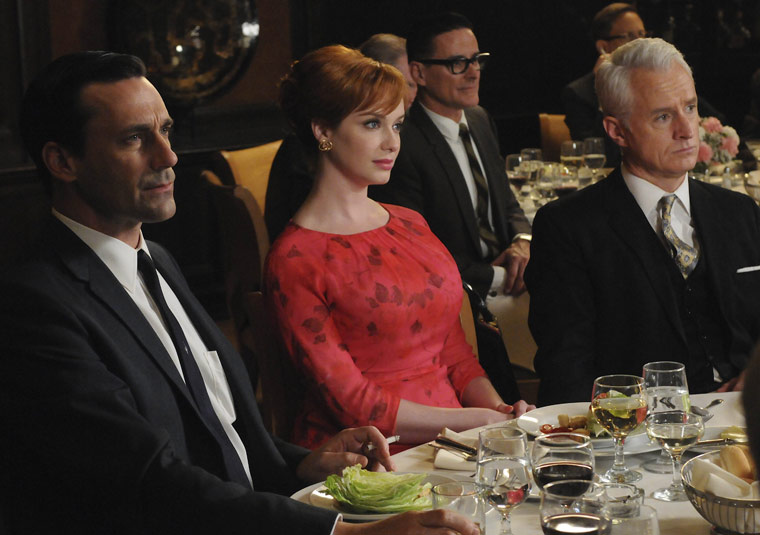
Early in his career, artist Roy Lichtenstein produced a series of paintings based on advertisements. In one of the great cultural ironies of our times, advertising started appropriating Lichtenstein’s paintings. Something similar is going on with Mad Men. Actors best known for appearing in a programme about an advertising agency have now become the commercial spokespeople for major companies. Lichtenstein’s work was ambivalent about advertising, or at least not wholly critical of it, and Matthew Weiner’s Mad Men is equally equivocal. Yet advertising which trades off them makes it seem as if the artists were wholeheartedly in favour of it.

Why, Don, darling! This commercial of yours is a masterpiece. Soon you’ll have all of New York clamoring for Heinz beans!

The way Mad Men sits in relation to the commercials fronted by its actors varies. Christina Hendricks’s ad for Johnnie Walker Red Label recalls the hard liquor consumed by the executives (and 1960s Americans) in the programme, hoping consumers will ignore the repercussions of excessive alcohol consumption shown by the series and only remember how delicious the drinks look poured over ice. It tries to capitalise on Mad Men’s re-invention of classic American styles and fashions to give Johnnie Walker’s outdated brand a retro spin. Hendricks is key here, having customised a classic sex symbol body image towards contemporary desires.

Jon Hamm’s American Airlines commercials have a more complicated relationship with Mad Men. Not only was the airline one of the fictional agency’s clients in the series (the irony of advertising companies by having them as clients within the show hasn’t escaped me) but the voiceover seems to have been modelled on one of Don Draper’s presentations. Hamm’s Sartre-with-abs voice is a big part of why a description of air travel ends up sounding like a metaphysical treatise on the American condition. But Draper’s pretentiously existential monologues about beans and hubcaps are clearly the inspiration behind what Hamm is saying.

As with virtually everything in Mad Men, including mind-altering drugs, John Slattery aka Roger Sterling aka the reason for sticking through shit Mad Men episodes is the trailblazer. Slattery’s deadpan punchline-intoned delivery and Ted Danson-without-horse-parent looks graced Lincoln commercials in 2010. Although Hamm beat Slattery to the luxury car gig with his Mercedes-Benz voiceovers (reminiscent of the pissing contest between Roger and Don in the series) Slattery was the first to extend his Mad Men persona into advertising, and make it acceptable. This was a smoother transition for the actor playing Sterling, who viewers already love as a shameless sell-out.

There is another campaign going on here. These commercials work incredibly hard to repress Mad Men’s misgivings about advertising. There’s no doubt that Mad Men treats advertising as art, or certainly as creative, innovative and disciplined as any other medium of expression, but it always confronts the unscrupulous, amoral and inhumane behaviour of advertising executives and clients. Advertisers generally use TV personalities who symbolise a feeling or an idea that they want their product to capture. What Roger, Don and Joan represent are people betrayed, victimised and held hostage by lives of advertising. It’s almost as if the commercials are aimed at the people who watch Mad Men for the curtains and have extrapolated from this that it was a good time to be alive.

Not exactly an advertisement for a life in advertising.

This probably explains why the most overtly sexy and glamorous actors (and characters) in Mad Men are the same cast members who now feature in commercials. I’m including Peggy here, as Elizabeth Moss did commercials for drug Excedrin, even though the character is rarely sexualised or regarded solely for her beauty, as the ads dreamily play up her cute girlish qualities and gorgeous natural skin tone. You’re unlikely to see Harry Crane hocking Dolce & Gabbana frames or Pete Campbell becoming the spokesman for Regaine (any brands I’ve mentioned should feel free to send me complimentary gifts, but especially the last two!). It’s much harder to re-brand avowedly mediocre characters whose onscreen personas make them the opposite of sex appeal as icons of stylish goods.

American TV is unthinkable without sponsorship and Mad Men’s network AMC is not even one of those boutique cable channels-like HBO and Showtime-that can claim independence from advertisers. So really it’s perfectly normal for the commercial airtime of Mad Men to be filled with ads featuring cast members and for the programme to be sponsored by many of the companies that the executives in the show deal with on a weekly basis. But it’s also undeniably jarring to see an industry and a culture dealt with so ambiguously suddenly depicted in an unreservedly optimistic light by the very same faces.

Sorry No Post Today

Posted in Uncategorized on May 15, 2013 by Tom Steward

Hello readers,

To my frustration and disappointment, Twitter have suspended my account @wtvamericans with no cause obvious to me and no reason given (even after 3 days!). This is my main source of publicising this blog so while I was intending to post something today I’m going to hold off until it’s all sorted. Apologies but I’d feel a lot better if the account was back up before I start posting again.

Enjoy your weeks and (hopefully) see you soon.

Tom.

TV is Balls

Posted in American TV (General), Americans watching British TV, BiogTV, British Shows on American TV, TV channels with tags , , , , , , , , , , , , , , , , , , , on May 8, 2013 by Tom Steward

I’m absent-mindedly glancing at the TV screens in the gym to periodically distract me from the pain and boredom of working out. The screens are usually set on sports and news channels in their rolling news phases, which don’t offer much in the way of entertainment. It’s a shame as I once did an hour on the treadmill when back-to-back Seinfeld was on. The news shown is of a fairly reactionary kind, typically Fox and CNN’s televisual garbage. The Rachel Maddow Show was on once but I think that was a mistake as the screen was turned off almost instantly.

Seinfeld: TV about working out

The point is I’m not really paying attention, nor am I listening on my headphones. I don’t want any Fox News editorials subliminally seeping into my brain like a hypnosis tape and I simply wouldn’t know what any of the laboriously paced sports discussion shows were unnecessarily shouting about. It’s safe to say I was caught off-guard when one of the screens starting showing highlights from an Oldham Athletic game, the football team from my home town who play in the 3rd tier of English soccer (‘soccer’ and ‘football’ are both English names for the sport, so suck it purists!).

Oldham Athletic: Not the team you expect to see in a San Diego gym.

It turned out not to be a hallucination brought on by loss of bodily fluids or even a bizarre coincidence like Oldham striker Matt Smith dating a Kardashian. No, apparently Fox Soccer, the football wing of the Fox Sports enterprise, shows the Saturday results feed of Sky Sports News every weekend. Apart from the shock of seeing Oldham on a TV in the USA (where Manchester is only known because of its global soccer brands), I don’t know why I’m surprised. Sky and Fox are both owned by NewsCorp, Rupert Murdoch’s international media conglomerate, so it makes good corporate sense.

Sky Sports News: Just another Murdoch enterprise in the world.

If you’re an American soccer fan, or British ex-pat, it makes sense to go directly to the source, as weirdly removed from local reality as it is watching a Northwest England League 1 team in Downtown San Diego. To those who know football from the European or Latin American leagues, watching a US soccer team play feels like the moment in Futurama where Fry finds that in the 30th Century baseball has become ‘Blernsball’, a barely recognisable Twilight Zone twist on the sport where spectators try to catch players instead of balls and giant spiders roam free through the diamond.

http://www.comedycentral.com/video-clips/4uymvs/futurama-intro-to-blernsball

For a British football fan, watching English soccer on TV gets weirder. It’s been common over the last couple of decades for veteran footballers in the English leagues to start their retirement early by going stateside to play for a US team. Beckham’s time with LA Galaxy when still in his prime is an exception attributable to his avarice. Some of them even end up commentating on TV soccer coverage. This is why I’m listening to ex-Blackburn Rovers and West Ham player-coach Tony Gale speaking over a Fulham FC game, multiplying the feeling of being at home when I’m not.

All your favourite players…from the 80s!

The locality of my new American residence helps the transition from a country where football eclipses all other sports to one where it doesn’t make the top 3. Being in a city with a large Latino community close to the Mexican border means that there’s more call for football from Latin American and European leagues on TV. And the commentators’ passion for the sport is evident from the Three Amigos vocal harmony following every goal.

It must be pretty baffling for US viewers stumbling upon the Sky Sports News feed on Fox Soccer. I don’t know what Americans would make of an interview with Crystal Palace manager Ian Holloway-hell it took us a few years to get used to his bizarre accent and analogies! It’s basically hours of places and teams they’ve never heard of, endless jokes about League 2 players from 1978 and recurring images of grim-looking fans with woolly hats and no necks walking to stadiums that look like backyards. And Kris Kamara, a Lionel Ritchie impersonator with Jerry Lewis levels of incompetence.

Anyway, back to the gym. I’ve never been so absorbed in the table positions of English lower league teams (though I’m a Blackburn fan so they may become increasingly important soon). I never thought of football clichés as my language but in a place where people struggle to understand and you them, players saying something as banal as ‘we nicked it early doors’ (translation: we scored early enough to kill the game) is oddly reassuring.