Archive for nbc

TV Time

Posted in American TV (General), American TV Shows, TV channels, TV Culture with tags , , , , , , , , , , , , , , , , , on July 23, 2013 by Tom Steward

I’ve been (hardly) working my way through Breaking Bad, one of the more remarkable American TV shows of our time, and one of the most striking features of the series is its timeframe. Eschewing the TV rule of thumb that the time onscreen runs parallel with the duration of the initial broadcast, all 5 seasons of AMC’s family crime dramedy take place over the course of a couple of years (there’s a few episodes left but all indications are we’ll go no further ahead than that) effectively making the series a period piece by the time it finishes in 2013. This jeopardises Breaking Bad’s plausibility. The tectonic shifts in character and flurry of cataclysmic events which transform a high school chemistry teacher into an international druglord would be far more credible if spread over a vast number of years. Inside an 18-month window, it puts the series in the realms of bizarre melodrama. We also can’t take what happens to the characters as development as no-one has the luxury of time for any significant growth to occur. Instead, we’re witnessing how the cast of characters react to crises and trauma and watching them expose the existing depths of their personalities.

From Walter White to Heisenberg…in a year?

The time we watch TV is regulated and ongoing so it’s natural for most shows to try and match this for the sake of minimum disruption. Look how seasons of The Office begin with a re-cap of what happened to the characters during the Summer, when the show was off-air, simply to remind audiences that the onscreen and offscreen time syncs up and that the hiatus experienced by viewers was simultaneously endured by the characters. It’s especially important to make sure TV shows can capitalise on seasonally themed episodes (Christmas, Halloween) by juxtaposing them with the time they occur in the real world. Deviating from this scheduling ritual is a source of much innovation and originality in US TV. Unconventional uses of time can be the difference between cliché-ridded formula fare and mould-breaking masterpiece. People were happy to forget what a laboured potboiler 24 was because of its real-time season-as-a-day format and that the non-linear point-of-view narrated Boomtown was just another cancellation fodder cop show. It can even just be temporary relief from a format that is grindingly rigid in how it treats time. Brain-sparing cause-and-effect procedural CSI frequently throws in a flashback or reverse episodes to break the monotony.

Cliche + Time = 24

In a show like Breaking Bad, quirky time management isn’t the first blow of brilliance hitting you over the head but more like a gentle pat on the shoulder reassuring you of quality. If timing is the most noticeable characteristic of a programme, then chances are it will be a fast-fading novelty. 24 lasted 10 years on air but no-one in TV seems especially interested in using its format again. Boomtown was cancelled after 2 seasons once all possibilities of fragmented viewpoint-driven storytelling had been exhausted. On the other hand, it’s possible to watch the entirety of Twin Peaks and Deadwood without acknowledging how each episode crafts its multiple storylines into one day’s worth of time and lose nothing of their artistic brilliance. Indeed it seems perfectly in tune with Twin Peaks’ satire of soap opera and tendency towards the supernaturally fantastic that such an overwhelming wealth of events occur in a ludicrously short space of time. More than that, equating a single episode with 1 day has subsequently become TV’s way of making it seem like it’s running alongside everyday life. Unlike the patchy coverage we get from calendar-linked shows, here we never miss a minute of the action.

30 Days in the Life of Twin Peaks

It would be wrong to assume that US TV shows deal with time in a way that is abstract or avant-garde. Even the most altered state of TV time is highly structured and controlled. The dream world of Twin Peaks may have ruptured the show’s real world chronology but it was only ever there in the first place to plug a gap in the middle of the screenplay of the pilot. The spread of TV might be amorphous and ever-expanding but individual programmes and their runs are tightly timetabled and time within them needs to follow suit. It’s no coincidence that the innovations of time in TV storytelling have complimented the scheduling of the programme. US TV dramas are an hour fitted into a run of 21-25 hence a thriller set over 24 hours with each episode an hour. So is Breaking Bad doing something genuinely outlandish? Time will tell.


It’s not TV…It’s Netflix

Posted in American TV (General), American TV Shows, Internet TV, TV advertising, TV channels, TV Culture, TV History with tags , , , , , , , , , , , , , , , , , , , on May 31, 2013 by Tom Steward

What am I watching? It’s the nature of the beast to find yourself in front of the television asking this very question. But usually when we ask we know exactly what we’re watching. It’s generally a comment on the poor quality of the programme we ended up watching or a realisation we drifted into something we didn’t choose to watch (like the time I accidentally turned over from The Terminator to Ordinary People and kept waiting for the robots to turn up). However, watching the Netflix series of Arrested Development, I found myself asking this question and genuinely not knowing.

‘Arrested Development’ delivered in one block.

I’ve grappled before with the question of whether content designed primarily for internet distribution can be considered television. When teaching media studies, I used to debate with students whether programmes that had all the characteristics of television but were being seen online-like the live coverage of Felix Baumgartner space jump-still qualified as TV. Since people are going to the internet to watch this content, on first impression it would seem not. But it’s the case with much television today that people will see it first-and often only-online. So is all the TV that is watched online disqualified too?

Impressive…but is it TV?

With internet content that originated online, you can argue it both ways. However, content that was previously a television programme but subsequently moved online should be a pretty clear cut case of television, right? Well, that’s what I thought until I saw the 15 30-minute episodes of Arrested Development released on Netflix last Saturday night. The series, a revival of a Fox sitcom from the mid-2000s, heralds a new way of telling stories online, adopts a style based on how information is presented on internet devices and is fit-to-burst with points of reference from consuming media content via web technologies.

Flashbacks provided by Showstealer Pro!

It’s a lot to do with how the episodes are delivered to the viewer. Instead of 1 or more episodes broadcast once a week until the run is complete, Netflix make all episodes of the series available at once. Of course, this is a way of watching derived from the possibility of consuming TV series all at once that has arisen from DVD, on-demand services and internet file-sharing. But that was always an option not the primary port of call. The producers of Arrested Development have clearly identified the difference this makes to how viewers are likely to watch the series.

‘Arrested Development’…full stream ahead!

Each episode has been constructed in the knowledge that viewers are able to watch each of the instalments out of order and expect some gratification for watching the concurrently available episodes in their entirety. The full story of what happens is revealed fragment by fragment and at different stages of the series depending on which of the endless combinations of chronologies the viewer chooses. Whatever journey you take, you’ll encounter non-sequiturs which will eventually become comprehensible while what you’re seeing is clarifying an enigma in another later or earlier episode. However, this all assumes viewers will take advantage of the potential for viewing episodes in a random, non-chronological order. In the end, it’s the old Jurassic Park question; of course you can but should you?

TV from the Great Dark Period!

I’m guessing that most viewers wouldn’t know to watch the episodes piñata-style without having been told in advance. Pre-publicity made a big deal of the chronology-optional viewing pleasures, and we’ve been hearing about the revival for some time, but I’m not sure it would be most people’s natural inclination to watch the show like Tarantino storyboarding Pulp Fiction. Sure, Netflix’s catalogues of full series allow for cherry-picking episode highlights, but at the point of selection we’re still in the dark about what episodes these might be. Basically, watching through is as good a way as any of getting to the end.

Who’s story do you want to see first?

In its network TV days, Arrested Development made a big deal of what it meant to be on Fox, and the Netflix revival seems as keen on reminding viewers that it is now internet content. Flashbacks and cut-aways come in the form of online videos, hacked TV-rip software and Prezi-esque slideshows. At times we think we’re looking at the world through a camera only to find we’re looking through someone’s eyes at a webpage. Network TV is still there in the background, with spot-on sideswipes at CBS’ This Morning and NBC’s To Catch a Predator. But you don’t feel like you’re surrounded by the flow of US TV entertainment and news anymore, you feel like you’ve plucked what you’re watching from the annals of cyberspace.

America is Not Ready for Love

Posted in American TV (General), American TV Shows, Reviews, TV channels, TV Culture with tags , , , , , , , , , , , , , , , , , , , on May 1, 2013 by Tom Steward

G and I have the TV on while we’re working in the living room. Don’t worry, it’s not like we’re doing anything important like finding someone the perfect home or determining the future of local government. I look up thinking I must have been writing the last sentence for hours as the programme has changed. I put my head down again and before I know it we’ve moved on to something else. I ask G if she went through with the surgery to get the remote chip installed in her brain. It’s not scheduled until next Thursday. So what’s happening?

There should have been a question mark where Eva Longoria was.

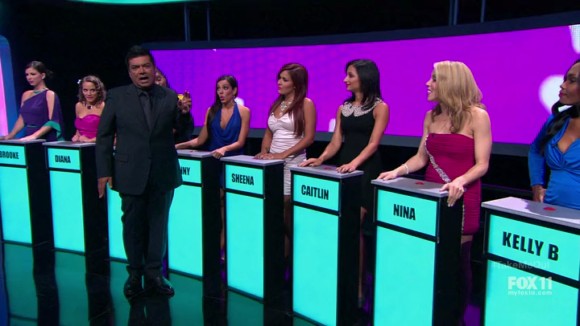
We’re watching Ready for Love, NBC’s new dating show. Or rather we’re watching Blind Date and Take Me Out closely followed by The Bachelor and Millionaire Matchmaker. It’s shopping mall television; all your favourite programmes under one roof. Unfortunately, the storeroom’s empty and the stock’s limited to what you see in the window. Each sequence is edited briskly in order to cram in all the various formats and create the illusion of pace in a 2-hour show. So what the viewer actually gets is a severely truncated cut-down of a pre-existing format that’s barely recognisable and lacks the original’s appeal.

Name the dating show…all of them!

In scenes eerily reminiscent of Invasion of the Body Snatchers women are delivered by pods into a studio. A man is then introduced via a video segment done in the style of a Just-for-Men commercial. The man is brought into the studio but cannot see the women and has to judge compatibility from their words, though superficiality has already been applied at the screening stage so no body-type surprises here. The podspawn that are not eliminated (apparently by incineration in the basement) are then imprisoned in a house together awaiting date-release and then the one with a personality goes home.

The women of the pod!

Periodically, the contestants are mentored by a panel of matchmakers, one of whom is played by a graduate Harry Potter interning at a stockbroker firm. Their advice is uniformly terrible, steering the women away from genuine self-expression and the men from picking a partner with a modicum of self-respect. At least the matchmakers on other dating programmes pay lip service to the contestants not picking women based entirely shallowly but here individuality is ruthlessly pruned like a weed.

What Harry did next…

NBC has already announced that it will cancel Ready for Love after only 3 airings. I’m no fan of snap cancellations nor the increasingly chop-happy actions of the networks but when a programme is so shamelessly derivative and cynically leeches off the success of other formats without putting anything new on the table, it is richly deserved. There is also something deeply offensive about continuing to promote the harem approach to dating. While the dating show is no stranger to giving a man his choice of women with no recourse in the other direction, Ready for Love does this unthinkingly.

‘Have the women incinerated’

I’m fully aware Ready for Love didn’t start the balls rolling on the sister-wife format. Though The Bachelor, from which this tradition sprung, had the good grace to turn the tables with The Bachelorette where men get the cattle market treatment. I know mutual exploitation isn’t exactly progressive gender politics but it’s better than dick all. Millionaire Matchmaker in which women are routinely subjected to the kind of bodily scrutiny one would typically see at a slave auction is still a reporting of what happens within an industry where women are demeaned, even if the producers don’t comment on the abnormality.

The Bachelorette: both genders exploited!

Take Me Out is another dating show where women outnumber men but for much of the process women have the upper hand even if the power of selection ultimately reverts to the man. Ready for Love seems to have no such compunctions and seems to want to add to the surplus of single, unfulfilled women left by dating shows as they whizz through the contestants with ruthless efficiency. It’s just as unforgiving for women who express qualms about how appropriate the format is for forging a healthy relationship. If you’re not willing to pander to male ego, please step aside.

Take Me Out: where women are in control…most of the time.

Though TV may seem like a sausage machine of recycled formats at times, the truth is that programmes which simply imitate other shows without useful variation will always fail miserably. Ready for Love didn’t make an argument for why it should be watched instead of its forbearers, except convenience and bulk buying, which given that the viewer doesn’t have to travel more than a few channels, isn’t really a selling point.

Conan The Destroyed

Posted in American TV (General), American TV Shows, TV History, Unsung Heroes with tags , , , , , , , , , , , , , , , , , , , on April 5, 2013 by Tom Steward


After weeks of speculation, as much of it on-air as off, NBC finally announced this week that Jimmy Fallon would take over hosting duties on The Tonight Show from Jay Leno. The network press release clearly stated that Leno had presented The Tonight Show uninterrupted for 21 years. But when interviewed Leno said ‘this time it feels right’ as if he had been replaced before and somehow managed to take back the host seat. Of course, if you’re not party to the Stalinistic effort to re-write late-night television history, you’d know there was a spindly-legged ginger elephant in the room.

The George Lazenby of late-night talk shows.

In late 2009 Fallon’s predecessor on Late Night with… Conan O’Brien took over from Leno as host of The Tonight Show having been promised the position years earlier by NBC while The Jay Leno Show began airing in primetime. In early 2010, the network attempted to move O’Brien from the current timeslot of 11.35pm to after midnight so that Leno could return to the original The Tonight Show spot with his new talk show following low ratings for both programmes. O’Brien naturally refused and left the network, leaving Leno free to return to his old job for four more years.

So who presents The Tonight Show?

Fallon taking over The Tonight Show only a few years after Leno resumed hosting is the latest in a series of slaps in the face for O’Brien, who after an aborted late-night talk show on Fox ended up with a signature 11pm vehicle on basic cable network TBS in late 2010. Prone to making light of his unexpected obscurity-his house musicians on Conan are self-effacingly named ‘The Basic Cable Band’-the melancholy sometimes seeps through. While comically feigning ignorance during an interview with Kelsey Grammer following a discussion of not getting recognition for doing cable television, O’Brien starts seeming genuinely forlorn.

O’Brien may have been written out of the Tonight Show story but he remains legendary in the history of another great American TV institution, The Simpsons. As writer and producer for the series between 1991 and 1993, O’Brien scripted some of the most undisputedly superb episodes the show has seen in its 24 years on the air (and, let’s face it, will ever see). In particular, ‘Marge vs. the Monorail’ in which Springfield invests in an ill-advised public transport system was a satirical highpoint with probably the best-written celebrity cameo (a tediously anecdotal Leonard Nimoy) and unbeatable dialogue and song-writing.

Other canon-worthy Simpsons classics penned by O’Brien include ‘Homer Goes To College’ and ‘New Kid on the Block’ which pioneered a sophisticated, self-reflexive humour for the show without losing the emotional resonance synonymous with the series from the outset. In fact, Bart’s unrequited crush on teenage babysitter Laura (Sara Gilbert) is positively heart-breaking. He created several characters, such as Ruth Powers (Louise to Marge’s Thelma) and the college nerds, who would return in future episodes. He might even be able to sue the creators of The Big Bang Theory for plagiarism. Perhaps that’s why TBS wanted him at the network.

‘You’re a lot less funny in live-action’

Despite a criminal lack of exposure for a comedian of his calibre, TBS’ Conan is more excellent TV from O’Brien. His sketches remain thoroughly witty and laugh-out-loud funny, as recent spoof discussion segment ‘PopeTalk’, which evaluated the chances of various contenders for the papacy in the manner of a talk radio sports phone-in show, attested. Many recurring bits, such as ‘Celebrity Survey’ in which projected celebrity Q&A responses are collated, seem like they’ll be around for decades to come. After only a couple of years on the air, we’ve seen some memorable interviews, not least a weird-off with Harrison Ford.

Conan: You ever think with all your flying, what you would do if the plane starts to go down?/Ford: Shit and die.

I don’t want to disparage Fallon as much as I want to praise O’Brien. Fallon’s skits and impersonations are first class, as his performance of Neil Young singing the Fresh Prince of Bel-Air theme tune amply demonstrated. In The Roots, Fallon has at his disposal not only the coolest house band in late-night television but also one of the finest hip-hop/soul outfits of modern times. Fallon’s emphasis on music and sketch comedy undoubtedly gives the late-night talk show a new dimension. But while O’Brien is a skilled, engaging interviewer, Fallon seems more like a teenager who has won a competition.

Class act that he is, O’Brien broke his silence on Fallon’s appointment yesterday only to endorse him and wish him well. He’d have been within his rights to lambast Fallon for taking his job. And call Leno a massive dick…but then there’s never a bad time and place for that.

Olympicks

Posted in American TV (General), American TV Shows, British Shows on American TV with tags , , , , , , , , , , , , , , , , , , , on August 20, 2012 by Tom Steward

In the last few weeks I’ve been viewing events in my country through a telescope. I don’t just mean that I’ve been watching from a distance but also that I’ve been seeing them filtered through another nation’s television. I’m speaking of course about NBC’s coverage of the London 2012 Olympics. In some ways it’s been a cultural revelation. It’s evident from how our ethnically mixed population was depicted in the coverage that the majority of Americans don’t recognise us as a land of diversity. This was demonstrated most strikingly when two Asian (our definition not yours, US readers) spectators-who to a native’s eyes were clearly British citizens-were picked out by the camera to signify the lengths people have travelled to get to the games. I never thought Dizzee Rascal’s presence at the opening ceremony needed an explanation but apparently-even in the post-Iris Elba era of US television-it does.

Black people in Britain: who knew?!

But this culturally out-of-touch tone to the coverage was not reserved for Brits alone. W. Kamau Bell’s comedy news show Totally Biased re-played some extraordinary footage of NBC’s Olympic anchorman Bob Costas rhapsodising about African-American gold medalist Gabby Douglas. Costas’ rhetoric made Douglas sound like a student at Little Rock in the 1950s and at a time when the demographic of young African-American girls includes the President’s children! Others in US TV were patently embarrassed about how NBC treated British culture and history. Jon Stewart’s Daily Show reported that an opening ceremony tribute to the victims of the July 7th London bombings was cut to make way for a Ryan Seacrest interview with Goldfinger-of-swimmers Michael Phelps. Insensitive, yes, but with such ceaseless spectacle it would have been difficult to know what to cut. I probably would have lost the 10 minutes of Mr. Bean dicking around to Vangelis, but that’s just me.

A fitting tribute to the dead?

Not that I’ve been particularly sensitive to the country hosting me. G wanted me to high-five every US Gold Medal, and why shouldn’t she? Team USA had some shit-hot performances this time round-well, if that kind of superlative commentary is good enough for NBC it’s good enough for little old me. It’s excruciatingly difficult to congratulate the USA for the same reason that people don’t generally root for the Empire in Star Wars or Man United in anything. It’s also hard to explain this without seeming spiteful, or a Communist. Lending my whooping voice to Team China simply because they threatened to topple the US in the medal stakes probably didn’t help my cause, especially when goading G about China overtaking the US in manufacturing. It might seem like post-imperial bitterness (also known as ‘Britishness’) but good things come out of rejecting the prevailing empire, the United States for one.

Go China!

Seeing the Olympics in America is a timely reminder that over here success is unquestionably a good thing. From what I’ve seen of the British media’s coverage of Olympics, ambivalence about the jingoism of commentary on Team GB’s medal victories began to seep in after a while. Some observers were perturbed about the propaganda uses of such rhetoric at a time of political failure while others, such as TV sports anchor Gary Lineker, vigorously defended the national media’s right to admire their athletes’ achievements. No such dilemma in the US. In fact, NBC coverage was so patriotic it even suggested that the USA helped other countries reach their Olympic glory. In a report on the rise of athletics in Grenada, it was heavily implied that the country couldn’t have won a medal in this sport were it not for the US’s intervention against Communism occupation forces in the 1980s.

Brought to you by the USA

In the same red, white and blue vein, I was struck by how little of the other countries competing I saw in NBC’s coverage, particularly in primetime slots. I realise each nation has to privilege its own participation but I expected an attempt at portraying a rounded view of the games, which never came. Isolationism is an accusation frequently levelled at US newscasting, so I suppose it shouldn’t come as a surprise. It certainly wasn’t surprising that the US won a gold medal in all the segments leading the coverage. Other notable tendencies of NBC Olympicasting included the pointless post-event interview in which reporters tried to brainwash the oxygen-deprived athletes with pre-prepared soundbytes which they were made to repeat,  as if they were victims of a lobotomy. Another was the Olympic-branded franchise of teaser trailers for NBC’s Fall schedule in which every cancellation-fodder sitcom was rendered in slow-motion as though prestige is somehow contagious.

Animal Practice: disqualified from the tournament