Archive for the shield

Selling TV to Americans

Posted in American TV (General), American TV Shows, Internet TV, Reviews, TV channels, TV Culture, TV History with tags , , , , , , , , , , , , , , , , , , , on August 7, 2013 by Tom Steward

My unofficial job title for the last couple of months has been PR Officer for American TV. Recently I’ve been introducing G to a number of my favourite US TV shows using the vast-if routinely inaccessible-archive of programming on Netflix and HuluPlus as well as my DVD collection, which lies within a handful of colossal CD carry cases in an object-fetishist’s version of efficient storage. Some programmes sold themselves. It didn’t take long for G to figure out that Northern Exposure was an engaging, endearing and intelligently written piece of television and not the geriatric-baiting fodder she suspected. Despite its nausea-inducing camerawork, the viscerality, complexity and wit of The Shield also won G over instantly. But there was always a fly in the ointment, and in every application. G took issue with the titles of both shows, Northern Exposure for its meandering moose and The Shield for its kid-friendly jingle. I tried to explain that these were some of the most iconic and beloved aspects of these shows but it fell on deaf ears and blind eyes. Much as I love them, I can see why G thinks these gimmick-driven, one-dimensional titles might be doing a disservice to the shows.

‘Stupid moose’-G

But sometimes G’s sales resistance is difficult to break down. Her response to the Pilot of Breaking Bad was ‘That’s it?’. I wanted to argue with her but it did seem slight in comparison to later episodes and I didn’t think my observation that it was a ‘postmodern version of MacGyver would make it seem any more profound. Twin Peaks was apparently ‘all dialogue’, which is a new one for Lynch critiques, and only became visually stimulating when the donuts came out.  In these instances, I did what every good salesperson should and tried to associate the product with something the customer knows and likes. ‘It’s like Northern Exposure…but with murders’ I said of Twin Peaks. ‘It’s Malcolm in the Middle on meth’, I said of Breaking Bad. ‘You watch Malcolm in the Middle? What are you, 10?’ G responded. I guess my cold reading skills aren’t as good as I thought. Or maybe the prospect of Bryan Cranston in underpants isn’t as alluring to the rest of the world as it is to me.

Just me, then…

On other occasions I became a victim of my own salesmanship. I’ve managed to hook G on a hoard of arresting novelty shows that I’m fast losing interest in. This means I’m watching their tiresomely protracted runs again as exactly the point when I’ve given up on them. 24 and Damages are the chief culprits here, both of them wildly overlong elaborations on an initially brilliant premise. I didn’t think I could lose much more respect for 24 than had already gone but sitting through those final few seasons again with their automated scenarios and tedious twistiness I think it went subterranean. Worse, as the gruesome compulsion to clear all the episodes in as little time as possible accelerated, the show became like wallpaper in our house, an ever-present wall-adornment barely noticeable to our jaded eyes. G is still at the point in Damages where the promise of finding out what will happen in the ongoing story arc is yet to be beaten down by the knowledge of what does happen. But I can see this fading fast. G’s already worked out that they’re only keeping a serial story strand so as not to lose Ted Danson from the series.

A reason for sticking with Damages.

Although G came to Mad Men much later than me, thus allowing me to cherry-pick the most tolerable episodes from the dreary first few seasons, we’ve both turned sour on the series at about the same time. Actually, G got there first before I was willing to admit that the party was over. Midway through the most recent season, the sixth overall, I remember her asking ‘Where’s the advertising gone?’, which should have been enough of an alarm bell given that it’s the equivalent to Cheers forgetting to feature beer. For me, though, it was the sexual reunion of one of the series’ estranged couples that signalled the end of quality. Breaking a rule of good television established in Northern Exposure, it haphazardly thrust (in every sense of the word!) two characters together whose entire function was to carry the suggestion of romantic involvement without ever reaching that point. G turned to me the other day and said ‘I miss British TV’. I think it might be time to start offering a new product line.


If you like these blog posts why not follow my new twitter account @tvinaword where I create new words to describe TV shows. Send your own and if I like them I’ll retweet them!
Johnson & Johnson

Posted in American TV (General), American TV Shows, Unsung Heroes with tags , , , , , , , , , , , , , , , , , , , on June 17, 2011 by Tom Steward

This is the first in a series of posts I’ll be writing sporadically which try to raise the profile of some of American TV’s most unfairly neglected artistic talent. We begin this week with actor-director Clark Johnson.

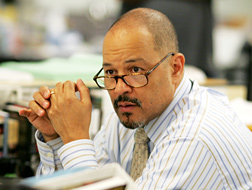
Clark Johnson as Gus in 'The Wire'

'People can't be evacuated...well they can. But that's not what you mean'

The unsung heroes of American television are the directors. While journalists, scholars and fans (not to mention the artists themselves) rhapsodise about US TV writers and producers like Steven Bochco and Joss Whedon, they are perfectly content to ignore, marginalise or deride the directors who carve out the visual and dramatic life of programmes. Direction seems only to be valued when it is either combined with writing and production to construct the myth of the omnipotent TV auteur or when it is attached to a big marquee name in the media, most likely from the cinema (e.g. Quentin Tarantino’s episodes of ER and CSI). Some in the academic community, like Tise Vahimagi and John Caldwell, have tried to bring the work of TV directors to light but even then directors of Pilots get all the credit while directors of random episodes are seen as artless journeymen anonymously re-hashing someone else’s vision.

ER, 'Motherhood'

'ER' directed by Quentin Tarantino

Another production ritual in American TV that slips by most commentators and audiences is actors going behind the camera. Look at the later episodes of virtually any of your favourite US shows and you’ll invariably see its stars and supporting actors taking up the directorial reins for a week or two. As US TV shows have a very limited shelf life thanks to the spectre of cancellation which hangs over even the most popular and acclaimed series, a direction job can give actors more options and opportunities for work in the industry, especially for the less well-known ensemble players.

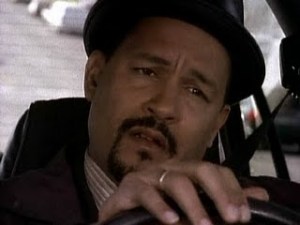
The subject of this blog is an actor from a renowned ‘90s cop drama, who went behind the camera only to create the enduring stylistic template and dramatic conventions for two of the most significant, innovative and exceptional police programmes of the last twenty years, perhaps ever. And what’s more, he went back on screen at the end of both of them to claim his deserved dues. Clark Johnson rose to public prominence playing the cool yet intemperate, honourable yet eminently fallible Baltimore police detective Meldrick Lewis in Paul Attanasio’s Homicide: Life on the Street based on David Simon’s book. Johnson’s performance helped to forge a distinct identity for the programme as a cop show that didn’t feel the need to romanticise or kowtow to the powers of its protagonists, particularly when bringing out Lewis’ reckless and impetuous side when crashing a police car into an ambulance in an early episode.

'Homicide: Life on the Street'

Clark Johnson as Detective Meldrick Lewis in 'Homicide: Life on the Street'

With a handful of behind-the-camera credits on Homicide, Johnson began to build up a portfolio of directing jobs on US TV in many of the most acclaimed dramas of the time e.g. NYPD Blue, The West Wing. Johnson seemed able to adjust to the distinct visual and dramatic styles of these shows effortlessly while successfully steering some conceptually tricky episodes and giving viewers some of these series’ most memorable moments, like Alison Janney’s hilarious and sexy mime to Ronny Jordan’s spoken word acid jazz piece ‘The Jackal’ in The West Wing.

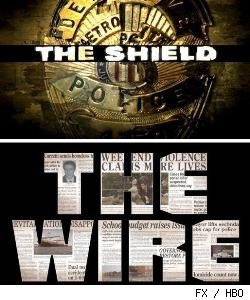
In 2002, Johnson pulled off a remarkable and practically unparalleled feat as he directed the Pilot and initial episodes of two crime dramas that would blow the lid off the American police procedural, but for very different reasons. In Shawn Ryan’s L.A. police corruption drama The Shield Johnson invented the kinetic and jolting camera style that made the programme so arresting and exhilarating and helped craft the visceral energy and sly humour that made Michael Chiklis’ Detective Vic Mackey America’s most feared and entertaining bent copper. Conversely, in Baltimore-set drugs investigation drama The Wire, Johnson set in motion a near-invisible and highly methodical visual approach that avoided aggrandising or distorting the show’s complex portrayal of American institutions while laying the foundations for some of the most compelling, attractive and finely-tuned character performances ever seen on TV. These directorial styles were poles apart and demonstrated Johnson’s brilliance at finding the aesthetic most suited to the concept and ambitions of a programme.

'The Shield' and 'The Wire'

Johnson's two triumphs

As these series drew to a close, Johnson not only presided over the direction of the finales but also returned to the screen in befitting tributes to his instrumental role in their success. In Season Five of The Wire, he plays Gus, the City Editor for The Baltimore Sun, a highly meta-textual role in which he is bestowed the honour of voicing the ethos of the series to represent society in all its collective complexity. In the finale of The Shield he plays the federal agent who takes Mackey’s wife and kids away from his Beelzebub-like hold, inadvertently becoming the hero of the piece. On the credits Johnson is listed as ‘Handsome Marshall’. He’s earned that adjective.