Archive for the American TV Shows Category

The Ch-Ching Crowd

Posted in American TV (General), American TV Shows, TV Acting, TV advertising, TV Culture, TV News with tags , , , , on November 16, 2015 by Tom Steward

Last week, Joel Hodgson launched a Kickstarter campaign to revive Mystery Science Theater 3000 with a characteristically sarcastic video in which he is heckled by Tom Servo and Crow T. Robot over his appeal for money to make a show famous for its low budget. Crowdfunding compliments a cult program like this, but it’s becoming a reality for all kinds of television. As the way we watch TV changes, so does the way that it’s financed. In fact, I’m currently involved as an actor in a TV project that needs a crowdfunding campaign before it can get off the ground.

It's a mystery...why they need money!

It’s a mystery…why they need money!

I’m talking about The Cast Members, a sitcom in the great American tradition of the comic ensemble about the employees of a cinema/theatre (delete depending on whether you’re saying it rightly or wrongly), created by Aaron David Roberts. Even though the concept is so good you can’t believe it hasn’t been done before, the scripts are as tight as those trousers David Bowie wore in Labyrinth, and it features some of the best onscreen and stage talent in San Diego – and in L.A., for that matter – without the backing of a production company or network (in whatever broadcast or digital form they exist now), it’s the audience that has to pay upfront to make the program they want to see. A crowdfunding campaign will start next year and my work for the project so far has been to shoot a promotional video that takes the form of a condensed pilot.

Crowdfunding is common enough when it comes to reviving a show that’s been cancelled by a network, as the Kickstarter campaign that brought Veronica Mars back to our screens as a feature film illustrates. It’s a relatively new concept for launching TV shows, however. Nat Geo’s global pub crawl Chug is considered the first Kickstarter-funded series and that starting airing in 2014. In most crowdfunding campaigns, success is determined as much by the incentives for donating as the product. These ‘perks’ – as they are known – range from bonus material (a callback to the DVD extra and Easter Eggs that made us pay twice to watch TV the first time round) to branded merchandise only available to donors, and usually only by donating a specific amount. It’s easy to see how this form of financing would work in the current TV climate, which is driven largely by multi-platform intertextuality and consumption.

Many of the series funded by Kickstarter campaigns are intended to stream on the web rather than ever make it to air, although the distinction between the two is closing as some of the most highly-regarded TV of our time now begins online and stays there. Chug eventually found a major cable network, despite the fact that it was their collective ambivalence that compelled producers to go the crowdfunding route in the first place, and can’t be seen as representative. The Veronica Mars feature film was streamed on Amazon Instant Video but I doubt whether the decision to add the film to their stores posed much of a quandary for the online shopping giant given that it was a known quantity and that production had already been paid for. I’m sure it’s not normal to exceed funding goals in the way the campaigns for Veronica Mars and Chug did either.

There’s usually some kind of trailer for the project requiring funding to launch the campaign. The Kickstarter for Veronica Mars assembled actors from the series and had them perform their launch video in the style of the teen noir. You might also say that the three seasons of the show were the trailers for the feature remake. For The Cast Members, Aaron decided on a mini-episode, which made the most sense since the actors had already been cast and storylines devised for the first season. It also meant that the Kickstarter could act as a shop window for the series and its stellar cast, as well as a fiscal means to an end. Mounting a pre-pilot also suggests that the ‘starter’ bit of the campaign website’s name is misleading, as projects need to be in an advanced stage, both conceptually and in finances, to even launch a campaign at all.

By all accounts, the Kickstarter to revive Mystery Science Theater 3000 is doing well, as did the one for Veronica Mars, while Chug demonstrated that it’s possible to get a brand new show on the air using crowdfunding. It’s still a high-risk, high-reward strategy that may bankrupt you before launch.

Network Failure

Posted in American TV (General), American TV Shows, Behind-The-Scenes, Reviews, TV Acting, TV channels with tags , , , , , on November 9, 2015 by Tom Steward

If there’s one problem that ABC have – apart from being a Big Three network in an era of digital multiplatforming – it’s authenticity. For two years in a row, debuting primetime offerings from the network have been pulled up for artificially rendering their source material. The complaints are as much from authors as critics. Second-generation Chinese-American restauranteur, writer and cultural activist Eddie Huang laid in to the ABC sitcom Fresh off the Boat based on his memoir of the same name for reverting to ethnic and racial stereotype in its depiction of a Chinese immigrant family settling in 1990s Orlando. Though credited as a producer and a narrator for the pilot season, Eddie has continually spoken against the homogenising and caricaturing of his life and people by the show’s writers and producers, as well as the network itself. Having read his memoir, it’s certainly no exaggeration that the events of Eddie’s life have been sanitised, his political views marginalized, and his experience of growing up in America made secondary to the demands of a family sitcom.

Eddie Huang, then and never!

Eddie Huang, then and never!

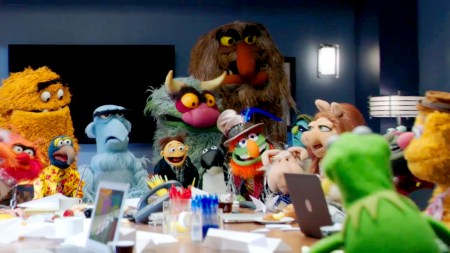
Flash-forward one year and critics are saying the same about The Muppets, ABC’s TV revival of the vaudevillian puppet characters owned by parent company Disney. While the two Disney movies that rebooted the Muppet franchise were highly regarded returns to the original talent show premise, the sitcom that followed revisited the characters in a behind-the-scenes mockumentary format replete with self-consciously adult humour. It’s no Meet the Feebles but nor it is the family-oriented and friendly fare we’re used to. Retrofitting Muppets like Miss Piggy, Kermit, Gonzo and Fozzy Bear into a Larry Sanders-style sitcom has meant the libidinal and laconic sides of these characters – which were traditionally alluded-to, offscreen things – have come to the fore, and long-time Muppet aficionados have questioned the connection between the current and original incarnations. Again, it’s hard to disagree. The Muppets were always meant to appeal to adults, but not solely, and usually as a by-product of their pan-familial ambitions. The idea that Jim Henson’s ensemble are able to compliment twisted modern comedy is cross-breeding even he would balk it.

Inauthentic? Yes. But worthless? Absolutely not. The sitcom variation on Fresh off the Boat may be far too cosy to do justice to the raw and acerbic memoir it was inspired by, but it is has never shied from addressing questions of race and assimilation. Last week’s episode filtered its discussion of Chinese media self-representation through the ghost of Long Duk Dong from Sixteen Candles, seen here as the gold standard of racist Asian stereotype in American popular culture. Occasionally, too, a fiercer take on caucasian culture and community reminiscent of Eddie’s own bleeds through, as when Grandma Huang casually remarks on the subject of family relations, that white people ‘are the cruellest race’. Though the format is familiar, the content is often challenging and we don’t forget about the problem of difference. There’s universality to the representation of the latter-day immigrant experience that even G, a Mexican-American, recognizes. To his credit, Eddie is gracious enough to admit that this universality is not altogether a bad thing, just that it lacks the reality he knows.

Though some of ABC’s The Muppets is like watching your parents make out (or worse!), I’ve enjoyed a lot of the writing that uncovers the parts of Muppet culture that previously remained – mostly for reasons of censorship – latent. Whether it’s the band’s unspoken pot habit finally exhaling it’s now-legal name or the romantic truth behind the sado-masochistic relationship between Beaker and Dr. Bunsen Burner, you might also say that in more progressive, accepting times, it’s the obvious way for the characters to go. Speaking of diversity, it’s been a pleasure to see Pepe the Prawn, a Latin Muppet, get some much-deserved screen time, including some of the show’s best dialogue. Having had an episode order trimmed severely and their showrunner leave after a single season, it seems as though the network is not happy, or at least buckling under the heavy criticism, much of it from parents and conservatives concerned about the sitcom contaminating the moral fibre of the Muppet brand. I’d disagree with them anyway, but objectively the transgressive stuff is still done tastefully.

The Writer's Room!

The Writer’s Room!

I’m not completely sold on either of these shows. Fresh off the Boat made father Louis Huang a virtual replica of Phil Dunphy instead of a progressively contradictory character while The Muppets has some of the worst qualities of the navel-gazing industry mockumentary tradition. But they make their own reality.

The Balking Dead

Posted in American TV (General), American TV Shows, Behind-The-Scenes, TV advertising, TV channels, TV Sports with tags , , , , , on October 26, 2015 by Tom Steward

I didn’t blog yesterday as usual because I was at my first (American) football (not soccer/football) game, which coincidentally took up the whole day due to stoppages for television. I’m glad though because now I get to talk about something that happened on TV last night. WARNING: DO NOT READ THIS BLOG POST IF YOU ARE NOT UP TO DATE WITH THE WALKING DEAD OR ARE PLANNING ON BINGEING THE SERIES IN THE FUTURE (UNLESS YOU TEND TO FORGET TV DRAMA CHARACTERS AS IF THEY WERE CONTESTANTS ON THE BACHELOR).

As spoiler-free a picture as I could find...

As spoiler-free a picture as I could find…

On Sunday’s The Walking Dead, everyone’s favorite post-apocalyptic pizza delivery boy – with the possible exception of Fry from Futurama – Glen Rhee apparently died. I say ‘apparently’ because while visually we seem to have seen his demise (and intestines), the storytelling, which continues intertextually in post-show discussion program Talking Dead, left Glen’s fate ambiguous, despite the unlikelihood of his escape from a throng of hungry, handsy walkers. In a series where every character is already to some degree dead, the writers and directors are obliged to be specific about what character is in which state of death. Moreover, the emotion surrounding certain leading characters, including Glen who has been there from the start, means there is an unwritten rule that they be killed visibly and memorably, so as to not play with or minimise those feelings.

Last night, when it came to ‘killing’ Glen, The Walking Dead did neither. Add this to the absence of the character death rituals on Talking Dead of having the actor appear as a guest and a slow-motion replay of their death on the mock-mournful ‘In Memoriam’ section of the show, and it appears that either the producers are playing a dangerous game with Walking Dead fans or floating the possibility that we didn’t see what we think we did. A note read out on Talking Dead by producer Scott M. Gimple hedged their bets even further, saying that ‘a version…or part’ of Glen would return to ‘complete the story’. Lost creator Damon Lindelof was a guest on the show – which is perhaps another clue that in a show where everyone is already dead anything is possible (OH YEAH DON’T READ THIS IF YOU HAVEN’T SEEN LOST) – and found it hard to believe that The Walking Dead would pull a Dallas and have Glen return from the dead against all conceivable odds.

Not that it will surprise anyone who suffered through all six seasons of Lost but Lindelof may be overstating the case here. The Walking Dead is rather fond of melodramatic cliffhangers, as the final ‘how do we get out of this’ moment of Season Four nicely illustrates. The show is not above waiting off on spoiling the death of a character if it helps heighten the drama. In Season Five, we didn’t know Bob had been bitten for nearly a whole episode until he finally revealed it to the cannibals who had just eaten his leg for dinner. The quality seal of the Mad Men network (which is also a guarantee of having to watch crappy action and horror movies back-to-back) sometimes makes us forget that what we’re watching here is popular genre television – quite literally a televised comic strip – in which such matinee-style twists and turns are not only possible, but rather their stock-in-trade.

Don't take it out on me, it's this guy's fault!

Don’t take it out on me, it’s this guy’s fault!

No-one doubts the class of Arthur Conan Doyle’s Sherlock Holmes stories yet the author had the Great Detective return from the dead in implausible circumstances. More to the point, I can see about three or four different ways Glen could have escaped from the pile of walkers he was crowd-surfing on. A couple of those have already been tried and tested in the series, so while the Talking Dead panel saw the callbacks to Glen’s earlier episodes as signs of his impending death, they may also spell the solution to his survival. All of this rhetoric might be my way of deflecting deep-seated sadness about seeing Glen depart The Walking Dead, and of course I’d rather all this conspiracy theorising be true rather than false (as anyone who purports a conspiracy theory does). But don’t underestimate the extra-textual games that TV producers in the digital age are willing to play to maintain interest in their program. One day we might be talking about the ‘Glen hoax’ in the same way we talk about affinity-based publicity stunts like ‘new Coke’. On a story level, if Glen does survive the unsurvivable, it’s a sure sign he’ll be the last man walking.

Tarantino on TV II

Posted in American TV (General), American TV Shows, Behind-The-Scenes, TV Acting, TV channels, TV Culture, TV News with tags , , , , , on October 18, 2015 by Tom Steward

Once again – and just as unintentionally – Quentin Tarantino has re-opened the debate about TV and film. Speaking on the release of The Hateful Eight in dual versions, one complimenting a 70mm Panavision format, the other more conducive to multiplexes and subsequent TV airings, the director observed:

‘The 70 is the 70. You’ve paid the money. You’ve bought your ticket. So you’re there. I’ve got you. But I actually changed the cutting slightly for a couple of the multiplex scenes because it’s not that. Now it’s on Showtime Extreme. You’re watching it on TV and you just kind of want to watch a movie on your couch. Or you’re at Hot Dog on a Stick and you just want to catch a movie.’

A 70mm shotgun!

A 70mm shotgun!

Tarantino has always been a lone voice in the debate, distinguished by an unerring respect for television as an artistic medium and his belief that there is still a tangible distinction between TV and cinema. There are few commentators on either side that can keep hold of both these ideas. Some of Tarantino’s finest work as a director was in television – in ER and CSI, no less – and it’s clear from his movies that TV falls under his muse. But he’s a filmdamentalist and his staunch refusal to acquiesce to the digital industry standard is also an outright denial that TV and cinema have conflated. Tarantino’s vivid descriptions of two experientially different media are more compelling than most critics’ vague sense that TV is becoming more like cinema.

The auteur reserves his derision for the cultural no man’s land of mall-adjunct multiplexes where, as Jackie Brown’s Max Cherry once observed, you see ‘something that starts soon and looks good’. It’s here that film is simply an afterthought of conspicuous consumption, not a thing of grand beauty and spectacle or part of a boutique outlet delivering sophisticated cable programming. There’s an all-or-nothing-at-all fatalism about Tarantino’s views on cinema, a regression to the mid-century belief in a divergence between TV and movies based solely on the size of the screen. It’s a welcome counterpoint to the ubiquity of convergence rhetoric, but perhaps in the end just as misguided and myth-driven as its opposing view.

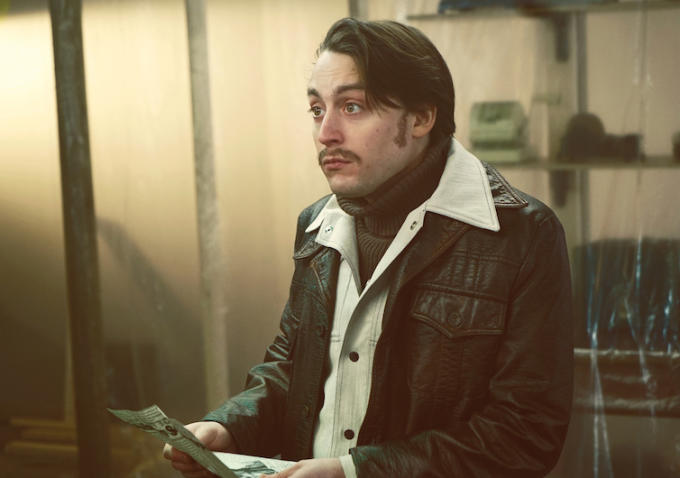
Another coincidence is that Tarantino’s remarks were reported in the same week that FX began airing the new season of Fargo, a series that asks questions about the relationship between TV and cinema. The series is a spin-off from the 1996 movie directed by Tarantino’s indie contemporaries The Coen Brothers, but once again this season is elusive about its status in regards to the cinematic source material. Actors in the series are frequently costumed and posed to look like characters from the movie, even though they’re playing completely new roles. This season is set during the Carter administration and has the crumpled golden look of late seventies movies, yet the split screen techniques speak more to TV title sequences of the era, not to mention a much more recent breakthrough in televisual narration, Fox’s own 24.

The previous season of Fargo – an anthology of season-long stories, which doesn’t make eliciting its cinematic and televisual qualities any easier – seemed at first a remake of the movie’s storyline with similarly Manichean characters and labyrinthine plotting yet by its end, it felt more like a sequel, having been found in and extrapolated from the timeline of the original. With Kieran Culkin’s uncanny resemblance to a young Steve Buscemi and in the very first episode a visual homage to the late Harve Presnell, whose implacable moustache loomed large over the movie, I suspect we might have just as ambiguous a play with the cinematic mythology this time around. The stars don’t help. Ted Danson has long been identified with television. Meanwhile there’s a Culkin in the cast and plenty of actors who are split exactly evenly across the two media. It’s almost as if Fargo wants to create a new hybrid creature that is neither and both.

Another funny-looking guy.

Another funny-looking guy.

Fargo’s messy intertwining of TV and film consciousnesses works at cross-purposes to what Quentin Tarantino is saying about the continued separation of the two. When we watch Fargo, we’re unsure about how much of what we’re watching belongs to which media. As Tarantino suggests, seeing a movie at a multiplex as a food court folly could lead to the same confusion, while watching it projected wide on film stock would absolutely not. The couch brings together movies and TV, often in the same flowing package, but does it always clarify which is which?

Late Risers

Posted in American TV (General), American TV Shows, TV Culture, TV History, TV News with tags , , , , , , , , , on October 11, 2015 by Tom Steward

Over the summer, two of the most important seats in late-night television were vacated. Unlike last year, when NBC’s The Tonight Show promoted Late Night host Jimmy Fallon and CBS’ The Late Late Show traded like for like – to maintain the quota of British late-night hosts at exactly one – each of the replacements was not the heir apparent. Host of CBS’ Late Show David Letterman was succeeded by Stephen Colbert, who came in from Comedy Central, having been host of The Colbert Report and contributor to The Daily Show, and not long-time Late Late Show host Craig Ferguson, Letterman’s protégé who had, like his mentor, smashed the orthodoxy of the genre. At least Colbert was recognized as a great innovator and radical presence on TV – as well as a nifty enough entertainer – when he was awarded the Late Show crown. Utterly unlike newcomer Trevor Noah, who was bumped several pay grades when he went from Daily Show contributor to taking Jon Stewart’s job as host. In fact, Colbert was the more likely of the two to take over The Daily Show. Former contributor and frequent guest host John Oliver was a shoo-in to take over until HBO made him an offer he couldn’t refuse. After that, the choice was anyone’s guess. But Noah was no-one’s.

That's Colbert baby!

That’s Colbert baby!

Noah and Colbert have wildly different briefs. To emulate Letterman, Colbert is obliged to be as challenging and groundbreaking as possible while Noah is the steward of a culturally necessary ritual, and cannot dismantle its beloved format. As such, Noah might seem to have the harder job. But Colbert’s fluent presentation masks his deft deconstruction of late-night talk formula. He has replaced the monologue with political analyses. Guests tend to be public figures with cultural significance rather than celebrities hawking their wares. It’s a forum for news and current affairs and a showcase for high culture. Fallon’s breakthroughs by contrast have been primarily vaudevillian and even Ferguson’s reinvention of the genre as burlesque slapstick went in the opposite direction to Colbert. It’s not just the fluency with which these changes have been implemented, but also how assured, joyous and endearing Colbert is while doing it. This he may have learnt from Fallon’s head-start, but Colbert pursues it the name of something far more significant. The sad irony is that Colbert is exactly the personality The Daily Show needed to preserve its legacy, while Noah is not. Two weeks in to Noah’s reign and the added value of Jon Stewart’s easy-going charm has finally been calculated in full. A solid comic mind is simply not enough.

Stewart covered a multitude of sins with his asides and interludes of self-mocking, and without them we can see just how little content there is in the average Daily Show news item. Noah has exposed this, but I don’t level the blame at him. It takes a particularly kind of host – a Letterman or Carson, for example – to engage the audience without losing them when holes appear in the format. Noah has his long, pregnant smile, but to the live studio audience and the viewers at home, it reads as a stumble or a stall, even in the strongest segments like his brilliant mash-up of the Trump mythos with that of African dictatorship. Moments like this reassure us that the quality of mock-journalism has not dropped off, but in this case a pair of safe hands will not suffice. We need someone who can convince us they’ve revolutionized The Daily Show when nothing has changed, not a competent caretaker. Conversely, Colbert’s Late Show coup seemed bloodless, yet was a conceptual genocide. Fallon has proved it’s possible to succeed in late-night television by being a vessel for the greatness of others, and indeed Stewart leaned on Oliver and Colbert in exactly that way when they were Daily Show contributors, so Noah cannot be written off yet.

Oh no, they forgot to change the titles!

Oh no, they forgot to change the titles!

The Daily Show and Late Show are probably the two late-night talk formats that matter most culturally – with the possible exception of Neil deGrasse Tyson’s StarTalk. The former is so because it is the closest America has to a reliable news source; the latter because Letterman made it a hotbed of comic artistry in the 90s. But because American TV is an inherently commercial animal, they require a certain kind of salesmanship to help audiences buy into them. Colbert’s hate-resistant persona is the perfect medium while Noah’s workmanlike anonymity may not be, at least not in the long-term. But can Colbert sustain these unimaginable highs?