Archive for the TV History Category

Baking The Waves

Posted in American TV (General), American TV Shows, Americans watching British TV, Behind-The-Scenes, British Shows on American TV, Touring TV, TV History with tags , , , , , , , on December 14, 2015 by Tom Steward

It’s not an unreasonable assumption that Americans prefer to know about Britain’s heritage than the way it is today. So it will come as no surprise to anyone on either side of the Atlantic that a Great British Bake-Off spin-off (which can be contracted to The Great British Bake-Off) called The Great Holiday Baking Show is airing on ABC primetime over the Christmas season. The Great British Bake-Off is a cooking competition celebrating British culinary traditions against a landscape idealizing Britain as the green and pleasant land of yore replete with signifiers of our imperial past, like the bunting-lined parties we used to host for wartime victories and royal events. Though if you’re labouring under the misapprehension that cultural fascination has triumphed over commercial interest, it’s worth remembering that in the UK this year the finale of The Great British Bake-Off was the most-watched program of the year, that past seasons of the show currently occupy peak Sunday airtime on PBS, and that a US version of the format called The American Baking Competition debuted in 2013 but was cancelled within a year following poor ratings. It’s both too lucrative and too particular to attempt anything other than a spin-off.
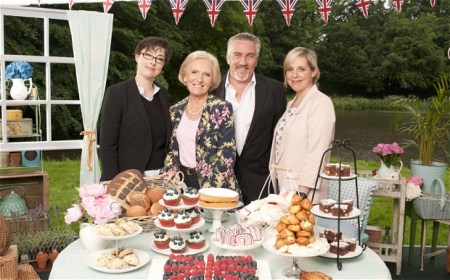
Bake Britain

Bake Britain

Americanizing the brand has proved difficult. PBS had to re-name the US airings The Great British Baking Show not because of cultural misunderstandings – as surely ‘Bake-Off’ is a term friendlier to the American spirit of competition than ours of miserable make-do – but America’s corporate hegemony. Girth-romanticising pastry company Pilsbury hold the trademark to the name ‘Bake-Off’ since it is the name of their patented annual cooking contest. The American Baking Competition continued the tradition of American reboots of British reality shows exporting celebrity judges, but it backed the wrong horse. Perhaps they were expecting some latent movie star glamour to suddenly burst forth from baker Paul Hollywood when he was brought into geographical proximity with his namesake – or more likely they wanted another British villain – but there was less gel than the sour scouse keeps in his hair when they brought him into the show. Though far sweeter and lacking the negativity that reality TV bottom-feeds off, The Great Holiday Baking Show has made a far better choice in calling upon veteran food writer and TV presenter Mary Berry to handle the judging, especially since any successful translation of the format requires as much exploitation of British icons as possible.

As is usually the case in television, the biggest factor affecting the success of The Great Holiday Baking Show is time. The Great British Bake-Off is shown over ten weeks and, while it is clear from the preponderance of sunlight and the frequently-used excuse of it being a ‘hot day’ that it is filmed in Summer, the baking is not linked to any particular season of the year. As the title states, The Great Holiday Baking Show is very clearly themed around the American Thanksgiving and Christmas holidays to reflect the period of the calendar year in which most baking is done and/or consumed in the US. The producers have evidently latched on to the seasonality of baking as justification for a short-run December-long series which also conveniently prevents them from having to commit to a full season in programming terms. Conversely, the configuration of cake-eating with sunny countryside settings in the British original has almost made it seem like an exclusively Summer activity in the UK, not a happy by-product of taking refuge from the cold of Autumn and Winter as it is in the US. Finding what is culturally equivalent about an imported show is often the key.

Baking in the Free World!

Baking in the Free World!

The subject matter and presentation of The Great British Bake-Off is twee and backwards but it gestures to the diversity of post-colonial Britain. Though by no means proportional, there is a range of ethnic, racial, sexual and regional representation in the contestant base. To wit, the 2015 winner was Nadiya Jamir Hussein, a British-Bengali women identifying as a Muslim. I’m glad to see that The Great Holiday Baking Show has followed in these footsteps, though in both cases it’s difficult to tell whether this is selection strategy or merely that it’s an inclusive enough application process for minorities to make it through. What makes the difference is the ability to use the original format and continue to have Mary Berry on board, although why they would make her a judge for an American spin-off only to patronise her like a cigar store Indian in a parallel universe is beyond me.

 

I Capture The Castle

Posted in American TV (General), American TV Shows, Internet TV, Reviews, TV Acting, TV History, Watching TV with tags , , , , , , , , , on December 7, 2015 by Tom Steward

Delivering seasons of TV programs through internet streaming has made writing a conventional review an even more fruitless enterprise than it already was. It’s impossible to determine – or even average – where those watching a season currently are in the run of episodes and it’s possible that they’re already done with it. A review makes no sense in either context. For want of a better solution to the futility of internet TV journalism, I’ve decided to formulate my response to Amazon Prime’s original series The Man in the High Castle as a list of what I’ve learned from the first season:


Who do you think you are kidding Mr. Churchill?

Who do you think you are kidding Mr. Churchill?


  1. The program doubles as an instructional video showing employers how to treat Amazon workers.


  1. There is no ‘Reich’ pun beyond the writers.


  1. I learnt what happened in the post-war world by the show telling me what didn’t happen in the post-war world.


  1. You will say the words: ‘I want Hitler to come back’.


  1. In a parallel universe where Philip K. Dick didn’t exist, people would have a lot less respect for Ridley Scott.


  1. I am still not convinced that the Trade Minister isn’t Hiro.


  1. South America is now a haven from Nazis.


  1. There is a moment where you will believe that Hitler’s apocryphal ‘one ball’ will become a plot point.


  1. The opening sequence is like Dad’s Army on rewind.


  1. There are British spies in The American Reich.


  1. All it took to teach Rufus Sewell restraint was playing a Nazi.


  1. It contains the best scene of an African-American man teaching a dwarf to fish outside of an epilogue of Walker, Texas Ranger.


  1. Berlin is still cool.


  1. We’d have had colour TV a lot sooner if the Nazis had won.


  1. Hitler must have been really affected by post-war European art cinema since he now prefers avant-garde documentaries to American B-movies.


  1. In Japan, morality is measured in spectacle rims.


  1. The Man in the High Castle is not Julian Fellowes, though they share a lot of the same political views.


  1. Hitler is way ahead of home theaters.


  1. The Smith & Jones sketch outlining the five Nazi General archetypes is still the standard for all screen portrayals.

  1. It’s basically Sliders.


Late Risers

Posted in American TV (General), American TV Shows, TV Culture, TV History, TV News with tags , , , , , , , , , on October 11, 2015 by Tom Steward

Over the summer, two of the most important seats in late-night television were vacated. Unlike last year, when NBC’s The Tonight Show promoted Late Night host Jimmy Fallon and CBS’ The Late Late Show traded like for like – to maintain the quota of British late-night hosts at exactly one – each of the replacements was not the heir apparent. Host of CBS’ Late Show David Letterman was succeeded by Stephen Colbert, who came in from Comedy Central, having been host of The Colbert Report and contributor to The Daily Show, and not long-time Late Late Show host Craig Ferguson, Letterman’s protégé who had, like his mentor, smashed the orthodoxy of the genre. At least Colbert was recognized as a great innovator and radical presence on TV – as well as a nifty enough entertainer – when he was awarded the Late Show crown. Utterly unlike newcomer Trevor Noah, who was bumped several pay grades when he went from Daily Show contributor to taking Jon Stewart’s job as host. In fact, Colbert was the more likely of the two to take over The Daily Show. Former contributor and frequent guest host John Oliver was a shoo-in to take over until HBO made him an offer he couldn’t refuse. After that, the choice was anyone’s guess. But Noah was no-one’s.

That's Colbert baby!

That’s Colbert baby!

Noah and Colbert have wildly different briefs. To emulate Letterman, Colbert is obliged to be as challenging and groundbreaking as possible while Noah is the steward of a culturally necessary ritual, and cannot dismantle its beloved format. As such, Noah might seem to have the harder job. But Colbert’s fluent presentation masks his deft deconstruction of late-night talk formula. He has replaced the monologue with political analyses. Guests tend to be public figures with cultural significance rather than celebrities hawking their wares. It’s a forum for news and current affairs and a showcase for high culture. Fallon’s breakthroughs by contrast have been primarily vaudevillian and even Ferguson’s reinvention of the genre as burlesque slapstick went in the opposite direction to Colbert. It’s not just the fluency with which these changes have been implemented, but also how assured, joyous and endearing Colbert is while doing it. This he may have learnt from Fallon’s head-start, but Colbert pursues it the name of something far more significant. The sad irony is that Colbert is exactly the personality The Daily Show needed to preserve its legacy, while Noah is not. Two weeks in to Noah’s reign and the added value of Jon Stewart’s easy-going charm has finally been calculated in full. A solid comic mind is simply not enough.

Stewart covered a multitude of sins with his asides and interludes of self-mocking, and without them we can see just how little content there is in the average Daily Show news item. Noah has exposed this, but I don’t level the blame at him. It takes a particularly kind of host – a Letterman or Carson, for example – to engage the audience without losing them when holes appear in the format. Noah has his long, pregnant smile, but to the live studio audience and the viewers at home, it reads as a stumble or a stall, even in the strongest segments like his brilliant mash-up of the Trump mythos with that of African dictatorship. Moments like this reassure us that the quality of mock-journalism has not dropped off, but in this case a pair of safe hands will not suffice. We need someone who can convince us they’ve revolutionized The Daily Show when nothing has changed, not a competent caretaker. Conversely, Colbert’s Late Show coup seemed bloodless, yet was a conceptual genocide. Fallon has proved it’s possible to succeed in late-night television by being a vessel for the greatness of others, and indeed Stewart leaned on Oliver and Colbert in exactly that way when they were Daily Show contributors, so Noah cannot be written off yet.

Oh no, they forgot to change the titles!

Oh no, they forgot to change the titles!

The Daily Show and Late Show are probably the two late-night talk formats that matter most culturally – with the possible exception of Neil deGrasse Tyson’s StarTalk. The former is so because it is the closest America has to a reliable news source; the latter because Letterman made it a hotbed of comic artistry in the 90s. But because American TV is an inherently commercial animal, they require a certain kind of salesmanship to help audiences buy into them. Colbert’s hate-resistant persona is the perfect medium while Noah’s workmanlike anonymity may not be, at least not in the long-term. But can Colbert sustain these unimaginable highs?

The Pig Country

Posted in American TV (General), American TV Shows, Behind-The-Scenes, TV Culture, TV History, TV News with tags , , , , on October 4, 2015 by Tom Steward

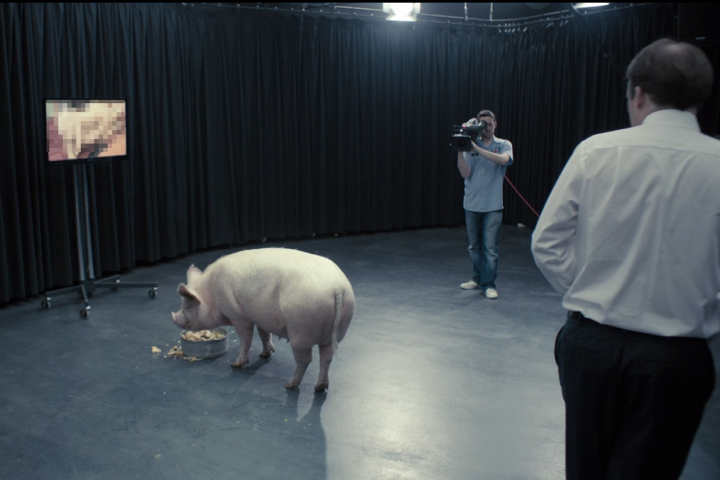
British and American TV are so rarely united, making it doubly surprising that there have been two stories in as many weeks relating to genitalia in the television cultures of both countries. Honestly, pigs might fly and the Old West will rise again before we see another coincidence like this.

Footage from The Conservative Party Conference

Footage from The Conservative Party Conference

On September 20th 20(and)15, British national newspaper The Daily Mail published extracts from an unauthorised biography of current Prime Minister David Cameron co-authored by passed-over former Deputy Conservative Party Chairman Michael Ashcroft. In them contained a story that as a student at Oxford University, Cameron had put ‘a private part of his anatomy’ into a dead pig’s mouth as part of an initiation ceremony for The Piers Gaveston Society (some paraphrasing of Groucho Marx’s famous ‘club’ quote is surely necessary here!). Remarkable as this allegation was for a sitting head-of-state – outside of Italy – it was not the first time such an idea had been nationally circulated. In 2011, British TV Renaissance man Charlie Brooker launched his modern-day answer to The Twilight Zone, a technology-fearing anthology made of speculative fiction called Black Mirror, the first instalment of which concerned a modern-day British Prime Minister blackmailed into having sex with a pig live on television to meet the ransom demands of a royal kidnapper. Like David Bowie after liquid water was discovered on Mars, Brooker was hounded by the press and social media following this story, asking him whether his television play was inspired by real rumours of which he had foreknowledge.

Brooker says he didn’t, which I for one believe wholeheartedly, namely because you don’t have to know the actual circumstances of such an act to imagine that it would be exactly the kind of thing a person of that background would do. I’m not convinced that the story – hashtagged ‘Piggate’ thus throwing agricultural livestock message boards into a state of disarray – is anything more than a revenge blow from an embittered ex-colleague but we know what absurd extremes the hazing rituals of fratboys at elite universities – on both sides of the Atlantic – can go to, and Cameron’s posh pillaging of the social contract as a university student has been well-documented. Even the most rudimentary scandalmonger could put a scenario like that together from Cameron’s backstory. Brooker, too, was trading off the fact that we as a nation could easily believe our Prime Minister was and has been capable of such things. My mentor in all things televisual Helen Wheatley observed that the morning after the Black Mirror episode ‘The National Anthem’ was first broadcast, it genuinely felt as if Cameron had fucked a pig the day before. It’s that vague aura of authenticity that both Brooker and Lord Ashcroft mined.

In the last couple of days, it has been reported that extras on the set of HBO’s reboot of the 1970s cult sci-fi western Westworld have been compelled to sign a consent form specifying numerous and elaborate acts of sexual contact and nudity, including the touching of each other’s genitals. Some extras apparently complained to their union SAG-AFTRA, who are currently investigating the matter. Those who know HBO (in the Biblical as well as the binge sense) won’t be surprised that one of its shows should contain such graphic content, but the concerned parties have different views about how bound (this is not a metaphor) supporting artists are to such demands contractually. I as a TV blogger (and potential future SAG-AFTRA member) am obviously fascinated by this story, but a lot of viewers I’m sure simply don’t want to know how the organic sausage is made. Great art and human exploitation have always gone hand-in-hand, and, to many, I’m sure this revelation makes Westworld seem like a far more interesting prospect than previously. Also, this seems the thin end of the wedge, providing everyone knows their rights and has the ability to pull out of the project at willy. Penis.

'While you're down there...'

‘While you’re down there…’

If there’s a theme here, it’s indecent exposure. Private parts have been unlawfully displayed in public. Whether it’s bestiality libel or union disputes, these kinds of stories are not for public consumption unless in fictional form. HBO needs to push boundaries on sexual representation to be challenging, while the inhuman behaviour of the Cameron-led Conservative government needs to be challenged for what it is, not what it represents satirically in some bizarre Animal Farm-like parallel reality. Piggate didn’t lend any credence to Black Mirror, rather the reverse. And sex acts and nudity on HBO is simply not a news item!

Doctor No

Posted in Americans watching British TV, British Shows on American TV, TV Criticism, TV History with tags , , , , , on September 20, 2015 by Tom Steward

Last night, new episodes of Doctor Who began airing in Britain and America. This is not a review of the season opener because I didn’t watch it. I didn’t watch it, because for the first time since the series re-launched in 2005, I won’t be watching Doctor Who. I don’t – like some fans – have an aversion to Peter Capaldi as The Doctor. In fact, I’ve said here before I think he’s probably the best actor to have played the role. This also isn’t the first time I’ve had serious issues with the direction that the showrunners have taken the series in, or some of the casting. And I’m not so naïve as to think that the ‘classic’ series – which I greatly prefer – wasn’t at times just as unwatchable as the new series is today. So why am I boycotting it now? Well, it’s for the same reasons that I don’t eat at McDonalds or (knowingly) use Nestle products. There are just too many reasons not to.

'What do you mean you're not watching?'

‘What do you mean you’re not watching?’

The main reason, of course, is Steven Moffat. Still showrunner and head writer after six years – with his creative control increasing annually – Moffat’s scripts and season arcs are incoherent, ramshackle rubbish and his dialogue is formed of soundbyte-friendly non-sentences. You can count the good ideas he’s had during his time on Doctor Who on one hand, and yet they do the job of keeping him afloat while he peddles plagiarism of everything from Source Code to That Mitchell and Webb Sound inbetween lightbulb moments. That’s before we get on to his politics. Moffat is incapable of writing strong women without sexualising them, sabotaging the progress made by breakthrough characters like transgender Timelady Missy with nymphomaniacal nonsense. His treatment of the material is invariably tasteless and perverted, encompassing romanticized suicides, desecration of dead Who actors like Nicholas Courtney, and treating time travel as some sort of incestuous gangbang! It was bad enough when this was in the name of change, now it’s billed as a return to the classic formula.

Much as I would like to, I can’t blame Moffat for all that’s wrong politically with Doctor Who. The series has had two women writers since 2005, a record easily beaten during the classic era which is often held up for being unfair to women and stretching back to the tenure of showrunner Russell T Davies, who supposedly opened the show up for a female audience. That said, Moffat did do a Lorne Michaels when it came to the issue of hiring women as writers, claiming that the entire gender did not have the appetite (nor presumably the talent) to take on the job much as the Saturday Night Live did when confronted with the absence of women of colour on the late-night comedy institution. Missy is not enough of a concessionary flip-flop, and certainly not when she’s this badly written. The Bechdel Test and various academic studies have singled out the sexism of Moffat’s era, though Davies set the idea of women talking adoringly about The Doctor in motion.

If I’m being honest, it’s actually the way that Moffat has tried to rectify the female companion’s Adam’s Rib relationship to The Doctor that has made Doctor Who so difficult for me to enjoy. Jenna-Louise Coleman’s Clara has a domestic and work sphere independent from The Doctor and his TARDIS, albeit one that still centres around her romantic interest in another man. The upshot of this is that one of the most shoddily conceived – and irritatingly portrayed – lead characters in the series’ history is at the heart of the concept in virtually every episode. There’s nothing innovative about The Doctor being The Companion’s sidekick, for that’s the status William Hartnell had when Doctor Who began, and it is a good bit of Bechdel-proofing, but for Clara to get that privilege – and, crucially, not Amy, the previous companion – is a kick in the teeth. For the past couple of seasons, Moffat has been working back from Clara’s original introduction as a mere plot device, and still can’t make her sufficiently human.

A Missied opportunity!

A Missied opportunity!

It’s no surprise that the creator of Sherlock and writer of The Adventures of Tintin re-boot can’t organize a piss-up in a brewery when it comes to Doctor Who. Steven Moffat has inherited perfect pop fiction formula time after time, and always drops the ball. So when he finally goes – and providing Jenna makes good on her recent promise – I’ll come back to the best concept on TV. Because we Whovians live to be disappointed.