Tarantino on TV

Posted in American TV (General), American TV Shows, Reviews, TV Culture, TV History, Unsung Heroes with tags , , , , , , , , , , , , , , , , , , , on December 9, 2012 by Tom Steward

Like a racist American businessman announcing self-deportation after Obama’s re-election or an old-school British entertainer forewarning a one-man emigration movement in wake of a 1990s Labour landslide, Quentin Tarantino has threatened to quit cinema. In a roundtable interview with The Hollywood Reporter, the director discussed his desire to retire because of the industry conversion to digital cameras and projection. But what debased metaphor could possibly capture the dire straits that the film industry now finds itself in? ‘I mean, it’s television in public’, said QT, as if there was nothing less dignified. To add insult to injury, Tarantino may have to lower himself to actually working in television. ‘If I’m gonna do television in public, I’d rather just write one of my big scripts as a miniseries for HBO’, he said, declaring his intention to slum it with such mediocre fare as The Wire, The Sopranos and Six Feet Under.

I quit says QT!

I’ll admit I expected more than bald TV-bashing from Tarantino, a director who has never been embarrassed to borrow influences from TV-see his adaptation of the Alfred Hitchcock Presents episode ‘Man from the South’ for the portmanteau film Four Rooms or his use of a refrain from the Ironside theme tune as a leitmotif in Kill Bill. Besides, he always seemed entirely comfortable with the prospect of directing for television. Let’s not forget that Tarantino directed a formative episode of lauded medical series ER called ‘Motherhood’ which not only saw his signature style and imagery seamlessly interweave with the fabric of 90s TV drama but also pioneered many of the show’s representational strategies, not least its handling of gore and casual violence. Tarantino also managed to direct an episode of CSI in which you actually cared about the characters and somehow managed to artfully deploy the series’ egregious audio-visual excesses.

A QT word in your ear!

Using TV to flagellate cinema runs contrary to what I think of as Tarantino’s egalitarian approach to popular culture. The usual snobbery you find from film directors about the aesthetically inferior nature and lack of artistic worth of television always seemed alien to QT, who appeared to recognise that it was at the heart of the popular, commercial Western imagery he was so fond of reappropriating, like a modern-day Lichtenstein. This makes his belligerent reluctance to making ‘a miniseries for HBO’ harder to swallow, especially as an announcement such as this deserves to be accompanied with enthusiasm and pride. Tarantino even admitted that this change of medium could solve a number of problems with producing his work as cinema. Speaking of the extended running and production time of HBO’s series, he said ‘I don’t have the time pressure I’m usually under, and I get to actually use all the script’.

Tarantino hangovers some nurses!

I’m sympathetic to Tarantino’s rage against the digital takeover of cinema and, as someone who finds that the signal beamed on to his television works far better than the digital projector at his local picturehouse, empathise with his feeling that television provides a better platform for a director than a medium that is now ‘film’ in name only. But he should take comfort in knowing that veteran film directors can use TV networks like HBO to reach artistic heights that their later-period movies continually fail to achieve. Mike Nichols hasn’t been able to make an above-average romantic comedy in decades and yet his HBO miniseries Angels in America was a transcendent delight. Scorsese hasn’t done a gangster movie in the last 20 years that could compete with Boardwalk Empire. Even an indie-hack like Gus van Sant looks like Ken Loach when surrounded by the hard-hitting political drama of Starz’s Boss.

CSI’s in Grave Danger of giving a damn!

Not to sound too much like a tele-fundamentalist but quite frankly Tarantino’s work has gotten too big for cinema. Since the two-part Kill Bill franchise, QT’s films have tended towards the epic and become distinguishable by their languor. This has protracted his cinematic vision and also compacted it at times, as in cases of cut-downs such as Death Proof. Like his beloved generational family martial arts TV sagas that spawned Kill Bill, television’s massive and never-ending texts and perma-fashion for serial storytelling can accommodate Tarantino’s expansive scale and indulgent timekeeping without a hint of bloat. A smaller screen it might be but it’s also a lot more elastic than the 3-hour radius of the silver one. At a purely PR level, Tarantino’s announcement might not have invoked the desired shock and dismay. For a director not exactly at his creative peak, the prospect of a TV afterlife looks positively heavenly.


Downton Empire or Boardwalk Abbey?

Posted in American TV (General), American TV Shows, Americans watching British TV, British Shows on American TV with tags , , , , , , , , , , , , , , , , , , , on November 24, 2012 by Tom Steward


Downton or Boardwalk?


Mr. Bojangles (formerly ‘Managing Director Boris Manjangles’)

SYNERGIES (formerly ‘SYNERGY INDUSTRIES’)

No. 2

Blind Alley

Londonshire (formerly ‘Great Britain’)

LOL BFF


Dear HBITVO,


I am addressing you using your synergy name-an amalgamation of HBO and ITV-which despite sounding like a new strain of a sexually transmitted virus will undoubtedly become your company acronym once I have informed you of the synergistic possibilities between two of your flagship programmes. A scan by our patented synergy-finding computer application-or SY-FI CRAP for short-has detected a 110% probability (the machine was the creation of retired football managers) of synergy between HBO’s Boardwalk Empire and ITV’s Downton Abbey. SYNERGIES believes that although the former is an obscene and offbeat historical crime drama and the latter a gentle and safe period soap opera, their worlds are colliding in ways that can only be described as ‘pointless’, a synergy word meaning both ‘poised’ and ‘relentless’.


Both programmes have featured scenes in Ireland in the 1920s during the ‘troubles’ (Idea for Programme: ‘Aving a Bit of The Troubles/Frank Spencer travels back in time on magic roller-skates to Bloody Sunday). But rather than having such scenes to make it look like these programmes give a damn about the country and its history, the results of our scan show that they are prime opportunities for synergy. SY-FI CRAP has projected a scenario in which Downton’s chauffeur-turned-in-law-turned-resident Uncle Seamus Tom Branson discovers his long-lost brother-from-another-overrated-show, the IRA soldier-turned-slutty bodyguard Owen Slater, has been killed by gangsters in New York and delivered in a crate to his employers (further offence was caused by listing him as ‘UK Cargo’) and leaves for the U.S.A. to exact his revenge.


At SYNERGIES we understand that the process of synergisation should attempt as much as possible to preserve the unique identity of the synergees. Hence SY-FI CRAP recommends that Tom recruit the help of several doughy white middle-aged character actors in exacting his revenge and that they should be introduced as they are sweatily entering much younger women. It is further suggested that when the perpetrator Joe Massereti is found by Tom he is taking tea with an elderly British film star who camply disparages him for his race and class and makes facial movements that looks like she is being buffered on iplayer.


SYNERGIES applaud previous efforts by ITV to synergise Downton Abbey with other HBO series. It has not gone unnoticed by our researchers that the producers had been planning a crossover with prison drama Oz. Why else would the valet Bates have been kept in jail for so long unless it was for him to eventually volunteer for a cryogenic freezing experiment offered to prisoners by an American scientist (Triangular Synergy Prospect: The scientist is Norm from Cheers reprising his role as an unconvincing 1940s inventor in Forever Young) and be defrosted in a 1990s Baltimore high-security prison? SYNERGIES appreciates that it was only Ofcom’s enforced removal of a scene in which Bates was raped with a potato-masher by Noel Coward that prevented this merger.


The SYNERGIES family (the cloned specimens that power SY-FI CRAP’s artificial intelligence are technically relatives) know that Downton Abbey depends on the American market and that, thanks to the efforts of the Prime Minister of Synergy (‘Synister’) conglomerate media mogul Rupert Murdoch, Boardwalk Empire is a hit on British TV…at least for those who have sold their souls for Mad Men. These audiences must be synergised as soon as possible. Our survey says that this could be achieved by Boardwalk Empire having dancing chimney-sweeps become bootleggers rather than WWI veterans as well as posh Englishmen who don’t understand things not understanding flapjacks. Downton Abbey would need to re-cast Lady Grantham’s mother with Kathy Bates shouting raucously in a Southern drawl while her boobs hang loose in a t-shirt.


Those who resist the synergy movement, which at time of writing our statisticians rounded up to ‘the population of the earth’, may consider such a crossover detrimental to the integrity of each individual programme. To those who defy progress, I say remember those pioneers of TV synergy (or ‘TV-Gy’ not to be confused with the rating or the budget-conscious gay channel) who boldly cross-fertilised Inspector Morse and Masterchef to produce the policious hit series Pie in the Sky and economised by re-using cooking show credits sequences. Who could forget the genius producer who decided that CBS should try to sell CSI to the audience demographic for The Golden Girls and call it NCIS, a title which innovatively uses ‘anagriarism’ (a cross between ‘anagram’ and ‘plagiarism’) with the N standing for ‘nodding off’.


SYNERGIES awaits your response in all possible forms of media (including pigeon) simultaneously. We offer consultancy on a pro bono basis, which is a synergy word combining ‘prostitution’ and ‘bonus’.


Yours disingenuously,


Mr. Bojangles


(Synergy Date/Time Conversion: 2for1/1score/dozen)


Boardwalk or Downton?


The Residential Telection

Posted in American TV (General), American TV Shows, BiogTV with tags , , , , , , , , , , , , , , , , , , , on November 13, 2012 by Tom Steward

I cannot tell a lie. As a flightless fledgling that has only ever developed use of his left wing part of me could not help but rejoice last week as Fox News atrophically awoke from its coma-deep political sleep and blearily wiped its coping-mechanism fantasy of a conservative America from its self-gauged sightless eye sockets. The humanitarian in me wept with relief as the network finally released its statistician hostages from their underground prison-all victims of a one-strike-you’re-out policy on including empirical evidence in reports-thanks to the efforts of negotiator Megyn Kelly, a woman who has made a career on telling comforting lies to people who have made bad life choices. As Kelly abandoned the obfuscation-forcefielded studio and walked the emergency-broadcast-network-after-zombie-apocalypse corridors to the quarantined chamber of facts, the façade fell away like actors in a fourth-wall sitcom coming out to meet their studio audience…only no-one was there except employees.

Whatever joy I felt was tainted by the knowledge that my smug sense of self-satisfaction would be shared by another news network which also puts partisan politics before reporting news and skews the facts towards a prevailing ideology: MSNBC. Sure enough, the following day signature anchor Rachel Maddow was on TV instructing viewers-who she clearly thinks of as eternally living in an episode of Thirtysomething-to get popcorn before her rundown of the election results. But results were not the focus of the item. They were simply cues in a spoken-word liberal version of the national anthem, a diatribe that one day will be set to the theme music of The West Wing (‘O-bama-wiiiiiiiins’) and released by Baz Luhrmann to be bought by thick people. Though evidently meant to anger Fox News, I can imagine Bill O’Reilly gazing on in awe similar to Goebbels admiring the propaganda power of Eisenstein’s films.

When asked to account for the relish with which she recounted Obama’s election victory by fake conservative Stephen Colbert-who for once didn’t have to try too hard to look pissed off with a liberal-Maddow replied that ‘this week the facts have a liberal bias’. Tongue-in-cheek, maybe, but no less a shameless piece of media spin and political fabrication for it. By Maddow’s rationale, there are weeks where Fox News coverage is entirely accurate, as long a conservative has been successful at something in the previous few days. Whether she knows it or not, Maddow is on to something. Fox News and MSNBC have a symbiotic relationship. One political extreme needs an equally uncompromising polar opposite to counter the damage. They turn viewers into party extremists when all they want is political options in their news consumption. The only high ground MSNBC has is to say childishly: ‘Fox News started it’.

You don’t need to be a conservative to attack this liberal…

Don’t get me wrong, I’m gravitationally inclined towards many of the politicised views espoused on MSNBC. I think Maddow recognises the minutiae and complexity of political systems and endows every hour of TV with the societal-unravelling sophistication of a season of The Wire. There is no comparison between her multi-faceted understanding of the world and Bill O’Reilly’s PowerPoint flow diagram of a political consciousness. I admire the Reverend Al Sharpton as an activist, politician and orator greatly and I’d take his wisdom over the washed-up, day-in-the-sun extremists that Fox News recruitment drive after their inevitable ignominious failures any day. I credit MSNBC for steadfastly avoiding the showbusiness ethos that Fox News presenters adhere to, even if it costs them ratings. What I object to is the idea that it’s the job of TV news to present political perspectives, legitimise partisan affiliations and comfort viewers about the righteousness of their choices.

Totally balanced coverage

I didn’t always feel this way. I once found tiresome the myth of objectivity that British TV news divisions such as the BBC wrap themselves in. I thought it better than reporters relinquish the façade of balance and own their opinions rather than pretending their reports were unbiased. The illusion of giving equal weight to both sides of an argument seemed to me entirely artificial, not only because in many cases there was no ‘other side’ and only one right thing to do but also because there was usually a clear affinity with one side or the other. I thought it more productive to admit bias and make it work for the report, especially in humanitarian crises such as famines or disasters where there was a global consensus. After prolonged exposure to American TV news, however, I now long for a token alternative viewpoint and the masquerade of even-handed commentary.

‘Where were you tonight Barack?’

I could not help but mourn for neutral window-dressing after witnessing MSNBC’s veteran newsman Chris Matthews, most recently seen reacting to Obama’s lethargic campaign debate performance like a disappointed father at a school football game, interview prolific investigative journalist Bob Woodward about his new book on the financial crisis. Woodward is known for his evidence-based investigations which privilege factual rigor over politicised interpretation. Yet Matthews tried to brow-beat his guest into admitting that Republicans were more to blame for stalemated response to the crisis than Democrats even though Woodward’s extensive research concluded that there were comparable errors on both sides, a systematic failure of government not of party. Relief comes in the form of news satires such as The Daily Show that, though entitled to bias, attack the inadequacies of both conservatives and liberals. And yet it is this show that holds a reputation for political bias and partisan machinery!

Hallow’s TV

Posted in American TV (General), American TV Shows, British Shows on American TV, Reviews, TV History with tags , , , , , , , , , , , , , , , , , , , on November 3, 2012 by Tom Steward

It occurred to me while watching the excellent Halloween special of one of the best new sitcoms on the block The Mindy Project how rarely I enjoy them. I think what bothers me is how wardrobe tends to take over and all other departments seem to take a week off. The Mindy Project kept its (hilarious) costume reveal to the last possible moment and didn’t buy into the holiday wholesale thanks to the eponymous lead character’s wariness and cynicism about Halloween rituals. There were storylines that could have been in any episode and the fancy dress aspects were invested with the show’s usual wit, imagination and absurdity. This is a far cry from the gagless and story-devoid episodes of (often great) US sitcoms like Roseanne or The Cosby Show which let the outfits do all the work. That said, it’s been a lot better since sitcoms lost their studio audiences. At one time a sitcom would move its live spectators to rapturous applause and accentuated laughter for being the on-the-spot witnesses of an inventive costume, albeit one which usually played off knowledge of the character, leaving the home viewer out of the joke rather than sweeping them along with the fun, as was more usually their function. Watching a Halloween-themed sitcom used to be like watching film footage of Hitler’s speeches; unimpressive and kind of shambolic and yet those in the crowd seem to be going wild for it. Fourth-wall sitcoms now recognise they have to do something more than catwalk a costume to get a laugh, hence The Office’s running gag about the surplus of Heath Ledger Joker costumes in the Halloween special the year The Dark Knight was released. This year Parks and Recreation even sneaked a huge story event into their Halloween special to counter the frivolity.


‘Tinkerbell, Tailor, Soldier, Spy’

British TV, like the country, came to Halloween late, and begrudgingly. Given British culture’s longstanding propensity for wanting to scare people in otherwise non-horrific periods of the year, like Christmas, it’s unsurprising that we narrow in on the ghostly and ghoulish connotations of Halloween in how we celebrate the occasion. And because we’ve never fully got the American way of celebrating a supernatural and spiritual event through soft porn dress sense and celebrity impersonations, we tend to stick to the reassuringly frightening arena of the macabre. Hence why our Halloween television is horror, plain and simple. Well, not quite. Over the last twenty years, Halloween has been a great excuse to make groundbreaking fantasy television in Britain. Through one-off Halloween specials, we’ve been attempting to make horror TV the equal of the movies that zombie-infect the schedules around October time but playing specifically to the effect of getting scared in our homes watching TV. This almost fell at the first hurdle with Ghostwatch, a 90-minute filmed drama shown on BBC 1 on Halloween in 1992 which posed as a live factual investigative programme about Britain’s most haunted house using real-life TV presenters playing themselves. Viewers claimed they had been duped, accused the BBC of betraying its values of trust and reliability, and a case of suicide was linked to the programme. It unsettled a nation of viewers who, unlike today, were unaccustomed to TV parodying its programming, and prickled cultural anxieties about paedophilia with its child-abusing poltergeist. The BBC never repeated or tried anything like this again, but in 2007 TV writer and critic Charlie Brooker made Dead Set, a mini-series shown over Halloween week on Channel 4 in which a zombie outbreak hits the Big Brother house, and suddenly horror had white-wormed its way back into our favourite TV shows.

Ghostwatch: please have nightmares

If I want good Halloween TV, though, I generally go to animated comedies. Crafting elaborate costumes and turning characters into ghoulish versions of themselves can be done so fluently in animation and with such minimal effort compared to live action that they’re free to explore Halloween in whatever way they wish. For The Simpsons this has meant annually becoming a contemporary equivalent of Rod Serling’s Night Gallery with their Halloween episodes portmanteaus of horror, fantasy and science-fiction stories which play into the well-worn conventions of spooky storytelling and with the naturalist style of the programme. These seasonal specials serve to enrich the programme conceptually by placing its characters and settings an alternative universe with infinite story and scenario possibilities. The producers of The Simpsons take this responsibility so seriously that over the years they’ve produced some of the most powerful, intricate and intelligent fantasy TV the US has ever seen. Mike Judge’s Chekhovian sitcom King of the Hill has also had some of its finest moments during Halloween. One particularly memorable special called appropriately ‘Hilloween’ concerns the cancellation of Halloween celebrations in the Texas small town of Arlen after pressure on local government from a conservative Christian fundamentalist. The episode was about the evangelistic brainwashing of locals and the resistance that takes back the holiday irregardless of its satanic imagery, because it makes being a kid fun. Fun is also had at the expense of the creationist movement, with a didactic anti-evolution spin on the haunted house. Addressing the religious boycotting of Halloween in devout parts of the American South, the series put an original spin on the concept, and made it relevant to the people and places the show is interested in. I guess what I’m saying is the Halloween special has to be special, not just themed.


Rod Serling would have been proud


Box-Set Collections and TV Themes

Posted in American TV (General), American TV Shows, BiogTV, TV Culture, TV History with tags , , , , , , , , , , , , , , , , , , , on October 27, 2012 by Tom Steward

Despite foetally premature chatter about TV being on its way out thanks to new media-which often forgets that many people use new media to get closer to TV-television is still pervasive in our culture. But it only struck me recently how much the culture and leisure sector rely on and are influenced by TV. During my last visit to the US, I didn’t just get my TV fix from the flatscreens in the many living rooms I patronised as housesitter-cum-benign intruder but from museums and theme parks.  Fascination with TV is widespread and so is the way it underpins our entertainment.

Out of the Box and all over the carpet!

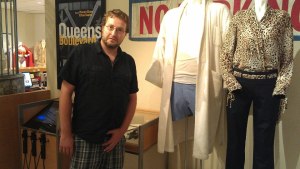
Following an overnight stay in Hollywood where we saw J-Lo and Enrique Iglesias at the Staples Center and lodged in a pre-smoking ban nostalgia-themed hotel, G and I braved the dystopian traffic and anti-social contract of LA driving to make our snail-like way to the Paley Center exhibition ‘Warner Brothers’ TV Out of the Box’. This was billed in the relationship vaudeville program as a ‘me’ act, or as much as a trip that involves a bigger-than-life Lego Conan O’Brien (one of G’s no-questions-asked celebrity one-night-stands) can be. Though the plethora of sets, props and memorabilia from hit network shows and cult classic series and a karaoke theme-tune box have broad appeal for anyone in America with a sense memory and an aerial, for a TV historian this was Porky Pig’s heaven.

You had to have the biiiiiiiiiiiiiiiiiiiiiiiiiiiiiiiiiiiiiiiiiiiiiiiiiiiiiiiiiiiiiiiiiiiiiiiiiiiiiiiig salad!

To my archaeological delight, historical documents-including production memos and patents-were liberally scattered around the exhibition. Other TV treasure chests, such as network preview catalogues sent to local affiliate stations, were also available to view. To say these gave an insight into US TV history would be an understatement tantamount to ‘Clint Eastwood could do with a teleprompter, couldn’t he?’ or ‘That Romney fellow might have a bit of an image problem’. It felt more like a journey into the unknown of how the American TV industry worked, and to some extent still works, with exhibits testifying to the power affiliates, many in anti-progressive states, have to decide what gets made and what doesn’t. It illuminated the little-known and widely ignored facts of TV’s origins, with memos pointing to the attempts of movie studios to control TV from the beginning and beam transmissions into cinemas rather than homes.

It’s funny how such an innocuous and populist-looking exhibition can be so revealing. I have to admit that I had my doubts. I was wary of Warner Brothers’ sponsorship of the exhibition and how it might skew history in favour of the studio. They made their case, though, with a timeline pointing out that they were pioneers of TV drama in the 1950s and led the line on the classic genre fare of the so (not) called (for) ‘vast wasteland’ with the inimitable Maverick. But I also appreciated that the exhibition was a TV playground. Not because it was ‘interactive’ (I hate that word!) but because it let you run around and sit down on your favourite shows.

You are now entering The Tweenlight Zone

Speaking of playgrounds, G and I went on a 16-hour ride-and-dine binge  at Disneyland and its now-with-booze sister theme park Disney’s California Adventure. Disneyland was built on TV in many ways. Its construction in the 1950s was televised in interstitial promotional segments between instalments of an anthology drama series of the same name presented by America’s bigamous uncle, the mouse-loving anti-Communist Walt Disney. While Disney’s canon of seminal animated movies provide the blueprint for most of the rides, as well as the psychological experiments on human endurance which no doubt provided the inspiration for It’s a Small World, TV still gets a look-in.

Disneyland: built on TV!

Nowhere is this more evident than The Twilight Zone Tower of Terror, a dropper-downer ride (it neither rolls nor coasts) inspired by the classic fantasy horror anthology series produced and presented by Rod Serling, whose voice can be simulated by trying to impersonate Ronald Reagan while whistling. One of the most impressive-looking and exquisitely designed rides at either park, the mock elevator lies within a purpose-built high-rise fitted with a customised exterior made to look like a decrepit Hollywood hotel…though it smelt considerably better than the one G and I stayed at. It’s easily the most disturbing and traumatising (animatronic uncanniness aside) experience available at the parks, and it’s the skilful interweaving of the original TV series into the fabric of the ride that causes such anxiety and fear. For starters, the elevator-attendant attired steward (or ‘death ombudsmen’ as I call them) cranked up the tension by letting fly with a groan-inducing patter of darkly comic puns about ‘dropping off’ the passengers that captures perfectly the black irony and sick sense of humour The Twilight Zone used to deal in. This is the show, after all, that once put the fate of humanity in the hands of the double meaning of the phrase ‘To serve man’ (Spoiler alert; it’s a cookbook!).

‘We’ll be dropping you off soon’

But what really unnerves you is the use of a Rod Serling voiceover (seamlessly cut together from his many introductions) as a prelude to the ride. This narration compels you to sit comfortably as if you were still in your armchair at home and makes you believe you are settling down for the evening snoozily watching some late-night retro TV before the elevator drops the depth of the building without so much as a warning. As you yo-yo through the building, the walls open up, ripping you from the safety of your living room and out into the murderous world that network news warned you about.

Serling’s Gold.

And though I have no hard evidence for this, I’m convinced the designer who created the digitally hyperreal set of the Atlantic City promenade pier for Boardwalk Empire got the idea from Disney’s California Adventure ersatz 1920s-era American fairground, right down to the in-period advertising hoardings. If it was the HBO field trip I’m imagining, then they probably got the idea for a show about conspicuous drinking during Prohibition from mixed messages about consuming alcohol in public places in the Disney parks.