U.S. Auto Know Better (Volume 2)

Posted in British Shows on American TV with tags , , , , , , , , , on March 29, 2011 by Tom Steward

Top Gear in the USA

While you’re enjoying the not-at-all tiresome spectacle of Dick Van Dyke dicking (or dyking) around on roller-skates as part of a major police murder investigation which he has no right to be involved in anyway, I thought I’d do a follow-up to my last blog about Top Gear. This one contains hard evidence of how this ‘Series of Unfortunate Bellends’ catches up with you when you’re an Englishman in the New World, in places you would never possibly expect. It also shows that Top Gear can be prime cultural capital to have in certain situations befacing a border-crossing Briton in and around the US, but only if used judiciously. To the best of my recollection, this is a transcript of a conversation between me and an agent at the border between the Mexico and the USA, having just come back from Tijuana:

(Tom walks up to checkpoint, passport in hand. Agent checks passport)

Agent: So, Top Gear or Fifth Gear?

Tom: Errr, hum, pum, well. Top Gear, I suppose.

Agent: Ah, you like the comedy, huh?

Tom: It’s certainly got that.

Despite my surprise, which evidently turned me into some sort of bumbling British huffer-puffer character in a 40s film played by Nigel Bruce, I couldn’t believe my luck. Instead of tricksy questions about where I’d been, what I’d done, and why the hell I was bothering them, I was being asked about television, something which I have professional expertise in. But this was a double-edged sword. I was about to get ahead of myself.

(Agent winds up ‘interview’. Tom begins to shuffle away)

Tom: They’re changing Top Gear, you know.

Agent: Visibly Alarmed What?!

Tom: They think it’s gotten too comic, so they’ll be less sitcom stuff in it.

Agent: Oh no.

At this point, I’m cursing my own stupidity. Here I had a border agent in the palm of my hand for merely being from the same country as ‘When Bigots Stage Accidents’ and I blow it! Couldn’t just leave it at a few innocuous exchanges, could I? No, I had to provide a production tidbit to bow out on, and then risk an angry border agent who’s just lost his favourite TV show shooting the messenger with extreme prejudice by detaining me forever. He didn’t, and I was on my way. But I’m sure the blow was lightened for him somewhat when this happened mere weeks later:

U.S. Auto Know Better

Posted in British Shows on American TV with tags , , , , , , , , , , , , , , , on March 25, 2011 by Tom Steward

There’s a British show you can’t avoid when watching TV with Americans, and it’s not for want of trying. Not only is it mis-representing what British telly is all about, it’s also drastically underselling us as a people. The American’s televisual window into the British psyche used to be Benny Hill, where Britons were shown to be highly sexist though only moderately successful at defiling women but prepared to go that extra mile to make it happen. Now we’re seen the world over for a whole host of bigotries, thanks to this programme, and for an array of approaches to bigotry. Yes, I’m talking about Top Gear (or ‘I’ve got a car, have you got a car?’ which I have renamed it in honour of the two lines that can substitute for any dialogue in the show). This car review programme has been around on British TV since the late 1970s, but has in the last decade splintered injudiciously into a barn-based talk show, a sub-Terry and June sitcom of endless campsite misunderstandings, and a version of The Cannonball Run without the debonair wit. Whereas host Jeremy Clarkson once saved his idioctavely (somewhere between idiotic and provocative) opinions on politics and news for column inches, he now puts them more and more in the show, and has even recruited a couple of crapprentices, James May and Richard Hammond, to one day be as hateful to the world as he is.

Disgracefully, Top Gear is consistently the most popular and beloved programme on British screens, and has proved to be the BBC’s most profitable export around the globe, particularly in the US market. What is even more baffling about the show’s international popularity is that Clarkson, May and Hammond (the Kirk, Spock and Bones of prejudice) are majorly responsible for its success. American audiences prefer to see the UK hosts rather than having a native re-make, which would normally be how to translate it overseas. The British establishment of TV academics seem resolved to resist explaining the global popularity of Top Gear. At a conference two years ago, a member of the editorial board for the ‘BFI TV Classics’ book range said outright that they would not commission a monograph on the show because ‘we didn’t want another book about Jeremy Clarkson’. Now I wouldn’t want to feed into Clarkson’s publishing empire either, but finding out what makes Top Gear so coveted might tell us something about what viewers are like across different nationalities, if only to force us to recognise our bad habits and change them immediately.

The Twataman Empire

People wanted more than one volume...look at yourselves!

But there’s a few things I’ve learnt from talking to Americans about Top Gear that helped me to understand its appeal in the US a little more. While watching the show with a friend in San Francisco, I asked why Americans were still so taken with the BBC version and remained lukewarm towards Top Gear USA, the US re-make. My friend told me she liked how the programme lambasted some of the major car companies in the US, and thought that this would be impossible to do on a US network show, where the same companies would most likely provide the advertising consideration. So maybe the cult of Clarkson, May and Hammond is not solely responsible for its success in the US. Maybe it’s also the vicarious and anarchic thrill of a programme breaking free of the dependence of advertising and loyalty to sponsors which has characterised American television since the 1950s. My friend openly admitted to finding the slapdick (my term) comedy of the three hosts hilarious, commenting that ‘we don’t have people like Clarkson on American TV’. ‘Fox News’ I thought, but didn’t say.

Nevertheless, the hosts’ freedom from corporate affiliations goes against an industry where hosts, especially on daytime TV, will suddenly starting doing a promotional spot in the middle of the show. Because it so freely flouts the commercial conventions of American television, and the presenters challenge the notion of an US TV host as a corporate spokesman, I can see how the programme would appeal to Americans on the left of the political spectrum, especially those who believe in and thirst for a non-commercial alternative to heavily sponsored and company-loyal TV. For UK viewers, the hosts are outwardly known as right-wing bigots, the competition to get products featured (positively or negatively) on the show is fierce between car companies, and the commercial-free, independent BBC  is accused of promoting consumer capitalism. Something has clearly been lost in the translation.

Who.S.A

Posted in British Shows on American TV with tags , , , , , , , , , , , , , , , , , , on March 23, 2011 by Tom Steward

I’m always surprised and impressed when I encounter Americans who adore Doctor Who. Surprised because it must have been such a pain to track down on TV that animosity would be a more natural response and impressed because they always seem to revere the qualities of the show that many British viewers have forgotten ever existed. But let’s go back in time. The BBC had wanted to sell Doctor Who to American television networks right from its inception. In fact, it was once touted as a replacement for CBS’ heavyweight science-fiction series The Twilight Zone. But it wasn’t until the 1970s that Americans finally got a run of the show, thanks in large part to PBS purchasing a block of Tom Baker serials. However, the series was being shifted around the schedules so regularly and so routinely butchered by editors that it became difficult to follow or enjoy.

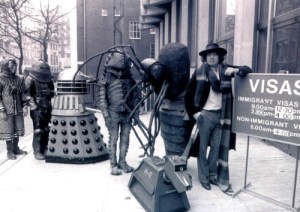
Doctor Who at US Customs

The Doctor and Friends fall foul of US Customs

Despite these viewing challenges, a fan culture emerged around Doctor Who in the US at this time. In the 1980s, the BBC and the producers of the show started actively courting American viewers; having an American companion in the series, organising US conventions and tours, and looking to the states for money for specials e.g. The Five Doctors. When the show was cancelled in Britain in 1989, it was American television that attempted to revive it. In 1996, a TV movie starring Paul McGann was broadcast by Fox with an eye to launching an American version of the programme. Roundly regarded as a failure critically, commercially and conceptually, it nonetheless laid many of the foundations for the show’s BBC revival in 2005, not least the still sacrilegious notion of The Doctor making out with his companions, which is virulent in the re-launched version of the programme.

 The export of post-2005 Doctor Who to America has been more straightforwardly successful. This is thanks to popular showings on BBC America, new episodes being bought by the Sci-Fi Channel, and interminable spin-off Torchwood being co-funded by US network Starz (formerly known as Starz!). Now we are in a situation where the first two episodes of the 2011 series are co-productions with BBC America set (as far as we can tell) in the American West and involving the White House.

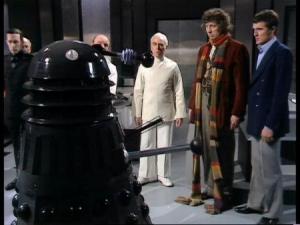
From my own experience talking to Americans about Doctor Who it seems that the devoted cult following might have actually been consolidated by the patchy US scheduling of the series in the 1970s. As a seller in a second-hand bookshop in San Francisco said whilst handing to me a copy of Terrance Dicks’ novelisation of Terror of the Autons ‘You had to want to see it’. It’s also striking to me how much the Americans I’ve spoken to treasure the ‘classic’ series (or, more accurately, Doctor Who before 2005) and seem resistant to it being reinvented for contemporary TV viewers. ‘I can’t watch it now’ said the shopkeeper ‘it’ll spoil the memory of me and my brother staying up late to catch it’. Again, there’s a sense that the obscure scheduling of the programme was part of the pleasure but it’s also clear that viewers had great emotional investment in those 1970s serials. Others I’ve spoken to seem nonplussed by the more recent series, even when recognising its achievements. ‘Yeah, it’s a smart show’ another interested party told me ‘but I miss the big scarves and those robots with the stalks’. It’s interesting that the Americans I’ve met light up when talking about those earlier serials but talk dispassionately about the latest episodes, even when their image of the series is sharper now than it was then.

Genesis of the Daleks

Floppy Scarves and Robots with Stalks

It’s doubly interesting to me, as I have this ‘American’ perspective on the series too (though less so now the wonderful Matt Smith and some very capable producers and writers have taken over), and surprising as I don’t really have much of a childhood attachment to the series, it’s just my opinion gained through watching the programme as an adult. This perspective on Doctor Who seems much more sophisticated to me than that of the hoards of British viewers who were happy to jettison the show’s past and fetishise the aspects of ‘New Who’ that were completely at odds with what made it great, the worst culprit being excess of emotion. It’s natural for Britons to be protective of such a remarkable part of our national culture and want to protect it from Americanisation, but given stateside attitudes to Doctor Who in comparison to ours, I do wonder sometimes.

Just a quickie (that’s what she said)

Posted in American TV Shows with tags , , , , , , , , , on March 18, 2011 by Tom Steward

Sorry to tear you away from your viewing (Columbo, I assume) but I just wanted to do a quick one about my favourite depiction of blogging on American TV. TV has always had trouble knowing how best to incorporate the internet into its programmes, often simply resorting to compiling clips from YouTube and putting them into a chart countdown format. And this makes the clip I’ve chosen doubly impressive. The Office: An American Workplace is a remake of the seminal British sitcom The Office that has surpassed the original in many ways, particularly in its development of the supporting cast of characters, two of whom are central to this clip.

 So Ryan the put-open (and later Machiavellian) office temp fools the unassumingly sinister paper salesman Creed into thinking he’s writing a blog when in fact he’s merely harmlessly firing away heinous observations into a word document. This vignette brilliantly captures the way that many people get so overawed by the wonder of new technology and so willingly buy in to the myth of absolute convenience that they fool themselves into believing that anything can be done for a minimum of effort. The fake blog is a bit like The Emperor’s New Clothes; Creed knows nothing about blogging except that it’s the fashion and although he’s never seen it with his own eyes he believes his blog’s out here. And this is in an age where every commercial debut of a new device feels exactly like the unveiling of a naked royal. The characterisation of the internet as a place where the dark recesses of the human psyche gain full expression is a familiar one to anybody who’s ever scrawled down a set of user comments on a blog or news page. But the disturbing suggestion that Creed’s thoughts are too extreme ‘even for the internet’ is one that brings out perfectly the latent terror of the character while tantalising us with an unseen Pandora’s Box of hateful prose.

But what I really love about this clip is that it reminds me of me. Like Creed, I’m writing this blog whilst being completely in the dark about how it really works. I too feel like I’m pouring out copy into a word document and hoping that internet fairies like Ryan will be scrupulous enough to ensure it makes it out on to the web. I’m always surprised other people read it.

Born in the USA

Posted in BiogTV with tags , , , , , , , , , , , , , , , , , , on March 16, 2011 by Tom Steward

I’ve always taken American TV too seriously. As a reluctant cub scout at some camp or other being compelled to walk blindfolded through a bit of bracken (for reasons which continue to escape me), I remember belligerently complaining to my schoolmates how outrageous it was that we were being made to do this while The A-Team was on, hoping to incite some kind of insurrection. This was, as my parents later told me, part of a childhood pattern of over-sensitivity to TV. Years previously I used to run on the spot along to chase sequences in cartoons like a dwarf soothsayer doing a dance prophesising the age of TV interactivity and behind the sofa (a cliché now but I was a pioneer) whenever Skeletor reared his skull in the thinly-veiled after-school special that was He-Man.

The A-Team

You'd be a fool to miss it

At some point, I got creative with my love of American TV. In primary school, when we were given the relatively inspiring brief of writing our own Aesop fables, my thoughts turned immediately to The Cosby Show and dieting Cliff Huxtable’s ingenious replacement of a piece of cream pie with tissue stuffing. I swapped Cliff for a Walrus according to the anthropomorphically bizarre conventions of these stories and threw into some stodgy morality about greed and how ‘in the end the pie was all tissues’. It never occurred to me that my teachers were watching the most popular sitcom on the country’s fastest-growing channel in the world’s mass-medium par excellence, and my plagiarism was duly exposed.

Dr. Cliff Huxtable

The Cosby Show: my favourite fable

Intellectual property issues aside, I was on to something. The sitcoms I used to watch as a kid were fables. They told me more about family and growing up and what adult life might be like than seemingly impenetrable allegories about relationships between incongruous talking animals ever did. And some of them did it so believably I actually thought they were saying something to me about my life (Pardon the DJ, so to speak). Roseanne was and still is so much a part of what I think of as family life. The details weren’t exactly spot on, we weren’t a working-class family from Illinois and I was an only child, but the show spoke to a larger truth about dysfunctional yet happy families around the world. I could really relate to the easy-going yet cynical parents, the weird and vaguely sociopathic little boy (because I, ahem, had a friend like that), the fraught but always loving family dynamic and the constant struggles of life that caring parents such as mine would always keep their kids blissfully oblivious to, even if we were part or all of the problem.

Roseanne

Smells like family life!

 But American TV wasn’t all about seeing or learning about my life. Sometimes I just wanted escape. So did the majority of Americans in the 1960s and 70s, by the looks of it. Thanks to a (now much-missed) scheduling policy of classic US TV repeats on Channel 4 in the 80s and 90s, I whittled away my childhood years to such delights as the camp escapades of Adam West’s Batman, which is stunning whether you know it’s taking the piss or not and hence the perfect family show, and the disturbing, bleak and violent non-adventures of two humans trapped in a hostile future with no chance of return (besides death-by-hunt) on the TV version of Planet of the Apes, proof that the fantasy in these shows was sometimes worse than the reality they escaped (see also Land of the Giants). But, looking back, I can see the seeds of a career as a TV critic and analyst in the way I watched these shows. I always knew a shot of the submarine (or, more accurately, the camera) rocking violently from side-to-side in Voyage to the Bottom of the Sea was the same one that appeared every single week, regardless of the story (it wasn’t hard-the haircuts changed all the time). Something was amiss and I knew it. And I’ve just spent four years trying to solve exactly the same production riddles, only this time I made a PhD out of it. But it was the same impulse I had when devotedly scanning these programmes into my mind’s eye forever.

Planet of the Apes (TV Series)

Tonight: A shocking glimpse into our future

 I can’t help thinking of Bart Simpson’s maxim about television and parenting ‘It’s hard not to listen to TV. It’s spent so much more time raising us than you’. Now my parents were attentive, loving and committed, and yet it’s still the same. American TV was the lifelong-learning course I enrolled on.

If you want to know what this blog is about, flick to here