Archive for boardwalk empire

Downton Empire or Boardwalk Abbey?

Posted in American TV (General), American TV Shows, Americans watching British TV, British Shows on American TV with tags , , , , , , , , , , , , , , , , , , , on November 24, 2012 by Tom Steward


Downton or Boardwalk?


Mr. Bojangles (formerly ‘Managing Director Boris Manjangles’)

SYNERGIES (formerly ‘SYNERGY INDUSTRIES’)

No. 2

Blind Alley

Londonshire (formerly ‘Great Britain’)

LOL BFF


Dear HBITVO,


I am addressing you using your synergy name-an amalgamation of HBO and ITV-which despite sounding like a new strain of a sexually transmitted virus will undoubtedly become your company acronym once I have informed you of the synergistic possibilities between two of your flagship programmes. A scan by our patented synergy-finding computer application-or SY-FI CRAP for short-has detected a 110% probability (the machine was the creation of retired football managers) of synergy between HBO’s Boardwalk Empire and ITV’s Downton Abbey. SYNERGIES believes that although the former is an obscene and offbeat historical crime drama and the latter a gentle and safe period soap opera, their worlds are colliding in ways that can only be described as ‘pointless’, a synergy word meaning both ‘poised’ and ‘relentless’.


Both programmes have featured scenes in Ireland in the 1920s during the ‘troubles’ (Idea for Programme: ‘Aving a Bit of The Troubles/Frank Spencer travels back in time on magic roller-skates to Bloody Sunday). But rather than having such scenes to make it look like these programmes give a damn about the country and its history, the results of our scan show that they are prime opportunities for synergy. SY-FI CRAP has projected a scenario in which Downton’s chauffeur-turned-in-law-turned-resident Uncle Seamus Tom Branson discovers his long-lost brother-from-another-overrated-show, the IRA soldier-turned-slutty bodyguard Owen Slater, has been killed by gangsters in New York and delivered in a crate to his employers (further offence was caused by listing him as ‘UK Cargo’) and leaves for the U.S.A. to exact his revenge.


At SYNERGIES we understand that the process of synergisation should attempt as much as possible to preserve the unique identity of the synergees. Hence SY-FI CRAP recommends that Tom recruit the help of several doughy white middle-aged character actors in exacting his revenge and that they should be introduced as they are sweatily entering much younger women. It is further suggested that when the perpetrator Joe Massereti is found by Tom he is taking tea with an elderly British film star who camply disparages him for his race and class and makes facial movements that looks like she is being buffered on iplayer.


SYNERGIES applaud previous efforts by ITV to synergise Downton Abbey with other HBO series. It has not gone unnoticed by our researchers that the producers had been planning a crossover with prison drama Oz. Why else would the valet Bates have been kept in jail for so long unless it was for him to eventually volunteer for a cryogenic freezing experiment offered to prisoners by an American scientist (Triangular Synergy Prospect: The scientist is Norm from Cheers reprising his role as an unconvincing 1940s inventor in Forever Young) and be defrosted in a 1990s Baltimore high-security prison? SYNERGIES appreciates that it was only Ofcom’s enforced removal of a scene in which Bates was raped with a potato-masher by Noel Coward that prevented this merger.


The SYNERGIES family (the cloned specimens that power SY-FI CRAP’s artificial intelligence are technically relatives) know that Downton Abbey depends on the American market and that, thanks to the efforts of the Prime Minister of Synergy (‘Synister’) conglomerate media mogul Rupert Murdoch, Boardwalk Empire is a hit on British TV…at least for those who have sold their souls for Mad Men. These audiences must be synergised as soon as possible. Our survey says that this could be achieved by Boardwalk Empire having dancing chimney-sweeps become bootleggers rather than WWI veterans as well as posh Englishmen who don’t understand things not understanding flapjacks. Downton Abbey would need to re-cast Lady Grantham’s mother with Kathy Bates shouting raucously in a Southern drawl while her boobs hang loose in a t-shirt.


Those who resist the synergy movement, which at time of writing our statisticians rounded up to ‘the population of the earth’, may consider such a crossover detrimental to the integrity of each individual programme. To those who defy progress, I say remember those pioneers of TV synergy (or ‘TV-Gy’ not to be confused with the rating or the budget-conscious gay channel) who boldly cross-fertilised Inspector Morse and Masterchef to produce the policious hit series Pie in the Sky and economised by re-using cooking show credits sequences. Who could forget the genius producer who decided that CBS should try to sell CSI to the audience demographic for The Golden Girls and call it NCIS, a title which innovatively uses ‘anagriarism’ (a cross between ‘anagram’ and ‘plagiarism’) with the N standing for ‘nodding off’.


SYNERGIES awaits your response in all possible forms of media (including pigeon) simultaneously. We offer consultancy on a pro bono basis, which is a synergy word combining ‘prostitution’ and ‘bonus’.


Yours disingenuously,


Mr. Bojangles


(Synergy Date/Time Conversion: 2for1/1score/dozen)


Boardwalk or Downton?


Box-Set Collections and TV Themes

Posted in American TV (General), American TV Shows, BiogTV, TV Culture, TV History with tags , , , , , , , , , , , , , , , , , , , on October 27, 2012 by Tom Steward

Despite foetally premature chatter about TV being on its way out thanks to new media-which often forgets that many people use new media to get closer to TV-television is still pervasive in our culture. But it only struck me recently how much the culture and leisure sector rely on and are influenced by TV. During my last visit to the US, I didn’t just get my TV fix from the flatscreens in the many living rooms I patronised as housesitter-cum-benign intruder but from museums and theme parks.  Fascination with TV is widespread and so is the way it underpins our entertainment.

Out of the Box and all over the carpet!

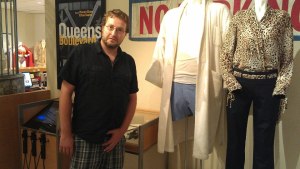
Following an overnight stay in Hollywood where we saw J-Lo and Enrique Iglesias at the Staples Center and lodged in a pre-smoking ban nostalgia-themed hotel, G and I braved the dystopian traffic and anti-social contract of LA driving to make our snail-like way to the Paley Center exhibition ‘Warner Brothers’ TV Out of the Box’. This was billed in the relationship vaudeville program as a ‘me’ act, or as much as a trip that involves a bigger-than-life Lego Conan O’Brien (one of G’s no-questions-asked celebrity one-night-stands) can be. Though the plethora of sets, props and memorabilia from hit network shows and cult classic series and a karaoke theme-tune box have broad appeal for anyone in America with a sense memory and an aerial, for a TV historian this was Porky Pig’s heaven.

You had to have the biiiiiiiiiiiiiiiiiiiiiiiiiiiiiiiiiiiiiiiiiiiiiiiiiiiiiiiiiiiiiiiiiiiiiiiiiiiiiiiig salad!

To my archaeological delight, historical documents-including production memos and patents-were liberally scattered around the exhibition. Other TV treasure chests, such as network preview catalogues sent to local affiliate stations, were also available to view. To say these gave an insight into US TV history would be an understatement tantamount to ‘Clint Eastwood could do with a teleprompter, couldn’t he?’ or ‘That Romney fellow might have a bit of an image problem’. It felt more like a journey into the unknown of how the American TV industry worked, and to some extent still works, with exhibits testifying to the power affiliates, many in anti-progressive states, have to decide what gets made and what doesn’t. It illuminated the little-known and widely ignored facts of TV’s origins, with memos pointing to the attempts of movie studios to control TV from the beginning and beam transmissions into cinemas rather than homes.

It’s funny how such an innocuous and populist-looking exhibition can be so revealing. I have to admit that I had my doubts. I was wary of Warner Brothers’ sponsorship of the exhibition and how it might skew history in favour of the studio. They made their case, though, with a timeline pointing out that they were pioneers of TV drama in the 1950s and led the line on the classic genre fare of the so (not) called (for) ‘vast wasteland’ with the inimitable Maverick. But I also appreciated that the exhibition was a TV playground. Not because it was ‘interactive’ (I hate that word!) but because it let you run around and sit down on your favourite shows.

You are now entering The Tweenlight Zone

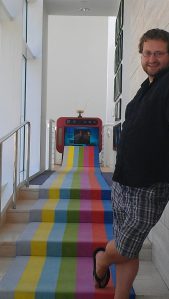
Speaking of playgrounds, G and I went on a 16-hour ride-and-dine binge  at Disneyland and its now-with-booze sister theme park Disney’s California Adventure. Disneyland was built on TV in many ways. Its construction in the 1950s was televised in interstitial promotional segments between instalments of an anthology drama series of the same name presented by America’s bigamous uncle, the mouse-loving anti-Communist Walt Disney. While Disney’s canon of seminal animated movies provide the blueprint for most of the rides, as well as the psychological experiments on human endurance which no doubt provided the inspiration for It’s a Small World, TV still gets a look-in.

Disneyland: built on TV!

Nowhere is this more evident than The Twilight Zone Tower of Terror, a dropper-downer ride (it neither rolls nor coasts) inspired by the classic fantasy horror anthology series produced and presented by Rod Serling, whose voice can be simulated by trying to impersonate Ronald Reagan while whistling. One of the most impressive-looking and exquisitely designed rides at either park, the mock elevator lies within a purpose-built high-rise fitted with a customised exterior made to look like a decrepit Hollywood hotel…though it smelt considerably better than the one G and I stayed at. It’s easily the most disturbing and traumatising (animatronic uncanniness aside) experience available at the parks, and it’s the skilful interweaving of the original TV series into the fabric of the ride that causes such anxiety and fear. For starters, the elevator-attendant attired steward (or ‘death ombudsmen’ as I call them) cranked up the tension by letting fly with a groan-inducing patter of darkly comic puns about ‘dropping off’ the passengers that captures perfectly the black irony and sick sense of humour The Twilight Zone used to deal in. This is the show, after all, that once put the fate of humanity in the hands of the double meaning of the phrase ‘To serve man’ (Spoiler alert; it’s a cookbook!).

‘We’ll be dropping you off soon’

But what really unnerves you is the use of a Rod Serling voiceover (seamlessly cut together from his many introductions) as a prelude to the ride. This narration compels you to sit comfortably as if you were still in your armchair at home and makes you believe you are settling down for the evening snoozily watching some late-night retro TV before the elevator drops the depth of the building without so much as a warning. As you yo-yo through the building, the walls open up, ripping you from the safety of your living room and out into the murderous world that network news warned you about.

Serling’s Gold.

And though I have no hard evidence for this, I’m convinced the designer who created the digitally hyperreal set of the Atlantic City promenade pier for Boardwalk Empire got the idea from Disney’s California Adventure ersatz 1920s-era American fairground, right down to the in-period advertising hoardings. If it was the HBO field trip I’m imagining, then they probably got the idea for a show about conspicuous drinking during Prohibition from mixed messages about consuming alcohol in public places in the Disney parks.