Archive for doctor who

Asylum of The Daleks (Review)

Posted in British Shows on American TV, Uncategorized with tags , , , , , , , , , , , , , , , , , , , , on September 8, 2012 by Tom Steward

An advantage of having a themed blog is that it challenges you to find suitable topics to talk about each week. A drawback is that you can’t talk about whatever you like. In some ways that defeats the point of blogging as the form is so conducive to a diary-like outpouring of what you want to say as it comes to you. So readers looking for a connection between my review of ‘Asylum of the Daleks’, the opener to the new season of Doctor Who, and this blog will have to be content with the knowledge that I watched it…in America.

The anticipation for ‘Asylum of the Daleks’ couldn’t have been higher. Not only had viewers waited 5 months longer than usual for the new season of Doctor Who to begin but the episode heralded the return (albeit from a bogus publicity-stunt hiatus) of the Daleks, the show’s lynchpin villains and one-time Beatlemania-emulating pop culture phenomena. Also, since the annual run of episodes has been cut in half for 2012, viewers watched the episode in trepidation of it constituting 1/6th of their Doctor Who fix this year. The close-season publicity for the series had also tantalized long-term fans of the show with staged, Abbey Road-style photographs of Dalek models stretching back to the 1960s, luring people into thinking that the episode would be a Dalek retrospective reflecting on how these Dyson sink-unblockers had figured in the series (or even British art and culture) in the past 49 years.

The Fab Four!

It all started very promisingly. Writer-producer Steven Moffat’s scripts for Doctor Who are often deeply flawed but he is adept at cold opens, as seen in the pre-title sequence of the 2011 Christmas Special which would have graced any Bond film. The teaser in which The Doctor and his companions are kidnapped from their times by Daleks and taken to their Parliament with a cryptic agenda was mouth-watering. But it also demonstrated a conspicuous whittling-down of extraneous dialogue (Moffat’s greatest weakness as a writer) in favour of imagistic storytelling, making the first 5 minutes of this effort eminently satisfying. The dialogue that remained was sparse and terrifying, especially in The Doctor’s opening exchange with an emptied-out, human-style Dalek on the mysteriously resurrected home planet Skaro, which effortlessly captured-and yet did not aggrandise-the cynicism and deep-seated resentment at the heart of Matt Smith’s portrayal of the central character.

Tough room!

As soon as the re-vamped credits-which managed in true digital-era BBC style to be simultaneously utilitarian and gaudy-ended, the problems began. Moffat seems to believe that to over-complicate something is to improve it, and the shock introduction of-and premature farewell to-The Doctor’s future companion (Jenna-Louise Coleman) was an ill-advised overegging of the narrative pudding, appropriately for an episode with a dairy-based leitmotif. It also completed unbalanced the episode, like Faustino Asprilla did to Newcastle (Google it, young’ns!). And here lies the problem with all the stories featuring classic villains since Moffat took over in 2010. The Daleks play second fiddle to the characters and their emotional dilemmas and all the potential of the set-up, in this case a planet inhabited by disturbed Daleks, is wasted. Contrary to the promo pictures, the episode had no respect for the Daleks or what they have meant to the show.

Hello new companion-Goodbye new companion!

The spectre hanging over the forthcoming departure of Amy and Rory (Karen Gillan and Arthur Darvill) loomed larger after the first look at their replacement. It’s a dispiriting thought, especially as the most compelling moments of this episode revolved around Rory. Darvill has the alchemy to turn Moffat’s entry-level humour into comedy gold, exemplified in this episode as Rory attempts to make peace with a Dalek by returning what he assumes is its egg spawn. Without this kind of performance polish, Moffat’s half-witticisms are going to look pretty pointless in the future. And it’s not long before the terse force of the minimal dialogue gives way to the excruciating baby-talk that Moffat increasingly takes as his signature meter. Moffat even seems to have lost the knack of writing the domestic life of the Ponds, throwing a red-herring divorce in their way reminiscent of the water-treading ‘marriage trouble’ storylines given to couples in soap operas.

Those aren’t chickens!

But worse was to come. Now I’m well aware that Doctor Who has leant heavily on popular culture over the years to inform its storylines. In fact, some of the best stories-like Victorian-lit romp ‘The Talons of Weng-Chiang’-are pure pastiche. I’m also entirely cogniscent of the dearth of new ideas in Moffat’s scripts for the show since his first in 2005. There are, for example, none between ‘Blink’in 2007 and ‘The Wedding of River Song’in 2011. But the Martin Bashir-meets-Johan Hari level of plagiarism in this episode is just inexcusable. Inexcusable because it brazenly lifts the plot twist and visual imagery from Duncan Jones’ Source Code without acknowledgement, adaptation or play. And inexcusable because an intriguing original idea had been abandoned to make way for a wholly derivative one. We saw nothing of the implicitly terrifying concept of a planet ruled by rogue and maddened Daleks. Instead we got a few broken plungers.

Doctor in the White House

Posted in British Shows on American TV with tags , , , , , , , , , , , , , , , , , , , , on May 11, 2011 by Tom Steward

The opening two episodes of this season of Doctor Who took the show’s affinity with America to a whole new level. For decades now, Britain’s eccentric and long-winded answer to the 1960s US craze for science-fiction TV has had an eye towards American distribution both in its internal content and marketing strategies. But this offhand nodding exploded like a Steven Moffat logic bomb into full-blown obsession in a two-part series premiere set in various iconic landmarks of the USA (the White House, the American frontier) and featuring the disgrace-redemption axis President Richard Nixon, Neil Armstrong’s historic foot, Christmas-cracker level gags about Watergate, people endlessly drawing guns, aliens and men in federal black tie, a Cold War throwback monsters-among-us storyline, a slow-moving NASA spacesuit with a Spielbergian ickle girl inside, badly timed and played presidential anthems performed by the starving man’s John Williams Murray Gold, an actor whose surname was ‘Baldwin’, and a man whose voice sounded like Christian Bale’s Batman being parodied by 30 Rock’s Jack Donaghy.

Doctor Who in the USA

Amy Across the Pond

Broadcast merely hours after the UK showings and co-produced by BBC America, the series was heavily previewed and publicised both on the channel (including a daylong marathon of the previous season) and throughout cable on-demand services. Special efforts were made to provide American-English translations for British-English nouns, suggesting a sycophancy about attracting US audiences (who I would argue like the show precisely because it’s not indigenous to America) not seen since the Sting-song superficial US crossover Doctor Who movie in 1996. Rather than find common ground through a mean or median word, as is usually done (the ‘marrow’ dilemma facing Wallace & Gromit, for instance) certain lines were re-played in American-English (e.g. ‘Where’s the toilet?’/‘For God’s sake take her to the restroom’), further weighing down and stalling an already leaden and repetitive script. There also seemed to be concern about US viewers coming into the show for the first time (not that long-time UK viewers are able to follow this season any better!) and each opening credits sequence was prefixed by a voiceover by Karen Gillan as Amy Pond orienting new viewers in the world of the show since Matt Smith’s first episode. While this has the feel and tone of Moffat’s Doctor Who, and is consistent with the themes of fairytale and prophecy he rams into the show like a sleeping bag into a holder, this recalls the hated Howard Da Silva voiceovers that American purchasers TimeLife tacked on to the beginning of episodes in the ’70 US airings that fans of the show protested against vigorously as a too dry overspoonfeeding jarring with the mysterious pleasures of the programme.

The Doctor and Young Amelia

The BBC America Voiceover recalls this meeting

Documentary guides to the show’s history were also broadcast on BBC America in the few days prior to the premiere. A tremendously good idea, I thought. This was until I realised the BBC were trying to create the impression that the show began in 2005, which was previously a producer-institutional policy (related to increasing the market for DVD sales, I suspect) synonymous with the tenure of executive producer Russell T Davies to wipe knowledge and information about past programmes (and, crucially, how good they were) from viewer’s memories or desires. I thought we’d got over this as Moffat and the BBC started to gradually acknowledge the show’s colossal backcatalogue of actors and serials. But apparently this was deemed to be the most easy and convenient way to market this two-part special to new US audiences which not only impoverishes the memory of this hugely significant piece of our art, culture and entertainment but also insults the plethora of US viewers who remember and treasure the show from their youths. An unignorable difference between watching Doctor Who on UK TV and on BBC America is the commercial breaks. The show airs on non-commercial channel BBC One in the UK and therefore runs without interruption whereas BBC America has the regulation set of commercial interludes (although seemingly less than on a network channel). While I thought BBC America did admirably with placing these breaks in moments of high suspense the cut-away to commercial from shock moments of danger reduced the show’s effectiveness as a piece of horror, in episodes that already, despite their tantalising combination of creepy elements, didn’t add up to much in the scare stakes. It was a shame also that the over-complicated and now routinely unfathomable story arc somewhat compromised the show’s portrayal of a pre-Watergate Nixon. There was a fascinating debate to be had about his legacy condensed irritatingly into a few (now signature) clipped Moffat-written exchanges.

Turn over to my previous post on Doctor Who here.

Who.S.A

Posted in British Shows on American TV with tags , , , , , , , , , , , , , , , , , , on March 23, 2011 by Tom Steward

I’m always surprised and impressed when I encounter Americans who adore Doctor Who. Surprised because it must have been such a pain to track down on TV that animosity would be a more natural response and impressed because they always seem to revere the qualities of the show that many British viewers have forgotten ever existed. But let’s go back in time. The BBC had wanted to sell Doctor Who to American television networks right from its inception. In fact, it was once touted as a replacement for CBS’ heavyweight science-fiction series The Twilight Zone. But it wasn’t until the 1970s that Americans finally got a run of the show, thanks in large part to PBS purchasing a block of Tom Baker serials. However, the series was being shifted around the schedules so regularly and so routinely butchered by editors that it became difficult to follow or enjoy.

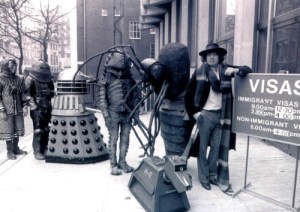
Doctor Who at US Customs

The Doctor and Friends fall foul of US Customs

Despite these viewing challenges, a fan culture emerged around Doctor Who in the US at this time. In the 1980s, the BBC and the producers of the show started actively courting American viewers; having an American companion in the series, organising US conventions and tours, and looking to the states for money for specials e.g. The Five Doctors. When the show was cancelled in Britain in 1989, it was American television that attempted to revive it. In 1996, a TV movie starring Paul McGann was broadcast by Fox with an eye to launching an American version of the programme. Roundly regarded as a failure critically, commercially and conceptually, it nonetheless laid many of the foundations for the show’s BBC revival in 2005, not least the still sacrilegious notion of The Doctor making out with his companions, which is virulent in the re-launched version of the programme.

 The export of post-2005 Doctor Who to America has been more straightforwardly successful. This is thanks to popular showings on BBC America, new episodes being bought by the Sci-Fi Channel, and interminable spin-off Torchwood being co-funded by US network Starz (formerly known as Starz!). Now we are in a situation where the first two episodes of the 2011 series are co-productions with BBC America set (as far as we can tell) in the American West and involving the White House.

From my own experience talking to Americans about Doctor Who it seems that the devoted cult following might have actually been consolidated by the patchy US scheduling of the series in the 1970s. As a seller in a second-hand bookshop in San Francisco said whilst handing to me a copy of Terrance Dicks’ novelisation of Terror of the Autons ‘You had to want to see it’. It’s also striking to me how much the Americans I’ve spoken to treasure the ‘classic’ series (or, more accurately, Doctor Who before 2005) and seem resistant to it being reinvented for contemporary TV viewers. ‘I can’t watch it now’ said the shopkeeper ‘it’ll spoil the memory of me and my brother staying up late to catch it’. Again, there’s a sense that the obscure scheduling of the programme was part of the pleasure but it’s also clear that viewers had great emotional investment in those 1970s serials. Others I’ve spoken to seem nonplussed by the more recent series, even when recognising its achievements. ‘Yeah, it’s a smart show’ another interested party told me ‘but I miss the big scarves and those robots with the stalks’. It’s interesting that the Americans I’ve met light up when talking about those earlier serials but talk dispassionately about the latest episodes, even when their image of the series is sharper now than it was then.

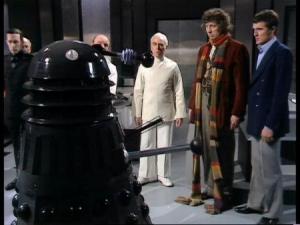
Genesis of the Daleks

Floppy Scarves and Robots with Stalks

It’s doubly interesting to me, as I have this ‘American’ perspective on the series too (though less so now the wonderful Matt Smith and some very capable producers and writers have taken over), and surprising as I don’t really have much of a childhood attachment to the series, it’s just my opinion gained through watching the programme as an adult. This perspective on Doctor Who seems much more sophisticated to me than that of the hoards of British viewers who were happy to jettison the show’s past and fetishise the aspects of ‘New Who’ that were completely at odds with what made it great, the worst culprit being excess of emotion. It’s natural for Britons to be protective of such a remarkable part of our national culture and want to protect it from Americanisation, but given stateside attitudes to Doctor Who in comparison to ours, I do wonder sometimes.