Archive for mad men

TV Titles: The Long and the Short of It

Posted in American TV (General), American TV Shows, Reviews, TV Culture, TV History with tags , , , , , , , , , , , , , , , , , , , on February 27, 2013 by Tom Steward

Recently I’ve been very much enjoying Homeland. Don’t worry; you haven’t defaulted to the 2011 archive. There simply aren’t enough hours in the year to watch all the US TV I’d like to at the time of transmission. For some shows, then, I’m forced to take the quasi-paedophilic Sound of Music route of waiting a couple years for them to mature (by which time I’ll be a Nazi!). Anyway, back to Homeland. What struck me about the series, apart from the regularity with which characters say ‘Abu fucken’ Nazir’, was chiefly the title sequence. Thankfully, this isn’t a news blog!

http://videos.nymag.com/video/Opening-Credits-Homeland#c=GPW04R137JDPW6CY&t=Opening%20Credits:%20’Homeland’

Homeland takes on the conventions of the title sequence, offering viewers a succession of images, sounds, clips and quotations instead of the usual illustrated theme tune. It’s partly there to provide a synopsis of the Pilot episode, presumably so the early-adopter viewer you’re watching it with doesn’t have to, and partly to tell the biographical backstory of  main character Carrie Matheson (Claire Danes), which the rest of the programme-to its credit-doesn’t want to waste its time with. The imagery is a cocktail of jazz and anti-terrorism, which are Carrie’s favourite hobbies, and extracts from America’s Greatest Foreign Policy Bloopers showreel.

Jazzing up Terrorism.

In the past decade, US TV title sequences have been pushed to extremes of utter gratuity and blink-length banality. Cable networks like HBO and AMC made title sequences seem like an art form on the back of triumphs like the tripodless New Jersey tourist board film that opens The Sopranos or the credits to Mad Men which features an advertising executive falling through Roy Lichtenstein’s mind. But the fashion for elaborate, extended titles was a curse too, compelling producers to artificially inflate sequences without enough content to back it up. Hence Boardwalk Empires beachcombing set to fret-wanking session musician travesty.

The flipside of that coin was network shows which opted out of doing title sequences altogether. Perhaps intimidated by the 3-minute masterpieces coming out of cable TV, or maybe just testing how low they could set the bar on introducing the programme, there were a spate of series in which the title sequence was the title. Better examples of this included the pushed-down-too-hard-on-the-screen digital watch effect in 24 which drew suspense and chaos out of a minimalist graphic. But then there was Lost which merely moved the title around like a mid-90s PC screensaver or Acorn Antiques without the irony.

Image grab longer than actual title sequence.

Amazingly, Homeland’s title sequence manages to be both. Like other cable greats, it stands as a piece in its own right while introducing and summarising the programme effectively. It’s terribly self-indulgent (especially as there’s another couple of minutes re-cap directly afterwards introduced by what sounds like the ghost of Bill O’Reilly) but it complements the jazz motif and prevailing sense that the war on terror is endless. However, each season premiere and finale eschews the sequence for a lone title screen. Fortunately, it’s one of the good ones, with the words of the title scrambled and redacted like military intelligence.

Not only is the title sequence of Homeland reaching into parts of the show’s fictional world untouched by the episodes themselves, it is rich with a history and a life before and beyond the show. Footage of national TV addresses about terrorism made by US Presidents from Reagan onwards-excluding, critically, George W. Bush-drifts in and out of view and sight. Boldly, moving images of the Twin Towers attacks are interwoven into the fictional fabric of the sequence, a seed of truth from which a ludicrous plant will grow. The American legacy of big band jazz offsets the background of fear.

Jazz in a 9/11 beat, daddy-o!

Homeland wasn’t the first US TV title sequence that asked us to think about images and sounds outside the musical diegesis of the theme tune. The opening credits of Elizabethan theatre-meets-Dragnet police procedural NYPD Blue features an ongoing percussive sound that drives the sequence along like the speeding L-train which visually bookends the titles. The penultimate image is of a traditional Chinese drummer in the middle of a New-Year ceremony pounding on his instrument with rolling-pin sized sticks. It takes us out of the world created by the score and into the reality of New York life; kinetic, diverse and relentless.

I always think of verbal exposition in US TV title sequences as something found more in comedy than drama. There is, of course, the A-Team but that might be a case of the exception being the rule in disguise. This could be because comedies don’t mind being seen as on-the-nose as much as dramas or simply because having that burden of exposition in the episodes might be detrimental to the comedy. In fairness, Homeland doesn’t have a contextualising song or voiceover but instead plucks lines of dialogue from the Pilot episode and these are more character tensions than Facebook profiles.
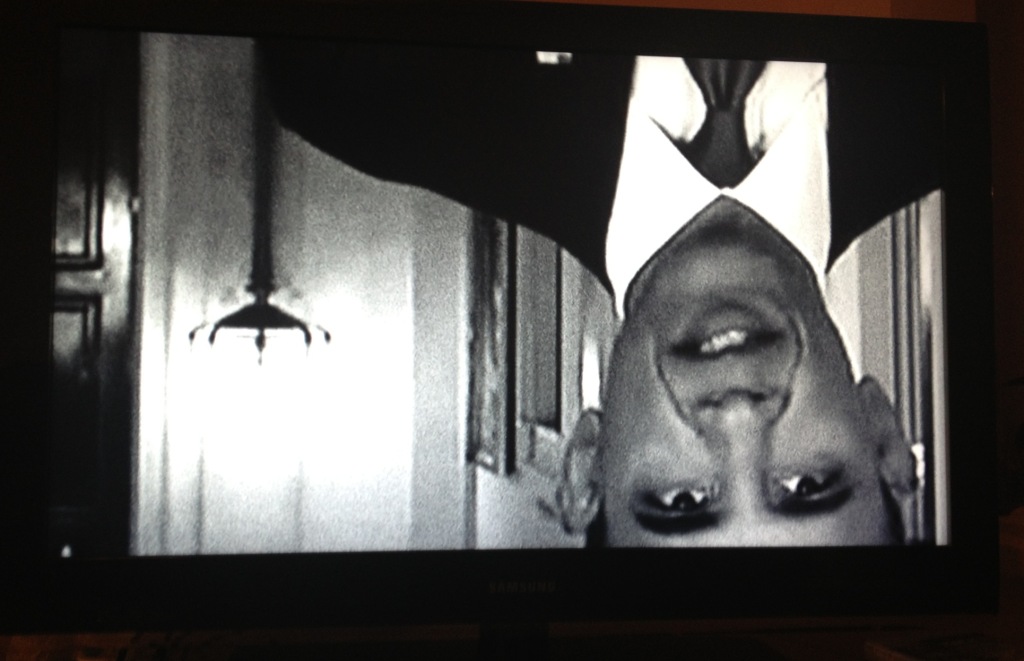
Do not adjust your set!

Do not adjust your set!

Title sequences are promises that whether fulfilled or neglected by the rest of the programme remain pleasurable on their own terms. Homeland may well already be a shadow of its former self at close of Season 2 play but somehow it’s impossible to entirely dismiss a programme which begins so beautifully. There’s enough to dig around in during those first few minutes to keep worries about underdeveloped sub-plots and writers’ knowledge of their dramatic endgame at bay. The producers might want you to wonder what Carrie and Brody will do next. I’m still questioning why Obama is upside down.

Downton Empire or Boardwalk Abbey?

Posted in American TV (General), American TV Shows, Americans watching British TV, British Shows on American TV with tags , , , , , , , , , , , , , , , , , , , on November 24, 2012 by Tom Steward


Downton or Boardwalk?


Mr. Bojangles (formerly ‘Managing Director Boris Manjangles’)

SYNERGIES (formerly ‘SYNERGY INDUSTRIES’)

No. 2

Blind Alley

Londonshire (formerly ‘Great Britain’)

LOL BFF


Dear HBITVO,


I am addressing you using your synergy name-an amalgamation of HBO and ITV-which despite sounding like a new strain of a sexually transmitted virus will undoubtedly become your company acronym once I have informed you of the synergistic possibilities between two of your flagship programmes. A scan by our patented synergy-finding computer application-or SY-FI CRAP for short-has detected a 110% probability (the machine was the creation of retired football managers) of synergy between HBO’s Boardwalk Empire and ITV’s Downton Abbey. SYNERGIES believes that although the former is an obscene and offbeat historical crime drama and the latter a gentle and safe period soap opera, their worlds are colliding in ways that can only be described as ‘pointless’, a synergy word meaning both ‘poised’ and ‘relentless’.


Both programmes have featured scenes in Ireland in the 1920s during the ‘troubles’ (Idea for Programme: ‘Aving a Bit of The Troubles/Frank Spencer travels back in time on magic roller-skates to Bloody Sunday). But rather than having such scenes to make it look like these programmes give a damn about the country and its history, the results of our scan show that they are prime opportunities for synergy. SY-FI CRAP has projected a scenario in which Downton’s chauffeur-turned-in-law-turned-resident Uncle Seamus Tom Branson discovers his long-lost brother-from-another-overrated-show, the IRA soldier-turned-slutty bodyguard Owen Slater, has been killed by gangsters in New York and delivered in a crate to his employers (further offence was caused by listing him as ‘UK Cargo’) and leaves for the U.S.A. to exact his revenge.


At SYNERGIES we understand that the process of synergisation should attempt as much as possible to preserve the unique identity of the synergees. Hence SY-FI CRAP recommends that Tom recruit the help of several doughy white middle-aged character actors in exacting his revenge and that they should be introduced as they are sweatily entering much younger women. It is further suggested that when the perpetrator Joe Massereti is found by Tom he is taking tea with an elderly British film star who camply disparages him for his race and class and makes facial movements that looks like she is being buffered on iplayer.


SYNERGIES applaud previous efforts by ITV to synergise Downton Abbey with other HBO series. It has not gone unnoticed by our researchers that the producers had been planning a crossover with prison drama Oz. Why else would the valet Bates have been kept in jail for so long unless it was for him to eventually volunteer for a cryogenic freezing experiment offered to prisoners by an American scientist (Triangular Synergy Prospect: The scientist is Norm from Cheers reprising his role as an unconvincing 1940s inventor in Forever Young) and be defrosted in a 1990s Baltimore high-security prison? SYNERGIES appreciates that it was only Ofcom’s enforced removal of a scene in which Bates was raped with a potato-masher by Noel Coward that prevented this merger.


The SYNERGIES family (the cloned specimens that power SY-FI CRAP’s artificial intelligence are technically relatives) know that Downton Abbey depends on the American market and that, thanks to the efforts of the Prime Minister of Synergy (‘Synister’) conglomerate media mogul Rupert Murdoch, Boardwalk Empire is a hit on British TV…at least for those who have sold their souls for Mad Men. These audiences must be synergised as soon as possible. Our survey says that this could be achieved by Boardwalk Empire having dancing chimney-sweeps become bootleggers rather than WWI veterans as well as posh Englishmen who don’t understand things not understanding flapjacks. Downton Abbey would need to re-cast Lady Grantham’s mother with Kathy Bates shouting raucously in a Southern drawl while her boobs hang loose in a t-shirt.


Those who resist the synergy movement, which at time of writing our statisticians rounded up to ‘the population of the earth’, may consider such a crossover detrimental to the integrity of each individual programme. To those who defy progress, I say remember those pioneers of TV synergy (or ‘TV-Gy’ not to be confused with the rating or the budget-conscious gay channel) who boldly cross-fertilised Inspector Morse and Masterchef to produce the policious hit series Pie in the Sky and economised by re-using cooking show credits sequences. Who could forget the genius producer who decided that CBS should try to sell CSI to the audience demographic for The Golden Girls and call it NCIS, a title which innovatively uses ‘anagriarism’ (a cross between ‘anagram’ and ‘plagiarism’) with the N standing for ‘nodding off’.


SYNERGIES awaits your response in all possible forms of media (including pigeon) simultaneously. We offer consultancy on a pro bono basis, which is a synergy word combining ‘prostitution’ and ‘bonus’.


Yours disingenuously,


Mr. Bojangles


(Synergy Date/Time Conversion: 2for1/1score/dozen)


Boardwalk or Downton?