Archive for the American TV Shows Category

Queen Me

Posted in American TV (General), American TV Shows, Americans watching British TV, Reviews, TV channels, TV Criticism, TV News with tags , , , , , , , , , on December 21, 2015 by Tom Steward

It’s Christmas so TV is all about messages. Though if you know your McLuhan, then you’ll already be aware that TV itself is the message. Far be it from me to buck seasonal television trends, so as this is the final blog post of the year I’ve prepared a Christmas message. As I hail from the land of tea and war (where do you think we got the tea?), the message will be delivered as if it were Queen Elizabeth II’s televised Christmas address to the nation, which all British subjects watch devoutly each year without ever ignoring it completely.

What are all you people doing in our house?

What are all you people doing in our house?

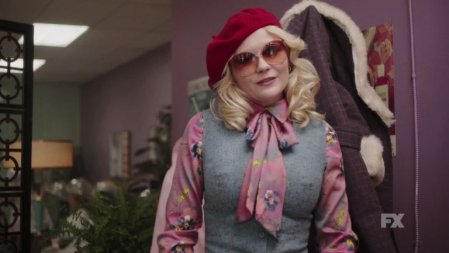
In the House of Commons this November, MPs debated whether to change the symbol of Britain from a lion to a hedgehog or, to put it another way, whether to write off the country by tying its fate to a species with a rapidly declining population. We are reminded of our long-lost children in the colonies who this year lost iconic hosts of late-night on their moving billboards. Like changing a lion for a hedgehog, the replacement may not seem as strong as its predecessor – and more difficult to pick up – but the more they stick out their noses and appear at our doors each night, the more the infants of the new world will grow to love them. We are also reminded of this because a couple of the new hosts look like hedgehogs.

Nocturnal hedgehogs

Nocturnal hedgehogs

If Britain does decide that it’s only economic salvation – following the debacle of a government I could’ve stopped if I had wanted to – is Beatrix Potter brand synergy, then we are reassured by the success of spin-offs in the living room magic lantern shows of the Europe’s emancipated teenager. As hedgehogs to lions, such derivations seemed paltry and incidental creatures yet they possess a unique quality all of their own that has been resting in the shade of bigger animals for so long it comes to light as soon as they shift their lumbering rears from view. Except CSI: Cyber.

There is always the possibility of reinvention – look at us, we’re much more cheery than we used to be – as the recent trend in the wall-mounted viewfinders of Columbus’s Indies for season-long anthology series reminds us. It is difficult to adjust to change – especially if one writes for HitFix – but we should remember that, like that bloody hedgehog we wish we’d never used as a metaphor in the first place, transformation has the potential to preserve a species that would otherwise have died out a lot sooner, or ended up on Hulu. It takes a true detective to see the worth in exchanging a tried-and-tested point of pride for something offbeat and challenging, but we must fargo our trepidations in order to save what we love while it still has a slim chance of survival.

The year of my lord – well he is technically my employer – 2015 was the end of an era, although not for me as we became the longest-reigning British monarch, of which we would like to say on record: ‘suck it, time’! But those less fortunate than us, such as everyone, have had to endure the loss of the many sinful delights that sit within the devil’s hatbox, especially those that hail from the land of not-having-one-of-me-in-charge. We are justified to feel sadness though we would be mad men if we didn’t notice that Parks & Recreation was just shit now.

Lions – for my speechwriter says that you’re simply all too stupid to handle more than one metaphor per message – are lazy and parasitic as well as strong and proud, so it is not with complete regret that we see two and a half of these individually wrapped entertainments make way for an animal that isn’t quite so boring and doesn’t steal from others…like a mentalist! There are those who say it is a scandal that those animals with such a grey anatomy should get away with murder, but here’s the catch. The ecosystem needs every animal – no matter how much it feeds off a rotting carcass – so, however much they induce dread, the lions of this world are just as important to the hedgehogs and, yes, my butler does mix drinks that badly as well.

To play us out, we have the Christmas TV movie carol ‘Edelweiss’ which this year reminds us of a world which my uncle would have been proud of. A very happy Christmas to you all… except those of you who want me to pay taxes.

http://www.youtube.com/watch?v=UIDKPydxAFM

Baking The Waves

Posted in American TV (General), American TV Shows, Americans watching British TV, Behind-The-Scenes, British Shows on American TV, Touring TV, TV History with tags , , , , , , , on December 14, 2015 by Tom Steward

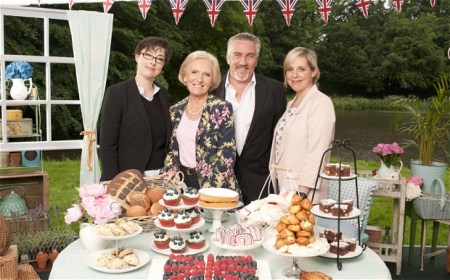
It’s not an unreasonable assumption that Americans prefer to know about Britain’s heritage than the way it is today. So it will come as no surprise to anyone on either side of the Atlantic that a Great British Bake-Off spin-off (which can be contracted to The Great British Bake-Off) called The Great Holiday Baking Show is airing on ABC primetime over the Christmas season. The Great British Bake-Off is a cooking competition celebrating British culinary traditions against a landscape idealizing Britain as the green and pleasant land of yore replete with signifiers of our imperial past, like the bunting-lined parties we used to host for wartime victories and royal events. Though if you’re labouring under the misapprehension that cultural fascination has triumphed over commercial interest, it’s worth remembering that in the UK this year the finale of The Great British Bake-Off was the most-watched program of the year, that past seasons of the show currently occupy peak Sunday airtime on PBS, and that a US version of the format called The American Baking Competition debuted in 2013 but was cancelled within a year following poor ratings. It’s both too lucrative and too particular to attempt anything other than a spin-off.

Bake Britain

Bake Britain

Americanizing the brand has proved difficult. PBS had to re-name the US airings The Great British Baking Show not because of cultural misunderstandings – as surely ‘Bake-Off’ is a term friendlier to the American spirit of competition than ours of miserable make-do – but America’s corporate hegemony. Girth-romanticising pastry company Pilsbury hold the trademark to the name ‘Bake-Off’ since it is the name of their patented annual cooking contest. The American Baking Competition continued the tradition of American reboots of British reality shows exporting celebrity judges, but it backed the wrong horse. Perhaps they were expecting some latent movie star glamour to suddenly burst forth from baker Paul Hollywood when he was brought into geographical proximity with his namesake – or more likely they wanted another British villain – but there was less gel than the sour scouse keeps in his hair when they brought him into the show. Though far sweeter and lacking the negativity that reality TV bottom-feeds off, The Great Holiday Baking Show has made a far better choice in calling upon veteran food writer and TV presenter Mary Berry to handle the judging, especially since any successful translation of the format requires as much exploitation of British icons as possible.

As is usually the case in television, the biggest factor affecting the success of The Great Holiday Baking Show is time. The Great British Bake-Off is shown over ten weeks and, while it is clear from the preponderance of sunlight and the frequently-used excuse of it being a ‘hot day’ that it is filmed in Summer, the baking is not linked to any particular season of the year. As the title states, The Great Holiday Baking Show is very clearly themed around the American Thanksgiving and Christmas holidays to reflect the period of the calendar year in which most baking is done and/or consumed in the US. The producers have evidently latched on to the seasonality of baking as justification for a short-run December-long series which also conveniently prevents them from having to commit to a full season in programming terms. Conversely, the configuration of cake-eating with sunny countryside settings in the British original has almost made it seem like an exclusively Summer activity in the UK, not a happy by-product of taking refuge from the cold of Autumn and Winter as it is in the US. Finding what is culturally equivalent about an imported show is often the key.

Baking in the Free World!

Baking in the Free World!

The subject matter and presentation of The Great British Bake-Off is twee and backwards but it gestures to the diversity of post-colonial Britain. Though by no means proportional, there is a range of ethnic, racial, sexual and regional representation in the contestant base. To wit, the 2015 winner was Nadiya Jamir Hussein, a British-Bengali women identifying as a Muslim. I’m glad to see that The Great Holiday Baking Show has followed in these footsteps, though in both cases it’s difficult to tell whether this is selection strategy or merely that it’s an inclusive enough application process for minorities to make it through. What makes the difference is the ability to use the original format and continue to have Mary Berry on board, although why they would make her a judge for an American spin-off only to patronise her like a cigar store Indian in a parallel universe is beyond me.


I Capture The Castle

Posted in American TV (General), American TV Shows, Internet TV, Reviews, TV Acting, TV History, Watching TV with tags , , , , , , , , , on December 7, 2015 by Tom Steward

Delivering seasons of TV programs through internet streaming has made writing a conventional review an even more fruitless enterprise than it already was. It’s impossible to determine – or even average – where those watching a season currently are in the run of episodes and it’s possible that they’re already done with it. A review makes no sense in either context. For want of a better solution to the futility of internet TV journalism, I’ve decided to formulate my response to Amazon Prime’s original series The Man in the High Castle as a list of what I’ve learned from the first season:


Who do you think you are kidding Mr. Churchill?

Who do you think you are kidding Mr. Churchill?


  1. The program doubles as an instructional video showing employers how to treat Amazon workers.


  1. There is no ‘Reich’ pun beyond the writers.


  1. I learnt what happened in the post-war world by the show telling me what didn’t happen in the post-war world.


  1. You will say the words: ‘I want Hitler to come back’.


  1. In a parallel universe where Philip K. Dick didn’t exist, people would have a lot less respect for Ridley Scott.


  1. I am still not convinced that the Trade Minister isn’t Hiro.


  1. South America is now a haven from Nazis.


  1. There is a moment where you will believe that Hitler’s apocryphal ‘one ball’ will become a plot point.


  1. The opening sequence is like Dad’s Army on rewind.


  1. There are British spies in The American Reich.


  1. All it took to teach Rufus Sewell restraint was playing a Nazi.


  1. It contains the best scene of an African-American man teaching a dwarf to fish outside of an epilogue of Walker, Texas Ranger.


  1. Berlin is still cool.


  1. We’d have had colour TV a lot sooner if the Nazis had won.


  1. Hitler must have been really affected by post-war European art cinema since he now prefers avant-garde documentaries to American B-movies.


  1. In Japan, morality is measured in spectacle rims.


  1. The Man in the High Castle is not Julian Fellowes, though they share a lot of the same political views.


  1. Hitler is way ahead of home theaters.


  1. The Smith & Jones sketch outlining the five Nazi General archetypes is still the standard for all screen portrayals.
  1. It’s basically Sliders.


Coen Artists

Posted in American TV (General), American TV Shows, Behind-The-Scenes, TV Acting, TV advertising, TV channels, TV Criticism, TV News with tags , , , , , , , on November 30, 2015 by Tom Steward

As someone who once publicly stated that hiring Steven Moffat as showrunner of Doctor Who was a good move by the BBC, I’m not used to my predictions about television coming to anything. So I was even more surprised to be vindicated about two separate predictions I’ve made on this blog in recent weeks. However, the ways in which they both came to fruition was enough was enough to make me think I should be more careful in what I wish for. As with the posts where these predictions were first made, this one comes with a lot of spoilers:

No guts, no glory

No guts, no glory

After weeks of waiting, on Sunday’s episode of The Walking Dead we finally found out what had happened to Glenn. Which was nothing. Despite it looking as if his guts were being eaten by a herd of walkers the last time we saw him, it was in fact Nicholas whose insides were being devoured, giving Glenn time and space to hide under a dumpster until the coast was clear. Like all those who appreciate Steven Yeun’s performance in the show, I’m relieved that he’s still around and believed he would be. But, unlike many, I’m not convinced this was the masterstroke of storytelling it’s currently being spun as, largely by people involved in the series. In fact, I think it’s cheap. Teasing the death of a beloved character for a month exploited the goodwill of fans towards the show for the sake of publicity and added nothing dramatically to it.

Post-show discussion program Talking Dead (boy, Chris Hardwick must really think I have it in for him!) did its usual whitewashing of the drama’s shortcomings, re-imagining Glenn’s death hoax as some kind of statement about the mindset of characters in the world and aligning the audience with it. Frankly, it smelled worse than Daryl surely does. I know the entire remit of Talking Dead is to make every artistic decision taken in The Walking Dead seem purely creative and exponentially meaningful – and feel the collective silence if like Kevin Smith you dare to critique some of the choices made – but this isn’t an artistic decision. At least it’s no more artistic than publicity stunts like ‘Who Shot J.R.?’ or whatever they do on Scandal each week to keep people coming back to that steaming pile of crap. It amounts to fixing something you purposefully broke just for the inevitable attention.

Last week’s episode of Fargo could’ve been dubbed a musical tribute to The Coen Brothers. While the FX series is always prone to the borrowing of visual imagery from its cinematic forbearer, more recently it has been honoring its muses through the aural. In the first season, there was an effort to connect Fargo to the timeline of the original movie, but in the second what seems more important is a – specifically musical – link to the Coen universe. Versions of ‘Man of Constant Sorrow’ and ‘O Death’ from O Brother Where Art Thou and ‘I Just Dropped In (To See What Condition My Condition Was In)’ from The Big Lebowski litter the soundtrack. At points, characters paraphrase or precis lines from Coen Brothers movies, as if quotations belong to the lexicon. It’s about half as satisfying as it sounds, and yet another distraction in a show full of them.

I was writing about Fargo in reference to playing with our understanding of what is TV and what is cinema. I seem to have given the series far too much credit since it is evidently more interested in propagating the cult of the auteur, something not even The Coen Brothers are that concerned about doing with their movies. It recalls the worst excesses of Quentin Tarantino, when the director decides to reference his own movies rather than other people’s. Or how Steven Moffat (because there’s only a few people I can ever write about) would remind audiences that all his garbage comes from the same bin. It’s a more style-conscious season, as anthology demands change, and I suppose intertextuality has got more on-the-nose as a result. But there’s a sense that the story doesn’t really stretch to ten episodes this time, and this – like shootouts – may be a way of prevaricating.

A style-conscious season of 'Fargo'.

A style-conscious season of ‘Fargo’.

I saw it coming and now I feel responsible. Whether it’s the survival of Glenn or the cinematic engagement of Fargo, it happened more or less as I expected it to. But perhaps that’s the problem. I think I saw through what these programs were doing, rather than seeing them.


Acts of Television

Posted in American TV (General), American TV Shows, Behind-The-Scenes, TV channels, TV News with tags , , , , , , , , on November 24, 2015 by Tom Steward

In the week following terrorist attacks on Paris, Beirut and Lebanon, the response of American television to these events is of little importance. But this is a blog about American television and so that’s what I’m going to talk about. To make this blog about the attacks – as if that had been its dormant purpose all along – would do a severe injustice to what is a complex geo-political situation. Sometimes I wish American television knew its limitations as well as I do. News and current affairs programs obviously must deal with what has happened – unfortunately for those of us who don’t think that refugees are responsible for the crimes of their persecutors – but TV entertainment doesn’t necessarily have to engage unless the latter’s remit crosses over into the former’s. Nonetheless, all entertainment programming, at least that which has been made since the attacks, seems to have an unwritten obligation to comment on the human tragedy. This sounds like an altogether good thing, suggesting that the genre isn’t as trivial as we suspected, but what it actually discovers is that entertainment formats are simply not equipped to handle this level of political discourse. Many of the results have been frankly insulting.

paris

Jean Oliver!

Take, for instance, Chris Hardwick’s gabbled epilogue of pseudo-Churchillian platitudes no doubt compiled from a graphic novel about Dunkirk in the closing moments of AMC’s Talking Dead, a post-show discussion of The Walking Dead. This resembled one of those rushed disclaimers at the end of pharmaceutical commercials. For events of this magnitude, you either have time to talk about them or you don’t. I’m all in favour – as my younger self would not have been – of cancelling scheduled shows in favour of extended news coverage, though this is one of the few times that a 24-hour news cycle is justified in my view. TNT made the decision to postpone the broadcast of an episode of Sean Bean vehicle Legends set in Paris, which though it may appear overly-sensitive also takes into account the fact that a terrorist act is represented. CBS’ Supergirl and NCIS: Los Angeles also shelved episodes that involved bombings and terrorists. Networks tend to err on the side of caution in these instances, reducing TV to a set of trending keywords and then disseminating entire programs that use them incidentally. It’s one of the few occasions that networks admit outright that their programming is not socially responsible.

Some responses were more judicious. As you might expect from our ironic culture of news, parodies of broadcast journalism did far better than the real thing in their treatment of the attacks. Last Week Tonight with John Oliver kept the talk of war cultural, badgering ISIS into taking on the global leaders of art, food and music with their apocalyptic asceticism. While this is one of the few shows on TV that had the time and scope to offer a full account of the attacks and their significance, the suddenness of the events and their proximity to airtime meant that the program was safer – and more effective – to be as schoolboy as possible in its response, exploiting the other boutique quality of HBO: Obscenity. While broader as befits its appeal, The Late Show with Stephen Colbert adopted a similar tact, leaving it to New Orleans-based house jazz band Jean Baptiste and Stay Human to pay tribute to the French origins of their musical culture. Colbert has always played both sides of the American political sphere and, whether scheduled or not, the pairing of Bill Maher and Medal of Honor recipient Flobert Groberg kept the extremists on both sides at bay.

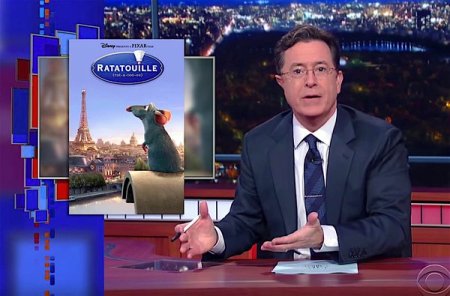
Vive la Rat!

Vive la Rat!

But what made Colbert’s response particularly powerful was its self-reflexive commentary on how to respond to events such as these. There was an affectionate poke at the tweeters who had the combination of compassion and ignorance that makes watching Ratatouille an act of solidarity with the French and a behind-the-scenes glimpse at the dilemma over whether to keep the booking of feline circus act The Acro-Cats on the first show since the attacks. Since taking over from Letterman at CBS, Colbert has made himself a defender of both American high culture and light entertainment, and so the ISIS attacks were a real (surely unwanted) test of his mettle in his dual function as cultural commentator and ringmaster, which he passed with high-flying colours. Colbert is unusually thoughtful for a talk show host, Oliver a journalistic powerhouse. It’s the ones who think they’re being thoughtful through acknowledgment that are the problem.