Archive for the TV News Category

Queen Me

Posted in American TV (General), American TV Shows, Americans watching British TV, Reviews, TV channels, TV Criticism, TV News with tags , , , , , , , , , on December 21, 2015 by Tom Steward

It’s Christmas so TV is all about messages. Though if you know your McLuhan, then you’ll already be aware that TV itself is the message. Far be it from me to buck seasonal television trends, so as this is the final blog post of the year I’ve prepared a Christmas message. As I hail from the land of tea and war (where do you think we got the tea?), the message will be delivered as if it were Queen Elizabeth II’s televised Christmas address to the nation, which all British subjects watch devoutly each year without ever ignoring it completely.

What are all you people doing in our house?

What are all you people doing in our house?

In the House of Commons this November, MPs debated whether to change the symbol of Britain from a lion to a hedgehog or, to put it another way, whether to write off the country by tying its fate to a species with a rapidly declining population. We are reminded of our long-lost children in the colonies who this year lost iconic hosts of late-night on their moving billboards. Like changing a lion for a hedgehog, the replacement may not seem as strong as its predecessor – and more difficult to pick up – but the more they stick out their noses and appear at our doors each night, the more the infants of the new world will grow to love them. We are also reminded of this because a couple of the new hosts look like hedgehogs.

Nocturnal hedgehogs

Nocturnal hedgehogs

If Britain does decide that it’s only economic salvation – following the debacle of a government I could’ve stopped if I had wanted to – is Beatrix Potter brand synergy, then we are reassured by the success of spin-offs in the living room magic lantern shows of the Europe’s emancipated teenager. As hedgehogs to lions, such derivations seemed paltry and incidental creatures yet they possess a unique quality all of their own that has been resting in the shade of bigger animals for so long it comes to light as soon as they shift their lumbering rears from view. Except CSI: Cyber.

There is always the possibility of reinvention – look at us, we’re much more cheery than we used to be – as the recent trend in the wall-mounted viewfinders of Columbus’s Indies for season-long anthology series reminds us. It is difficult to adjust to change – especially if one writes for HitFix – but we should remember that, like that bloody hedgehog we wish we’d never used as a metaphor in the first place, transformation has the potential to preserve a species that would otherwise have died out a lot sooner, or ended up on Hulu. It takes a true detective to see the worth in exchanging a tried-and-tested point of pride for something offbeat and challenging, but we must fargo our trepidations in order to save what we love while it still has a slim chance of survival.

The year of my lord – well he is technically my employer – 2015 was the end of an era, although not for me as we became the longest-reigning British monarch, of which we would like to say on record: ‘suck it, time’! But those less fortunate than us, such as everyone, have had to endure the loss of the many sinful delights that sit within the devil’s hatbox, especially those that hail from the land of not-having-one-of-me-in-charge. We are justified to feel sadness though we would be mad men if we didn’t notice that Parks & Recreation was just shit now.

Lions – for my speechwriter says that you’re simply all too stupid to handle more than one metaphor per message – are lazy and parasitic as well as strong and proud, so it is not with complete regret that we see two and a half of these individually wrapped entertainments make way for an animal that isn’t quite so boring and doesn’t steal from others…like a mentalist! There are those who say it is a scandal that those animals with such a grey anatomy should get away with murder, but here’s the catch. The ecosystem needs every animal – no matter how much it feeds off a rotting carcass – so, however much they induce dread, the lions of this world are just as important to the hedgehogs and, yes, my butler does mix drinks that badly as well.

To play us out, we have the Christmas TV movie carol ‘Edelweiss’ which this year reminds us of a world which my uncle would have been proud of. A very happy Christmas to you all… except those of you who want me to pay taxes.

http://www.youtube.com/watch?v=UIDKPydxAFM

Coen Artists

Posted in American TV (General), American TV Shows, Behind-The-Scenes, TV Acting, TV advertising, TV channels, TV Criticism, TV News with tags , , , , , , , on November 30, 2015 by Tom Steward

As someone who once publicly stated that hiring Steven Moffat as showrunner of Doctor Who was a good move by the BBC, I’m not used to my predictions about television coming to anything. So I was even more surprised to be vindicated about two separate predictions I’ve made on this blog in recent weeks. However, the ways in which they both came to fruition was enough was enough to make me think I should be more careful in what I wish for. As with the posts where these predictions were first made, this one comes with a lot of spoilers:

No guts, no glory

No guts, no glory

After weeks of waiting, on Sunday’s episode of The Walking Dead we finally found out what had happened to Glenn. Which was nothing. Despite it looking as if his guts were being eaten by a herd of walkers the last time we saw him, it was in fact Nicholas whose insides were being devoured, giving Glenn time and space to hide under a dumpster until the coast was clear. Like all those who appreciate Steven Yeun’s performance in the show, I’m relieved that he’s still around and believed he would be. But, unlike many, I’m not convinced this was the masterstroke of storytelling it’s currently being spun as, largely by people involved in the series. In fact, I think it’s cheap. Teasing the death of a beloved character for a month exploited the goodwill of fans towards the show for the sake of publicity and added nothing dramatically to it.

Post-show discussion program Talking Dead (boy, Chris Hardwick must really think I have it in for him!) did its usual whitewashing of the drama’s shortcomings, re-imagining Glenn’s death hoax as some kind of statement about the mindset of characters in the world and aligning the audience with it. Frankly, it smelled worse than Daryl surely does. I know the entire remit of Talking Dead is to make every artistic decision taken in The Walking Dead seem purely creative and exponentially meaningful – and feel the collective silence if like Kevin Smith you dare to critique some of the choices made – but this isn’t an artistic decision. At least it’s no more artistic than publicity stunts like ‘Who Shot J.R.?’ or whatever they do on Scandal each week to keep people coming back to that steaming pile of crap. It amounts to fixing something you purposefully broke just for the inevitable attention.

Last week’s episode of Fargo could’ve been dubbed a musical tribute to The Coen Brothers. While the FX series is always prone to the borrowing of visual imagery from its cinematic forbearer, more recently it has been honoring its muses through the aural. In the first season, there was an effort to connect Fargo to the timeline of the original movie, but in the second what seems more important is a – specifically musical – link to the Coen universe. Versions of ‘Man of Constant Sorrow’ and ‘O Death’ from O Brother Where Art Thou and ‘I Just Dropped In (To See What Condition My Condition Was In)’ from The Big Lebowski litter the soundtrack. At points, characters paraphrase or precis lines from Coen Brothers movies, as if quotations belong to the lexicon. It’s about half as satisfying as it sounds, and yet another distraction in a show full of them.

I was writing about Fargo in reference to playing with our understanding of what is TV and what is cinema. I seem to have given the series far too much credit since it is evidently more interested in propagating the cult of the auteur, something not even The Coen Brothers are that concerned about doing with their movies. It recalls the worst excesses of Quentin Tarantino, when the director decides to reference his own movies rather than other people’s. Or how Steven Moffat (because there’s only a few people I can ever write about) would remind audiences that all his garbage comes from the same bin. It’s a more style-conscious season, as anthology demands change, and I suppose intertextuality has got more on-the-nose as a result. But there’s a sense that the story doesn’t really stretch to ten episodes this time, and this – like shootouts – may be a way of prevaricating.

A style-conscious season of 'Fargo'.

A style-conscious season of ‘Fargo’.

I saw it coming and now I feel responsible. Whether it’s the survival of Glenn or the cinematic engagement of Fargo, it happened more or less as I expected it to. But perhaps that’s the problem. I think I saw through what these programs were doing, rather than seeing them.


Acts of Television

Posted in American TV (General), American TV Shows, Behind-The-Scenes, TV channels, TV News with tags , , , , , , , , on November 24, 2015 by Tom Steward

In the week following terrorist attacks on Paris, Beirut and Lebanon, the response of American television to these events is of little importance. But this is a blog about American television and so that’s what I’m going to talk about. To make this blog about the attacks – as if that had been its dormant purpose all along – would do a severe injustice to what is a complex geo-political situation. Sometimes I wish American television knew its limitations as well as I do. News and current affairs programs obviously must deal with what has happened – unfortunately for those of us who don’t think that refugees are responsible for the crimes of their persecutors – but TV entertainment doesn’t necessarily have to engage unless the latter’s remit crosses over into the former’s. Nonetheless, all entertainment programming, at least that which has been made since the attacks, seems to have an unwritten obligation to comment on the human tragedy. This sounds like an altogether good thing, suggesting that the genre isn’t as trivial as we suspected, but what it actually discovers is that entertainment formats are simply not equipped to handle this level of political discourse. Many of the results have been frankly insulting.

paris

Jean Oliver!

Take, for instance, Chris Hardwick’s gabbled epilogue of pseudo-Churchillian platitudes no doubt compiled from a graphic novel about Dunkirk in the closing moments of AMC’s Talking Dead, a post-show discussion of The Walking Dead. This resembled one of those rushed disclaimers at the end of pharmaceutical commercials. For events of this magnitude, you either have time to talk about them or you don’t. I’m all in favour – as my younger self would not have been – of cancelling scheduled shows in favour of extended news coverage, though this is one of the few times that a 24-hour news cycle is justified in my view. TNT made the decision to postpone the broadcast of an episode of Sean Bean vehicle Legends set in Paris, which though it may appear overly-sensitive also takes into account the fact that a terrorist act is represented. CBS’ Supergirl and NCIS: Los Angeles also shelved episodes that involved bombings and terrorists. Networks tend to err on the side of caution in these instances, reducing TV to a set of trending keywords and then disseminating entire programs that use them incidentally. It’s one of the few occasions that networks admit outright that their programming is not socially responsible.

Some responses were more judicious. As you might expect from our ironic culture of news, parodies of broadcast journalism did far better than the real thing in their treatment of the attacks. Last Week Tonight with John Oliver kept the talk of war cultural, badgering ISIS into taking on the global leaders of art, food and music with their apocalyptic asceticism. While this is one of the few shows on TV that had the time and scope to offer a full account of the attacks and their significance, the suddenness of the events and their proximity to airtime meant that the program was safer – and more effective – to be as schoolboy as possible in its response, exploiting the other boutique quality of HBO: Obscenity. While broader as befits its appeal, The Late Show with Stephen Colbert adopted a similar tact, leaving it to New Orleans-based house jazz band Jean Baptiste and Stay Human to pay tribute to the French origins of their musical culture. Colbert has always played both sides of the American political sphere and, whether scheduled or not, the pairing of Bill Maher and Medal of Honor recipient Flobert Groberg kept the extremists on both sides at bay.

Vive la Rat!

Vive la Rat!

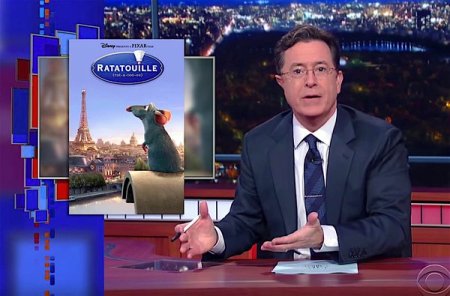
But what made Colbert’s response particularly powerful was its self-reflexive commentary on how to respond to events such as these. There was an affectionate poke at the tweeters who had the combination of compassion and ignorance that makes watching Ratatouille an act of solidarity with the French and a behind-the-scenes glimpse at the dilemma over whether to keep the booking of feline circus act The Acro-Cats on the first show since the attacks. Since taking over from Letterman at CBS, Colbert has made himself a defender of both American high culture and light entertainment, and so the ISIS attacks were a real (surely unwanted) test of his mettle in his dual function as cultural commentator and ringmaster, which he passed with high-flying colours. Colbert is unusually thoughtful for a talk show host, Oliver a journalistic powerhouse. It’s the ones who think they’re being thoughtful through acknowledgment that are the problem.

The Ch-Ching Crowd

Posted in American TV (General), American TV Shows, TV Acting, TV advertising, TV Culture, TV News with tags , , , , on November 16, 2015 by Tom Steward

Last week, Joel Hodgson launched a Kickstarter campaign to revive Mystery Science Theater 3000 with a characteristically sarcastic video in which he is heckled by Tom Servo and Crow T. Robot over his appeal for money to make a show famous for its low budget. Crowdfunding compliments a cult program like this, but it’s becoming a reality for all kinds of television. As the way we watch TV changes, so does the way that it’s financed. In fact, I’m currently involved as an actor in a TV project that needs a crowdfunding campaign before it can get off the ground.

It's a mystery...why they need money!

It’s a mystery…why they need money!

I’m talking about The Cast Members, a sitcom in the great American tradition of the comic ensemble about the employees of a cinema/theatre (delete depending on whether you’re saying it rightly or wrongly), created by Aaron David Roberts. Even though the concept is so good you can’t believe it hasn’t been done before, the scripts are as tight as those trousers David Bowie wore in Labyrinth, and it features some of the best onscreen and stage talent in San Diego – and in L.A., for that matter – without the backing of a production company or network (in whatever broadcast or digital form they exist now), it’s the audience that has to pay upfront to make the program they want to see. A crowdfunding campaign will start next year and my work for the project so far has been to shoot a promotional video that takes the form of a condensed pilot.

Crowdfunding is common enough when it comes to reviving a show that’s been cancelled by a network, as the Kickstarter campaign that brought Veronica Mars back to our screens as a feature film illustrates. It’s a relatively new concept for launching TV shows, however. Nat Geo’s global pub crawl Chug is considered the first Kickstarter-funded series and that starting airing in 2014. In most crowdfunding campaigns, success is determined as much by the incentives for donating as the product. These ‘perks’ – as they are known – range from bonus material (a callback to the DVD extra and Easter Eggs that made us pay twice to watch TV the first time round) to branded merchandise only available to donors, and usually only by donating a specific amount. It’s easy to see how this form of financing would work in the current TV climate, which is driven largely by multi-platform intertextuality and consumption.

Many of the series funded by Kickstarter campaigns are intended to stream on the web rather than ever make it to air, although the distinction between the two is closing as some of the most highly-regarded TV of our time now begins online and stays there. Chug eventually found a major cable network, despite the fact that it was their collective ambivalence that compelled producers to go the crowdfunding route in the first place, and can’t be seen as representative. The Veronica Mars feature film was streamed on Amazon Instant Video but I doubt whether the decision to add the film to their stores posed much of a quandary for the online shopping giant given that it was a known quantity and that production had already been paid for. I’m sure it’s not normal to exceed funding goals in the way the campaigns for Veronica Mars and Chug did either.

There’s usually some kind of trailer for the project requiring funding to launch the campaign. The Kickstarter for Veronica Mars assembled actors from the series and had them perform their launch video in the style of the teen noir. You might also say that the three seasons of the show were the trailers for the feature remake. For The Cast Members, Aaron decided on a mini-episode, which made the most sense since the actors had already been cast and storylines devised for the first season. It also meant that the Kickstarter could act as a shop window for the series and its stellar cast, as well as a fiscal means to an end. Mounting a pre-pilot also suggests that the ‘starter’ bit of the campaign website’s name is misleading, as projects need to be in an advanced stage, both conceptually and in finances, to even launch a campaign at all.

By all accounts, the Kickstarter to revive Mystery Science Theater 3000 is doing well, as did the one for Veronica Mars, while Chug demonstrated that it’s possible to get a brand new show on the air using crowdfunding. It’s still a high-risk, high-reward strategy that may bankrupt you before launch.

Tarantino on TV II

Posted in American TV (General), American TV Shows, Behind-The-Scenes, TV Acting, TV channels, TV Culture, TV News with tags , , , , , on October 18, 2015 by Tom Steward

Once again – and just as unintentionally – Quentin Tarantino has re-opened the debate about TV and film. Speaking on the release of The Hateful Eight in dual versions, one complimenting a 70mm Panavision format, the other more conducive to multiplexes and subsequent TV airings, the director observed:

‘The 70 is the 70. You’ve paid the money. You’ve bought your ticket. So you’re there. I’ve got you. But I actually changed the cutting slightly for a couple of the multiplex scenes because it’s not that. Now it’s on Showtime Extreme. You’re watching it on TV and you just kind of want to watch a movie on your couch. Or you’re at Hot Dog on a Stick and you just want to catch a movie.’

A 70mm shotgun!

A 70mm shotgun!

Tarantino has always been a lone voice in the debate, distinguished by an unerring respect for television as an artistic medium and his belief that there is still a tangible distinction between TV and cinema. There are few commentators on either side that can keep hold of both these ideas. Some of Tarantino’s finest work as a director was in television – in ER and CSI, no less – and it’s clear from his movies that TV falls under his muse. But he’s a filmdamentalist and his staunch refusal to acquiesce to the digital industry standard is also an outright denial that TV and cinema have conflated. Tarantino’s vivid descriptions of two experientially different media are more compelling than most critics’ vague sense that TV is becoming more like cinema.

The auteur reserves his derision for the cultural no man’s land of mall-adjunct multiplexes where, as Jackie Brown’s Max Cherry once observed, you see ‘something that starts soon and looks good’. It’s here that film is simply an afterthought of conspicuous consumption, not a thing of grand beauty and spectacle or part of a boutique outlet delivering sophisticated cable programming. There’s an all-or-nothing-at-all fatalism about Tarantino’s views on cinema, a regression to the mid-century belief in a divergence between TV and movies based solely on the size of the screen. It’s a welcome counterpoint to the ubiquity of convergence rhetoric, but perhaps in the end just as misguided and myth-driven as its opposing view.

Another coincidence is that Tarantino’s remarks were reported in the same week that FX began airing the new season of Fargo, a series that asks questions about the relationship between TV and cinema. The series is a spin-off from the 1996 movie directed by Tarantino’s indie contemporaries The Coen Brothers, but once again this season is elusive about its status in regards to the cinematic source material. Actors in the series are frequently costumed and posed to look like characters from the movie, even though they’re playing completely new roles. This season is set during the Carter administration and has the crumpled golden look of late seventies movies, yet the split screen techniques speak more to TV title sequences of the era, not to mention a much more recent breakthrough in televisual narration, Fox’s own 24.

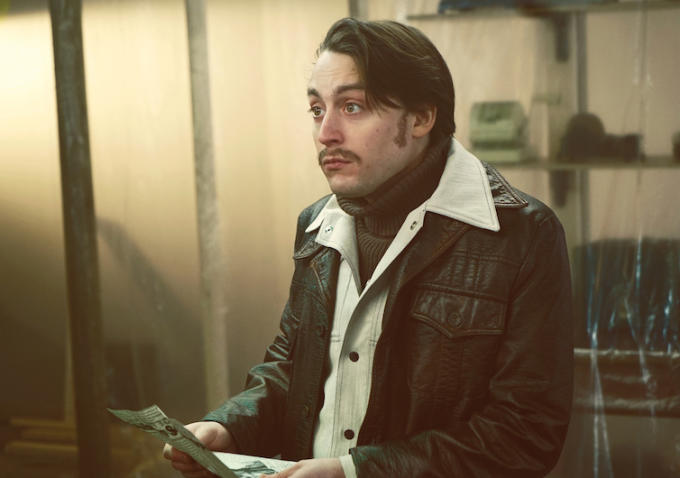
The previous season of Fargo – an anthology of season-long stories, which doesn’t make eliciting its cinematic and televisual qualities any easier – seemed at first a remake of the movie’s storyline with similarly Manichean characters and labyrinthine plotting yet by its end, it felt more like a sequel, having been found in and extrapolated from the timeline of the original. With Kieran Culkin’s uncanny resemblance to a young Steve Buscemi and in the very first episode a visual homage to the late Harve Presnell, whose implacable moustache loomed large over the movie, I suspect we might have just as ambiguous a play with the cinematic mythology this time around. The stars don’t help. Ted Danson has long been identified with television. Meanwhile there’s a Culkin in the cast and plenty of actors who are split exactly evenly across the two media. It’s almost as if Fargo wants to create a new hybrid creature that is neither and both.

Another funny-looking guy.

Another funny-looking guy.

Fargo’s messy intertwining of TV and film consciousnesses works at cross-purposes to what Quentin Tarantino is saying about the continued separation of the two. When we watch Fargo, we’re unsure about how much of what we’re watching belongs to which media. As Tarantino suggests, seeing a movie at a multiplex as a food court folly could lead to the same confusion, while watching it projected wide on film stock would absolutely not. The couch brings together movies and TV, often in the same flowing package, but does it always clarify which is which?